Peace Path Lesson Plan 6th Grade SEL • Teacher Guide
The Peace Path: Lesson Plan
Duration
45 Minutes
Learning Objectives
Identify underlying root causes of peer conflicts (needs, values, or misunderstandings).
Demonstrate active listening (eye contact, paraphrasing, calm body language).
Formulate respectful 'I' statements to express feelings and needs without blame.
Collaborate with peers to build win-win solutions through role-play.
Materials & Prep
Peace Path Slides (projected for whole class)I-Statement Lab Worksheet (1 per student)Conflict Scenarios Activity (cut scenario cards; 1 sheet per trio)Peacekeepers Quest Game (1 board + cut cards, tokens, and 1 die per group of 3–4)
45-Minute Pacing Guide
Time
Phase
Teacher & Student Actions
0–5 min
1. Trailhead Hook
Show Slide 2. Students Turn & Talk about a minor peer disagreement. Introduce the 4-Step Peace Path.
5–15 min
2. Direct Instruction
Use Slides 3–6 to teach Root Causes (the Iceberg), Active Listening (E.A.R.S.), and the 4-part 'I' Statement formula.
15–23 min
3. Guided Practice
Students complete Parts 1–2 of I-Statement Lab Worksheet , converting blaming "You" statements into 'I' statements.
23–35 min
4. Role-Play Lab
In trios (Speaker A, Speaker B, Trail Coach), students use Conflict Scenarios Activity cards and record a win-win plan.
35–42 min
5. Peacekeepers Quest
Groups of 3–4 play Peacekeepers Quest Game to practice skills under playful pressure (can extend to Day 2).
42–45 min
6. Debrief & Exit
Students complete the Exit Reflection on Page 2 of their worksheet. Share 2–3 takeaways aloud.
Core Trail Vocabulary
Root Cause: The deeper unmet need, fear, or misunderstanding underneath an argument.
Active Listening: Focusing fully on the speaker and paraphrasing back what you heard.
'I' Statement: Sharing your feelings and needs calmly without attacking the other person.
Facilitation Notes & Differentiation
Page 2 of 2
Key Discussion Prompts & Teacher Moves
Spot the Iceberg (Root Causes):
Ask: "When two friends argue over a seat at lunch, is it really about the chair, or about feeling left out?" Help students name needs like belonging, fairness, and respect.
Coach the 'I' Statement Trap:
Watch for disguised "You" statements like "I feel like you are selfish." Remind students: after "I feel..." must come an emotion word (frustrated, worried, unheard), not an accusation.
Role-Play Safety:
Keep scenarios fictional and relatable to 6th grade. Assign the Trail Coach role so a third student observes and gives positive feedback.
Common Misconceptions to Address
"Conflict means someone is bad." Conflict is a normal part of relationships—it's how we handle it that matters."Active listening means agreeing." Paraphrasing shows you understand the other person's view, even if you see things differently."Compromise means I lose." Win-win solutions mean finding a path where both people's core needs are respected.
Scaffolds & Supports
Provide the emotion word bank on the worksheet during role-play.
Allow students to write their 'I' statement before speaking aloud.
Pair emergent bilinguals with supportive partners as Trail Coach first.
Extensions
Have fast finishers write a new 6th-grade conflict card for the class deck.
Challenge groups to resolve a scenario where both sides have a valid point.
Connect to ELA: analyze a character conflict using the Peace Path steps.
Quick Formative Assessment Checklist
Circulate during the Role-Play Lab and check for: (1) naming a genuine emotion after "I feel...", (2) stating a specific behavior without name-calling, (3) paraphrasing the partner's perspective before offering a solution, and (4) proposing a realistic win-win next step.
Peace Path Slides 6th Grade SEL • Conflict Resolution
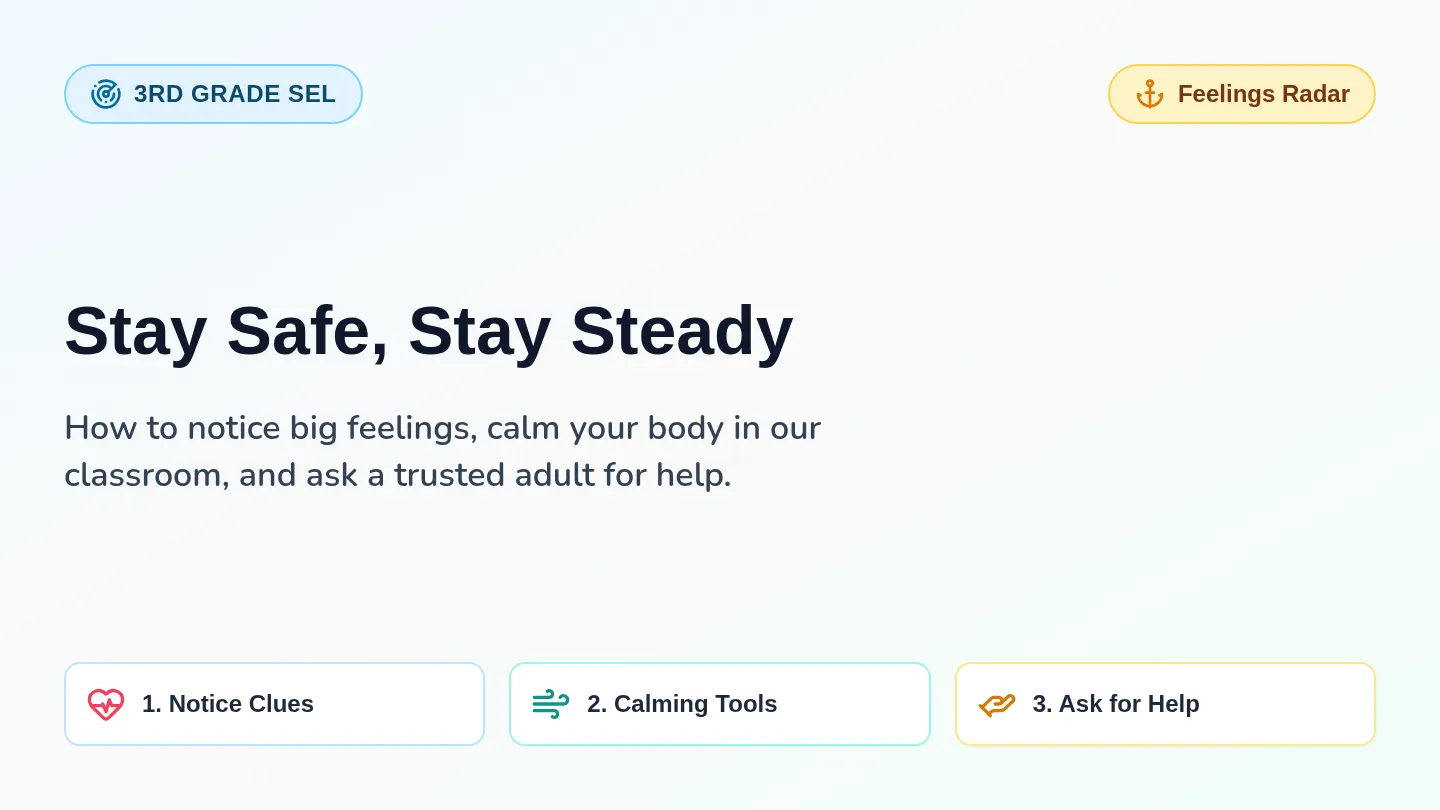
The Peace Path
Navigating conflicts with confidence, respect, and clear communication.
Spot Root Causes
Active Listening
Use 'I' Statements
Trailhead Warm-Up
Have You Ever Felt Stuck Here?
Scenario A
Your group partner hasn't done their part of the science poster, and it's due tomorrow.
Scenario B
A friend keeps making jokes about your new haircut in front of everyone at lunch.
Turn & Talk (2 min): What usually makes these situations worse ? What could make them better ?
Our Roadmap
The 4-Step Peace Path
1. Pause & Cool Down
Take 3 slow breaths. Step back before reacting in anger.
2. Share with 'I' Statements
Speak calmly about your feelings and needs—no blaming.
3. Listen with E.A.R.S.
Hear the other person's side and repeat back what you understood.
4. Build a Win-Win Plan
Brainstorm solutions where both people feel respected.
Step 1 • Dig Deeper
The Conflict Iceberg: Root Causes
Above the Surface
What we see and hear : arguing over a pencil, slamming a locker, eye-rolling, or silent treatment.
Below the Surface (Root Cause)
• Unmet Needs: fairness, respect, belonging
• Misunderstandings: missed texts, assumptions
• Different Values: how we work or play
Step 3 • Listen to Understand
Active Listening with E.A.R.S.
E — Eye Contact
Face the speaker and put away distractions.
A — Ask Questions
Ask calmly: "Can you tell me more about that?"
R — Reflect Back
Paraphrase: "So what I hear you saying is..."
S — Stay Calm
Don't interrupt or plan your comeback while they talk.
Step 2 • Speak Without Blame
The 4-Part 'I' Statement Formula
"I feel [emotion] when [specific action] because [impact/need]. I would appreciate [clear request]."
Blaming "You" Statement:
"You always ignore me and you're a terrible partner!"
Peace Path 'I' Statement:
"I feel stressed when tasks aren't split up because I want us to finish on time. Can we divide the slides?"
Practice Time
Role-Play Lab: Trios in Action
Speaker A
Shares the problem using a 4-part 'I' statement.
Speaker B
Practices E.A.R.S. active listening and reflects back.
Trail Coach
Observes, checks the Peace Path steps, and gives 1 compliment.
Rotate roles after each scenario so everyone practices every skill!
Carry the Compass Forward
Conflict is normal—how we respond is our choice. Today you practiced spotting root causes, listening with E.A.R.S., and speaking with 'I' statements.
Exit Reflection:
Which Peace Path step will be most helpful for you this week—and why? Write your answer on Page 2 of your worksheet.
I-Statement Lab Worksheet The Peace Path • Student Lab
I-Statement & Root Cause Lab
Name: ____________________________
Date: _____________________________
Part 1: Spot the Root Cause
Read the conflict below and circle the most likely root cause underneath the argument.
Scenario: Maya snaps at Jordan when Jordan accidentally bumps her Chromebook off the desk, even though it didn't break. Maya has been worried all morning about her grades.
A. Maya dislikes Chromebooks.
B. Maya feels stressed and worried about her schoolwork.
C. Jordan wanted to break Maya's desk.
D. The classroom desks are too small.
The 4-Part 'I' Statement Formula
"I feel [emotion] when [specific action] because [impact/need]. I would appreciate [clear request]."
Emotion Bank: frustrated • left out • overwhelmed • disappointed • anxious • unheard • embarrassed
Part 2: Flip the Blame into an 'I' Statement
Rewrite each blaming "You" statement into a respectful 4-part 'I' statement.
1. Blame: "You never let me talk during group work! You're so bossy!"
2. Blame: "You always borrow my markers without asking and lose the caps!"
3. Blame: "You're ignoring me at lunch just to be mean!"
Active Listening & Peace Path Reflection
Page 2 of 2
Part 3: Practice Paraphrasing (The "R" in E.A.R.S.)
Read what your classmate says. Write a calm paraphrasing response starting with "So what I hear you saying is..."
Classmate says: "I feel stressed when we wait until the last minute to start our slides because I'm afraid we won't finish before class ends."
Your active listening paraphrase:
What is one win-win solution you could suggest next?
Part 4: Active Listening Quick Check
Which action shows active listening during a disagreement?
A. Crossing your arms and looking at your phone.
B. Interrupting to explain why they are wrong.
C. Making eye contact and summarizing their point.
D. Walking away before they finish speaking.
Part 5: Trail Exit Reflection
Which step of the Peace Path (Pause, 'I' Statement, Listen with E.A.R.S., or Win-Win Plan ) will be most helpful for you this week, and why?
Conflict Scenarios Activity The Peace Path • Trio Role-Play
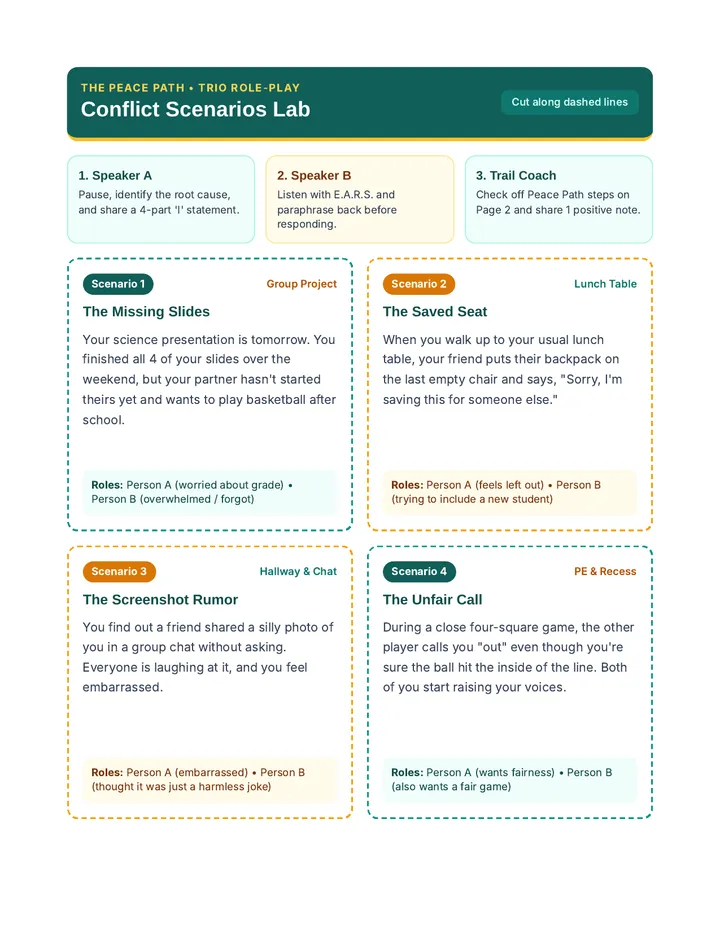
Conflict Scenarios Lab
Cut along dashed lines
1. Speaker A
Pause, identify the root cause, and share a 4-part 'I' statement.
2. Speaker B
Listen with E.A.R.S. and paraphrase back before responding.
3. Trail Coach
Check off Peace Path steps on Page 2 and share 1 positive note.
Scenario 1 Group Project
The Missing Slides
Your science presentation is tomorrow. You finished all 4 of your slides over the weekend, but your partner hasn't started theirs yet and wants to play basketball after school.
Roles: Person A (worried about grade) • Person B (overwhelmed / forgot)
Scenario 2 Lunch Table
The Saved Seat
When you walk up to your usual lunch table, your friend puts their backpack on the last empty chair and says, "Sorry, I'm saving this for someone else."
Roles: Person A (feels left out) • Person B (trying to include a new student)
Scenario 3 Hallway & Chat
The Screenshot Rumor
You find out a friend shared a silly photo of you in a group chat without asking. Everyone is laughing at it, and you feel embarrassed.
Roles: Person A (embarrassed) • Person B (thought it was just a harmless joke)
Scenario 4 PE & Recess
The Unfair Call
During a close four-square game, the other player calls you "out" even though you're sure the ball hit the inside of the line. Both of you start raising your voices.
Roles: Person A (wants fairness) • Person B (also wants a fair game)
Role-Play Debrief
Peace Path Planning & Coach Log
Name: ____________________________
Date: _____________________________
Part A: Our Group's Win-Win Plan (Complete Together)
1. Which scenario did your trio act out, and what was the root cause?
2. Write the 'I' statement Speaker A used (or improved together):
3. What win-win solution did both speakers agree to try?
Part B: Trail Coach Checklist (Check when observed)
Paused & used a calm tone
Used "I feel..." with a real emotion
Made eye contact & didn't interrupt
Paraphrased the other person's view
One strength you noticed as Trail Coach:
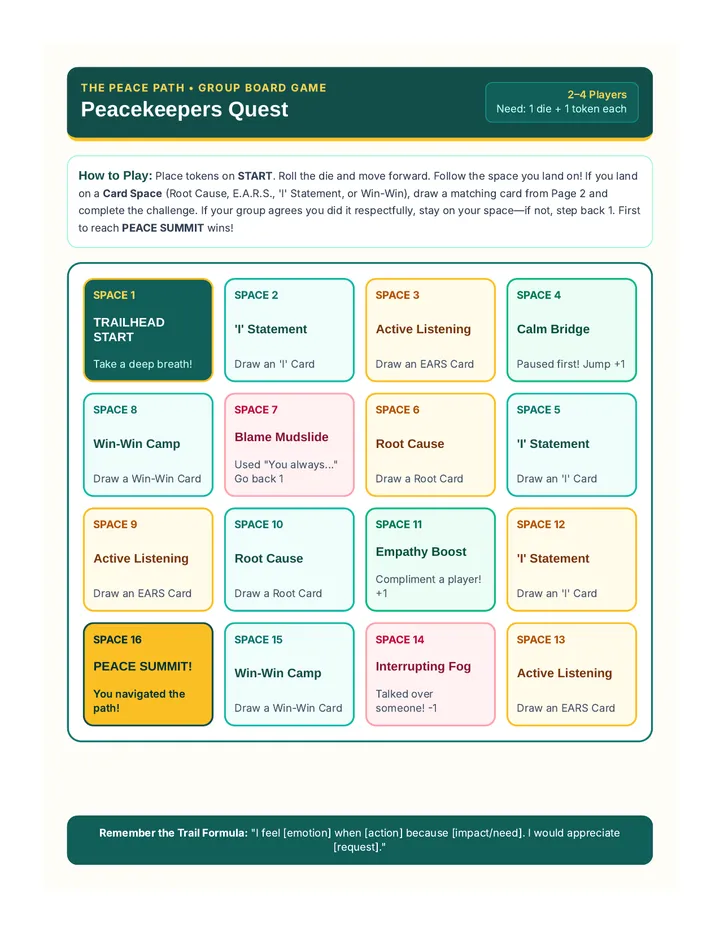
Peacekeepers Quest Game The Peace Path • Group Board Game
Peacekeepers Quest
2–4 Players
Need: 1 die + 1 token each
How to Play: Place tokens on START . Roll the die and move forward. Follow the space you land on! If you land on a Card Space (Root Cause, E.A.R.S., 'I' Statement, or Win-Win), draw a matching card from Page 2 and complete the challenge. If your group agrees you did it respectfully, stay on your space—if not, step back 1. First to reach PEACE SUMMIT wins!
SPACE 1
TRAILHEAD START
Take a deep breath!
SPACE 2
'I' Statement
Draw an 'I' Card
SPACE 3
Active Listening
Draw an EARS Card
SPACE 4
Calm Bridge
Paused first! Jump +1
SPACE 8
Win-Win Camp
Draw a Win-Win Card
SPACE 7
Blame Mudslide
Used "You always..." Go back 1
SPACE 6
Root Cause
Draw a Root Card
SPACE 5
'I' Statement
Draw an 'I' Card
SPACE 9
Active Listening
Draw an EARS Card
SPACE 10
Root Cause
Draw a Root Card
SPACE 11
Empathy Boost
Compliment a player! +1
SPACE 12
'I' Statement
Draw an 'I' Card
SPACE 16
PEACE SUMMIT!
You navigated the path!
SPACE 15
Win-Win Camp
Draw a Win-Win Card
SPACE 14
Interrupting Fog
Talked over someone! -1
SPACE 13
Active Listening
Draw an EARS Card
Remember the Trail Formula: "I feel [emotion] when [action] because [impact/need]. I would appreciate [request]."
Peacekeepers Quest
Trail Challenge Cards (Cut Along Dashed Lines)
Page 2 of 2
'I' Statement Card
A classmate keeps tapping their pencil loudly during a quiet quiz. Say a 4-part 'I' statement to ask them to stop.
Check: Emotion + Action + Impact + Request
'I' Statement Card
Your friend promised to walk home with you, then left with another group without telling you. Share an 'I' statement.
Check: No blaming "You" statements!
E.A.R.S. Listening Card
Player to your left complains for 15 seconds about having too much homework. Paraphrase what they said using "So what I hear is..."
Check: Eye contact + calm paraphrase
E.A.R.S. Listening Card
Name all 4 letters of E.A.R.S. and demonstrate one of them with a partner right now.
Hint: Eye contact, Ask, Reflect, Stay calm
Root Cause Card
Two siblings argue over who gets the front seat. What is a deeper root cause underneath the argument?
Check: Name a need like fairness or respect
Root Cause Card
A student snaps at their friend for borrowing a highlighter. Name two possible root causes below the surface.
Check: Think about feelings or stress
Win-Win Camp Card
One partner wants to draw the poster; the other wants to write the facts, but both want credit. Propose a win-win plan!
Check: Both people's needs are met
Win-Win Camp Card
Half the group wants to play soccer at recess; the other half wants four-square. Suggest a fair compromise.
Check: Realistic & respectful idea