Size Up Problems Teacher Guide Grade 3 SEL • Lesson Plan
Size Up Problems Teacher Guide
Duration: 45–50 Mins
Focus: Self-Solving vs. Adult Help
Lesson Purpose
Equip 3rd graders with a shared vocabulary and visual framework to evaluate problem sizes (Small, Medium, Big), match their emotional reactions accordingly, and decisively identify when to independently resolve issues versus when to seek adult support.
Essential Question
"How do I match my reaction to the size of my problem, and who is responsible for solving it?"
Learning Objectives
Categorize common school scenarios into Small, Medium, or Big problems with 85%+ accuracy.Differentiate between self-solvable conflicts ("Telling/Reporting" vs. "Tattling").Select 2+ coping strategies to match emotional reactions to problem severity.
Key Vocabulary
Small Problem (Glitch): Quick to fix, 1-2 people, self-solve.
Medium Problem (Bumpy): Needs cool-down, try 2 steps then adult.
Big Problem (Emergency): Danger, injury, property harm; tell adult immediately.
Lesson Schedule & Instructional Steps
8 Mins
1. Hook & The "Broken Pencil" Demonstration
Act out an oversized reaction to a snapped pencil (gasps, stomping). Ask students: "Did my reaction fit the size of this problem?" Introduce the Problem Meter.
12 Mins
2. Direct Instruction: The 3-Tier Problem Scale
Present the slides. Teach the rule: "Small problems get small calm fixes; big problems get immediate adult help." Walk through the "Tattling vs. Reporting" test.
15 Mins
3. Guided & Partner Practice: Task Card Sorting
Pairs sort 12 Scenario Cards onto the Sorting Mat (Green = Solve It Myself, Yellow = Try 2 Steps First, Red = Tell Adult Right Now). Teacher circulates with prompt questions.
10 Mins
4. Independent Application & Exit Check
Students complete the Activity Sheet and individual Reflection Exit Ticket to demonstrate understanding.
Size Up Problems Facilitator Guide Page 1 of 2
Teaching Guidance
Teacher Scripts, Dialogue & Differentiation
Classroom Best Practices
Teacher Dialogue & Explicit Modeling Script
Say: "Have you ever felt like a tiny bump in the day turned into an explosion? When someone accidentally cuts in line, or your marker runs out, it can feel huge in our bodies. But problems come in different sizes, just like shoes or backpacks!"
Model the Self-Check Question: "Ask yourself three questions:Is anyone hurt or in danger? (If YES = BIG problem, tell adult now.)Can I fix this in under 2 minutes with a calm choice? (If YES = SMALL problem, solve it!)Did I try 2 calm strategies and it's still stuck? (If YES = MEDIUM problem, ask adult for coaching.)"
!
Reporting (Adult Needed)
Purpose is to keep someone safe .
Someone is hurt, bullied, or in danger.
Emergency or broken property.
"I need to tell an adult to protect someone."
✓
Tattling (Solve Yourself)
Purpose is to get someone in trouble .
No one is hurt or in danger.
A minor annoyance or harmless mistake.
"Can I ignore it, ask politely, or take a breath?"
Common Student Misconceptions
Misconception Teacher Correction Strategy "If I feel really mad, it must be a BIG problem." Validate feelings, then decouple emotion from problem scale: "Feelings are real, but size depends on danger & fixability." "I should never ask the teacher for help." Clarify the "Rule of 2": Try 2 independent peace tools first; if stuck, adult guidance is welcomed.
Differentiation & Support Adaptations
Support / ENL:
Provide color-coded thumb cards (Green/Yellow/Red) for nonverbal participation during slides.
On-Level:
Have partners role-play the "I-Statement" resolution for medium scenarios before recording.
Extension:
Students write and illustrate a mini comic strip showing a "Reaction Resize" transformation.
Size Up Problems Facilitator Guide Page 2 of 2
Size Up Problems Slides 3rd Grade SEL Squad
Self-Management Skills
Size Up Problems!
Match Your Reaction
Learn how to tell a Small, Medium, and Big problem apart—and know exactly when to solve it yourself!
Solve Myself Try 2 Tools Get Adult Help
Whole Group Lesson
The Big Idea 3 Problem Levels
Every Problem Has a Size
Our reaction should match the real size of the situation!
1. Small
"A Tiny Glitch"
Quick fix (1-2 mins). No one is hurt. Easily solved on your own.
Who Solves It? 👉 I Can Solve It Myself
2. Medium
"A Bumpy Road"
Needs cool-down time or talking. Try 2 strategies first.
Who Solves It? 👉 Try 2 Tools, Then Ask
3. Big
"Emergency / Danger"
Someone is hurt, unsafe, or property is being destroyed.
Who Solves It? 👉 Tell an Adult Right Away
Remember: Big emotions can happen for small problems—we can resize them!
1
Small Problems = Self-Solvers
Quick & Calm
Examples in 3rd Grade
• Your pencil tip snaps during math.
• Someone accidentally bumps your chair.
• You didn't get to be line leader today.
• A friend took the blue crayon you wanted.
My Self-Solve Toolkit
1. Take 3 Deep Breaths: Inhale for 4s, exhale for 4s.
2. Use an "I-Statement": "Please stop, I was using that."
3. Ignore or Move: Shrug it off and focus on your work.
Matching Reaction: Level 1-2 Calm Reaction (No crying, shouting, or running to teacher)
2
Medium Problems = Try 2 First
Cooldown & Talk
What Counts as Medium?
• An ongoing game argument during recess.
• You asked a classmate to stop 2 times and they won't.
• You feel stuck and frustrated on an assignment.
• Someone hurt your feelings with teasing words.
The "Rule of 2" Step Path
Step 1: Try 2 calm strategies (Rock-Paper-Scissors, Talk it out, Take a break).
Step 2: Is it still stuck after trying?
Step 3: Ask teacher/adult: "We tried two ways to solve this, can you help us mediate?"
Matching Reaction: Level 3-4 Focus & Patience (Express frustration calmly, ask for coaching)
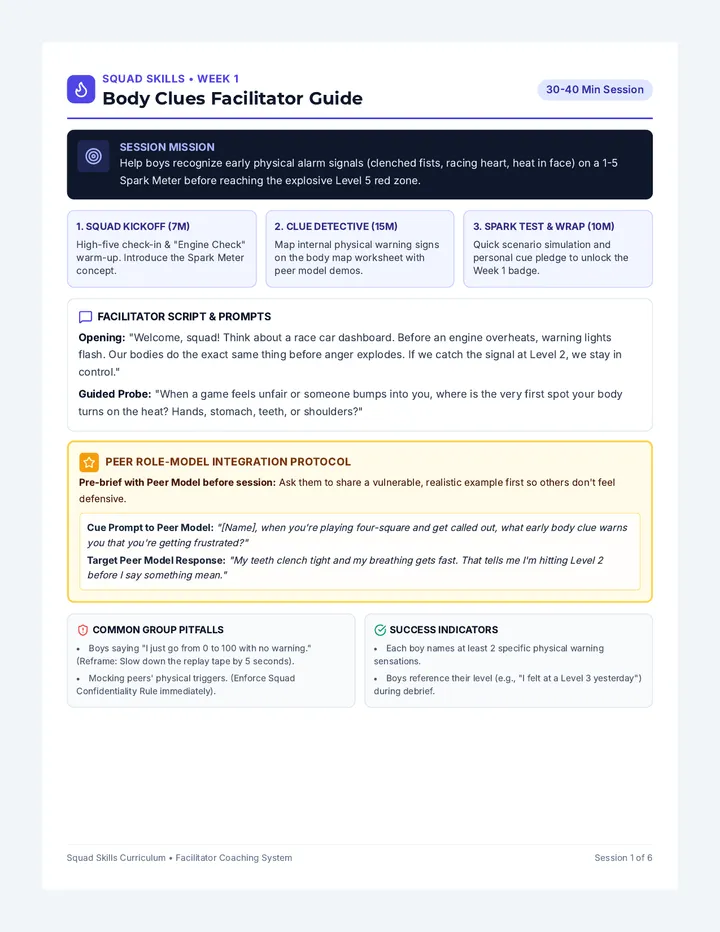
Problem Scale Anchor Chart The Problem Size Scale
Match your reaction to the size of your problem!
1
SMALL PROBLEM (Tiny Glitch)
Reaction: Calm & Quick (Level 1–2)
👉 I Solve It Myself
What it Looks Like:
Pencil breaks or paper rips.
Someone bumps you accidentally.
You don't get the turn or seat you wanted.
What I Can Do:
Take 3 slow deep breaths.
Use a polite "I-Statement."
Ignore it, shrug, and move on.
2
MEDIUM PROBLEM (Bumpy Road)
Reaction: Patient & Focused (Level 3–4)
👉 Try 2 Tools, Then Ask
What it Looks Like:
Game rules disagreement at recess.
Friend keeps teasing after being asked to stop.
Feeling frustrated/confused on tough work.
What I Can Do:
Play Rock-Paper-Scissors or compromise.
Take a 2-minute cool-down break.
Ask teacher: "Can you coach us through this?"
3
BIG PROBLEM (Emergency / Danger)
Reaction: Urgent & Serious (Level 5)
👉 Tell Adult Right Away
What it Looks Like:
Someone is bleeding, injured, or sick.
Physical fighting, hitting, or bullying.
Fire alarm, dangerous items, or stranger.
What I Can Do:
Go straight to the nearest adult teacher/staff.
State clearly: "Someone is hurt/in danger at..."
Stay calm and follow adult directions.
Golden Rule: Does someone need protection? Tell an adult. Is it an annoyance? Try your tools first!
Student Mini Anchor Charts (Desk Reference Strips)
Cut along the dotted lines. Tape to student desks or keep in SEL toolkits.
4 Copies Per Page
🔍 My Problem Size Meter
🟢 SMALL (Level 1-2): Solve Myself Broken pencil, spilled water, waiting turn. Take 3 deep breaths!
🟡 MEDIUM (Level 3-4): Try 2 First Game dispute, teasing. Use "I-statement" or Rock-Paper-Scissors.
🔴 BIG (Level 5): Adult Now Injury, danger, physical fight. Tell nearest adult immediately!
"Match the reaction to the problem!"
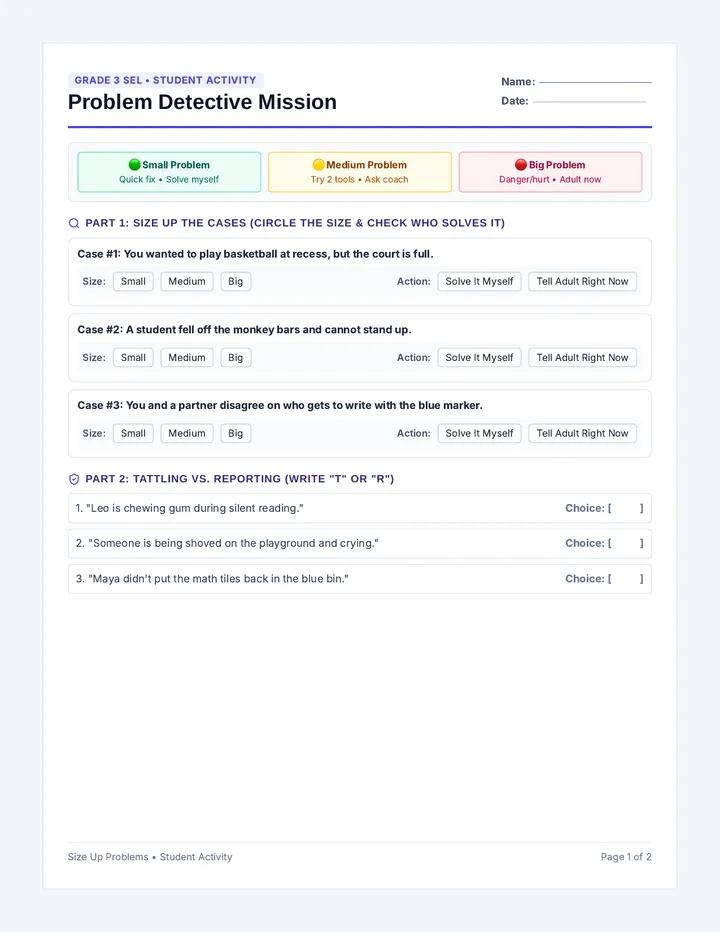
Problem Detective Activity Sheet Grade 3 SEL • Student Activity
Problem Detective Mission
Name:
Date:
🟢 Small Problem Quick fix • Solve myself
🟡 Medium Problem Try 2 tools • Ask coach
🔴 Big Problem Danger/hurt • Adult now
Part 1: Size Up the Cases (Circle the Size & Check Who Solves It)
Case #1: You wanted to play basketball at recess, but the court is full.
Size: Small Medium Big
Action: Solve It Myself Tell Adult Right Now
Case #2: A student fell off the monkey bars and cannot stand up.
Size: Small Medium Big
Action: Solve It Myself Tell Adult Right Now
Case #3: You and a partner disagree on who gets to write with the blue marker.
Size: Small Medium Big
Action: Solve It Myself Tell Adult Right Now
Part 2: Tattling vs. Reporting (Write "T" or "R")
1. "Leo is chewing gum during silent reading."
Choice: [ ]
2. "Someone is being shoved on the playground and crying."
Choice: [ ]
3. "Maya didn't put the math tiles back in the blue bin."
Choice: [ ]
Size Up Problems • Student Activity Page 1 of 2
Part 3 & 4
The Reaction Resizer
Self-Management Toolkit
Part 3: Fix the Oversized Reaction
Read each scenario where someone had a reaction that was TOO BIG. Write a calm, matching reaction instead.
Scenario: Oversized Reaction!
Event: Jordan's pencil lead snapped during spelling.Oversized Reaction: Jordan slammed their desk, yelled "I hate school!", and crossed their arms.
Write a Right-Sized Reaction:
Scenario: Oversized Reaction!
Event: Sam was tagged out in freeze tag during recess.Oversized Reaction: Sam stomped over to the teacher crying that the game is unfair.
Write a Right-Sized Reaction:
Part 4: My Self-Solve Peace Tools
Check the 2 strategies you will use next time you face a Small or Medium problem:
Take 3 deep box breaths (4-4-4). Play Rock-Paper-Scissors to decide. Use an "I-Statement" to talk it out. Shrug it off and focus on my work.
My Problem Solver Pledge:
"When I have a small problem, I will before asking an adult."
Size Up Problems • Student Activity Page 2 of 2
Scenario Sorting Task Cards Hands-On Learning Station
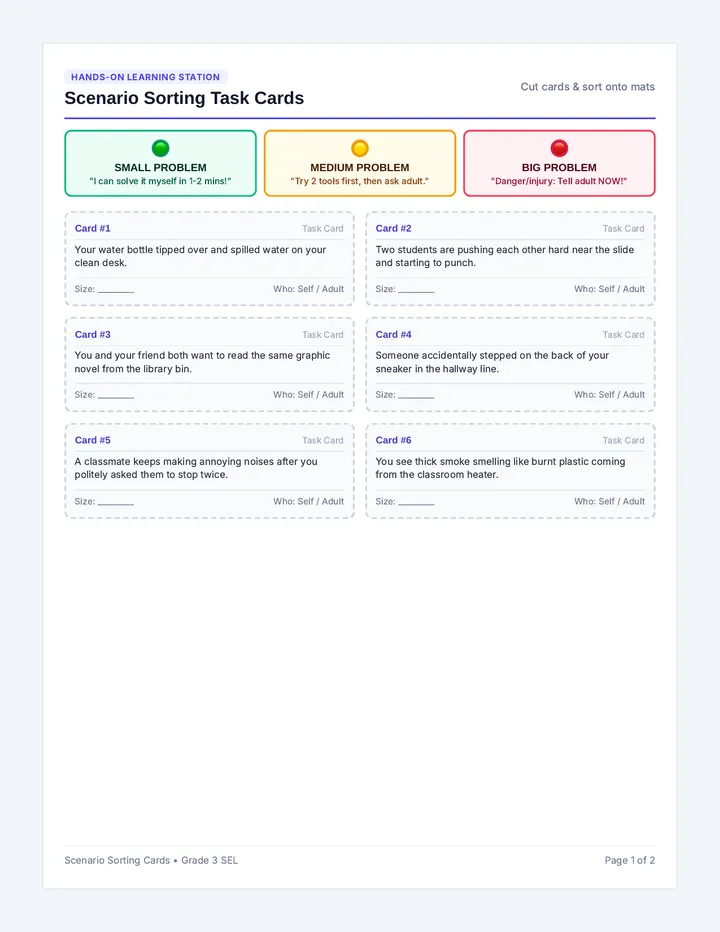
Scenario Sorting Task Cards
Cut cards & sort onto mats
🟢
SMALL PROBLEM
"I can solve it myself in 1-2 mins!"
🟡
MEDIUM PROBLEM
"Try 2 tools first, then ask adult."
🔴
BIG PROBLEM
"Danger/injury: Tell adult NOW!"
Card #1 Task Card
Your water bottle tipped over and spilled water on your clean desk.
Size: _________ Who: Self / Adult
Card #2 Task Card
Two students are pushing each other hard near the slide and starting to punch.
Size: _________ Who: Self / Adult
Card #3 Task Card
You and your friend both want to read the same graphic novel from the library bin.
Size: _________ Who: Self / Adult
Card #4 Task Card
Someone accidentally stepped on the back of your sneaker in the hallway line.
Size: _________ Who: Self / Adult
Card #5 Task Card
A classmate keeps making annoying noises after you politely asked them to stop twice.
Size: _________ Who: Self / Adult
Card #6 Task Card
You see thick smoke smelling like burnt plastic coming from the classroom heater.
Size: _________ Who: Self / Adult
Scenario Sorting Cards • Grade 3 SEL Page 1 of 2
Cards 7-12 & Recording Grid
Task Cards & Partner Sort Tracker
Names: _______________________
Card #7 Task Card
You made a spelling mistake on your final drawing paper.
Card #8 Task Card
A classmate fell during soccer and their wrist hurts too badly to move.
Card #9 Task Card
A peer is saying mean rumors about you at lunch every single day.
Card #10 Task Card
You don't understand question #4 on the science worksheet.
Card #11 Task Card
You were not picked first for the kickball team today.
Card #12 Task Card
A student in your group refuses to share the scissors and sticks their tongue out.
Partner Recording Sheet (Write S = Small, M = Medium, B = Big)
Card # Size (S / M / B) Who Solves? (Self / Try 2 / Adult) Card # Size (S / M / B) Who Solves? (Self / Try 2 / Adult) #1