Counselor Compass Slides
Upper Elementary SEL Series
School Year Kickoff
Welcome to a New Year
Meet Your School Counselor
Your trusted guide for big feelings, strong friendships, problem solving, and reaching your personal best this year.
Safe Space • Always Here to Help
Slide 1 of 8
The Three Pillars
What Does a School Counselor Do?
Here for Every Student
Mind & Emotions
Helping you navigate stress, anxiety, sadness, anger, and big life changes with healthy coping tools.
Coping Strategies
Friendships & Team
Resolving peer disagreements, building empathy, active listening, and practicing teamwork skills.
Conflict Mediation
Goals & Success
Setting academic goals, staying organized, building confidence, and discovering your unique strengths.
Growth Mindset
We visit in whole classes, small groups, or 1-on-1 check-ins. Slide 2 of 8
Setting the Record Straight
Counselor Mythbusters
True or False?
Myth
"You only visit the counselor if you are in trouble."
Fact
The counselor's office is not for punishment! It is a safe support space for everyone.
Myth
"The counselor tells everyone all of your personal business."
Fact
Our talks are confidential (private), with only 3 specific safety exceptions.
Myth
"You must have an extreme crisis to talk to the counselor."
Fact
You can come for everyday friendship snags, goal setting, or a quick recharge!
Never hesitate to ask for support—asking for help is a superpower! Slide 3 of 8
Trust & Safety
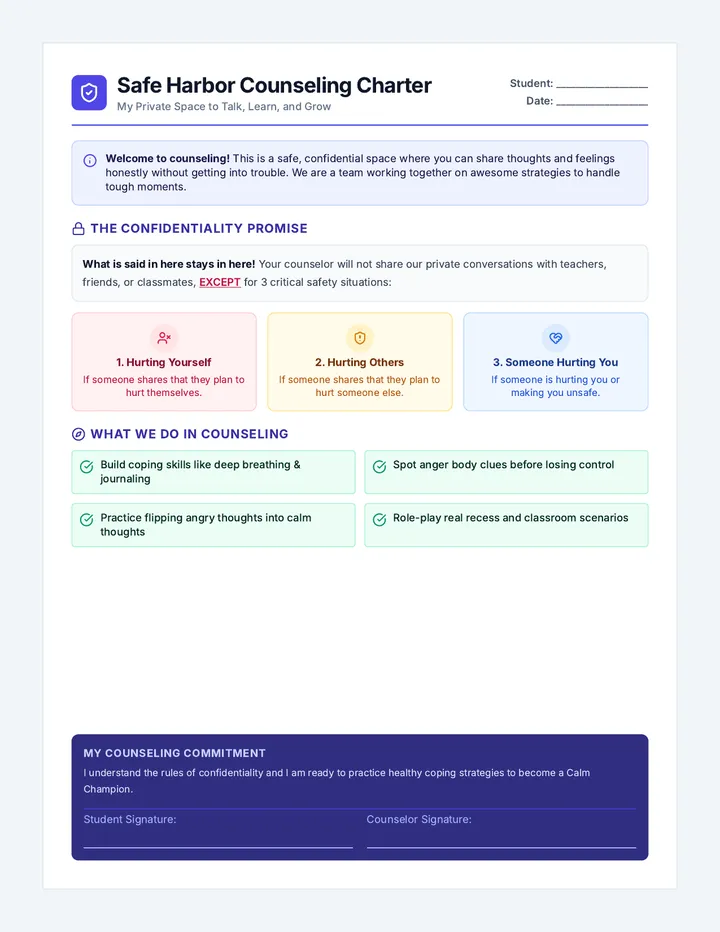
The Confidentiality Promise
Locked & Protected
The General Rule
What is shared stays here
What you share with the counselor is private. We won't gossip or share your feelings with classmates.
"Your stories, worries, and dreams are safe with me."
3 Safety Exceptions (When I MUST tell an adult to protect you):
1
Someone is hurting you
If someone is causing you physical harm, abuse, or danger.
2
You want to hurt yourself
If you are feeling unsafe with your own body or thoughts.
3
You want to hurt someone else
If there is a plan or threat to harm another person's safety.
Keeping you safe is always our highest priority. Slide 4 of 8
Self-Regulation
Your Coping Toolkit
Quick Calm Strategies
Box Breathing
Inhale for 4s, hold for 4s, exhale for 4s, pause for 4s. Resets your nervous system instantly.
Inhale • Hold • Exhale • Rest
5-4-3-2-1 Grounding
Name 5 things you see, 4 you feel, 3 you hear, 2 you smell, and 1 positive thought.
Anchor in the Present
Positive Self-Talk
Replace "I can't do this" with "This is tough, but I am learning and getting stronger."
Flip the Script
Body Reset
Drink cold water, do shoulder rolls, stretch your spine, or take a quick supervised sensory break.
Release Physical Tension
Which coping strategy works best for you when you feel overwhelmed? Slide 5 of 8
Navigating Challenges
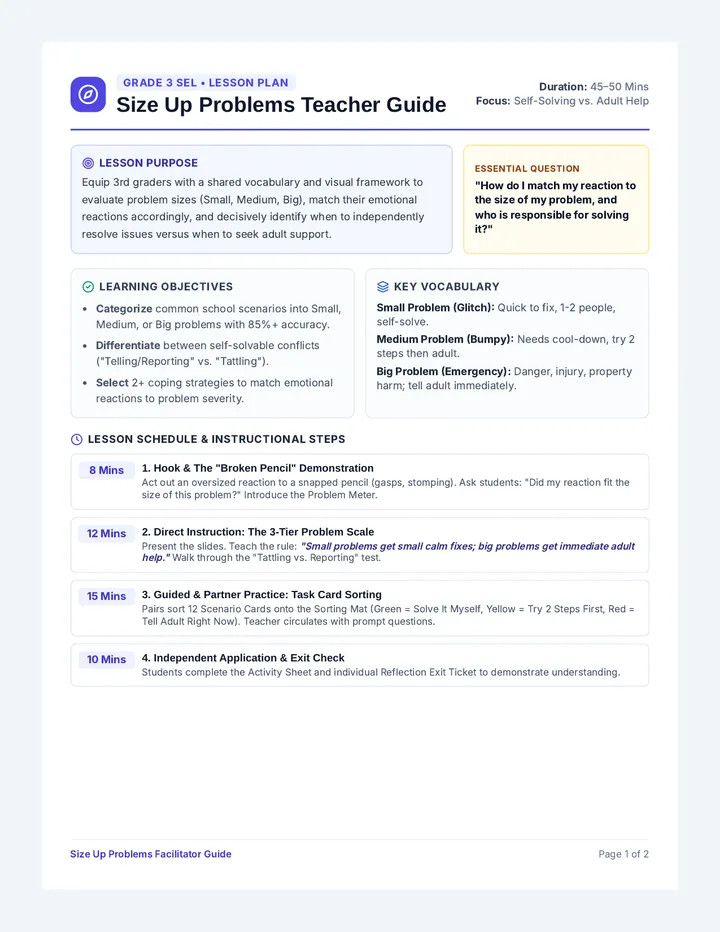
Glitches vs. Big Deals
Conflict Navigator
Small Glitch (1-2 Level)
Try peer strategies first!
- Bug & Wish: "It bugs me when... I wish you would..."
- Walk Away: Take 2 minutes of space to cool off.
- Compromise: Rock-Paper-Scissors or take turns.
Big Deal (3-5 Level)
Get adult / counselor support!
- Repeated Conflict: You tried solving it, but it keeps happening.
- Targeted Bullying: Hurtful words, exclusion, or intimidation.
- Heavy Hearts: Grief, family stress, or big ongoing anxiety.
Knowing when to handle it and when to ask for help is emotional maturity! Slide 6 of 8
Step-by-Step Access
How Do I Connect with the Counselor?
Easy as 1, 2, 3
1
Counselor Mailbox / Slip
Fill out a counselor request pass and drop it into the counselor mailbox outside my door or in your classroom.
Checked daily!
2
Ask Your Teacher
Let your classroom teacher know during independent work or transition that you'd like a counselor check-in.
Easy communication
!
Emergency / Immediate Safety
If it is an immediate safety crisis, tell your teacher or nearest staff member right away for immediate support.
Immediate help
I will schedule our chat during non-core instructional time so you don't miss key lessons. Slide 7 of 8
Let's Have a Great Year
Ready to Grow
Remember: You Are Capable, Strong & Never Alone
Quick Class Reflection
"What is one goal you have for this school year, and what is one coping strategy you want to try when things get tough?"
Thank you for being an awesome classroom community!
Slide 8 of 8
Counselor Connection Worksheet
Counselor Connection Guide
Upper Elementary Navigation & Coping Sheet
Page 1 of 2
Name:
Date:
Teacher / Room:
1
Problem Navigator: Match the Action
Write the letter corresponding to the best next step: [S] Self / Peer Strategy, [C] Counselor Visit, or [E] Immediate Adult Emergency.
1. A classmate accidentally bumped you in line. ___
2. You feel ongoing anxiety before every test. ___
3. Someone is threatening physical harm right now. ___
4. You and your best friend have had ongoing fights. ___
2
The Confidentiality Promise & Safety Rules
The Golden Rule: What you say to your counselor stays private, unless there is a safety risk.
List the 3 Safety Exceptions when a counselor must tell another adult to protect you:
1 Someone is:
2 You want to hurt:
3 You want to hurt:
3
My Coping Toolkit Inventory
Check the strategies you already use, and star (★) one new strategy you want to practice:
Box Breathing (4-4-4-4)
5-4-3-2-1 Sensory Reset
Positive Self-Talk Mantra
Drink Cold Water
Drawing / Journaling
Muscle Relaxation
My favorite personal calm-down phrase or activity:
Counselor Compass • Upper Elementary SEL Turn to page 2 for your Support Web & Counselor Pass →
Support Network & Action Plan
Building Your Circle of Trust
Page 2 of 2
4
My Safe Adults Map
Write the names of trusted adults who can support you when you need help:
At School (Teacher/Staff)
At Home (Family/Caregiver)
School Counselor
5
Scenario Reflection
Scenario: Jordan feels left out at recess because a group of friends started whispering whenever Jordan walks near. Jordan feels sad and having trouble focusing in class.
What is one step Jordan could take using what we learned today?
Counselor Check-In Request Pass (Tear or Keep in Folder)
Private & Confidential
My Name:
Date & Classroom:
I would like to talk about (check any):
Friendship / Peer
Counselor Intro Facilitator Guide
Facilitator Lesson Guide
Upper Elementary Counselor Classroom Introduction
Page 1 of 2
Target Audience Grades 3–5
Lesson Length 35–45 Minutes
ASCA Standards M 1, M 2, B-SS 2, B-SMS 7
Materials Slides & Handout
Learning Objectives
• Students will explain the primary roles of the school counselor (academic, social-emotional, goal-setting).
• Students will articulate the confidentiality rule and identify the three mandatory safety exceptions.
• Students will demonstrate how to access counselor support using the classroom request procedure.
• Students will identify at least two personal coping strategies for emotional regulation.
Lesson Pacing & Architecture
| Time | Phase | Core Teacher / Counselor Actions |
|---|
| 0–5 min | Hook & Welcome | Slide 1–2: Introduction, counselor identity, warm greeting, demystifying the role. |
| 5–12 min | Mythbusting & Safety | Slide 3–4: Interactive True/False + Clear confidentiality lock & 3 safety rules script. |
| 12–20 min | Skills & Problem Types | Slide 5–6: Coping toolbox tryout (Box breathing modeling) + Glitch vs Big Deal chart. |
| 20–35 min | Guided Handout Work | Students complete Sections 1–4 of the Connection Worksheet; practice request slip. |
| 35–40 min | Wrap-Up & Mailbox Tour | Slide 7–8: Show physical location of counselor mailbox; student reflection share. |
Verbatim Script: Explaining Confidentiality to Upper Elementary
"When we talk in my office, imagine there is a lock on the door. What you tell me stays private between us. I won't go out to recess and tell your friends, and I won't announce your worries. BUT, as your counselor, my #1 job is keeping you safe. There are three times I must unlock that door and bring in trusted adults: 1) If someone is hurting you, 2) If you are thinking of hurting yourself, or 3) If you plan to hurt someone else. That isn't to get you in trouble—it's to keep you and everyone safe."
Counselor Compass • Facilitator Guide See Page 2 for Slide Prompts & Sensitive Disclosure Protocols →
Slide Discussion Prompts & Protocols
Implementation Notes & Responsive Counseling
Page 2 of 2
Slide-by-Slide Facilitation Tips
Slide 3 (Mythbusters):
Have students give a 'Thumbs Up' (Fact) or 'Thumbs Down' (Myth) before revealing each answer. Ask: