Cool Heads Lesson Guide Kind Words, Cool Heads
Teacher Facilitation & Instructional Guide • Grades 2–3
Time: 45–55 Mins
Core Learning Objectives
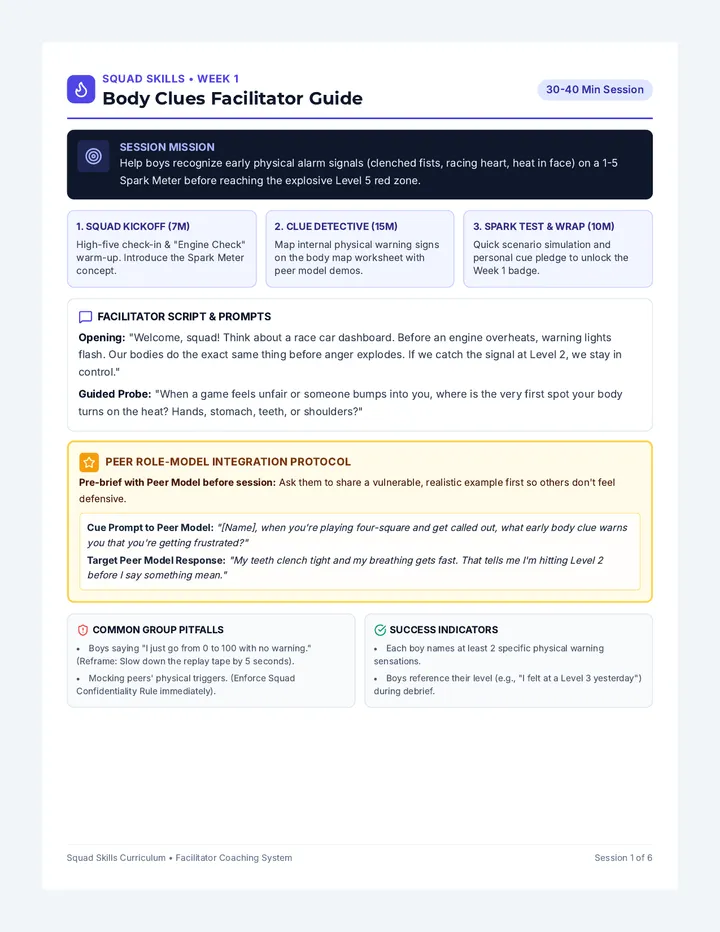
Identify physical body cues (clenched fists, racing heart) when frustration begins.
Apply the "Think It vs. Say It" verbal filter before speaking.
Distinguish hurtful, repetitive bullying behaviors from respectful problem-solving.
Select and practice at least two self-regulation strategies to de-escalate anger.
Big Question
“How can tuning into our bodies help our words stay kind and helpful?”
SEL: Self-Awareness & Social Skills
Key Teaching Mindset: Focus on Behaviors, Not Labels
Avoid labeling children as “bullies” or “bad kids.” Frame situations around choices and impact : “That specific action or word hurts someone and is unsafe.” Every student can learn to pause, regulate, and choose kind alternatives.
Lesson Flow & Teacher Scripts
1 Hook: The Soda Bottle vs. Water Bottle (7 Mins) Slides 1–2
Hold up a clear bottle of water and a bottle of seltzer/soda. Gently swirl the water (calm). Shake the soda (building pressure).
Teacher Talk: “When we get frustrated, our feelings can build up like bubbles in a shaken soda bottle. If we unscrew the cap right away, what happens? Fizz everywhere! Our job today is to learn how our body signals pressure so we can let the air out safely before our words spray hurt.”
2 Body Clues & The Alarm System (10 Mins) Slides 3–4 • Poster 1
Guide students through a head-to-toe body scan to identify physical warning cues when anger or frustration starts brewing.
Face & Head Hot cheeks, jaw clenching, rapid breathing.
Chest & Stomach Thumping heart, fluttery tummy knots.
Hands & Feet Tight fists, stomping urges, restless jittering.
Lesson: Kind Words, Cool Heads • Teacher Resource Page 1 of 2 →
Part 3 & 4: Filter Training, Scenario Roleplay & Calm Toolkit
Instruction & Practice
3 The Verbal Filter: “Think It vs. Say It” (12 Mins) Slides 5–6 • Poster 2
Introduce the mental strainer/filter. Every thought pops into our brain, but kind leaders use a 3-Question Filter before words leave their lips:
1. Is it True? Does this help state facts without exaggerating?
2. Is it Helpful? Does it solve a problem or make someone feel safe?
3. Is it Kind? Would I feel respected if someone said this to me?
Teacher Prompt: “If a thought is hurtful, teasing, or meant to exclude, it stays in the ‘Think It’ zone. We can reframe it into a calm, constructive request.”
4 Partner Scenario Role-Play & Sorting Activity (15 Mins) Cards • Worksheets
Distribute Calm & Kind Scenario Cards to pairs. Direct students to act out the 3-step routine:
Catch the Trigger: State the body cue (e.g., “My hands are clenching because someone took my marker!”).Press Pause: Take 1 deep “5-Finger Breath” before reacting.Filter & Speak: Discard the hurtful reaction (“You always ruin everything!”) and speak the kind alternative (“I was still using that. Can you please ask next time?”).
Calming Toolkit Quick-List
5-Finger Breathing: Trace fingers while breathing in and out.The 5-Second Count: Count 5 blue objects around the room.The Lemon Squeeze: Tense hands like squeezing lemons, then relax.Safe Rephrase: “I feel frustrated right now. I need space.”
Formative Check & Wrap-Up
Have students complete the My Kindness Compass Reflection . Observe whether students can link a personal physical body trigger to a chosen calming tool.
Exit Ticket: 5 Mins
Differentiation & Scaffolding Support:
Support / ELL: Provide visual sentence starters (“I feel ___ when ___. Please ___.”) and use picture cards for body clues.
Challenge: Ask students to write a short comic strip showing a character de-escalating a recess argument using the verbal filter.
Lesson: Kind Words, Cool Heads • Teacher Resource Page 2 of 2
Kind Words Slide Deck Social Emotional Learning • Grades 2–3
Cool Heads • Calm Words
Kind Words, Cool Heads
How to spot body warning signs, calm the storm inside, and choose words that build others up.
1. Spot Body Cues
2. Press Calm Pause
3. Use Verbal Filter
Lesson Hook
The Shaken Soda Bottle
Clear & Calm
When we feel relaxed, our thoughts are clear like calm water. We can listen, share, and speak kindly.
Shaken Pressure
When frustration builds up, we feel bubbly like shaken soda. If we pop the top fast, words spray and hurt others!
“Our goal: Learn how to slowly release the pressure BEFORE we speak!”
Step 1: Self-Awareness
What Are Your Body Clues?
Head & Face
• Hot, red cheeks
• Tight, clenched jaw
• Furrowed eyebrows
Chest & Tummy
• Fast thumping heart
• Tight stomach knots
• Short, fast breathing
Hands & Feet
• Squeezed tight fists
• Urge to stomp feet
• Shaky, restless arms
When your body alarm rings, that is your signal to PRESS PAUSE!
Step 2: Self-Regulation
The Cool-Down Toolbox
5-Finger Breathing
Trace each finger. Inhale going up, exhale going down. 5 full calming breaths!
Lemon Squeeze
Squeeze your fists tight for 3 seconds like juicing lemons, then release all tension.
5-Object Grounding
Look around the room and silently spot 5 things that are blue or square.
Calm Self-Talk
Whisper inside: “I can handle this. I am in charge of my words.”
Which tool works best for you when you need 10 seconds of calm?
Step 3: Social Filter
Think It vs. Say It Filter
Keep in “Think It”
Thoughts that hurt, judge, tease, or exclude others:
“You are terrible at this game! Give me that!”
→ Action: Keep inside your mind and rephrase calmly.
Safe to “Say It”
Words that are true, kind, and solve problems:
“Let’s take turns so we both get a chance to play.”
→ Action: Speak clearly using a calm, respectful voice.
1. Is it True? • 2. Is it Helpful? • 3. Is it Kind?
Words and Actions Sort Worksheet SEL Activity • Grade 2–3
Think It vs. Say It Filter
Use your 3-question filter: Is it True? Is it Helpful? Is it Kind?
Name:
Date:
Activity Instructions:
Read the 6 statements at the bottom of the page. Decide if each statement belongs in your Think It Cloud ☁️ (keep inside to calm down and reframe) or your Say It Bubble 💬 (safe and kind to say aloud). Write the number of each statement into the correct column!
☁️
Keep in “Think It”
Hurtful / Unfiltered
Thoughts that might hurt feelings, tease, or start an argument:
A Statement Number: ________
B Statement Number: ________
C Statement Number: ________
💬
Safe to “Say It”
Kind & Helpful
Words that are respectful, honest, and help solve problems:
A Statement Number: ________
B Statement Number: ________
C Statement Number: ________
Statement Bank
1. “Your drawing looks so messy and weird!”
2. “I love the bright colors you picked for your sky.”
3. “Can I please have a turn when you finish this round?”
4. “You always ruin the game for everyone!”
5. “I feel frustrated when people run ahead. Let’s walk together.”
6. “Nobody wants you on our soccer team today.”
Kind Words, Cool Heads • Student Practice Worksheet Page 1 of 2 →
Body Alarm & Kind Words Rewrite
Spot your body cues and turn hurtful words into helpful solutions.
Part B & C
Part 1: What Does Your Body Alarm Feel Like?
Check (✓) the body warning signs you usually feel when you start getting upset:
Cheeks get hot or red
Hands squeeze into fists
Heart beats fast & hard
Teeth/Jaw clench tight
Tummy feels in knots
Urge to shout or stomp
Part 2: Kindness Rewrite Challenge
Rewrite each hurtful thought into a calm, kind, and helpful statement using words like “I feel...” , “Please...” , or “Can we...”
Hurtful Thought: Scenario: Someone cuts in front of you in line.
“Get out of my way! You are so annoying!”
My Kind & Clear Rewrite:
Calm and Kind Scenario Cards Calm & Kind Scenario Cards
Partner Role-Play & Discussion Prompts • Grades 2–3
Cards 1–4 of 8
Directions: Cut along dashed lines. In pairs, take turns reading the situation, acting out the body clue, and practicing the kind response! Cut Out
Card #1 • Recess Topic: Sharing Equipment
The Stolen Basketball
You were waiting your turn for 5 minutes. As soon as it’s your turn, another student grabs the ball and shoots.
Body Trigger: Hot cheeks & clenched fists
Think It (Keep Inside): “Give that back, you jerk! I hate you!”
Say It (Role-Play): “I was next in line. You can shoot right after my turn.”
Calm Tool: Take 2 slow 5-finger breaths.
Card #2 • Classroom Topic: Accidental Mistakes
Spilled Paint on Art Project
You worked hard on your painting for 30 minutes. A classmate walks by, trips, and water spills all over your paper.
Body Trigger: Racing heartbeat & heavy breathing
Think It (Keep Inside): “You ruin everything! You are so clumsy!”
Say It (Role-Play): “I feel sad because my art got ruined. Can you help me wipe it up?”
Calm Tool: Lemon squeeze hand tension release.
Card #3 • Cafeteria Topic: Including Others
Saving Seats at Lunch
You walk to a lunch table with an open seat. Someone puts their lunchbox on the seat and says, “This is only for our group.”
Body Trigger: Tight stomach knots & holding breath
Think It (Keep Inside): “You guys are mean bullies. I hope nobody sits with you.”
Say It (Role-Play): “In our school, anyone can sit at open seats. There is plenty of room for all of us.”
Calm Tool: Grounding (Find 3 green things).
Card #4 • Partner Work Topic: Disagreeing Calmly
Different Ideas on a Poster
Your partner wants to draw dinosaurs for your science project, but you want to draw space planets.
Body Trigger: Jaw clenching & rolling eyes
Think It (Keep Inside): “Your idea is so stupid. I am doing it my way.”
Say It (Role-Play): “What if we split the page in half, or do dinosaurs in space?”
Calm Tool: Silent whisper “I can compromise.”
Kind Words, Cool Heads • Printable Role-Play Cards Page 1 of 2 →
Cool Down Anchor Posters Self-Regulation Anchor Chart
MY BODY ALARM & CALM-DOWN TOOLKIT
When you feel frustration rising, catch the clues and press pause!
1
Spot Your Body Alarm Clues
Hot Face Cheeks burn, teeth or jaw clenched
Fast Heart Chest thumps, breathing speeds up
Tummy Knots Stomach feels tight or nervous
Tight Fists Hands squeeze tight, feet restless
2
Choose Your Calm-Down Tool
5-Finger Breathing
Trace up your finger (breathe in). Trace down your finger (breathe out). Repeat for all 5 fingers!
The Lemon Squeeze
Squeeze your fists tight for 3 seconds like juicing a sour lemon, then open your fingers and shake it out.
5-Item Spotting
Look around the room and silently spot 5 blue objects or 5 rectangles to reset your focus.
Calm Mind Whisper
Whisper: “I am in control of my body and words. I can take a breath and solve this.”
“When feelings get loud, our breath makes us calm and proud.”
Social Communication Anchor Chart
THE THINK IT vs. SAY IT FILTER
Filter your thoughts before words leave your lips!
The 3-Question Filter Check:
1 Is it True? Not exaggerated
2 Is it Helpful? Solves a problem
3 Is it Kind? Respects others
☁️
Keep in “Think It”
Keep inside your mind
Teasing or pointing out flaws (“Your hair looks funny!”)
Excluding words (“You can’t sit with us!”)
Angry blame (“You ruined our whole game!”)
Action: Pause, breathe, and reframe!
💬
Safe to “Say It”
Speak kindly & clearly
Genuine compliments (“I like your drawing!”)
Calm requests (“May I please use the green marker next?”)
Encouraging words (“Nice try! You’ve got this!”)
Action: Speak with a calm, friendly voice!
“Words have power. Use yours to lift people up!”
Kindness Compass Reflection Sheet Student Reflection • Grade 2–3
My Kindness & Calm Action Plan
When pressure builds, I have the power to stay calm and choose kindness.
Name:
Date:
Step 1: My Body Alarm Signal
When I start to feel angry or frustrated, the first clue my body gives me is:
Step 2: My Favorite Cool-Down Tool
Select the tool that helps you calm down best (circle or check one):
5-Finger Breathing Tracing fingers while breathing in & out
The Lemon Squeeze Tensing fists and releasing tension
5-Item Grounding Silently spotting 5 blue or square items
Calm Whisper Mantra “I can handle this with calm words.”
Step 3: Using My Filter
Write one kind phrase you can say aloud next time someone upsets you:
My Kind Leader Pledge
“I promise to listen to my body’s clues, take a deep breath when I feel upset, and use words that build people up instead of knocking them down.”
Student Signature:
Kind Words, Cool Heads • Personal Action Plan & Exit Ticket Self-Regulation Record
Team Empathy Lesson Guide Team Empathy & Kind Circles
Teacher Facilitation Guide • Grades 2–3 • Lesson 2
Time: 45–55 Mins
Core Learning Objectives
Define Empathy : understanding and feeling what another person experiences.
Practice Perspective-Taking through the “Empathy Glasses” routine.
Experience the Hula Hoop Open Circle Game to physically master group inclusion.
Apply 4 proactive kindness moves to prevent accidental and intentional group exclusion.
Big Question
“How does looking through someone else’s eyes change how we treat them in a group?”
SEL: Social Awareness & Empathy
Empathy In Action: The Power of “Open Circles”
In 2nd and 3rd grade, exclusionary behaviors often happen unconsciously when groups form tight circles. By teaching students to physically and emotionally “widen the circle,” we build empathy as a daily habit rather than just a concept.
Lesson Flow & Facilitation Script
1 Hook: The “Empathy Glasses” Routine (6 Mins) Slides 1–2
Introduce the concept of “Empathy Glasses” — putting on a magical lens that reveals how someone feels on the inside.
Teacher Script: “When we look at our classmates through Empathy Glasses, we don’t just see their clothes or shoes; we see whether their heart feels included, shy, or left out. Today we are using our empathy glasses in every game!”
2 Kinesthetic Game: The Hula Hoop Open Circle (12 Mins) Slide 3 • Movement
Have 5–6 students form a circle holding hands with a hula hoop looped on one arm. 2 students stand outside.
Round 1: Closed Ring Group passes the hoop facing inward tightly. Outside students try to join but can’t find space. (Discuss how that feels).
Round 2: The Unlock Move When an outside peer approaches, the group calls “Open Circle!”, steps back 2 paces together, raises hands, and welcomes them in seamlessly!
Lesson 2: Team Empathy & Kind Circles • Teacher Guide Page 1 of 2 →
Part 3 & 4: The 4 Empathy Moves & Team Role-Plays
Instruction & Role-Play
3 The 4 Empathy Kindness Moves (10 Mins) Slides 4–5 • Poster 2
Equip students with concrete ways to show empathy in group settings:
1. Spot the Lone Player Notice anyone standing on the edge of the playground or table.
2. Make Physical Space Say: “Scoot over so they have a spot right between us!”
Group Power Slide Deck SEL Lesson 2 • Grades 2–3
Empathy • Group Dynamics
Team Empathy, Kind Circles
How to see through someone else’s eyes, notice hidden feelings, and build an open, welcoming team.
1. Put On Empathy Glasses
2. Hula Hoop Open Circle
3. Choose Daily Kindness
Core Concept
What is Empathy?
Perspective-Taking
Empathy means imagining what it feels like to be in another person’s shoes.
“If I were standing over there right now, how would I feel?”
Caring Action
Empathy isn’t just feeling sad for someone — it’s taking action to help them feel seen, safe, and included.
Empathy + Action = A Kind Classroom!
When we understand feelings, kind choices become easy!
Classroom Game
The Hula Hoop Open Circle Game
1
Round 1: Closed Ring
• Group stands facing inward tightly passing hoop
• Outside classmates try to join but find no opening
• How it feels: Left out, invisible, locked out
Closed circles keep friends on the outside.
2
Round 2: The Unlock Move
• When someone approaches, call: “Open Circle!”
• Everyone steps back 2 paces together to widen the ring
• How it feels: Welcomed, excited, valued!
One step back makes room for everyone!
Kind leaders don’t lock the circle — they widen it!
Perspective-Taking
How Group Words Land on Hearts
Group Action
Group Whispering & Smirking
The group might think: “We are just sharing a private secret, it’s no big deal.”
Empathy Reality: The student nearby thinks: “Are they laughing at me? Did I do something wrong?”
Group Action
Welcoming Someone In
The group might think: “It’s just a simple hello, it’s easy.”
Empathy Reality: The quiet student feels: “I have friends here! I am safe and valued!”
Small group actions have HUGE effects on how people feel all day.
Action Plan
4 Ways to Build an Open Circle
1
Spot the Edge
Look around the playground, cafeteria, or rug. Notice who is sitting or playing alone.
Words Heal or Hurt Worksheet SEL Lesson 2 • Grade 2–3
In Someone Else’s Shoes
Practicing empathy and choosing kind actions in group moments.
Name:
Date:
Empathy Activity Instructions:
Read the 6 group moments below. Put on your Empathy Glasses 👓 to imagine how the person on the outside feels. Sort each moment into the correct box by writing its number!
🚪
Closed Circle
Excludes / Hurts
Actions that make someone feel left out, invisible, or small:
Moment Number: ________
Moment Number: ________
Moment Number: ________
🤝
Open Circle
Empathy & Welcoming
Actions that make someone feel valued, welcomed, and safe:
Moment Number: ________
Moment Number: ________
Moment Number: ________
Group Moment Statements
1. “Hey, slide over! Let’s make room so Jordan can sit with us.”
2. Whispering secrets and covering your mouth when someone walks by.
3. “You can’t play four-square with us today, our game is full.”
4. Waving to a quiet student standing alone and inviting them to kick the ball.
5. Cheering for a teammate who missed a goal: “Nice try! You’ll get it!”
6. Laughing and repeating a mean joke because other kids are laughing.
Lesson 2: Team Empathy & Kind Circles • Student Practice Worksheet Page 1 of 2 →
The Empathy Bridge Builder
Look through their eyes and write an empathy-driven kind response.
Part B
1 Recess Soccer Situation Perspective-Taking
A classmate is standing by the soccer goalposts with their hands in their pockets, watching your group play.
👓 Through their eyes: “I really want to play, but I feel shy and worried they will say no.”
My Kind Bridge Response:
2 Cafeteria Lunch Table Perspective-Taking
Someone walks down the aisle with their tray looking nervous because all the tables look full.
👓 Through their eyes: “I hope someone notices me and invites me before my food gets cold.”
My Kind Bridge Response:
3 Group Project Disagreement Perspective-Taking
Your partner suggests an idea for your poster that is different from yours and looks a little worried you will reject it.
Group Dynamics Scenario Cards Group Empathy Scenario Cards
Perspective-Taking & Kind Circles Role-Play • Grades 2–3
Cards 1–4 of 8
Directions: Read the scenario in pairs or trios. Step into the other person’s shoes and act out the kind empathy bridge! Cut Out
Card #1 • Recess Topic: Soccer Field Invite
Watching from the Goalpost
A student stands near your soccer game quietly watching the ball roll. They look eager but hesitant.
Through Their Eyes: “I want to join so badly, but I’m scared they will say no.”
Empathy Action: Open Circle “Hey! We have room on our team — come play defense with us!”
Empathy Move: Spot the edge & wave them in.
Card #2 • Cafeteria Topic: Lunch Tray Search
Looking for a Seat
A student walks past your table with a lunch tray. Three kids have backpacks placed on the empty chair.
Through Their Eyes: “It feels embarrassing to walk around with nobody inviting me.”
Empathy Action: Scoot & Invite “Let me move this bag! You can sit right here with us!”
Empathy Move: Make physical space with a smile.
Card #3 • Art Room Topic: Accidental Mistakes
The Paint Smudge
A classmate accidentally rips their paper while erasing. Two other tablemates start giggling.
Through Their Eyes: “I worked so hard on this. Now everyone is laughing at my mistake.”
Empathy Action: Reassurance “Don’t worry, we can tape the back! Your drawing is super cool.”
Empathy Move: Offer comfort and a practical fix.
Card #4 • Math Group Topic: Patient Encouragement
The Tricky Math Word Problem
In your small group, one student is having trouble solving a math problem while others finish fast.
Through Their Eyes: “I feel stressed and rushed. I don’t want to look behind.”
Empathy Action: Patient Teamwork “Take your time! Let’s draw a picture together to break it down.”
Empathy Move: Slow down and support with patience.
Lesson 2: Team Empathy & Kind Circles • Scenario Cards Page 1 of 2 →
Group Empathy Scenario Cards (Continued)
Perspective-Taking & Kind Circles Role-Play • Grades 2–3
Cards 5–8 of 8
Directions: Role-play the situation: identify the hidden feeling and practice the empathy bridge response! Cut Out
Card #5 • PE Class Topic: Cheer & Support
Upstander Crew Anchor Posters Social Awareness Anchor Chart
PUT ON YOUR EMPATHY GLASSES!
See through someone else’s eyes and feel with your heart.
The Empathy Question:
“If I were standing in their shoes right now, how would I feel? What kind words would I hope to hear?”
1
Notice Hidden Clues
Look at body language: Are their eyes looking down? Are they standing alone with hands in pockets? Are they quiet?
2
Connect with Care
Remember a time when you felt nervous, left out, or made a mistake. Connect to that feeling inside your heart.
3
Build a Kind Bridge
Take action! Say a warm hello, make physical room at your table, or invite them to kick the ball.
“Empathy is love in action: Seeing, feeling, and reaching out!”
Classroom Culture Anchor Chart
HOW WE BUILD OPEN KIND CIRCLES
In our classroom and on our playground, everyone belongs!
1
Spot the Edge
Scan the rug, lunch table, or playground. Always look for classmates sitting on the outer edge.
“I notice my friend is sitting alone. Time to reach out!”
2
Scoot & Make Room
Physically open your body language. Slide over, move backpacks, and unlock the circle.
“There is always room for one more at our table!”
3
Warm Invitations
Don’t wait for others to ask. Smile, make eye contact, and invite them in directly!
“Come play soccer with us! We would love to have you!”
4
Cheer Effort
Encourage group members when they try hard or make a mistake. Build teammates up!
“Awesome effort! Great hustle! Let’s get the next one!”
“A strong team doesn’t keep people out — it welcomes everyone in!”
Team Kindness Pledge Reflection Student Reflection • Grade 2–3
My Team Empathy Action Plan
Using empathy glasses to build open, welcoming kind circles every day.
Name:
Date:
Step 1: My Empathy Glasses Check
When I look at my classmates during recess or group time, one hidden feeling I will look out for is:
Step 2: Opening My Circle
Select the move you are excited to try today (circle or check one):
Scoot & Make Room Move over so an open chair is ready
Spot & Wave Over Notice someone alone and wave them in
Warm Invitation “Come join our soccer team!”
Effort Cheerleader High-fives when teammates try hard
Step 3: My Kind Bridge Words
Write one kind sentence you can say to invite someone into your game or conversation:
My Kind Circle Pledge
“I promise to look through my empathy glasses, open my circle for others, and choose kindness in every group, game, and table!”
Student Signature:
Lesson 2: Team Empathy & Kind Circles • Action Plan & Exit Ticket Team Empathy Record