Case A Disaster Files Unit 4, Lesson 4.5 • Human Services Case Investigation
CASE A: DISASTER & DISPLACEMENT
Release
STAGE 1
Client / Family The Alvarez Family
Household Members Maria (38), David (40), Sofia (14), Mateo (9)
Stage Focus The Original Crisis
Stage 1 Field Update: The Original Event
Five days ago, a Category 4 hurricane struck the coastal town where the Alvarez family had lived for eleven years. With only twelve hours of mandatory evacuation notice, Maria and David packed essential documents and drove forty-five miles inland with their children, Sofia and Mateo. Storm surge flooded their rented duplex, destroying furniture, clothing, and family keepsakes.
Before the storm, the family had steady routines. Maria worked full-time as a medical receptionist at a local clinic, and David worked independently doing residential carpentry. They had a close-knit neighborhood, active ties to a local community center, and supportive extended family two hours away.
Currently, the family is staying in a crowded regional emergency shelter while waiting to hear whether their landlord will rebuild or terminate their lease. Both children’s schools are closed indefinitely due to roof damage.
Research Team Task — Stage 1
Discuss this update with your team and record your analysis in the Stage 1 section of your Group Analysis Organizer before requesting Stage 2:
Identify the original potentially traumatic event.
List two possible immediate effects or concerns for the family.
Identify at least three risk or protective factors present at this stage.
Assign the correct Social-Ecological Model level to each factor.
CASE A • STAGE 1 OF 4 Do not assume future outcomes — analyze only what is known so far.
Unit 4, Lesson 4.5 • Human Services Case Investigation
CASE A: DISASTER & DISPLACEMENT
Release
STAGE 2
Client / Family The Alvarez Family
Timeline 3 Weeks Post-Event
Stage Focus The Coping Response
Stage 2 Field Update: Behavioral & Coping Shifts
Three weeks after the hurricane, the Alvarez family has moved from the shelter into a single-room motel using a temporary disaster voucher. Their landlord confirmed the duplex is uninhabitable.
David has stopped watching television news or checking weather apps because forecasts make his heart race. He refuses to drive back toward the coast, even to check for salvageable tools, and insists the family keep all their belongings packed in sealed plastic bins near the motel door "in case we have to leave fast." Keeping the bins ready helps him feel prepared and temporarily calms his tension.
Meanwhile, Maria picked up extra shifts at a temporary inland clinic site. Working long hours keeps her mind occupied and brings in cash, though she feels too drained to talk with friends. Both parents keep Sofia and Mateo inside the motel room after school because the unfamiliar area feels unpredictable.
Research Team Task — Stage 2
Analyze how the family’s coping responses connect to short-term relief and potential long-term trade-offs. Record your answers in Stage 2 of your organizer:
Identify two coping or protective responses shown in this update.
Explain what short-term purpose each response serves.
Describe how one response could become less helpful if it continues.
Identify information about the family’s situation that remains uncertain.
CASE A • STAGE 2 OF 4 Consider the Coping Paradox: short-term relief vs. longer-term impact.
Unit 4, Lesson 4.5 • Human Services Case Investigation
CASE A: DISASTER & DISPLACEMENT
Release
STAGE 3
Client / Family The Alvarez Family
Timeline 2 Months Post-Event
Stage Focus The Ripple Effect
Stage 3 Field Update: Emerging Secondary Difficulties
Two months after the hurricane, the family’s motel voucher has expired, and they are paying daily motel rates out of pocket. Across the region, thousands of displaced residents are competing for limited apartments, driving local rents up by nearly thirty percent.
David’s ongoing avoidance of coastal highways has led him to turn down two steady carpentry contracts near the shore, sharply cutting household income. Maria’s exhausting overtime schedule caused her to miss two weekday intake appointments for regional housing assistance, and the family has become isolated from former neighbors and church friends who relocated elsewhere.
Sofia is falling behind at her new school and rarely speaks with classmates, while Mateo becomes tearful whenever heavy rain begins. With savings nearly gone and motel fees due weekly, the Alvarez family now faces imminent housing loss.
Research Team Task — Stage 3
Examine how coping patterns and environmental pressures are interacting. Record your analysis in Stage 3 of your organizer:
Identify the emerging secondary crisis or significant difficulty.
Explain at least three contributing factors across at least two Social-Ecological Model levels.
Explain how these factors interact with one another.
Distinguish what the case explicitly establishes from what your team is inferring.
CASE A • STAGE 3 OF 4 Remember: Trauma is rarely the sole cause of a secondary crisis.
Unit 4, Lesson 4.5 • Human Services Case Investigation
CASE A: DISASTER & DISPLACEMENT
Final Release
STAGE 4
Client / Family The Alvarez Family
Timeline 3 Months Post-Event
Stage Focus Changing the Trajectory
Stage 4 Field Update: Protective Factors & Shifting Conditions
When Sofia’s school counselor notices her missed assignments and fatigue, she refers the family to a regional Disaster Recovery Community Navigator. Instead of requiring weekday office visits, the navigator meets Maria and David at the motel during an evening hour.
Through a local community coalition, the family qualifies for a six-month rental-deposit and utility stabilization grant for a two-bedroom apartment near a bus line. The navigator also connects David with an inland builders’ cooperative seeking carpenters for regional school repairs, allowing him to earn steady income without traveling to the coast.
At school, Sofia and Mateo join an after-school peer group for displaced students. While the family still faces depleted savings and uncertainty about long-term rent affordability once the six-month grant ends, their immediate risk of homelessness has decreased.
Research Team Task — Stage 4
Evaluate how new protective factors can alter a trajectory without guaranteeing a single outcome. Complete Stage 4 in your organizer:
Identify the new protective factor(s) or resources introduced.
Explain which existing risk factors they may reduce.
Describe how they could change the family’s circumstances.
Identify one remaining challenge or limitation.
Explain why improved outcomes are possible but not guaranteed.
CASE A • STAGE 4 OF 4 Next Step: Construct your team’s Ripple Effect Map.
Case B Safety Files Unit 4, Lesson 4.5 • Human Services Case Investigation
CASE B: INTERPERSONAL VIOLENCE & SUBSTANCE USE
Release
STAGE 1
Client Elena Morales, Age 34
Occupation / Context Dental Assistant • New Apartment
Stage Focus The Original Crisis
Stage 1 Field Update: The Original Event
Two weeks ago, Elena Morales left a four-year relationship in which she experienced prolonged interpersonal violence and controlling behavior. With help from her older sister, Rosa, Elena moved into a small apartment across town so she could live in a safer environment.
Elena brings several steady strengths to this transition. She has worked full-time for six years as a skilled dental assistant, enjoys strong professional respect from her clinic supervisor, and has a close, supportive bond with Rosa, who lives thirty minutes away.
Even in her safer apartment, Elena feels exhausted and unsettled. Paying a security deposit and moving costs on a single income has strained her budget, and she often startles at footsteps in the hallway outside her door.
Research Team Task — Stage 1
Discuss this update with your team and record your analysis in the Stage 1 section of your Group Analysis Organizer before requesting Stage 2:
Identify the original potentially traumatic event.
List two possible immediate effects or concerns for Elena.
Identify at least three risk or protective factors present at this stage.
Assign the correct Social-Ecological Model level to each factor.
CASE B • STAGE 1 OF 4 Do not assume future outcomes — analyze only what is known so far.
Unit 4, Lesson 4.5 • Human Services Case Investigation
CASE B: INTERPERSONAL VIOLENCE & SUBSTANCE USE
Release
STAGE 2
Client Elena Morales, Age 34
Timeline 6 Weeks Post-Move
Stage Focus The Coping Response
Stage 2 Field Update: Behavioral & Coping Shifts
Six weeks after moving, Elena’s physical safety has improved, yet her nervous system remains on high alert. She scans parking lots carefully when leaving work, checks her apartment locks multiple times before bed, and experiences sudden intrusive memories of past conflict when she tries to rest.
After several nights of lying awake until 3:00 a.m., Elena discovers that drinking two or three glasses of wine in the evening quiets her racing thoughts and helps her fall asleep faster. Because she needs to be rested for her 7:30 a.m. clinic shifts, the immediate relief feels practical.
At the same time, Elena begins declining Rosa’s weekend dinner invitations, telling her sister she is simply catching up on rest. Avoiding conversations about the breakup spares her from feeling overwhelmed in the moment.
Research Team Task — Stage 2
Analyze how Elena’s coping responses connect to short-term relief and potential long-term trade-offs. Record your answers in Stage 2 of your organizer:
Identify two coping or protective responses shown in this update.
Explain what short-term purpose each response serves.
Describe how one response could become less helpful if it continues.
Identify information about Elena’s situation that remains uncertain.
CASE B • STAGE 2 OF 4 Consider the Coping Paradox: short-term relief vs. longer-term impact.
Unit 4, Lesson 4.5 • Human Services Case Investigation
CASE B: INTERPERSONAL VIOLENCE & SUBSTANCE USE
Release
STAGE 3
Client Elena Morales, Age 34
Timeline 3.5 Months Post-Move
Stage Focus The Ripple Effect
Stage 3 Field Update: Emerging Secondary Difficulties
Three and a half months after relocating, Elena’s nightly alcohol use no longer produces restful sleep. Instead, she wakes up dehydrated and groggy, needing larger amounts on stressful evenings to achieve the same calming effect.
Over the past month, Elena arrived late to the clinic three times and made two minor scheduling errors while fatigued. Her supervisor issued a written attendance warning, noting that another late arrival could jeopardize her position. Embarrassed and worried about stigma, Elena stops eating lunch with coworkers and rarely answers Rosa’s text messages.
With no paid sick leave remaining and rent due on a single income, Elena faces growing occupational instability and increasing isolation, which in turn heighten her evening distress.
Research Team Task — Stage 3
Examine how coping patterns and environmental pressures are interacting. Record your analysis in Stage 3 of your organizer:
Identify the emerging secondary crisis or significant difficulty.
Explain at least three contributing factors across at least two Social-Ecological Model levels.
Explain how these factors interact with one another.
Distinguish what the case explicitly establishes from what your team is inferring.
CASE B • STAGE 3 OF 4 Remember: Trauma is rarely the sole cause of a secondary crisis.
Unit 4, Lesson 4.5 • Human Services Case Investigation
CASE B: INTERPERSONAL VIOLENCE & SUBSTANCE USE
Final Release
STAGE 4
Client Elena Morales, Age 34
Timeline 4.5 Months Post-Move
Stage Focus Changing the Trajectory
Stage 4 Field Update: Protective Factors & Shifting Conditions
During a private check-in, Elena’s supervisor avoids judgment and shares confidential information about the clinic’s Employee Assistance Program (EAP), which offers six free counseling sessions with evening hours and temporary schedule flexibility.
Encouraged by that support, Elena calls Rosa and admits she has been struggling with sleep and relying on wine. Rosa responds with care, begins coming over twice a week for quiet dinners, and helps Elena connect with a local community advocacy center that provides free support groups and safety planning.
With accessible services and a safe relationship in place, Elena cuts back on evening alcohol use and misses fewer mornings. Still, rebuilding her savings and establishing consistent sleep remain gradual processes.
Research Team Task — Stage 4
Evaluate how new protective factors can alter a trajectory without guaranteeing a single outcome. Complete Stage 4 in your organizer:
Identify the new protective factor(s) or resources introduced.
Explain which existing risk factors they may reduce.
Describe how they could change Elena’s circumstances.
Identify one remaining challenge or limitation.
Explain why improved outcomes are possible but not guaranteed.
CASE B • STAGE 4 OF 4 Next Step: Construct your team’s Ripple Effect Map.
Case C Stability Files Unit 4, Lesson 4.5 • Human Services Case Investigation
CASE C: FAMILY INSTABILITY & RESTRICTIVE COPING
Release
STAGE 1
Client Jordan Bennett, Age 16
Context High School Junior • New School
Stage Focus The Original Crisis
Stage 1 Field Update: The Original Event
Over the past two years, sixteen-year-old Jordan Bennett has lived through repeated family instability, sudden household conflicts, and four unexpected moves between temporary apartments and relatives’ living rooms. Three weeks ago, another sudden lease termination forced Jordan to move in with their grandmother across town and transfer to a new high school.
Jordan brings meaningful strengths into this transition. They are creative, enjoy digital graphic design, and previously found pride in running cross-country. Jordan’s grandmother is warm and welcoming, though she works evening retail shifts to cover household bills.
Right now, Jordan feels constantly on edge about whether this living arrangement will last. Walking into unfamiliar hallways at school, Jordan worries about falling behind and wonders when the next disruption might happen.
Research Team Task — Stage 1
Discuss this update with your team and record your analysis in the Stage 1 section of your Group Analysis Organizer before requesting Stage 2:
Identify the original potentially traumatic event or ongoing stressor.
List two possible immediate effects or concerns for Jordan.
Identify at least three risk or protective factors present at this stage.
Assign the correct Social-Ecological Model level to each factor.
CASE C • STAGE 1 OF 4 Do not assume future outcomes — analyze only what is known so far.
Unit 4, Lesson 4.5 • Human Services Case Investigation
CASE C: FAMILY INSTABILITY & RESTRICTIVE COPING
Release
STAGE 2
Client Jordan Bennett, Age 16
Timeline 5 Weeks Into Semester
Stage Focus The Coping Response
Stage 2 Field Update: Behavioral & Coping Shifts
Five weeks into the semester, Jordan still feels anxious whenever plans change unexpectedly at home or school. To quiet that uneasiness, Jordan begins creating strict personal rules for daily life.
Jordan maps out every afternoon in exact thirty-minute blocks, keeps school supplies lined up identically, and starts following rigid personal rules about what and when they will eat—skipping school lunches and cutting out snacks to feel disciplined and in control. When everything follows the schedule, Jordan’s anxiety drops noticeably for a few hours.
When two teammates from cross-country invite Jordan to hang out after practice, Jordan declines because unscheduled social time feels stressful and disrupts their routine.
Research Team Task — Stage 2
Analyze how Jordan’s coping responses connect to short-term relief and potential long-term trade-offs. Record your answers in Stage 2 of your organizer:
Identify two coping or protective responses shown in this update.
Explain what short-term purpose each response serves.
Describe how one response could become less helpful if it continues.
Identify information about Jordan’s situation that remains uncertain.
CASE C • STAGE 2 OF 4 Consider the Coping Paradox: short-term relief vs. longer-term impact.
Unit 4, Lesson 4.5 • Human Services Case Investigation
CASE C: FAMILY INSTABILITY & RESTRICTIVE COPING
Release
STAGE 3
Client Jordan Bennett, Age 16
Timeline 3 Months Into Semester
Stage Focus The Ripple Effect
Stage 3 Field Update: Emerging Secondary Difficulties
Three months into the school year, Jordan’s restrictive routines have become exhausting to maintain. Skipping daytime meals and staying up late to finish every item on their checklist leave Jordan feeling lightheaded during afternoon classes and unable to focus during exams.
Because Jordan’s grandmother works evenings, she rarely sees how little Jordan eats during the day. Meanwhile, the school’s crowded cafeteria and short twenty-minute lunch period make eating feel overwhelming, and long waitlists at the community youth clinic delay routine checkups.
Jordan quits cross-country due to low energy, stops sitting with peers, and sees their grades drop sharply—creating a secondary crisis of physical health strain, academic decline, and social isolation.
Research Team Task — Stage 3
Examine how coping patterns and environmental pressures are interacting. Record your analysis in Stage 3 of your organizer:
Identify the emerging secondary crisis or significant difficulty.
Explain at least three contributing factors across at least two Social-Ecological Model levels.
Explain how these factors interact with one another.
Distinguish what the case explicitly establishes from what your team is inferring.
CASE C • STAGE 3 OF 4 Remember: Trauma is rarely the sole cause of a secondary crisis.
Unit 4, Lesson 4.5 • Human Services Case Investigation
CASE C: FAMILY INSTABILITY & RESTRICTIVE COPING
Final Release
STAGE 4
Client Jordan Bennett, Age 16
Timeline 4 Months Into Semester
Stage Focus Changing the Trajectory
Stage 4 Field Update: Protective Factors & Shifting Conditions
After Jordan’s graphic design teacher notices their dizziness and missing assignments, she connects Jordan and their grandmother with the school social worker. Together, they arrange a quiet room where Jordan can eat lunch comfortably and meet weekly with a school-based wellness counselor.
The social worker also refers Jordan to a free neighborhood youth arts studio that offers structured evening design workshops and supportive peer mentoring. At home, Jordan’s grandmother swaps two evening shifts for weekend mornings so they can share predictable, relaxed dinners together.
With healthier structure and caring adults involved, Jordan’s daytime energy begins to improve. However, long clinic waitlists and lingering worry about family housing stability mean recovery remains gradual.
Research Team Task — Stage 4
Evaluate how new protective factors can alter a trajectory without guaranteeing a single outcome. Complete Stage 4 in your organizer:
Identify the new protective factor(s) or resources introduced.
Explain which existing risk factors they may reduce.
Describe how they could change Jordan’s circumstances.
Identify one remaining challenge or limitation.
Explain why improved outcomes are possible but not guaranteed.
CASE C • STAGE 4 OF 4 Next Step: Construct your team’s Ripple Effect Map.
Case D Recovery Files Unit 4, Lesson 4.5 • Human Services Case Investigation
CASE D: ACCIDENT & AVOIDANCE
Release
STAGE 1
Client Marcus Chen, Age 22
Context Apprentice Electrician • Suburban Area
Stage Focus The Original Crisis
Stage 1 Field Update: The Original Event
Three weeks ago, twenty-two-year-old Marcus Chen survived a serious multi-car highway collision during heavy evening rain while driving home from a trade class. Emergency responders freed him from his vehicle; although his bruised ribs and sprained wrist are healing, his older sedan was totaled.
Marcus has several solid strengths in place. He has completed two years toward his commercial electrician apprenticeship, is respected by his shop mentor, and has a close relationship with his older brother, Devon, who lives fifteen minutes away.
However, Marcus lives in a sprawling suburban neighborhood with minimal public transit. Without a car or the savings to replace it right away, he feels shaken and worried about how he will get to morning job sites.
Research Team Task — Stage 1
Discuss this update with your team and record your analysis in the Stage 1 section of your Group Analysis Organizer before requesting Stage 2:
Identify the original potentially traumatic event.
List two possible immediate effects or concerns for Marcus.
Identify at least three risk or protective factors present at this stage.
Assign the correct Social-Ecological Model level to each factor.
CASE D • STAGE 1 OF 4 Do not assume future outcomes — analyze only what is known so far.
Unit 4, Lesson 4.5 • Human Services Case Investigation
CASE D: ACCIDENT & AVOIDANCE
Release
STAGE 2
Client Marcus Chen, Age 22
Timeline 5 Weeks Post-Accident
Stage Focus The Coping Response
Stage 2 Field Update: Behavioral & Coping Shifts
Five weeks after the crash, Marcus’s physical bruises have faded, but his chest tightens and his hands sweat whenever he sits in a car or hears highway traffic. Even as a passenger, sudden braking makes him feel panicked.
To avoid that overwhelming physical reaction, Marcus begins turning down rides on the highway. He cancels two follow-up clinic appointments across town and skips weekend gatherings with friends, telling them he is busy. Staying in his apartment keeps his heart rate calm and prevents panic.
For work, Marcus relies on Devon to drive him along slower back roads before dawn, though the extra detour makes Devon late to his own job twice.
Research Team Task — Stage 2
Analyze how Marcus’s coping responses connect to short-term relief and potential long-term trade-offs. Record your answers in Stage 2 of your organizer:
Identify two coping or protective responses shown in this update.
Explain what short-term purpose each response serves.
Describe how one response could become less helpful if it continues.
Identify information about Marcus’s situation that remains uncertain.
CASE D • STAGE 2 OF 4 Consider the Coping Paradox: short-term relief vs. longer-term impact.
Unit 4, Lesson 4.5 • Human Services Case Investigation
CASE D: ACCIDENT & AVOIDANCE
Release
STAGE 3
Client Marcus Chen, Age 22
Timeline 2.5 Months Post-Accident
Stage Focus The Ripple Effect
Stage 3 Field Update: Emerging Secondary Difficulties
Two and a half months after the collision, Marcus feels guilty about delaying his brother’s morning commute and stops asking Devon for rides. Instead, he walks forty minutes to catch an infrequent suburban bus that does not serve several construction sites.
After missing two early job-site dispatches and falling behind on required trade-class hours, Marcus is placed on unpaid apprenticeship probation. Without steady paychecks, he falls behind on rent and utilities, cuts back on groceries, and stops answering calls from friends because he feels embarrassed.
Limited regional transit, lost income, and growing isolation now interact to threaten both Marcus’s housing stability and his career training.
Research Team Task — Stage 3
Examine how coping patterns and environmental pressures are interacting. Record your analysis in Stage 3 of your organizer:
Identify the emerging secondary crisis or significant difficulty.
Explain at least three contributing factors across at least two Social-Ecological Model levels.
Explain how these factors interact with one another.
Distinguish what the case explicitly establishes from what your team is inferring.
CASE D • STAGE 3 OF 4 Remember: Trauma is rarely the sole cause of a secondary crisis.
Unit 4, Lesson 4.5 • Human Services Case Investigation
CASE D: ACCIDENT & AVOIDANCE
Final Release
STAGE 4
Client Marcus Chen, Age 22
Timeline 3.5 Months Post-Accident
Stage Focus Changing the Trajectory
Stage 4 Field Update: Protective Factors & Shifting Conditions
Concerned about Marcus’s probation, his shop mentor stops by his apartment to check in. After learning about the transportation barrier, the mentor arranges a temporary morning carpool with a coworker who commutes on calm neighborhood streets rather than the highway.
The mentor also helps Marcus apply to a union-sponsored Community Workforce Support Fund, which provides emergency transit vouchers and connects him with free telehealth counseling focused on gradual accident recovery without requiring travel.
Marcus returns to work, resumes weekly walks with Devon, and begins stabilizing his income. However, highway travel still feels intimidating, and catching up on overdue rent will take several months.
Research Team Task — Stage 4
Evaluate how new protective factors can alter a trajectory without guaranteeing a single outcome. Complete Stage 4 in your organizer:
Identify the new protective factor(s) or resources introduced.
Explain which existing risk factors they may reduce.
Describe how they could change Marcus’s circumstances.
Identify one remaining challenge or limitation.
Explain why improved outcomes are possible but not guaranteed.
CASE D • STAGE 4 OF 4 Next Step: Construct your team’s Ripple Effect Map.
Ripple Effect Group Organizer Unit 4, Lesson 4.5 • 40 Formative Points
GROUP ANALYSIS ORGANIZER
Page 1 of 4
Team Dossier
Case Letter:
Case Name / Client:
Date:
Class Period:
Research Team Members (3–4 Students):
STAGE 1: THE ORIGINAL CRISIS
8 Points
1. Identify the original potentially traumatic event:
2. Identify two possible immediate effects or concerns:
3 & 4. Identify at least three risk or protective factors and assign the Social-Ecological Model level (Individual, Relationship, Community, or Societal):
Factor Observed in Stage 1
Risk or Protective?
Social-Ecological Level
Make preliminary observations only — do not assume future outcomes. Stop here until Stage 2 is released.
GROUP ANALYSIS ORGANIZER • CASE: ____________ Page 2 of 4
STAGE 2: THE COPING RESPONSE
8 Points
1 & 2. Identify two coping or protective responses and explain what short-term purpose each response may serve:
Coping or Protective Response
Short-Term Purpose / Relief Provided
3. Describe how one response might become less helpful if it continues (Coping Paradox / negative reinforcement):
4. Identify information about the client’s or family’s situation that remains uncertain:
Social-Ecological Model: Four Levels of Vulnerability Tracker
Update Across Stages
Individual Level (biology, distress, habits, skills)
Relationship Level (family, peers, coworkers, mentors)
Community Level (schools, workplaces, transit, clinics)
Societal Level (housing costs, policies, stigma, economy)
Update the Four Levels of Vulnerability Tracker as new details emerge. Stop here until Stage 3 is released.
GROUP ANALYSIS ORGANIZER • CASE: ____________ Page 3 of 4
STAGE 3: THE RIPPLE EFFECT
10 Points
1. Identify the emerging secondary crisis or significant difficulty:
2 & 3. Explain at least three contributing factors (must include at least two different Social-Ecological Model levels):
Social-Ecological Level
Contributing Factor & How It Adds Pressure
4. Explain how those factors may interact (why the original trauma is not the sole cause):
5. Distinguish what the case explicitly establishes from what your team is inferring:
Explicitly Established in Case
Reasonable Team Inference
Look for feedback loops — how one difficulty intensifies another. Stop here until Stage 4 is released.
GROUP ANALYSIS ORGANIZER • CASE: ____________ Page 4 of 4
STAGE 4: CHANGING THE TRAJECTORY
8 Points
1. Identify the new protective factor(s) or resource(s) introduced:
2. Explain which existing risk factors these resources may reduce:
3. Describe how they could change the person’s or family’s circumstances:
4. Identify one remaining challenge or limitation:
5. Explain why improved outcomes are possible but not guaranteed:
Team Contribution Record
Required for Group Credit
Team Member Name
Specific Contributions (Analysis, Mapping, Evidence Checking, Presenting)
Proceed to your 11×17 Ripple Effect Map once Stage 4 is complete. Attach to final submission.
Ripple Effect Map Guide Unit 4, Lesson 4.5 • Visual Synthesis Instructions
CONSTRUCTING YOUR RIPPLE EFFECT MAP
Format
11 × 17 Poster
Team Goal: Transform your Stage 1–4 analysis into a clear visual map on 11 × 17 paper . Your map should show how and why multiple factors interact over time—not a simple list of vocabulary terms or a single straight-line "domino" chain.
Seven Required Map Components
1
Original Crisis: Clearly identify the triggering potentially traumatic event and client context.
2
Trauma-Related Responses: Show possible emotional, cognitive, or behavioral effects observed in the case.
3
Coping Responses: Identify behaviors that provided short-term relief or protection (note the Coping Paradox).
4
Layers of Vulnerability: Include and label relevant Individual, Relationship, Community, and Societal factors.
5
Secondary Crisis: Identify the later serious difficulty that developed through interacting pressures.
6
Protective Factors: Show existing strengths and Stage 4 resources that reduce vulnerability or shift the trajectory.
7
Connections & Explanations: Use labeled arrows with brief phrases explaining how factors influence one another.
Show Complexity, Not Inevitability
Branching Pathways: Show how multiple factors converge on an outcome—never imply trauma alone caused it.Feedback Loops: Use curved return arrows where a difficulty intensifies distress (e.g., isolation increasing stress).Alternate Outcomes: Show how Stage 4 protective factors open a different, hopeful—but not guaranteed—pathway.
Required Visual Key (Include on Poster)
Solid Box / Arrow: Explicitly established in the case files.
Dashed Box / Arrow: Reasonable team inference or alternate outcome.
Protective Color / Symbol: Resource or strength interrupting risk.
Before the Gallery Walk: Write your Case Letter & Client Name at the top of your poster. Confirm that every arrow has a short explanation label (not just a bare line) and that no clinical diagnoses or treatment plans are included.
Time Target: ~13–15 minutes to construct map Be ready to explain your map during the Gallery Walk.
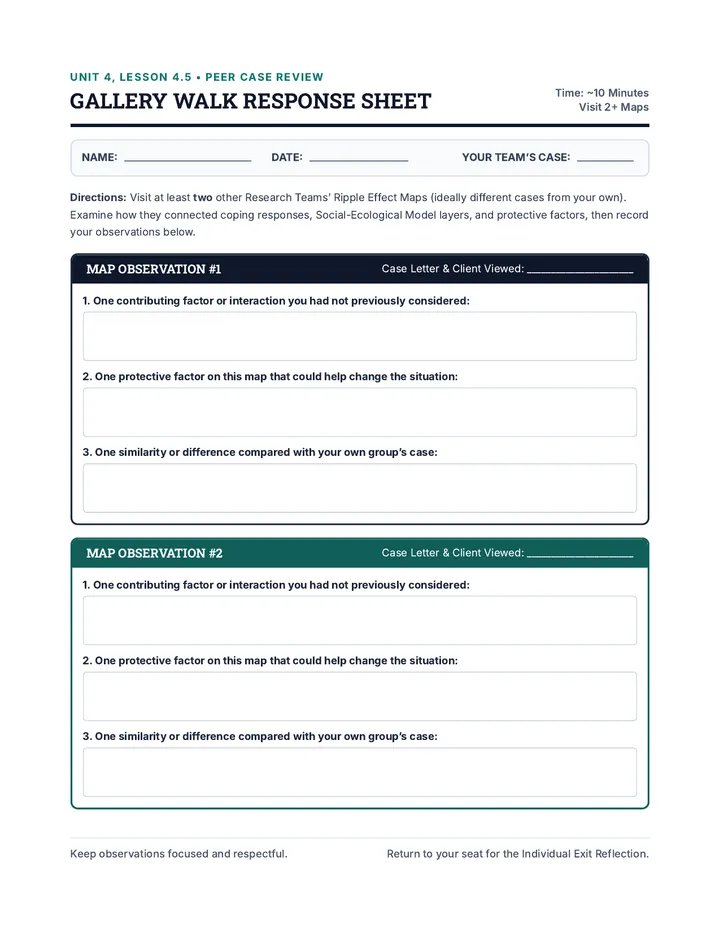
Gallery Walk Response Sheet Unit 4, Lesson 4.5 • Peer Case Review
GALLERY WALK RESPONSE SHEET
Time: ~10 Minutes
Visit 2+ Maps
Name:
Date:
Your Team’s Case:
Directions: Visit at least two other Research Teams’ Ripple Effect Maps (ideally different cases from your own). Examine how they connected coping responses, Social-Ecological Model layers, and protective factors, then record your observations below.
MAP OBSERVATION #1 Case Letter & Client Viewed: ______________________
1. One contributing factor or interaction you had not previously considered:
2. One protective factor on this map that could help change the situation:
3. One similarity or difference compared with your own group’s case:
MAP OBSERVATION #2 Case Letter & Client Viewed: ______________________
1. One contributing factor or interaction you had not previously considered:
2. One protective factor on this map that could help change the situation:
3. One similarity or difference compared with your own group’s case:
Keep observations focused and respectful. Return to your seat for the Individual Exit Reflection.
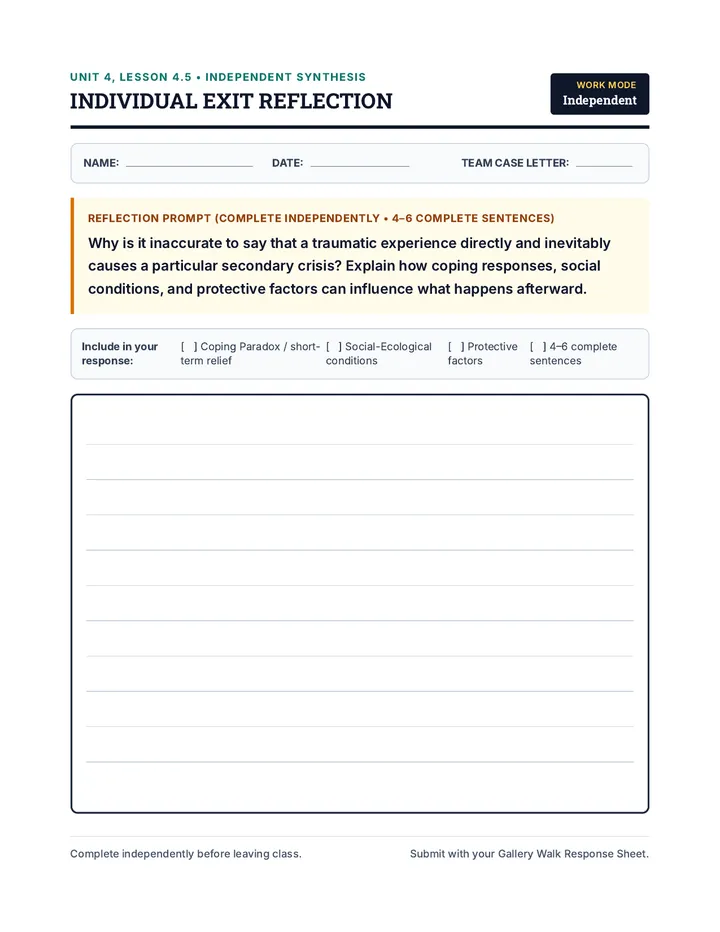
Ripple Effect Exit Reflection Unit 4, Lesson 4.5 • Independent Synthesis
INDIVIDUAL EXIT REFLECTION
Work Mode
Independent
Name:
Date:
Team Case Letter:
Reflection Prompt (Complete Independently • 4–6 Complete Sentences)
Why is it inaccurate to say that a traumatic experience directly and inevitably causes a particular secondary crisis? Explain how coping responses, social conditions, and protective factors can influence what happens afterward.
Include in your response: [ ] Coping Paradox / short-term relief [ ] Social-Ecological conditions [ ] Protective factors [ ] 4–6 complete sentences
Complete independently before leaving class. Submit with your Gallery Walk Response Sheet.
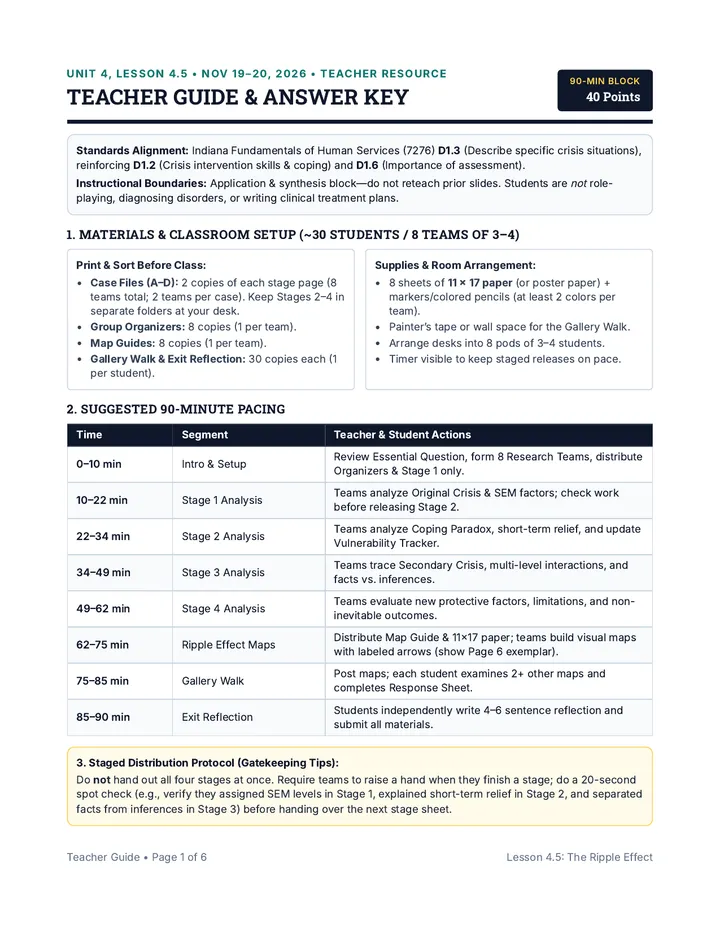
Ripple Effect Teacher Guide Unit 4, Lesson 4.5 • Nov 19–20, 2026 • Teacher Resource
TEACHER GUIDE & ANSWER KEY
90-Min Block
40 Points
Standards Alignment: Indiana Fundamentals of Human Services (7276) D1.3 (Describe specific crisis situations), reinforcing D1.2 (Crisis intervention skills & coping) and D1.6 (Importance of assessment).
Instructional Boundaries: Application & synthesis block—do not reteach prior slides. Students are not role-playing, diagnosing disorders, or writing clinical treatment plans.
1. Materials & Classroom Setup (~30 Students / 8 Teams of 3–4)
Print & Sort Before Class:
Case Files (A–D): 2 copies of each stage page (8 teams total; 2 teams per case). Keep Stages 2–4 in separate folders at your desk.Group Organizers: 8 copies (1 per team).Map Guides: 8 copies (1 per team).Gallery Walk & Exit Reflection: 30 copies each (1 per student).
Supplies & Room Arrangement:
8 sheets of 11 × 17 paper (or poster paper) + markers/colored pencils (at least 2 colors per team).
Painter’s tape or wall space for the Gallery Walk.
Arrange desks into 8 pods of 3–4 students.
Timer visible to keep staged releases on pace.
2. Suggested 90-Minute Pacing
Time
Segment
Teacher & Student Actions
0–10 min
Intro & Setup
Review Essential Question, form 8 Research Teams, distribute Organizers & Stage 1 only.
10–22 min
Stage 1 Analysis
Teams analyze Original Crisis & SEM factors; check work before releasing Stage 2.
22–34 min
Stage 2 Analysis
Teams analyze Coping Paradox, short-term relief, and update Vulnerability Tracker.
34–49 min
Stage 3 Analysis
Teams trace Secondary Crisis, multi-level interactions, and facts vs. inferences.
49–62 min
Stage 4 Analysis
Teams evaluate new protective factors, limitations, and non-inevitable outcomes.
62–75 min
Ripple Effect Maps
Distribute Map Guide & 11×17 paper; teams build visual maps with labeled arrows.
75–85 min
Gallery Walk
Post maps; each student examines 2+ other maps and completes Response Sheet.
85–90 min
Exit Reflection
Students independently write 4–6 sentence reflection and submit all materials.
3. Staged Distribution Protocol (Gatekeeping Tips):
Do not hand out all four stages at once. Require teams to raise a hand when they finish a stage; do a 20-second spot check (e.g., verify they assigned SEM levels in Stage 1, explained short-term relief in Stage 2, and separated facts from inferences in Stage 3) before handing over the next stage sheet.
Teacher Guide • Page 1 of 5 Lesson 4.5: The Ripple Effect
TEACHER GUIDE & ANSWER KEY • SAMPLE RESPONSES Page 2 of 5
CASE A: DISASTER & DISPLACEMENT (The Alvarez Family)
Sample Key
Stage 1 (Original Crisis): Category 4 hurricane destroying their home & forcing evacuation. Immediate concerns: crowded shelter stress, closed schools/disrupted routine, loss of belongings. Factors: Close family bond (Relationship – Protective); steady clinic job & carpentry skills (Individual/Community – Protective); loss of neighborhood/closed schools (Community – Risk); rental housing vulnerability (Societal/Community – Risk).
Stage 2 (Coping Response): (1) David avoids weather news/coastal driving & keeps belongings packed in bins → Short-term relief: reduces panic and restores a sense of readiness. (2) Maria works extra shifts & parents keep kids inside → Short-term relief: earns cash, stays distracted, protects kids from unfamiliar area. Long-term trade-off: Avoiding coastal roads limits David’s work; overworking exhausts Maria; staying inside isolates kids. Uncertain: Whether landlord/FEMA aid will come through, how long motel voucher lasts.
Stage 3 (Ripple Effect): Secondary crisis: Imminent housing loss / homelessness & child school withdrawal. Contributing factors: David’s coastal avoidance cutting income (Individual), Maria missing housing intake due to overtime (Individual/Community), 30% regional rent surge & expired voucher (Societal/Community), loss of church/neighbor network (Relationship). Facts vs. Inference: Case establishes missed appointments, lost contracts, and rent surge; teams infer whether Mateo’s rain fear or Sofia’s silence will persist long-term.
Stage 4 (Trajectory Shift): Protective factors: Evening-hour Community Navigator, 6-month rental deposit grant, inland builders’ cooperative, school peer group. Reduces: Missed intake barriers, coastal driving conflict, child isolation. Remaining challenge: Depleted savings & long-term rent affordability after 6 months; recovery is supported, not guaranteed.
CASE B: INTERPERSONAL VIOLENCE & SUBSTANCE USE (Elena Morales)
Sample Key
Stage 1 (Original Crisis): Prolonged interpersonal violence & recent relocation to escape it. Immediate concerns: hypervigilance/startle response, single-income financial strain. Factors: 6-year dental assistant career & supportive supervisor (Community/Relationship – Protective); close bond with sister Rosa (Relationship – Protective); moving costs on one income & unfamiliar neighborhood (Individual/Community – Risk).
Stage 2 (Coping Response): (1) Drinking 2–3 glasses of wine at night → Short-term relief: quiets racing thoughts and helps her fall asleep before early shifts. (2) Declining Rosa’s dinner invitations → Short-term relief: avoids emotional overwhelm of talking about the breakup. Long-term trade-off: Alcohol disrupts deep sleep and builds tolerance; pulling away from Rosa removes a key safety buffer. Uncertain: Whether ex-partner knows her new address, whether she has health insurance for counseling.
Stage 3 (Ripple Effect): Secondary crisis: Occupational instability (attendance warning/risk of job loss) & escalating alcohol reliance. Contributing factors: Nightly alcohol causing morning fatigue (Individual), fear of workplace/social stigma causing isolation (Societal/Relationship), no paid sick leave & single-income rent pressure (Societal/Community). Facts vs. Inference: Case establishes 3 late arrivals, written warning, and nightly wine; teams infer how long stigma has kept her from seeking help.
Stage 4 (Trajectory Shift): Protective factors: Non-judgmental supervisor sharing confidential EAP (free evening counseling + schedule flexibility), Rosa’s biweekly dinners, advocacy center support group. Reduces: Workplace stigma, isolation, reliance on wine for sleep. Remaining challenge: Rebuilding savings and consistent sleep take time; outcomes depend on continued access and safety.
Teacher Guide • Page 2 of 5 Note: Do not accept clinical diagnoses (e.g., "she has AUD/PTSD") as answers.
TEACHER GUIDE & ANSWER KEY • SAMPLE RESPONSES Page 3 of 5
CASE C: FAMILY INSTABILITY & RESTRICTIVE COPING (Jordan Bennett)
Sample Key
Stage 1 (Original Crisis): Repeated family instability, 4 unexpected moves, and sudden transfer to grandmother’s home/new school. Immediate concerns: anxiety over housing permanence, feeling like an outsider at school. Factors: Graphic design talent & running interest (Individual – Protective); caring grandmother (Relationship – Protective); grandmother’s evening shifts & repeated school transitions (Relationship/Community – Risk).
Stage 2 (Coping Response): (1) Rigid 30-minute schedules & restrictive food rules → Short-term relief: creates predictability and a sense of control when life feels chaotic. (2) Declining unscheduled time with teammates → Short-term relief: prevents social stress and schedule disruption. Long-term trade-off: Skipping meals/rest drains energy and isolates Jordan from peers. Uncertain: Whether Jordan’s parents remain in contact, how stable grandmother’s lease is.
Stage 3 (Ripple Effect): Secondary crisis: Physical health strain (dizziness/low energy), academic decline, and social isolation. Contributing factors: Restrictive eating & late-night checklists (Individual), grandmother’s evening work schedule (Relationship), crowded 20-minute school lunch & clinic waitlists (Community/Societal). Facts vs. Inference: Case establishes dizziness, quitting cross-country, and clinic waitlists; teams infer Jordan’s internal fears about losing control.
Stage 4 (Trajectory Shift): Protective factors: School social worker & wellness counselor, quiet lunch room, free youth arts studio with mentoring, grandmother swapping shifts for shared dinners. Reduces: Cafeteria stress, daytime isolation, evening disconnection. Remaining challenge: Clinic waitlists and broader family housing uncertainty remain; rigid habits shift gradually.
CASE D: ACCIDENT & AVOIDANCE (Marcus Chen)
Sample Key
Stage 1 (Original Crisis): Serious multi-car highway collision totaling his car. Immediate concerns: shaken nerves/physical soreness, lack of transportation in a car-dependent suburb. Factors: 2 years of apprenticeship & shop mentor (Individual/Relationship – Protective); brother Devon’s support (Relationship – Protective); minimal suburban public transit & low savings (Community/Societal – Risk).
Stage 2 (Coping Response): (1) Refusing highway rides & canceling cross-town appointments → Short-term relief: prevents chest tightness and panic reactions. (2) Turning down weekend outings & relying only on Devon’s back-road rides → Short-term relief: keeps heart rate calm while still getting to work. Long-term trade-off: Strains Devon’s job, cuts off medical follow-up, and shrinks social life. Uncertain: Insurance payout amount, whether employer offers medical leave.
Stage 3 (Ripple Effect): Secondary crisis: Unpaid apprenticeship probation, rent/utility arrears, and social isolation. Contributing factors: Vehicle avoidance & guilt over burdening Devon (Individual/Relationship), sparse suburban bus routes not reaching job sites (Community), lack of paid leave or transit support (Societal). Facts vs. Inference: Case establishes missed dispatches, probation, and 40-minute walk; teams infer how embarrassment deepens his isolation.
Stage 4 (Trajectory Shift): Protective factors: Mentor home visit, coworker side-street carpool, union Workforce Support Fund (transit vouchers + free telehealth), weekly walks with Devon. Reduces: Highway panic trigger, transit barrier, isolation. Remaining challenge: Highway travel still feels intimidating; catching up on back rent takes months.
Teacher Guide • Page 3 of 5 Encourage students to cite specific details from the case text.
TEACHER GUIDE & ANSWER KEY • CONCEPTUAL SYNTHESIS Page 4 of 5
4. Examples of Logical Relationships & Feedback Loops
Negative Reinforcement Loop (Coping Paradox): Distress triggers an avoidance or numbing behavior (e.g., Elena drinking wine, Marcus refusing highway rides, Jordan restricting routines) → immediate drop in anxiety reinforces the behavior → over time, the behavior creates new practical problems (missed work, fatigue, isolation) → those new problems increase baseline stress, driving even stronger reliance on the coping behavior.
Cross-Level Interaction (SEM): Individual trauma responses rarely create a secondary crisis alone. In Case A, David’s individual avoidance interacts with a community/societal post-disaster rent surge and Maria’s workplace schedule to produce housing loss. In Case D, Marcus’s fear interacts with community transit gaps.
5. Protective Factors & Alternative Outcomes
How Protective Factors Interrupt Trajectories: Effective supports meet people where they are—lowering structural barriers rather than relying solely on willpower (e.g., evening Navigator visits in Case A, confidential EAP in Case B, quiet lunch space in Case C, side-street carpool & telehealth in Case D).
Alternative Outcomes (Not Guaranteed): Even with Stage 4 supports, trajectories can branch. If Case A’s 6-month grant ends before rents stabilize, housing stress could return; if Case B’s workplace stays supportive and Rosa remains consistent, Elena may sustain recovery without losing her job.
6. Common Misconceptions to Address During Circulation
Student Misconception
Teacher Redirect / Clarification
"Trauma automatically causes PTSD, addiction, or eating disorders."
Trauma increases vulnerability, not destiny. Many people recover with strong supports, and secondary difficulties require multiple interacting factors.
"The client is making bad choices / just needs to try harder."
Point to the Coping Paradox and structural barriers (rent surges, transit gaps, clinic waitlists). Coping behaviors originally served a protective purpose.
"We should diagnose the client and write a therapy plan."
Remind students of Human Services scope (Unit 2): we analyze patterns, risk/protective factors, and resource connections—not clinical diagnosis.
"Once Stage 4 resources arrive, the crisis is completely solved."
Ask: "What risk factors still remain?" Recovery is gradual and non-linear; protective factors improve odds without guaranteeing outcomes.
Teacher Guide • Page 4 of 5 Circulate actively during Stages 2 and 3 to catch single-cause thinking.
TEACHER GUIDE & ANSWER KEY • ASSESSMENT Page 5 of 5
7. 40-Point Formative Grading Rubric
Component (Points)
Full Credit
Partial Credit
Minimal Credit
Stage 1: Original Crisis & Vulnerability
(8 points)
7–8 pts: Accurately identifies event, 2 immediate concerns, and 3+ risk/protective factors with correct SEM levels; avoids premature assumptions.4–6 pts: Identifies event and concerns, but misses 1–2 factors or mislabels SEM levels.0–3 pts: Incomplete, vague, or jumps ahead to unstated diagnoses/outcomes.
Stage 2: Coping Response Analysis
(8 points)
7–8 pts: Identifies 2 coping responses, clearly explains short-term relief, analyzes how 1 becomes less helpful, and notes uncertainties.4–6 pts: Identifies responses but gives shallow short-term/long-term explanation or omits uncertainties.0–3 pts: Labels coping simply as "bad choices" without explaining short-term purpose.
Stage 3: Secondary Crisis & Interactions
(10 points)
9–10 pts: Clearly identifies secondary crisis, explains 3+ factors across 2+ SEM levels, shows interaction, and separates facts from inferences.5–8 pts: Lists factors but treats them as isolated or blurs case facts with team inferences.0–4 pts: Relies on single-cause explanation ("trauma caused it") or lacks SEM breadth.
Stage 4: Protective Factors & Outcomes
(8 points)
7–8 pts: Identifies new protective factors, links them to specific reduced risks, notes 1 limitation, and explains why outcomes are not guaranteed.4–6 pts: Identifies resources but gives vague risk links or overlooks remaining challenges.0–3 pts: Treats Stage 4 resources as a guaranteed "fix" or prescribes clinical treatment.
Ripple Effect Map, Gallery Walk & Exit Reflection
(6 points)
5–6 pts: Map includes all 7 components with labeled arrows & fact/inference key; Gallery Walk complete; Exit Reflection (4–6 sentences) synthesizes coping, social context, and protective factors.3–4 pts: Map misses 1–2 components or uses unlabeled arrows; Gallery Walk or Reflection is brief/partially developed.0–2 pts: Map is a simple list without connections; Gallery Walk or Reflection missing/incomplete.
Sample Full-Credit Individual Exit Reflection (4–6 Sentences)
"It is inaccurate to say a traumatic experience directly causes a secondary crisis because many interacting factors shape what happens afterward. After a distressing event, people often use coping responses—like avoidance, overworking, or substance use—that provide real short-term relief from overwhelming stress. However, if those behaviors continue, they can create new problems such as missed work or social isolation. Broader social and community conditions, like high housing costs, limited public transit, or workplace stigma, can worsen those pressures. When protective factors such as safe relationships, accessible counseling, or financial assistance are introduced, they can reduce vulnerability and open healthier pathways, even though recovery is never guaranteed."
Teacher Guide • Page 5 of 5 Total: 40 Formative Points