Resolving Conflicts Lesson Plan Resolving Conflicts
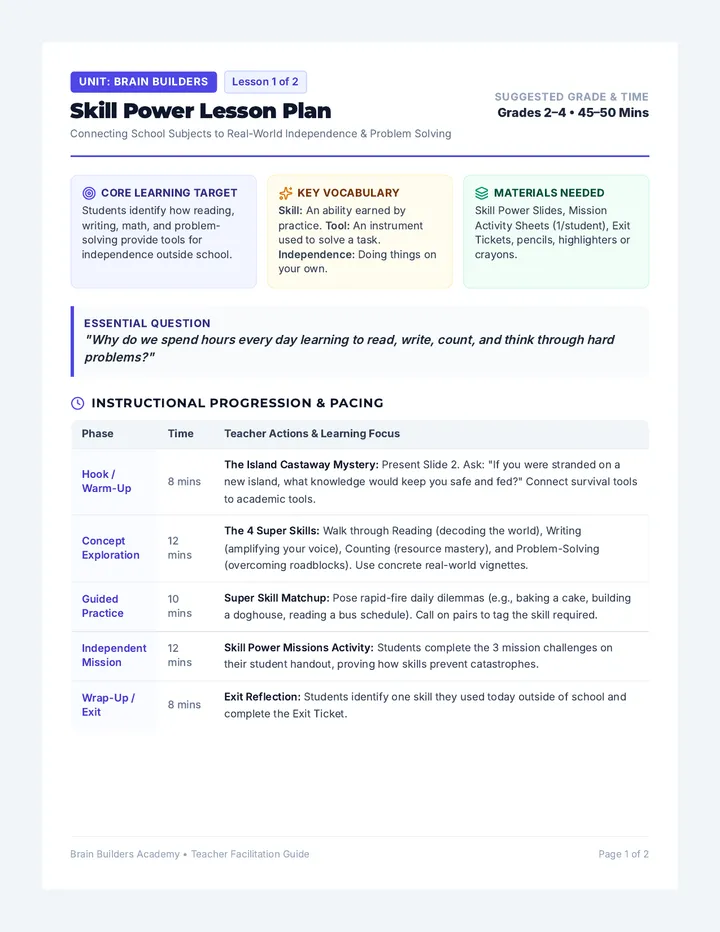
Teacher Lesson Plan
4th Grade
Time
40 Minutes
Approach
Active & Blended Learning
Objective
Conflict Resolution Strategies
Value
Forgiveness & Compassion
Why This Lesson?
This lesson focuses on teaching 4th-grade students effective conflict resolution skills through active and blended learning strategies. By engaging with a video, reading material, and interactive activities, students will learn how to identify conflicts, understand different perspectives, and apply problem-solving techniques. Additionally, it incorporates Catholic teachings on forgiveness and compassion, reinforcing the importance of resolving conflicts in a manner that aligns with faith-based values.
Materials Needed
Video: Getting Help - Building Resilience
Conflict Resolution Worksheet
Conflict Resolution Reading
Exit Ticket
Answer Key
Printable Conflict Scenarios
Instructional Sequence
1
Introduction
5 MINS
Begin with a brief discussion on what conflict is and why it's important to resolve conflicts peacefully.
Discuss how conflict resolution aligns with Catholic teachings, such as forgiveness and compassion.
Share the Parable of the Prodigal Son (Luke 15:11-32) to illustrate forgiveness and reconciliation.
Highlight Catholic teachings on forgiveness, emphasizing that it is a path to healing and peace, as taught by Jesus in the Gospels.
Introduce the video to set the stage for understanding conflict resolution.
2
Video Viewing
3 MINS
Watch the video Getting Help - Building Resilience with Hunter and Eve .
Ask students to pay attention to how the characters resolve their issues.
3
Guided Reading
7 MINS
Distribute the 'Conflict Resolution Reading' handout.
Read together as a class, pausing to discuss key points and ask questions about the content.
4
Group Activity
10 MINS
Divide students into small groups and provide each group with a conflict scenario from the 'Printable Conflict Scenarios'.
Instruct groups to discuss and role-play how they would resolve the conflict using the strategies learned.
Encourage students to incorporate Catholic values such as forgiveness and empathy in their resolutions.
Have each group present their scenario and resolution to the class.
5
Worksheet Activity
10 MINS
Hand out the 'Conflict Resolution Worksheet'.
Have students work individually or in pairs to complete the worksheet, applying what they've learned from the video and reading.
Circulate the room to provide support and answer questions.
6
Closure & Exit Ticket
5 MINS
Review the key points of the lesson, emphasizing the steps to resolve conflicts.
Discuss how the strategies learned can be applied in a way that reflects Catholic values, such as showing kindness and understanding.
Reflect on the Parable of the Prodigal Son and how forgiveness can lead to healing and reconciliation.
Reinforce the Catholic teaching that forgiveness is essential for peace and harmony.
Distribute the 'Exit Ticket' for students to complete.
Facilitation Tips
Modeling Empathy
When discussing the Parable of the Prodigal Son, emphasize the father's reaction of joy and welcome rather than anger. Ask students how they think the brother felt to prompt discussion on fairness and mercy.
Safe Environment
Remind students that conflicts are normal, but how we handle them defines our character. Create a "no blame" zone during role-plays to focus on solutions.
Peacebuilders Slides Resolving Conflicts
Building Bridges with Compassion & Forgiveness
4th Grade Peacekeepers
What is a conflict?
1
A disagreement between people who have different ideas or feelings.
2
An opportunity to practice forgiveness and understanding.
The Prodigal Son
"But while he was still a long way off, his father saw him and was filled with compassion..."
Forgiveness heals relationships.
Compassion means feeling what others feel.
Reconciliation brings peace.
Watch & Observe
Building Resilience with Hunter & Eve
Click here to play video
How did the characters feel?
What steps did they take to fix it?
Peacebuilding Strategies
Listen Actively
Hear their side without interrupting.
Stay Calm
Take a breath. Speak softly.
Find Common Ground
Find what you both agree on.
Be Respectful
Treat them with kindness.
Group Challenge
In your groups, use the Peacebuilding Strategies to solve your scenario. Don't forget to include forgiveness !
Ready, Set, Resolve!
Conflict Resolution Reading Handout Student Resource
The Peacekeeper's Guide
1 Understanding Conflict Resolution
Conflict resolution is the process of finding a peaceful solution to a disagreement. It involves understanding each person's perspective and working together to find a solution that everyone can agree on. In our classroom, we strive to be peacebuilders just like Jesus taught us.
2 Key Strategies
Listen Actively
Pay attention to what the other person is saying without interrupting. Try to understand their feelings.
Stay Calm
Keep your emotions in check. Speak in a calm, quiet voice so others can hear you clearly.
Find Common Ground
Look for areas where you both agree. Building from common ground makes solving problems easier.
Be Respectful
Treat the other person with respect, even if you disagree. Remember, every person is a child of God.
"Blessed are the peacemakers, for they will be called children of God."
— Matthew 5:9
Conflict Resolution Worksheet Peacebuilder's Log
Resolving Conflicts Worksheet
Name:
Date:
1
Reflect on a Conflict
Describe a conflict you have experienced and how you resolved it. Think about a time you disagreed with a friend or family member.
2
Action Steps
List three steps you can take to resolve a conflict peacefully. Consider what you learned from the video and reading.
1
2
3
Printable Conflict Scenarios Cards Scenario Challenge Cards
Print and Cut for Group Role-Play
Scenario 1
The Recess Game
A group of friends is playing kickball at recess. Two students disagree about whether a runner was "safe" or "out." One student starts yelling that the other is cheating, and the whole game stops.
Your Challenge:
How can you use active listening to hear both sides and find a fair way to continue the game?
Scenario 2
The Messy Desk
You and your partner are working on a science poster. Your partner accidentally knocks over a cup of markers, and some of the ink gets on the drawing you spent 20 minutes working on.
Your Challenge:
How can you stay calm and practice forgiveness? How do you both work together to fix the poster?
Scenario 3
The Left-Out Feeling
During lunch, a group of students is whispering about a birthday party. One student at the table realizes they weren't invited and feels very hurt and angry. They want to say something mean back.
Your Challenge:
How can the students show compassion and respect? How can they find common ground to make everyone feel included?
Scenario 4
The Library Book
You borrowed a favorite book from a classmate and accidentally tore one of the pages. When you return it, your classmate gets very upset and says they will never let you borrow anything again.
Your Challenge:
How do you apologize sincerely? How can the owner of the book practice reconciliation and forgiveness?
Pro-Tip for Teachers
Encourage students to act out both the conflict and the "Peaceful Path" resolution.
Conflict Resolution Exit Ticket Exit Ticket
Peacebuilding Reflections
Name:
Date:
1
What is one thing you learned about resolving conflicts today?
How to listen actively
How to ignore conflicts
How to win every argument
2
Why is it important to find common ground in a conflict?
To make the other person happy
To find a solution everyone agrees on
To avoid talking about the problem
How can you show forgiveness to a friend today?
Conflict Resolution Answer Key Answer Key
Resolving Conflicts Lesson
Teacher Resource
Conflict Resolution Worksheet
1. Describe a conflict you have experienced and how you resolved it.
Answers will vary by student. Look for students reflecting on personal experiences and applying strategies like listening, talking calmly, or apologizing.
2. List three steps you can take to resolve a conflict peacefully.
Listen actively, stay calm, and find common ground.
Acceptable variations include: Be respectful, apologize, use "I" statements, show forgiveness.
Exit Ticket
1. What is one thing you learned about resolving conflicts today?
How to listen actively
2. Why is it important to find common ground in a conflict?
To find a solution everyone agrees on
Scenario Guidance
When students role-play, facilitate by asking: "How would Jesus want us to respond here?" or "What does forgiveness look like in this situation?" Ensure the "common ground" found in scenarios is fair to both parties.