Regulation Playbook Session Plan Regulation Playbook
Tier 3 Individual Session • 7th Grade
50 Minutes
Session Objective
Co-create a personalized Regulation Playbook with a 7th grader to help them recognize their emotional zones and select tailored sensory and self-regulation strategies with clear, illustrated steps.
Why This Matters
This individualized session builds self-awareness and empowers students to manage their emotions using concrete tools, fostering independence and reducing dysregulation in academic and social settings.
Prep & Materials
Print My Regulation Playbook Template
Print Playbook Completion Rubric
Print Zones Success Stories
Review student's previous regulation goals
Arrange a quiet, distraction-free workspace
Session Playbook
5'
Greeting & Check-In
Welcome the student and establish rapport.
Ask "How are you feeling today?" and identify their current Zone.
Note any recent challenges or successes related to regulation.
10'
Review Zones & Personal Examples
Briefly revisit the four Zones of Regulation.
Share select scenarios from Zones Success Stories relevant to the student.
Ask the student to name personal moments they felt in each Zone.
20'
Co-Create Strategies for Each Zone
Prompt student to brainstorm 2–3 strategies that work for them per Zone.
Guide student to illustrate and write step-by-step instructions in the Playbook Template .
Ask: "What tools do you need? Where will you go? How long will you use this?"
10'
Introduce Completion Rubric & Reflect
Review the Completion Rubric with the student.
Check off completed sections and discuss any areas needing more detail.
Reflection: "Which strategy will you try first? How will you remember to use it?"
5'
Set Next Steps & Close
Agree on where the student will keep their Playbook.
Encourage practice and recording of outcomes.
End with positive reinforcement and confirm focus for next session.
Regulation Playbook Slides Regulation Playbook
Tier 3 Individual Session | 7th Grade
50 Minutes One-on-One
Welcome the student and set a positive tone. Introduce the purpose: to co-create a personalized Regulation Playbook.
Session Objectives
Recognize and label emotions using the Zones of Regulation
Identify personal examples for each Zone
Co-create strategies in your personalized Playbook
Understand the Completion Rubric
The Four Zones
Blue Zone
Low energy, sad, tired, bored, moving slowly.
Green Zone
Calm, focused, ready to learn, feeling good.
Yellow Zone
Anxious, wiggly, excited, frustrated, losing some control.
Red Zone
Angry, out of control, terrified, yelling/hitting.
The Template
In Progress
Brainstorm 2–3 personal strategies for every Zone.
Add illustrations and clear step-by-step instructions.
Specify tools, locations, and timing details.
My Regulation Playbook
Championship Standards
1
All 4 Zones addressed
2
At least 2 strategies per Zone
3
Clear illustrations and steps
4
Tools & environment specified
"Your Playbook should be so clear that someone else could read it and help you get back to Green."
Zones Success Stories
Let's look at how other students manage their energy.
Blue & Red Strategies
New Ideas
Session Plan
5 min
Check-In & current Zone
10 min
Review Zones & Personal Examples
20 min
Brainstorm & Illustrate Strategies
10 min
Rubric Review & Reflection
5 min
Next Steps & Practice Plan
Let's Get Started!
Ready to co-create your Regulation Playbook ?
How are you feeling today, and what Zone are you in?
Zones Success Stories Reading Zones Success Stories
Real-world examples of regulation in action
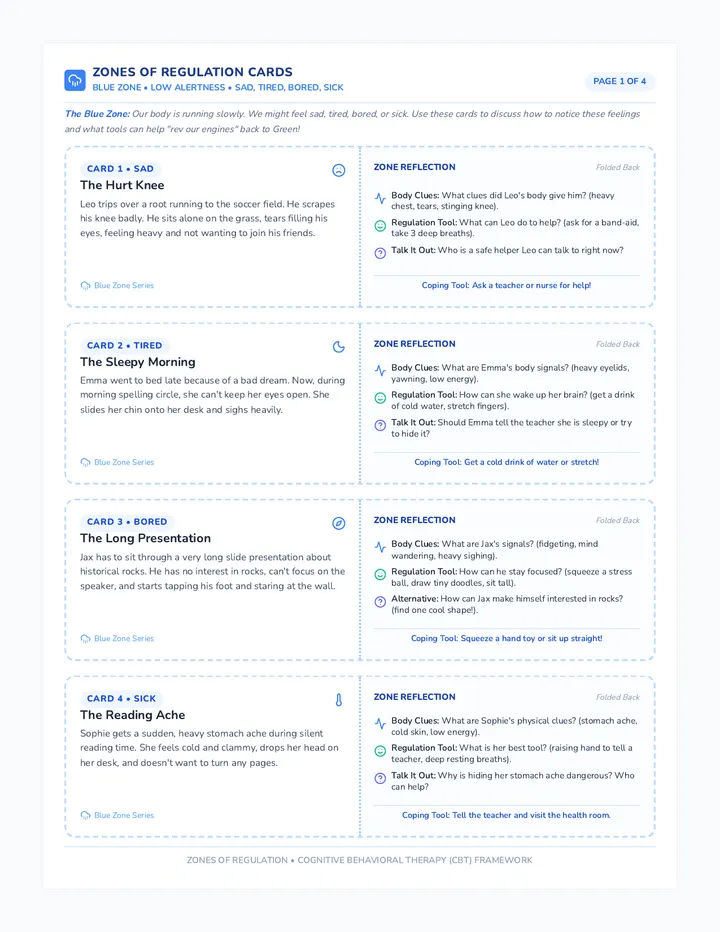
Blue Zone: Finding Calm with Gentle Movement
Last Tuesday, Emma noticed she felt extra tired and a bit down before math class. She worked with her teacher to step into a quiet corner of the room, grab a soft stress ball, and do five slow squeezes while taking deep, gentle breaths. After a few moments of this gentle movement and breathing, she felt her body relax and her energy lift just enough to join the lesson with a little more focus.
Green Zone: Staying Focused Through Breathing
Jamal often feels calm and ready when he follows his regular routine, but before a big science quiz, he began to notice his heart race a bit. Remembering a strategy he’d learned, he set a timer for one minute, closed his eyes, and used the 4-7-8 breathing exercise (inhale for 4 counts, hold for 7, exhale for 8). Once the timer beeped, he opened his eyes and discovered his mind felt clearer—he calmly tackled each quiz question and even finished with time to spare.
Yellow Zone: Channeling Nervous Energy
Before gym class, Sofia often felt jittery and a bit anxious—her Yellow Zone moment. Last week, she decided to try a quick stretch break: she stood by the wall, reached both arms overhead for a slow stretch count of ten, then rolled her shoulders back and forth. The simple movements helped her feel more centered, so she joined her teammates with less fidgeting and more confidence in her game.
Red Zone: Using a Safe Space to Regain Control
One afternoon, Leo felt his anger boil over after an argument with a friend—he was in the Red Zone. His teacher gently reminded him of his personalized plan: walk to the calm corner in the library, sit on the beanbag chair, and write down what happened and how he feels. After ten minutes in his safe space, he felt enough control to return to class, apologize to his friend, and work on a solution together.
Which of these stories sounds most like you? Thinking about how others handle their zones can help us find the strategies that work best for our own playbook.
My Regulation Playbook Template My Regulation Playbook
Personal strategies, steps, and tools for every zone.
Name / Date
Use this template to record your personal strategies, step-by-step instructions, and illustrations for each zone. List 2–3 strategies per zone , draw your favorite tools or places, and write clear steps you can follow.
Blue Zone
Low Energy • Sad • Tired
1. How I feel when I'm in the Blue Zone:
Describe your feelings here...
2. My Strategies & Steps:
Strategy 1: ____________________
Step 1: _________________________
Step 2: _________________________
Strategy 2: ____________________
Step 1: _________________________
Step 2: _________________________
3. Illustration (Tool or Place):
Green Zone
Calm • Focused • Ready
1. How I feel when I'm in the Green Zone:
Describe your feelings here...
2. My Strategies & Steps:
Strategy 1: ____________________
Step 1: _________________________
Step 2: _________________________
Strategy 2: ____________________
Step 1: _________________________
Step 2: _________________________
3. Illustration (Tool or Place):
Yellow Zone
Anxious • Wiggly • Excited
1. How I feel when I'm in the Yellow Zone:
Describe your feelings here...
2. My Strategies & Steps:
Strategy 1: ____________________
Step 1: _________________________
Step 2: _________________________
Strategy 2: ____________________
Step 1: _________________________
Step 2: _________________________
3. Illustration (Tool or Place):
Red Zone
Angry • Out of Control • Terrified
1. How I feel when I'm in the Red Zone:
Describe your feelings here...
2. My Strategies & Steps:
Strategy 1: ____________________
Step 1: _________________________
Step 2: _________________________
Strategy 2: ____________________
Step 1: _________________________
Step 2: _________________________
3. Illustration (Tool or Place):
"Review your steps and pictures. Keep this Playbook handy so you can follow your own guide whenever you notice you're shifting into a new Zone."
Playbook Completion Rubric Playbook Completion Rubric
Standards for a Championship-Ready Regulation Guide
Criteria 4 – Exemplary 3 – Proficient 2 – Developing 1 – Beginning Zones Addressed All four Zones clearly labeled with detailed descriptions of how you feel in each. All four Zones labeled with basic descriptions of feelings. Three Zones labeled; one Zone missing or described vaguely. Fewer than three Zones labeled; little or no description. Strategies per Zone At least 3 distinct strategies listed for every Zone (12+ total), tailored to the Zone. 2 strategies listed for each Zone (8 total), all relevant. 1 strategy listed for each Zone or some Zones missing a second. Many Zones have no strategies or only one for multiple Zones. Clarity of Steps Step-by-step instructions are detailed and logical for independent use. Instructions are clear and mostly sequential. Steps present but sometimes unclear or out of logical order. Steps are incomplete, confusing, or missing. Illustrations Neat, relevant drawings accompany every Zone, enhancing understanding. Drawings included for each Zone and generally clear. Drawings included for some Zones but missing/unclear for others. Illustrations are absent or irrelevant. Tools & Context Needed tools, location, and approximate timing are precisely specified for every strategy. Most strategies include tools and location. Some strategies lack clear tool or location details. Tools and environment information missing for most.
Scoring Guide
4
Comprehensive, visually rich, and fully actionable.
3
Meets expectations; may need small clarifications.
2
Incomplete or partially unclear.
1
Significant sections missing; major revision needed.
Self-Assessment: Look at your Playbook. Based on this rubric, what is one thing you did really well? What is one thing you could add to make it even better?