Listen Up Worksheet Real Talk Toolkit • Skill 01
Listen Up Worksheet
The Art of Active Listening, Paraphrasing & Intentional Inquiries
Name:
Date:
Period:
Hearing vs. Active Listening Hearing is automatic; active listening is a conscious choice. When you actively listen, you focus 100% on understanding the speaker's emotional message before preparing your response, judging, or offering quick fixes.
1 Self-Audit: What Is Your Default Listening Habit?
Check the box that best describes your everyday tendency when someone is venting or telling a story:
The Problem Solver
Jumps straight to giving advice ("Here is what you need to do...") before the person even finishes.
The Story Hijacker
Immediately steers the focus back to themselves ("Omg, that exact same thing happened to me!").
The Multitasker
Nods along while checking phone notifications or scanning the hallway, missing key body language.
2 Paraphrase Challenge: Reflecting Without Parroting
Paraphrasing proves you understood the feeling and facts. Use reflection stems such as: "It sounds like you felt...", "So what's stressing you most is...", "If I understand right..."
Scenario A
"My track coach just moved me off the 4x100 relay after I spent the whole weekend training. She said someone else was quicker today, but I worked so hard for that spot!"
Your Paraphrased Response (Validate their emotion and core situation):
Scenario B
"My parents are constantly interrogating me about college applications every time I walk into the kitchen. I know deadlines are coming up, but I feel like I can't even eat dinner in peace."
Your Paraphrased Response (Reflect their pressure and desire for space):
Real Talk Toolkit • Active Listening Page 1 of 2
Real Talk Toolkit • Skill 01 (Continued)
Deepening the Connection
Powerful Questions
3 Flipping Questions: From Interrogation to Curiosity
Closed questions shut down conversations with one-word answers ("Yes", "No", "Fine"). Open questions invite exploration without making the person feel defensive.
Closed/Accusatory: "Why didn't you just study earlier for the midterm?"
Rewrite as an open, non-judgmental question (start with 'How' or 'What'):
Closed/Dismissive: "Are you mad at Taylor or not?"
Rewrite as an open, curious question that invites them to share how they feel:
4 Real-World Simulation: The Group Project Tension
The Situation: Your friend Jordan says: "Everyone thinks I'm slacking on our science poster, but my grandma is in the hospital and my parents made me watch my younger siblings all week. Now Jordan won't even reply to my group texts."
Step 1: Identify Jordan's primary underlying feelings (e.g., overwhelmed, misunderstood, hurt):
Step 2: Write what you would say using active paraphrasing and zero unsolicited advice:
Step 3: What thoughtful, supportive follow-up question would you ask to help Jordan feel supported?
Active Listening Commitment
Next time a peer or family member talks to me when they are frustrated, I will avoid (habit): and instead I will try to:
Real Talk Toolkit • Active Listening Page 2 of 2
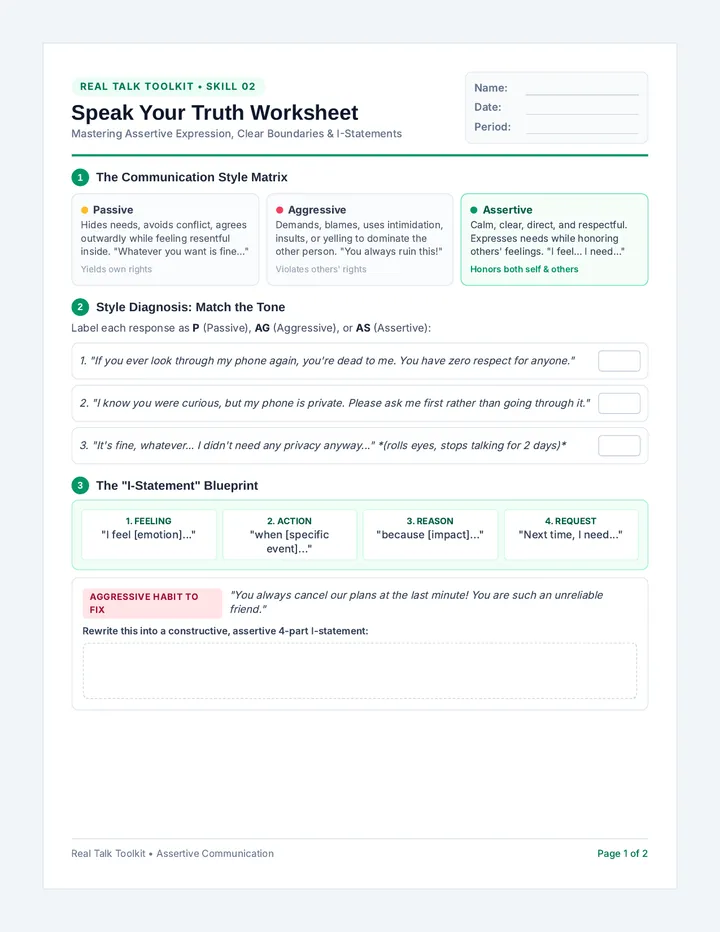
Speak Your Truth Worksheet Real Talk Toolkit • Skill 02
Speak Your Truth Worksheet
Mastering Assertive Expression, Clear Boundaries & I-Statements
Name:
Date:
Period:
1 The Communication Style Matrix
Passive
Hides needs, avoids conflict, agrees outwardly while feeling resentful inside. "Whatever you want is fine..."
Yields own rights
Aggressive
Demands, blames, uses intimidation, insults, or yelling to dominate the other person. "You always ruin this!"
Violates others' rights
Assertive
Calm, clear, direct, and respectful. Expresses needs while honoring others' feelings. "I feel... I need..."
Honors both self & others
2 Style Diagnosis: Match the Tone
Label each response as P (Passive), AG (Aggressive), or AS (Assertive):
1. "If you ever look through my phone again, you're dead to me. You have zero respect for anyone."
2. "I know you were curious, but my phone is private. Please ask me first rather than going through it."
3. "It's fine, whatever... I didn't need any privacy anyway..." *(rolls eyes, stops talking for 2 days)*
3 The "I-Statement" Blueprint
1. Feeling "I feel [emotion]..."
2. Action "when [specific event]..."
3. Reason "because [impact]..."
4. Request "Next time, I need..."
Aggressive Habit to Fix
"You always cancel our plans at the last minute! You are such an unreliable friend."
Rewrite this into a constructive, assertive 4-part I-statement:
Real Talk Toolkit • Assertive Communication Page 1 of 2
Real Talk Toolkit • Skill 02 (Continued)
Holding Boundaries with Grace
Boundary Scripts
Remember: A boundary is not a punishment or a wall to shut people out. It is a clear property line showing people how to treat you so the relationship stays healthy.
4 Real Teen Scenarios: Script Your Response
Case A: The Homework Co-Sign Peer Pressure
A close friend texts you at 10:30 PM: "Send me photos of your completed chemistry packet. I didn't do it and I'll get an F if I don't turn it in tomorrow morning."
Write an assertive text message setting a boundary without being mean or giving in:
Case B: The Teasing "Joke" Social Dignity
At lunch, someone repeatedly makes jokes about your haircut or clothing in front of a group. When you don't laugh, they say,
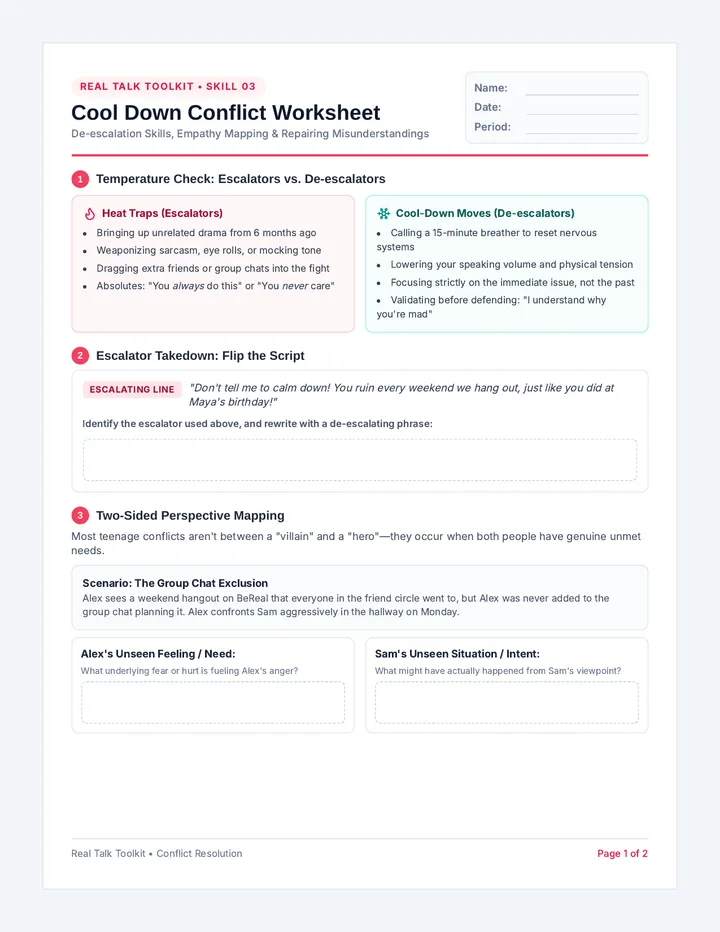
Cool Down Conflict Worksheet Real Talk Toolkit • Skill 03
Cool Down Conflict Worksheet
De-escalation Skills, Empathy Mapping & Repairing Misunderstandings
Name:
Date:
Period:
1 Temperature Check: Escalators vs. De-escalators
Heat Traps (Escalators)
Bringing up unrelated drama from 6 months ago
Weaponizing sarcasm, eye rolls, or mocking tone
Dragging extra friends or group chats into the fight
Absolutes: "You always do this" or "You never care"
Cool-Down Moves (De-escalators)
Calling a 15-minute breather to reset nervous systems
Lowering your speaking volume and physical tension
Focusing strictly on the immediate issue, not the past
Validating before defending: "I understand why you're mad"
2 Escalator Takedown: Flip the Script
Escalating Line
"Don't tell me to calm down! You ruin every weekend we hang out, just like you did at Maya's birthday!"
Identify the escalator used above, and rewrite with a de-escalating phrase:
3 Two-Sided Perspective Mapping
Most teenage conflicts aren't between a "villain" and a "hero"—they occur when both people have genuine unmet needs.
Scenario: The Group Chat Exclusion
Alex sees a weekend hangout on BeReal that everyone in the friend circle went to, but Alex was never added to the group chat planning it. Alex confronts Sam aggressively in the hallway on Monday.
Alex's Unseen Feeling / Need:
What underlying fear or hurt is fueling Alex's anger?
Sam's Unseen Situation / Intent:
What might have actually happened from Sam's viewpoint?
Real Talk Toolkit • Conflict Resolution Page 1 of 2
Real Talk Toolkit • Skill 03 (Continued)
The Relationship Repair Protocol
Repair & Rebuild
4 The 4-Step Repair Framework
Step 1: Cool Off
Wait until your heart rate slows and defensiveness drops.
Step 2: Own Your Part
Acknowledge your mistake without offering excuses or "buts".
Step 3: Validate
Name the impact your choice had on the other person.
Step 4: Commit
Agree on concrete changes for the future together.
5 Authentic Apology vs. Counterfeit Apology
Counterfeit Apologies:
• "I'm sorry you took it the wrong way." (Blames them)