Reaction Radar Slides Grade 2 • Life Skills & SEL
Problem Detective Academy
Size of the Problem
Reaction Radar
Is it a Little Deal, a Medium Deal, or a Big Deal? Let's match our reaction!
Little Deal
Quick fix by yourself
Medium Deal
Ask for adult help
Big Deal
Safety alert right now
1
The Golden Detective Rule
Matching Rule
The Goal
Match the size of your reaction to the size of the problem!
When our feelings get bigger than the problem, the problem actually grows bigger too.
Mismatched Reaction
Screaming, crying, or stomping over a snapped pencil creates a brand new, bigger problem!
Matched Reaction
Take one deep breath, grab the pencil sharpener, and jump right back into your fun art project.
Remember: All feelings are okay, but our reactions are our superpower choices!
2
Little Deal (A Quick Glitch)
You Can Fix It!
What It Looks Like
• Dropped your eraser
• Lost a game of tag
• Someone cuts ahead in line
How Long It Lasts
Usually solved in under 1 minute.
Nobody is hurt, and nobody is unsafe.
Your Action Plan
1. Take 1 belly breath
2. Tell yourself: "I can handle this!"
3. Pick it up, trade, or shrug it off
Detective Clue: If you can solve it without asking an adult, it is a Little Deal!
3
Medium Deal (A Bumpy Hiccup)
Needs Teamwork
What It Looks Like
• Scraped knee on asphalt
• Teasing or hurt feelings
• Lost backpack or jacket
How Long It Lasts
Takes a few minutes to fix.
Needs a grown-up or a friend to help sort it out.
Your Action Plan
1. Use your strong, calm voice
2. Tell a trusted teacher or adult
3. Work together on a solution
Detective Clue: Ask for adult help calmly without screaming or shouting.
4
Big Deal (Safety Emergency)
Emergency Alert
What It Looks Like
• Fire or fire alarm
• Someone can't breathe or severe injury
• An unsafe stranger
Why It Matters
Someone is in real danger or severely hurt.
Kids cannot fix this alone. Adults must take charge.
Your Action Plan
1. Get an adult RIGHT NOW
2. Yell for help if you need to
3. Follow safety instructions fast
Detective Clue: Big reactions (yelling loudly for an adult) are ONLY for Big Deals!
Detective Case #1 Spot the Size!
Class Discussion
"During art class, your purple crayon breaks in half while coloring."
What size is this problem?
A. Little Deal
Take a breath: now you have two crayons to share or use!
B. Medium Deal
Needs teacher conference and office pass.
C. Big Deal
Pull the fire alarm and run out of the room.
Thumbs up when you know the answer and can explain why!
Detective Case #2 Spot the Size!
Class Discussion
"Your water bottle tips over at your desk and soaks your math paper."
What is the matched reaction?
Mismatched Reaction (Giant):
Screaming "Everything is ruined!", kicking your chair, and crying under the desk.
Matched Reaction (Calm):
Grab paper towels right away, wipe the spill, and ask the teacher for a new worksheet.
Which reaction actually solves the puddle fastest?
★
Your Superpower: The 3-Step Reset
Toolbox
1
PAUSE
Stop your hands and feet. Put your hands on your belly or desk.
"Freeze the body first!"
2
BREATHE
Smell the birthday cake (in through nose), blow out the candles (out mouth).
"Slow down your heart!"
3
CHECK RADAR
Ask yourself: "Is anyone hurt? Can I solve this myself or ask nicely?"
"Match the reaction!"
Ready to test your detective skills? Let's open our Reaction Radar Activity Sheet!
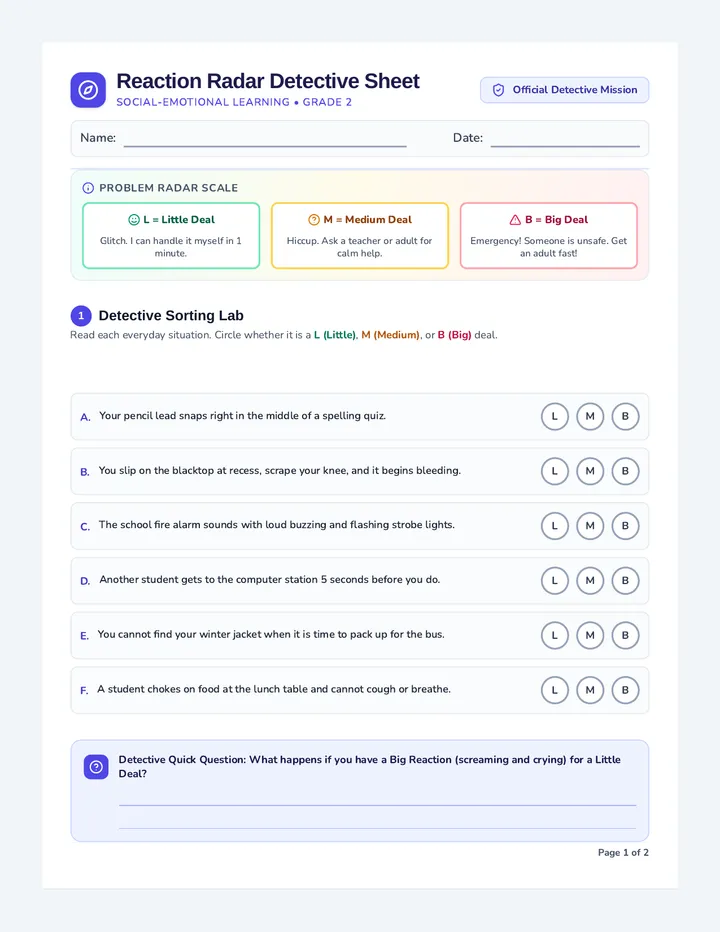
Reaction Radar Worksheet Reaction Radar Detective Sheet
Social-Emotional Learning • Grade 2
Official Detective Mission
Name:
Date:
Problem Radar Scale
L = Little Deal
Glitch. I can handle it myself in 1 minute.
M = Medium Deal
Hiccup. Ask a teacher or adult for calm help.
B = Big Deal
Emergency! Someone is unsafe. Get an adult fast!
1 Detective Sorting Lab
Read each everyday situation. Circle whether it is a L (Little), M (Medium), or B (Big) deal.
A. Your pencil lead snaps right in the middle of a spelling quiz.
L M B
B. You slip on the blacktop at recess, scrape your knee, and it begins bleeding.
L M B
C. The school fire alarm sounds with loud buzzing and flashing strobe lights.
L M B
D. Another student gets to the computer station 5 seconds before you do.
L M B
E. You cannot find your winter jacket when it is time to pack up for the bus.
L M B
F. A student chokes on food at the lunch table and cannot cough or breathe.
L M B
Detective Quick Question: What happens if you have a Big Reaction (screaming and crying) for a Little Deal?
Page 1 of 2
Reaction Match & Action Plan
Part 2 & 3
2 Spot the Matched Reaction
Read each scenario and check the box next to the best-matched reaction.
Scenario 1 Your artwork got a small paint smudge in the corner.
Rip up the whole paper, stomp your feet, and refuse to do art again.
Take a breath, wipe it gently with a towel, or turn it into a flower or star.
Scenario 2 You drop your tray in the cafeteria and your milk spills.
Hide your face, run out of the cafeteria, and cry in the hallway.
Stay calm, tell the cafeteria monitor, and help wipe the table with napkins.
3 My Calm Down Action Plan
Personal Plan
Think about a Little Deal that happens to you sometimes (losing a game, losing a crayon, dropping a book). Complete your plan below:
1. One Little Deal that sometimes frustrates me is:
2. Words I can whisper in my head to stay calm (Self-Talk):
3. One quick physical action I can do to calm my body:
Problem Detective Pledge
"I will check the size of the problem before I choose the size of my reaction!"
Detective Signature:
Page 2 of 2
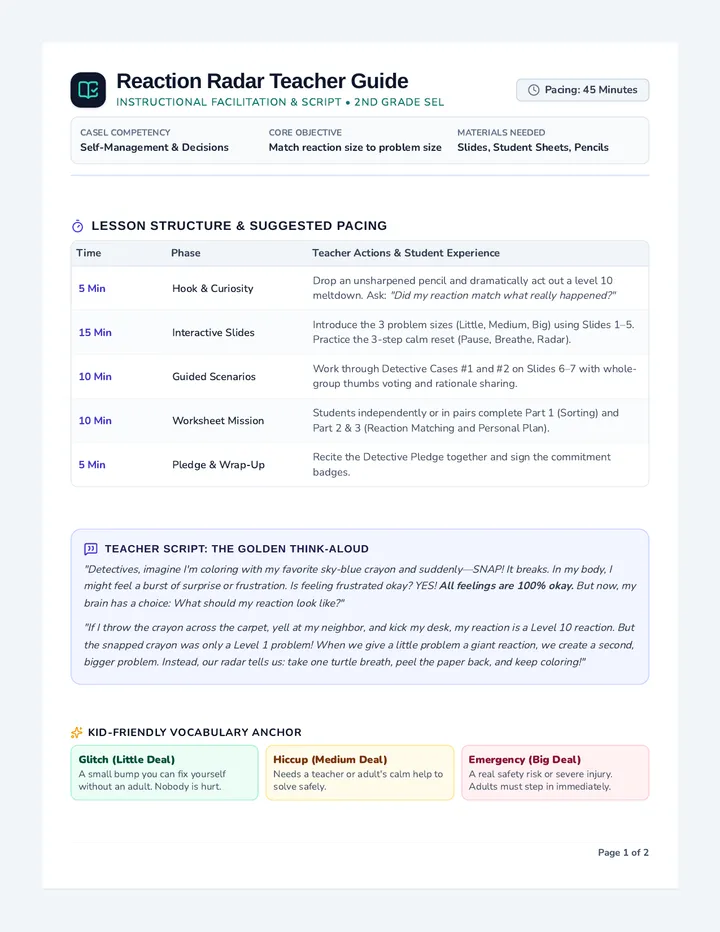
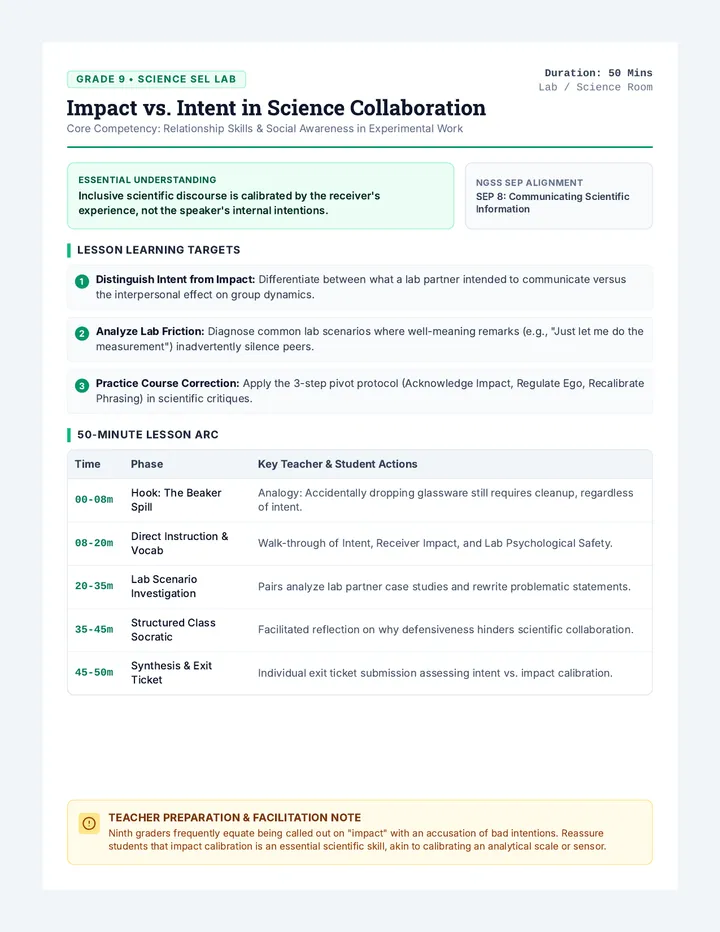
Reaction Radar Teacher Guide Reaction Radar Teacher Guide
Instructional Facilitation & Script • 2nd Grade SEL
Pacing: 45 Minutes
CASEL Competency Self-Management & Decisions
Core Objective Match reaction size to problem size
Materials Needed Slides, Student Sheets, Pencils
Lesson Structure & Suggested Pacing
Time
Phase
Teacher Actions & Student Experience
5 Min
Hook & Curiosity
Drop an unsharpened pencil and dramatically act out a level 10 meltdown. Ask: "Did my reaction match what really happened?"
15 Min
Interactive Slides
Introduce the 3 problem sizes (Little, Medium, Big) using Slides 1–5. Practice the 3-step calm reset (Pause, Breathe, Radar).
10 Min
Guided Scenarios
Work through Detective Cases #1 and #2 on Slides 6–7 with whole-group thumbs voting and rationale sharing.
10 Min
Worksheet Mission
Students independently or in pairs complete Part 1 (Sorting) and Part 2 & 3 (Reaction Matching and Personal Plan).
5 Min
Pledge & Wrap-Up
Recite the Detective Pledge together and sign the commitment badges.
Teacher Script: The Golden Think-Aloud
"Detectives, imagine I'm coloring with my favorite sky-blue crayon and suddenly—SNAP! It breaks. In my body, I might feel a burst of surprise or frustration. Is feeling frustrated okay? YES! All feelings are 100% okay. But now, my brain has a choice: What should my reaction look like?"
"If I throw the crayon across the carpet, yell at my neighbor, and kick my desk, my reaction is a Level 10 reaction. But the snapped crayon was only a Level 1 problem! When we give a little problem a giant reaction, we create a second, bigger problem. Instead, our radar tells us: take one turtle breath, peel the paper back, and keep coloring!"
Kid-Friendly Vocabulary Anchor
Glitch (Little Deal) A small bump you can fix yourself without an adult. Nobody is hurt.
Hiccup (Medium Deal) Needs a teacher or adult's calm help to solve safely.
Emergency (Big Deal) A real safety risk or severe injury. Adults must step in immediately.
Page 1 of 2
Facilitation Tips & Answer Key
Page 2 of 2
Common Misconceptions to Address
Misconception 1: "Little deal means my feelings don't matter."
Teacher Reframing: "Your feelings ALWAYS matter! Being disappointed is normal. Calling it a Little Deal doesn't mean you can't feel sad—it means you are powerful enough to solve it quickly!"