Pocket Calm Slides Counseling & Wellness Workshop
SEL Self-Management
Personal Regulation Blueprint
Pocket Calm Toolkit
Discover how your body signals stress, test proven regulation strategies, and build a personalized toolkit for any emotional weather.
Sensory Breath
Movement Reset
Mind Release
Social Anchors
Step 1 • Body Clues
Reading Your Inner Weather
Emotion Gauge
Level 1: Calm
Clear & Ready
Body is relaxed, breathing is steady, brain is open and ready to learn.
Goal: Maintenance
Gratitude, hydration, steady routines.
Level 2: Warning
Restless & Tight
Clenched jaw, shallow breathing, racing thoughts, stomach flutter.
Goal: Downshifting
Sensory checks, slow exhales, stretching.
Level 3: Storm
Overwhelmed
Fight/Flight/Freeze triggered. Thinking brain feels locked offline.
Goal: Safety & Grounding
Physical anchors, quiet space, support.
💡 Pro Tip: Coping skills work quickest when you catch Level 2 clues early!
Step 2 • The Strategy Arsenal
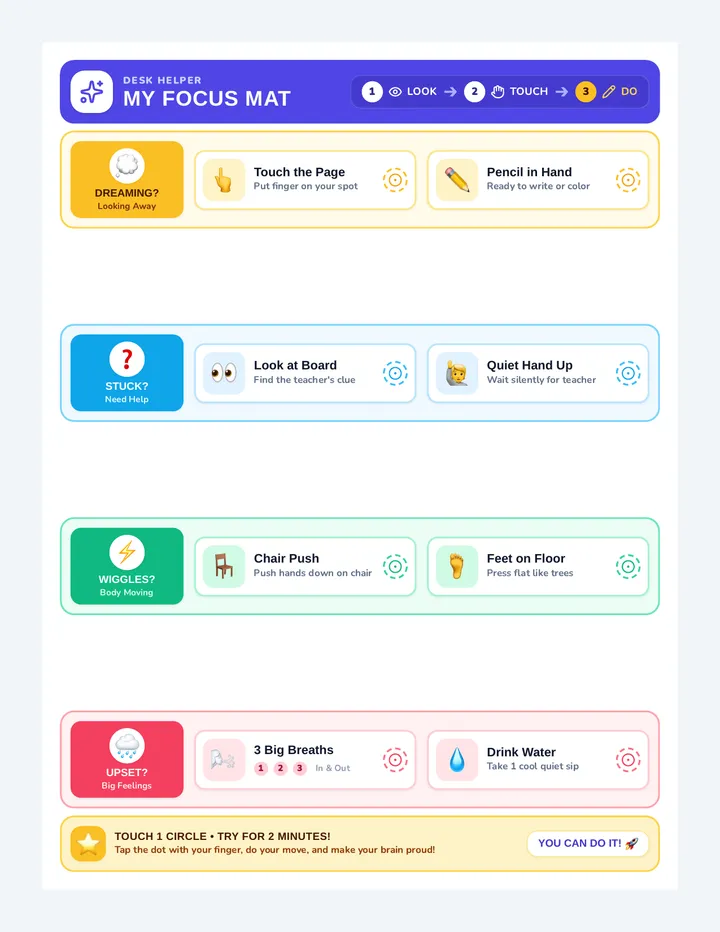
The 4 Coping Skill Zones
Every Brain Needs Options
1. Sensory & Breath
Calms the physical nervous system
• 4x4 Box breathing & 5-4-3-2-1
2. Body & Movement
Releases stored adrenaline safely
• Wall push-ups & heavy desk press
3. Mind & Expression
Redirects and processes thoughts
• Brain-dump scribble & journaling
4. Social Anchors
Connects to safety and comfort
• Quick check-in with a trusted adult
⭐ What helps your friend might not help you — finding what fits is your superpower!
Practice Lab • Technique 1
The 4x4 Box Breath
Reset Your Heart Rate
1
INHALE
4s
Breathe slowly in through your nose, expanding your ribs.
2
HOLD
4s
Keep lungs comfortably full. Relax your shoulders.
3
EXHALE
4s
Blow out smoothly through mouth like blowing a candle.
4
HOLD
4s
Pause empty before beginning the next round.
Why it works: Deep rhythmic breathing signals safety to your nervous system.
Repeat 3-4 Cycles
Practice Lab • Technique 2
5-4-3-2-1 Grounding Countdown
Brings Brain Back to Now
5
Things you can SEE
Spot details: a crack in the tile, a specific shade of blue, sunlight pattern.
4
Things you can FEEL
Feel textures: denim fabric, smooth desk wood, cool metal on chair legs.
3
Things you can HEAR
Listen closely: clock ticking, hum of ventilation, hallway footsteps.
2
Things you can SMELL
Notice scents in the air, notebook paper, fresh lotion, or pencil shavings.
1
Kind Statement to Yourself
Say inside: "I can handle this moment one breath at a time."
Step 3 • Action Time
Build Your Custom Toolkit
Workbook Mission
A
Map Your Signals
Record what your body does right before you erupt or shut down.
Page 1 • Clue Tracker
B
Test & Rate
Rate strategies from all 4 zones to find your top personal calm drivers.
Page 1 • Skills Matrix
C
Emergency Card
Assemble your top 3 go-to strategies and emergency adult contacts.
Page 2 • Pocket Card
The Golden Rule: Practice when you are calm so it works when you need it!
Coping Toolbox Builder Activity Student Regulation Workbook
Coping Toolbox Builder
Explore, test, and rate regulation strategies that work best for your unique nervous system.
Name:
Date:
Counselor/Room:
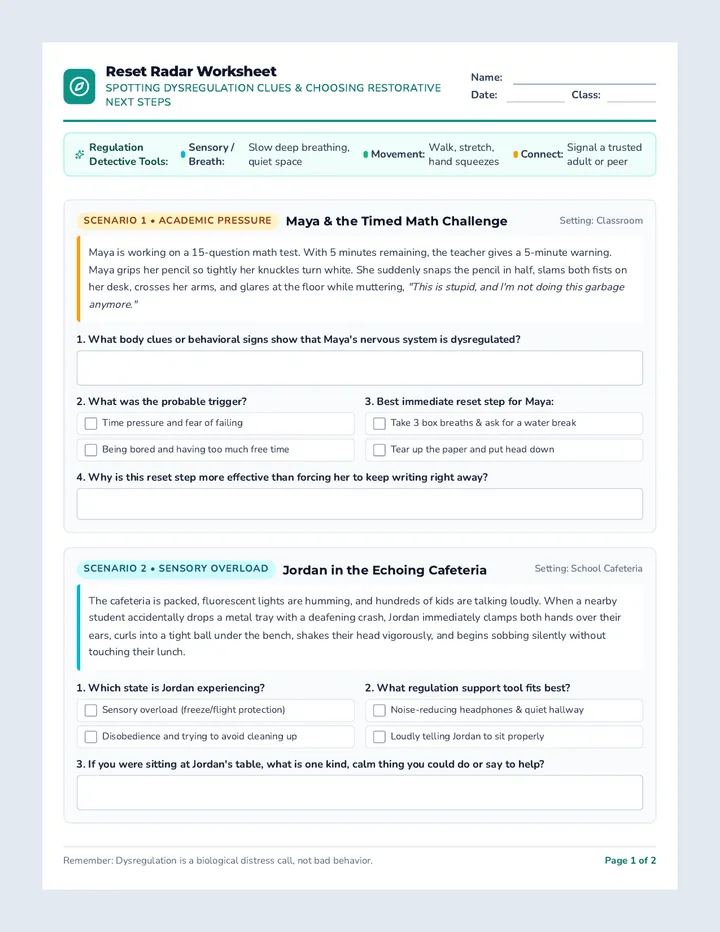
1. My Body's Early Warning Radar
Before we reach our "storm" level, our bodies give off physical whisper clues. Check all the signals your body gives when tension begins to rise:
Racing heart rate Clenched fists or jaw Stomach butterflies / drop Face feels warm / red Tight shoulders Wanting to run away Bouncing leg / tapping Trouble hearing words Mind spinning / loud
Other signal:
2. Coping Skills Test-Drive Matrix
Rate: 🟢 Love it (3) • 🟡 Okay (2) • 🔴 Not for me (1)
Circle your rating for each tool. Remember: everyone has different sensory preferences!
Coping Zone Strategy & Technique My Rating
Sensory & Breath
4x4 Box Breathing: Inhale 4s, hold 4s, exhale 4s, hold 4s.
3 2 1
Sensory & Breath
5-4-3-2-1 Grounding: Name 5 see, 4 feel, 3 hear, 2 smell, 1 positive thought.
3 2 1
Body & Movement
Wall Push-Ups / Chair Press: Push flat palms into wall for 10s of heavy work.
3 2 1
Body & Movement
Muscle Freeze & Melt: Squeeze fists and shoulders tight for 5s, then release limp.
3 2 1
Mind & Expression
Brain-Dump Doodle: Scribble hard on scrap paper, then tear or fold it away.
3 2 1
Mind & Expression
Power Mantra: Repeat silent phrase: "This feeling is temporary; I am safe."
3 2 1
Social Anchors
Pass / Signal Card: Show pre-arranged signal card to teacher to step out for water.
3 2 1
Social Anchors
Co-Regulation Check: Sit quietly in the same room with a trusted adult or counselor.
3 2 1
Reflect: Look at your "3" ratings. These will become the foundation of your emergency plan on Page 2!
Page 1 of 2
Action Blueprint
My Custom Coping Plan & Pocket Card
Student:
3. My Tiered Response Action Plan
When I notice LEVEL 2 clues (Restless, Irritated, Tense): Early Intervention
I will immediately pause and use these two go-to downshifting skills:
Downshift Tool #1:
Downshift Tool #2:
When I hit LEVEL 3 (Overwhelmed, Explosive, Shut Down): Emergency Reset
My #1 safe immediate action to protect myself and others:
Pocket Calm Facilitation Guide Counselor & Educator Guide
Pocket Calm Facilitation Guide
Tier 1 Classroom Core Lesson or Tier 2 Small Group Social-Emotional Intervention
Duration: 45–50 Mins
Grades: 3rd – 8th Grade
CASEL: Self-Management
Learning Objective
Students will identify 3+ personal physical warning signs of dysregulation and assemble a personalized 4-zone coping toolkit.
Advance Prep
Print 2-sided Activity Workbooks; prepare sample tactile items (textured stones, stress squeeze balls, scrap paper, scissors).
Neurodiversity Lens
Offer non-verbal rating formats, allow standing/movement during breathing, validate that sensory preferences vary widely.
Pacing & Guided Facilitation Script (Part 1)
1 Phase 1: Hook & The Body Weather Radar (10 Minutes) Slides 1–2
Counselor Prompt: "Have you ever seen thunderclouds roll in before a sudden summer storm? Our emotions work the exact same way. Our bodies give off subtle physical signals—like clenched fists, tight stomachs, or warm cheeks—long before we hit an emotional storm."
Action: Direct students to Section 1 of the Workbook. Have students check their body clues.
Turn & Talk: "Share 1 physical clue your body sends when you feel frustrated with an elbow partner."
2 Phase 2: The 4 Coping Skill Zones (10 Minutes) Slide 3
Instructional Point: Demystify coping skills. A single tool (e.g., deep breathing alone) rarely works for every situation. Different emotional states require different biological pathways:
1. Sensory/Breath: Calms racing autonomic nervous system and down-regulates fight-or-flight.
2. Movement: Burns off surges of cortisol and adrenaline trapped in large muscle groups.
3. Mind/Expression: Re-engages prefrontal cortex through creative release or mantras.
4. Social Anchors: Restores emotional equilibrium through safe co-regulation with adults/peers.
Pocket Calm Counseling Toolkit • Professional Instructional Resource Page 1 of 2
Facilitation Script & Interventions
Practice Labs, Plans & Safety Protocols
Pocket Calm • Part 2
3 Phase 3: Real-Time Practice Labs (15 Minutes) Slides 4–5 • Matrix
Facilitator: Lead the group in real-time through the 4x4 Box Breath and 5-4-3-2-1 Sensory Grounding. Have students circle their ratings (3, 2, or 1) in the Table on Page 1 as each exercise finishes.