Patience Playbook Teacher Guide SEL Character Curriculum • Grades 3–5
Patience Playbook Teacher Guide
Pacing: 50–60 Min
Competency
Self-Management
Core Virtue
Patience & Stamina
Materials
Slides, Handout, Exit Slip
Format
Direct + Partner Trials
Learning Targets
Identify physical warning signs of impatience and frustration.
Apply at least 2 somatic reset tools during delay or difficulty.
Reframe "I can't do this" into steady persevering self-talk.
Essential Questions
Why does waiting feel like work, and how can we manage time?
What happens in our brains and bodies when tasks get hard?
How does patience protect relationships and teamwork?
The Three Pillars of Patience
1. Managing Frustration
Spot body cues (clenched fists, fast breathing) and cool down before speaking or reacting.
Tool: "Volcano Reset"
2. Waiting Respectfully
Replace fidgeting, complaining, or interrupting with calm focus and productive pause tasks.
Tool: "Productive Waiting"
3. Persevering Steady
Stick with slow, confusing, or multi-step tasks instead of abandoning effort midway.
Tool: "Next Small Step"
Instructional Flow & Timeline
10 Mins • Hook
The 60-Second Stillness Experiment: Have students sit in absolute quiet without checking clocks. Debrief why unstructured waiting feels uncomfortable and where impatience lives in our bodies.
15 Mins • Teach
Direct Instruction with Slides: Present the 3 Pillars of Patience. Practice the 4-7-8 Breath, the "Next Micro-Step" formula, and explore real scenario dilemmas together.
15 Mins • Practice
Patience Lab Handout: Students work in pairs to analyze 3 real-world friction scenarios (Line Lag, Glitched Game, The Unsolvable Riddle) and map action plans.
10 Mins • Close
Synthesis & Exit Ticket: Students complete the Patience Check Exit Ticket, committing to one specific calm-down tool for the week ahead.
Patience Playbook • Facilitation & Architecture Page 1 of 2
Facilitation Tools & Assessment
Scripts, Scaffolds & Evaluation
Teacher Resource
Guided Discussion Scripts
Prompt 1: Normalizing Impatience (Opening Hook)
"Raise your hand if you've ever felt like your brain was buzzing because you had to wait your turn. Why does waiting feel like physical work?"
Teacher follow-up: Validate that feeling impatient is biological—it's energy waiting for an outlet. Patience isn't suppressing feelings; it's steering that energy purposefully.
Prompt 2: De-escalating the "Volcano" (Managing Frustration)
"When a task goes wrong twice in a row, what is your brain's immediate story? What happens if you pause for 5 seconds before speaking?"
Teacher follow-up: Highlight that the first thought is usually automatic frustration, but the second thought is our chosen response.
Tiered Support (Scaffolding)
Provide tangible tactile anchors (sensory strip, breathing card) during wait times.
Pre-teach the "Volcano Meter" using visual color zones (Green, Yellow, Red).
Allow sentence stems for expressing frustration politely without shut-down.
Extension & Leadership
Assign students as "Patience Advocates" to model respectful waiting in team tasks.
Challenge advanced students to script a comic strip showing a character conquering frustration.
Analyze how scientific discoveries took years of patient perseverance.
Observational Rubric (Formative SEL Assessment)
Skill Area Emerging Developing Proficient / Mastered Managing Frustration Reacts impulsively, gives up quickly, or uses negative self-talk. Identifies anger/annoyance with teacher cue; tries breathing. Independently recognizes physical cues and uses a calming strategy before reacting. Waiting Respectfully Interrupts, vocalizes complaints, or distracts peers during delays. Waits quietly with gentle reminders; occasionally fidgets. Maintains composure, uses waiting time constructively, honors turn-taking. Persevering Steadily Abandons difficult tasks at first sign of confusion or delay. Continues effort when directly prompted and assisted by teacher. Breaks tough tasks into smaller steps; asks productive questions when stuck.
Patience Playbook • Facilitation & Architecture Page 2 of 2
Patience Power Slides Character Lab • SEL Series
Grades 3–5
Patience Power
The superpower of staying calm when things get hard, waiting respectfully, and finishing what you start.
Manage Frustration
Wait Respectfully
Persevere Steady
The Big Shift What is Patience Really?
It is NOT...
• Never feeling angry or annoyed
• Freezing like a statue while suffering
• Giving up your rights or voice
Patience is not doing nothing.
It IS...
• Choosing how you respond to irritation
• Keeping your cool when plans get delayed
• Putting in steady work even when progress is slow
Patience is strength under control!
Discussion: When was the last time patience helped you avoid a regret?
1 Pillar 1: Managing Frustration
Body First, Brain Next
Notice the Signals
Your body warns you before you snap:
• Clenched jaw or fists
• Hot face or chest
• Fast heartbeat
The 4-Second Pause
Cool the brain’s alarm system:
• Inhale deep for 4
• Hold gentle for 4
• Exhale slow like cooling soup
Flip the Script
Replace thought traps:
"I am frustrated, and that is okay. I can handle this calmly."
Rule of Thumb: Never make a major decision or send a harsh message while your volcano is erupting!
2 Pillar 2: Waiting Respectfully
Master the Delay
The Waiting Dilemma
Waiting feels hardest when we have empty hands and an impatient mind:
Standing in long lines
Waiting for teacher feedback
Waiting for your turn in games
Impatience makes 1 minute feel like 10 minutes.
The Active Wait Toolkit
Replace complaining with productive mental micro-tasks:
Mind Scanning: Find 3 blue things in the room.Cheering On: Notice a classmate doing great work.Next-Step Prep: Organize your workspace quietly.
Respecting others means giving them their time!
Quick Practice: What is your favorite way to pass 30 seconds quietly?
Patience Lab Activity Handout Student Investigation Handout
Patience Lab Activity
Pillars in Action
Name:
Date:
Class:
Lab Mission: Test your reaction skills across three real-life friction zones. Analyze the immediate reaction impulse versus the thoughtful Patience Power response.
Trial 1 • Managing Frustration Scenario: The Ruined Artwork
You spent 30 minutes on a delicate watercolor painting. A classmate accidentally knocks over a water cup, smudging half your drawing.
Unhealthy Reaction (Immediate Impulse):
Patience Power Response (Calm Reset):
Trial 2 • Waiting Respectfully Scenario: The Playground Queue
Only 10 minutes remain in recess, and 4 students are ahead of you in line for the tire swing. You feel annoyed and want to cut ahead.
Unhealthy Reaction (Complaining / Pushing):
Patience Power Response (Active Waiting Tool):
Trial 3 • Persevering Through Challenges Scenario: The Impossible Word Problem
You have read math problem #5 three times, and you still cannot figure out how to set up the equation. You feel like shutting your notebook.
Unhealthy Reaction (Giving Up / Quitting):
Patience Power Response (Micro-Step Strategy):
Patience Lab Handout • Section 1: Scenario Trials Page 1 of 2
Section 2: Personal Blueprint
My Patience Action Plan & Stamina Log
Self-Regulation Plan
Part A • My Volcano Early Warning Signals
Check the top physical cues your body gives you when impatience or anger starts rising:
Clenched jaw / teeth Tight fists in pockets Racing heartbeat Hot cheeks or neck Loud sighing / tapping Wanting to run away
Part B • My Top 2 Calming Moves
Write two specific strategies you will use to de-escalate:
Part C • My Patience Power Mantra
Write a steady sentence you will tell your brain when things get tough:
"I am in control of my choices."
Part D • 5-Day Patience Stamina Tracker
Each day this week, log one moment where you chose patience instead of reacting hastily:
Day Situation (Where did impatience happen?) Tool Used (Breath, Waiting Mindset, Next Step) Score (1-3 ) Mon
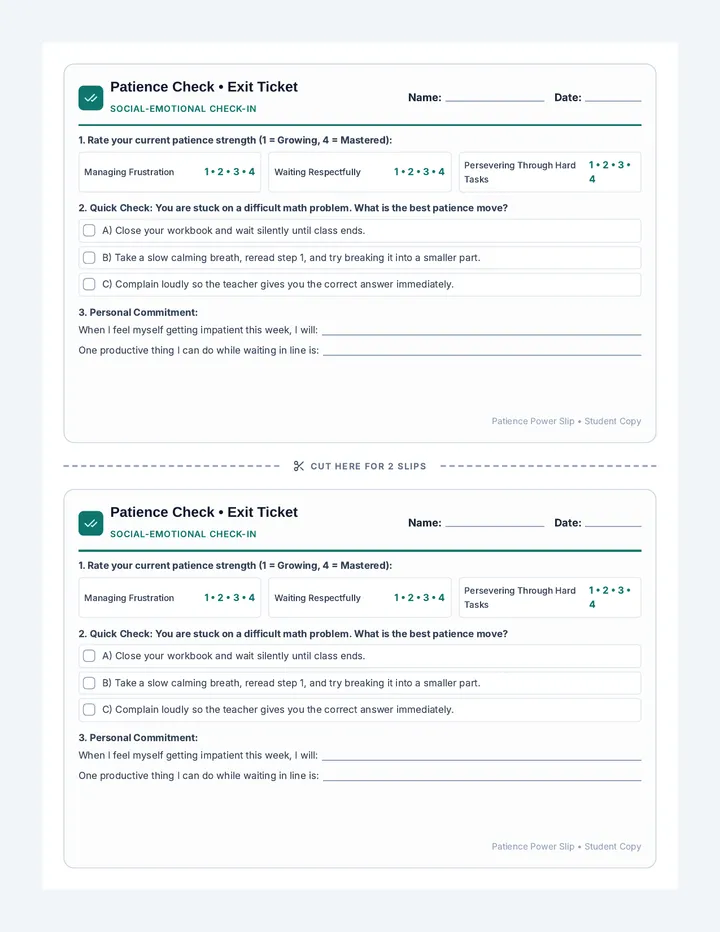
Patience Check Exit Ticket Patience Check • Exit Ticket
Social-Emotional Check-In
Name:
Date:
1. Rate your current patience strength (1 = Growing, 4 = Mastered):
Managing Frustration 1 • 2 • 3 • 4
Waiting Respectfully 1 • 2 • 3 • 4
Persevering Through Hard Tasks 1 • 2 • 3 • 4
2. Quick Check: You are stuck on a difficult math problem. What is the best patience move?
A) Close your workbook and wait silently until class ends.
B) Take a slow calming breath, reread step 1, and try breaking it into a smaller part.
C) Complain loudly so the teacher gives you the correct answer immediately.
3. Personal Commitment:
When I feel myself getting impatient this week, I will:
One productive thing I can do while waiting in line is:
Patience Power Slip • Student Copy
Cut Here For 2 Slips
Patience Check • Exit Ticket
Social-Emotional Check-In
Name:
Date:
1. Rate your current patience strength (1 = Growing, 4 = Mastered):
Managing Frustration 1 • 2 • 3 • 4
Waiting Respectfully 1 • 2 • 3 • 4
Persevering Through Hard Tasks 1 • 2 • 3 • 4
2. Quick Check: You are stuck on a difficult math problem. What is the best patience move?
A) Close your workbook and wait silently until class ends.
B) Take a slow calming breath, reread step 1, and try breaking it into a smaller part.
C) Complain loudly so the teacher gives you the correct answer immediately.
3. Personal Commitment:
When I feel myself getting impatient this week, I will:
One productive thing I can do while waiting in line is:
Patience Power Slip • Student Copy