Mindful Moment Warmup
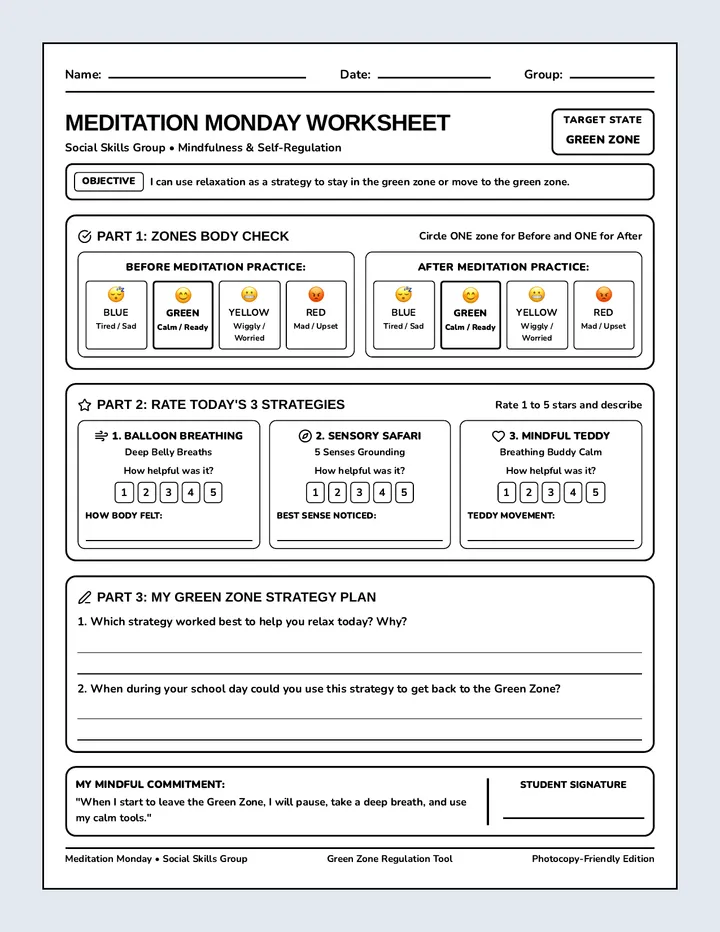
Mindful Moment
Daily Check-In Warm-up
Name: __________________________
Date: ___________________________
Objective
To gently transition into the session by encouraging participants to briefly acknowledge their current physical and emotional state without judgment.
1
Find Your Center
As we begin today, let's take a quick moment to "check in" with ourselves. This isn't about fixing anything, but simply noticing what's present. Find a comfortable posture, and if you feel safe to do so, gently close your eyes or soften your gaze.
2
Scan Inward
Bring your attention inward. Notice any sensations in your body. Are there areas of tension, or perhaps ease? Just observe. Now, gently acknowledge any emotions that might be present. You don't need to understand them or change them, just notice what's here right now. Perhaps you feel a little tired, or maybe energized, curious, or even a bit restless.
3
Identify and Share
When you're ready, you can open your eyes or refocus your gaze. In the chat, or if we're in a small group, you can briefly share one word or a short phrase that describes how you're feeling right now. There's no right or wrong answer.
My current state in one word or short phrase:
Mindful Mastery Activity Sheet
Mindful Mastery
Bridging Thought and Feeling Activity
Name: __________________________
Date: ___________________________
Introduction
Welcome to "Mindful Mastery." This exercise is designed to help you gently explore the connection between your thoughts and feelings, particularly those associated with anxiety and depression. By practicing mindfulness and cognitive reframing, you can gain a greater sense of control and cultivate more adaptive responses to challenging emotions.
1 Part 1: Noticing the Storm
Step 1: Grounding In (5 minutes)
Focus on your breath. Observe the sensation of air entering and leaving your body. Expand your awareness to sounds, sensations, and emotions. Notice them without judgment.
What physical sensations do you notice in your body right now?
What emotions are present? (e.g., curious, calm, restless, heavy, alert)
Step 2: Identifying Core Thoughts (10-15 minutes)
Identify a core thought or belief triggered by a recent situation (e.g., "I'm not good enough").
My core thought/belief is:
What emotions accompany this thought? (e.g., sadness, fear, hopelessness, worry)
2 Part 2: Unpacking the Thoughts
Step 3: Examining the Evidence (5-7 minutes)
Distinguish facts from feelings. Look at your core thought objectively.
Evidence supporting my thought:
Evidence contradicting my thought:
Step 4: Seeking Alternative Perspectives (5-7 minutes)
What might a trusted friend or therapist say about this situation?
Step 5: Reframing for Balance (5-6 minutes)
How can you reframe the original thought into one that is more realistic and helpful?
Example: from "I'm not good enough" to "I am capable, and I'm learning and growing."
My reframed, more balanced thought is:
3 Part 3: Charting Your Course
Step 6: Choosing an Action (5-7 minutes)
What is one small, achievable action you can take this week that aligns with your new balanced thought?
One small action I will take is:
Step 7: Crafting a Coping Statement (5-8 minutes)
Create a concise, empowering phrase to say to yourself when challenging thoughts arise.
Example: "I can handle this one step at a time" or "My feelings are temporary."
My personal coping statement is:
Continuing the Journey
This "Mindful Mastery" exercise is a tool you can return to whenever you feel overwhelmed. Progress isn't always linear, and self-compassion is key.
Mindful Mastery Session Script
Mindful Mastery Session Script
Professional Facilitator Guide • 45-60 Minutes
Zoom Specific Facilitation Tips
- • Encourage Camera Use: Gently invite participants to connect visually if they feel comfortable.
- • Chat Reflections: Use the chat function for quick word associations or hesitant speakers.
- • Mindful Muting: Remind participants to mute when not speaking to preserve the "quiet space."
- • Screen Fatigue: Incorporate short stretch breaks or "eye-rest" moments if needed.
Introduction (5 Minutes)
"Welcome everyone to our 'Mindful Mastery' session today. This exercise is designed to help us gently explore the connection between our thoughts and feelings, particularly those associated with anxiety and depression. Our goal is to gain a greater sense of control and cultivate more adaptive responses to challenging emotions. You'll find all the prompts in your activity sheet. Take your time with each section, allowing yourself to reflect honestly."
Part 1: Noticing the Storm (15-20 Minutes)
Step 1: Grounding In (5 Minutes)
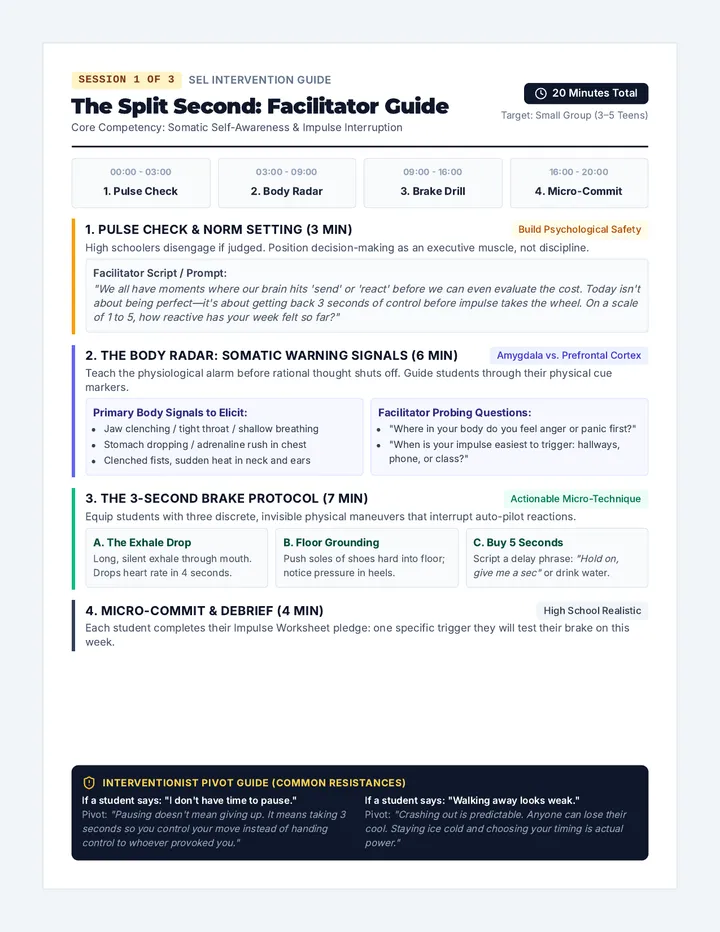
"Let's begin by grounding ourselves. Find a comfortable position, either sitting or lying down. You can gently close your eyes or soften your gaze. Now, bring your attention to your breath. Just notice the sensation of air entering and leaving your body."
"Now, expand your awareness to include any sounds you might hear, any physical sensations in your body, or any emotions that are present in this moment. Simply notice them without judgment."
[PAUSE FOR 30-60 SECONDS]
"On your activity sheet, take a moment to write down what physical sensations and emotions you notice right now."
Step 2: Identifying Core Thoughts (10-15 Minutes)
"Next, we'll move to identifying a core thought. Bring to mind a recent situation or a recurring thought that has triggered feelings of anxiety or depression for you. For example: 'I'm not good enough,' or 'Something bad is going to happen.' Write down that specific thought."
"Now, consider: What emotions accompany this core thought? Jot those down on your sheet."
Part 2: Unpacking the Thoughts (15-20 Minutes)
Step 3: Examining the Evidence (5-7 Minutes)
"Look at the core thought you identified. Consider: What objective evidence (facts, not feelings) supports this thought? And then, what objective evidence contradicts this thought? Be honest and consider all sides."
Facilitator Note: Remind them that feelings are not facts.
Step 4: Seeking Alternative Perspectives (5-7 Minutes)