Mind Traps Worksheet
CBT Explorer Series
Mind Traps Field Guide
Name:
Date:
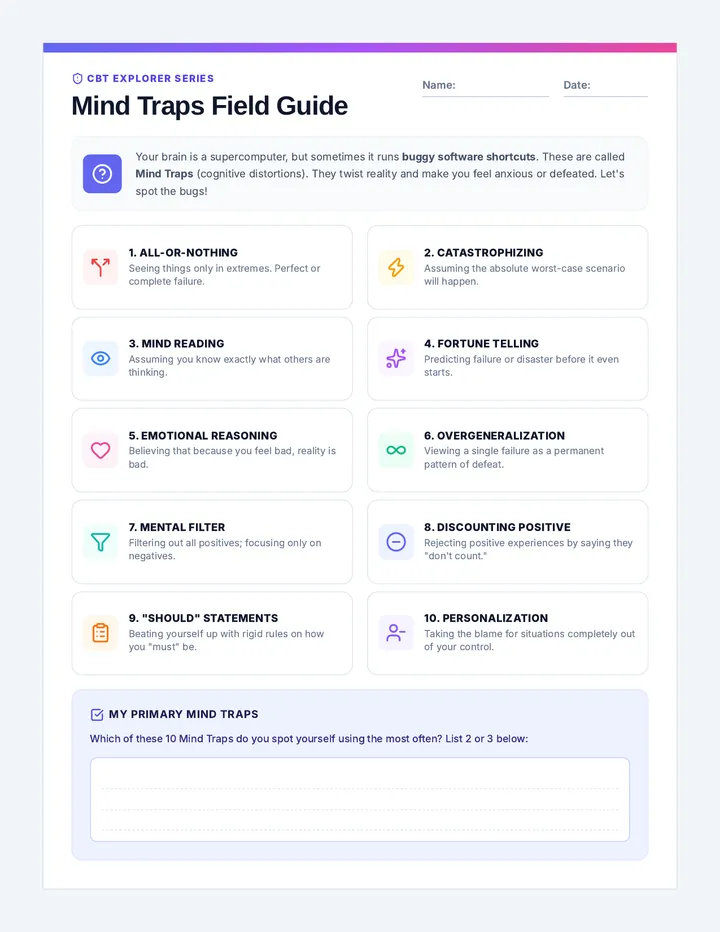
Your brain is a supercomputer, but sometimes it runs buggy software shortcuts. These are called Mind Traps (cognitive distortions). They twist reality and make you feel anxious or defeated. Let's spot the bugs!
1. All-or-Nothing
Seeing things only in extremes. Perfect or complete failure.
2. Catastrophizing
Assuming the absolute worst-case scenario will happen.
3. Mind Reading
Assuming you know exactly what others are thinking.
4. Fortune Telling
Predicting failure or disaster before it even starts.
5. Emotional Reasoning
Believing that because you feel bad, reality is bad.
6. Overgeneralization
Viewing a single failure as a permanent pattern of defeat.
7. Mental Filter
Filtering out all positives; focusing only on negatives.
8. Discounting Positive
Rejecting positive experiences by saying they "don't count."
9. "Should" Statements
Beating yourself up with rigid rules on how you "must" be.
10. Personalization
Taking the blame for situations completely out of your control.
My Primary Mind Traps
Which of these 10 Mind Traps do you spot yourself using the most often? List 2 or 3 below:
CBT Mapping Session
The CBT Loop Analyzer
Map 01
Stress starts a chain reaction: a neutral Situation occurs, which automatically triggers a distorted Thought (a Mind Trap). That thought generates your Feeling and guides your final Behavior. Let's trace it!
Think Feel Act
1
Map a Recent Event in Your Life
Situation Neutral facts only. What happened?
The Thought What did you instantly tell yourself?
Identify Mind Trap: ____________________
The Feeling Emotions & where you felt it in your body.
The Action What did you actually do in response?
Break the Loop: The thought above is just an *opinion*, not a fact. On the next page, we are going to run a full fact-check and upgrade your operating system!
CBT Restructuring Lab
The Reality Reframer
Map 02
Time to put your automatic thought from Page 2 on trial. Strip away emotional opinions and examine only real, physical Evidence.
Step 1: The Evidence Room
Real facts only, no theories!
Proof the thought is true:
Proof the thought is false:
Step 2: Cross-Examination
The Bestie Check
What would you say to a close friend who had this exact thought?
Alternative Theory
What is a completely different, logical explanation for the situation?
Step 3: Upgrading the Operating System
Replace the old bug with a balanced fact
My New, Balanced Thought:
Original Impact
Anxiety, anger, and avoidance.
Upgrade Impact
Confidence, perspective, and logic.
Mind Traps Slides
Mental Fitness Lab
CBT Core Skills
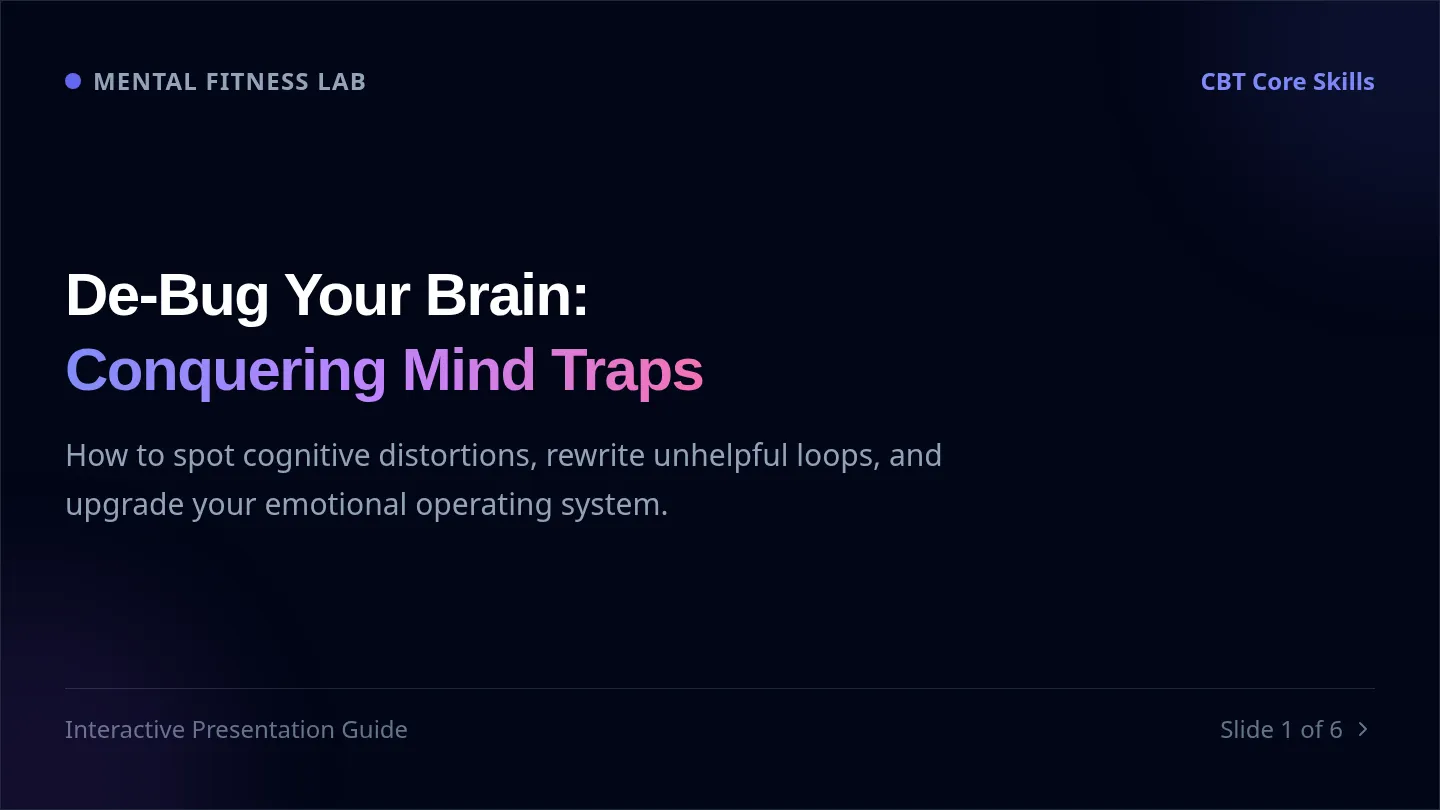
De-Bug Your Brain:
Conquering Mind Traps
How to spot cognitive distortions, rewrite unhelpful loops, and upgrade your emotional operating system.
Interactive Presentation Guide Slide 1 of 6
System Architecture
The Cognitive Loop
Your Brain's OS
CBT teaches us that Situations themselves don't make us feel bad.
Instead, it's our automatic Thoughts about the situation that generate our Feelings and drive our Behaviors.
1. Situation
The Event
2. Thought
The Story You Tell
3. Feeling
Your Emotion & Body
4. Behavior
Your Action / Response
Change your Thoughts, change your entire Experience.
Unit 1: The Basics of CBT Slide 2 of 6
Bug Alert
Cognitive Distortions
What is a "Mind Trap"?
- A thinking shortcut: Your brain's quick, automated attempt to make sense of a stressful situation.
- Always Biased: They filter out facts and focus heavily on danger, mistakes, or failures.
- Universal: Every human brain falls into these traps daily. Spotting them is half the battle!
Identify to Neutralize
Simply learning the name of a Mind Trap weakens its power over you.
Understanding Thinking Shortcuts Slide 3 of 6
Interactive Game
Spot the Bug
Can you name the Mind Trap?
Read this scenario and guess which cognitive distortion is happening:
"I missed one soccer goal in practice today. I am absolutely terrible at soccer. I'm quitting the team because I will never be good."
A) Mind Reading
B) Personalization
C) Overgeneralization
Discussion & Active Learning Slide 4 of 6
Cognitive Reconstruction
Reality Reframing
How to Rewrite the Code
We don't replace bad thoughts with "fake positive thoughts." We replace them with factual, balanced thoughts.
By examining the Evidence For and Evidence Against, we show our brain that the distortion is mathematically incorrect.