Mastering Impulse Lesson Plan Mastering Impulse
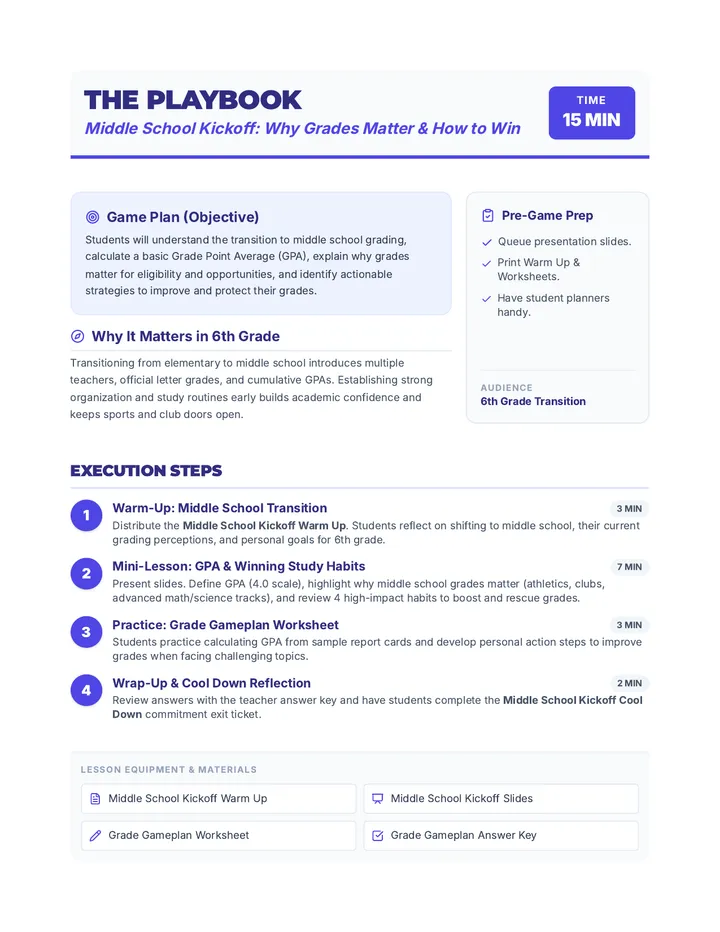
Facilitator Lesson Plan
TIER 2 GROUP
Audience
7th Grade Boys
Duration
20 Minutes
Objective
Regulate Impulses
Why This Matters
Developing impulse control is essential for well-thought-out decision-making and improved behavior in academic and social settings. For middle school boys, this "brain brake" is the difference between reaction and action.
Preparation (5 Min)
1 Review the Mastering Impulse Lesson Plan to understand the flow of activities.
2 Familiarize yourself with the Brain Brake Worksheet and game instructions.
3 Print copies of the worksheet and cut out the Pause Button Game Cards .
Lesson Timeline
03
Minutes
Intro & Objective Setting
Briefly explain the importance of impulse control. Share examples of impulsive behaviors (blurting, reacting physically) and discuss the benefits of thoughtful decision-making.
07
Minutes
Pause Button Game
Conduct the Pause Button Game to engage students. Use the scenario cards provided. Require quick responses then "freeze" to debrief the implications of their choices.
05
Minutes
Group Discussion
Facilitate a discussion on how impulse control impacts school and life. Encourage students to share personal experiences and reflections from the game.
05
Minutes
Brain Brake Worksheet
Distribute the individual worksheet. Guide students through the first example, then allow independent completion of the remaining sections.
Brain Brake Worksheet Brain Brake
Impulse Control Workshop
Name
Date
01. Understanding Impulse Control
What does impulse control mean to you? Explain in your own words.
Why is impulse control an important skill at your age? (Give 2 reasons)
02. Scenario Analysis
Scenario 1: The Blurt-Out
You're in class and suddenly feel the urge to shout out an answer without raising your hand.
What is the impulse?
Positive response?
Scenario 2: The Recess Rage
A teammate makes a major mistake during a game and you feel an impulse to shout at them.
Potential consequences?
Better way to support?
03. Reflection & Personal Strategies
Describe a time when you acted impulsively. What did you learn?
Identify 1-2 strategies to "Pause" when you feel overwhelmed or excited.
Draw or write a quick "Mission Success" story where impulse control worked.
Impulse Intel Discussion Guide Impulse Intel
Group Discussion Guide
Respect
Listen when others speak.
Perspective
Value different viewpoints.
Honesty
Share real experiences.
01 Reflect on the Game
What was the most surprising part of the game?
How did you feel when you had to quickly decide?
02 Connecting to Real Life
Can you think of a time at school or home where you felt an impulse? How did it go?
How might controlling that impulse lead to a better outcome?
03 Learning from Each Other
Did anyone see someone using effective impulse control today?
What strategy discussed today are you actually excited to try?
My Impulse Action Plan
One strategy I'll use next time I'm overwhelmed:
Managing impulses is a journey. Every pause helps you make a better decision.
Pause Button Game Kit Pause Button
Impulse Control Simulation Game
Game Setup
1. Divide the class into small groups of 3-4 students.2. Give each group a scenario card (below).3. Appoint one "Spokesperson" for each team.
How to Play
Teacher reads a scenario aloud.
Groups have 30 seconds to discuss the best "pause" response.
Spokesperson shares the choice.
Scenario Cards (Cut Out)
Card A
The Group Chat Trap
Your friend posts something in the group chat that is totally wrong and kind of annoying. Your thumbs are ready to fire back a mean joke. What's the Pause?
Card B
The Hallway Hype
You see a crowd gathered in the hall laughing at something. You want to sprint over and join in without knowing what's happening. What's the Pause?
Card C
The Blurt-Out
You have a hilarious comment about a movie the teacher just mentioned. It’s on the tip of your tongue during a quiet reading time. What's the Pause?
Card D
The Controller Kick
You're playing a game and your teammate misses an easy shot. You feel like yelling or throwing the controller. What's the Pause?
Post-Game Debrief
What did you notice during the 30-second "Think" time?
How did your group decide on the best response?
What could happen if you acted immediately?
How can these strategies help in real life?