Calm Tools Slides Social Skills Group
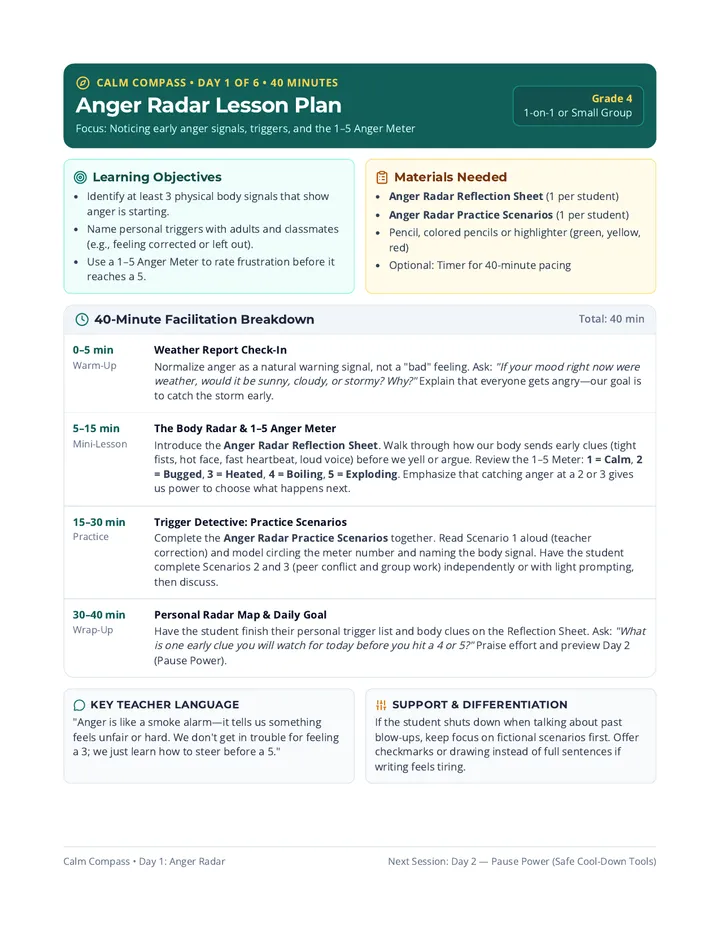
Today's Plan
Steady Storm Tamers
Learning calm tools for big, frustrating, or too-much feelings
1. Check-In
2. Body Clues
3. 4 Tools
4. Practice
5. My Plan
You can always take a break or pass on sharing.
Step 1: Check-In
All Feelings Are Okay
Everyone gets big feelings sometimes. Big feelings are not "bad"—they are signals that something feels hard, loud, or unfair.
😤
Frustrated
When something is tricky or doesn't work.
😵💫
Overwhelmed
When there is too much noise, light, or rushing.
🌋
Mad or Stuck
When plans change fast or things feel unfair.
Step 2: Body Clues
How Does Your Body Tell You?
Before a storm hits, your body gives early clues:
Fast Heart
Chest feels thumpy or speeded up.
Tight Hands
Fists clench or shoulders creep up.
Hot Face or Ears
Cheeks feel warm or prickly.
Loud Brain
Wanting to cover ears, hide, or yell.
Step 3: Calm Tools (1 & 2)
Let's Try Two Body Tools Together
1. Bubble Breaths
1. Breathe in slowly through your nose (3 sec).
2. Blow out gently like making a giant bubble (5 sec).
3. Do it 3 times!
2. Turtle Squeeze
1. Pull shoulders up & squeeze hands tight (5 sec).
2. Drop shoulders down like wet noodles.
3. Shake out your hands!
Step 3: Calm Tools (3 & 4)
Two More Tools for Your Toolkit
3. 3-2-1 Anchor
1. Spot 3 things you can see.
2. Touch 2 things (chair, shirt, table).
3. Hear 1 quiet sound.
4. Break Signal
1. Hold up a Break Card or tap the desk.
2. Say: "I need a 2-minute break."
3. Step to a quiet spot.
Step 4: Practice Time
Scenario 1: The Tower Crashed!
You spent 10 minutes building a tall block tower. Someone bumps the table, and it crashes down!
1. Body Clue?
What might your hands or face feel like?
2. Pick a Tool!
Which calm tool can you try right now?
3. Rehearse It!
Let's practice doing that tool together.
Step 4: Practice Time
Scenario 2: Too Loud, Too Much!
The room is very noisy, everyone is talking at once, and you feel like your brain is buzzing.
1. Body Clue?
What signal is your body sending you?
2. Pick a Tool!
Break Signal, 3-2-1 Anchor, or Bubble Breaths?
3. Rehearse It!
Show or say how you ask for space.
Step 5: My Calm Plan
Build Your Own Calm Plan
You are the boss of your toolkit! Next, we will fill out My Calm Plan so you know your favorite tools before a big feeling shows up.
Remember: Calm tools take practice—and every try counts!
Big Feelings Teacher Guide Social Skills Group • Ages 6–10
Steady Storm Tamers: Teacher Guide
35–40 Minutes
Group Objective
Learners will identify 1–2 personal body clues of frustration or sensory overwhelm and rehearse at least two concrete calming strategies (breathing, muscle release, sensory grounding, or requesting a break) in low-stakes role-play.
Materials Needed
• Calm Tools Slides (projected or tablet)
• Calm Strategy Cards (1 cut set per 2–3 kids)
• My Calm Plan Worksheet (1 per student)
• Optional: fidgets, noise-dampening headphones, visual timer, blocks for Scenario 1
Sensory-Friendly Setup
• Post the 5-step visual schedule where all can see it.
• Designate a clear, cozy Break Spot in the room before starting.
• Allow sitting on cushions, standing, or fidgeting—no forced eye contact.
Session Pacing & Flow
Phase
Time
Facilitator Moves & Key Points
1. Check-In
5 min
Review the 5-step schedule (Slide 1). Normalize big feelings (Slide 2). Invite a low-pressure check-in: thumbs up/sideways/down or pointing to a feeling word.
2. Body Clues
7 min
Show Slide 3. Ask: "Where do you feel a storm starting in your body?" Model your own clue (e.g., "My shoulders creep up by my ears"). Complete Part 1 of the worksheet.
3. 4 Calm Tools
10 min
Introduce Tools 1–4 (Slides 4–5) with the Calm Strategy Cards . Practice each one physically as a group for 30 seconds while calm—never wait until a meltdown to teach a tool!
4. Rehearsal
12 min
Run Slides 6–7 plus 1–2 Scenario Cards. Students pick a tool card, act out the body clue briefly, and rehearse using the tool or handing over a Break Signal.
5. My Calm Plan
6 min
Students complete Parts 2–4 of My Calm Plan Worksheet and cut/keep their Go-To Calm Card. End with a predictable goodbye routine.
Coaching Scripts & Differentiation
Facilitator Reference
Role-Play Coaching Loop (Say → Pick → Do)
1. Read & Freeze: Read the scenario card aloud. Ask: "If this happened to you, what might your body do first?" (Accept any answer, including "nothing" or "cover my ears").2. Choose a Tool: Have the learner hold up or tap one of the 4 Calm Strategy Cards . Remind them: "You don't have to like all 4 tools—just find the ones that fit your brain." 3. Rehearse Out Loud or Silently: Practice the exact motion or phrase (e.g., actually blowing 2 slow Bubble Breaths, or handing the Break Card to a partner without needing to speak).4. Praise Effort, Not Compliance: Say "I noticed you grabbed your Break Card right away—your body knew what it needed!"
Differentiation by Age & Communication Style
Younger Group (Ages 6–7)
• Use real props (actual bubbles or a pinwheel for Bubble Breaths; a toy turtle or blanket for Turtle Squeeze).
• Keep role-plays short (30 seconds) with you modeling first.
• Allow drawing or circling instead of writing on the worksheet.
Older Group (Ages 8–10)
• Discuss early vs. late clues ("When is it easiest to use a tool—at level 2 or level 5?").
• Let peers take turns being the "coach" holding the timer or cue card.
• Have them write custom situations on their worksheet.
Supporting Non-Speaking, AAC, & Shutdown Moments
When overwhelmed, speaking often becomes harder. Explicitly teach that pointing to a card, tapping the desk, or walking to the Break Spot is just as valid as saying "I need a break." Never require verbal apologies or eye contact during or right after a big feeling.
Neurodiversity-Affirming Reminders
• Sensory overload is not misbehavior: If a student covers their ears, rocks, or paces, validate that their nervous system is protecting itself.
• Stimming is a valid calm tool: Hand-flapping, rocking, or squeezing a sensory object can be added to their personal Calm Plan!
• Opt-out safety: Passing on a role-play turn is always allowed; watching a peer model still builds learning.
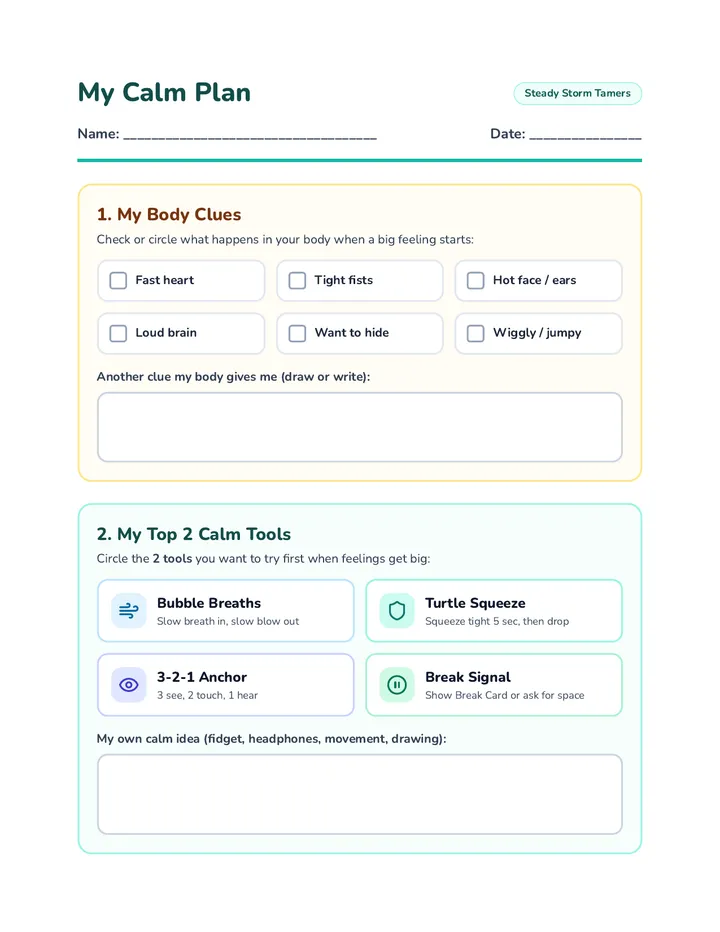
My Calm Plan Worksheet My Calm Plan
Steady Storm Tamers
Name: ____________________________________
Date: ________________
1. My Body Clues
Check or circle what happens in your body when a big feeling starts:
Fast heart
Tight fists
Hot face / ears
Loud brain
Want to hide
Wiggly / jumpy
Another clue my body gives me (draw or write):
2. My Top 2 Calm Tools
Circle the 2 tools you want to try first when feelings get big:
Bubble Breaths
Slow breath in, slow blow out
Turtle Squeeze
Squeeze tight 5 sec, then drop
3-2-1 Anchor
3 see, 2 touch, 1 hear
Break Signal
Show Break Card or ask for space
My own calm idea (fidget, headphones, movement, drawing):
3. Practice Match-Up
Draw or write which tool you would use!
A. Something I built fell down or broke.
Tool I can try:
B. The room is way too loud and busy.
Tool I can try:
C. Our schedule or game changed suddenly.
Tool I can try:
4. My Go-To Calm Card (Cut & Keep!)
When my body feels
I can try
Or I can ask for
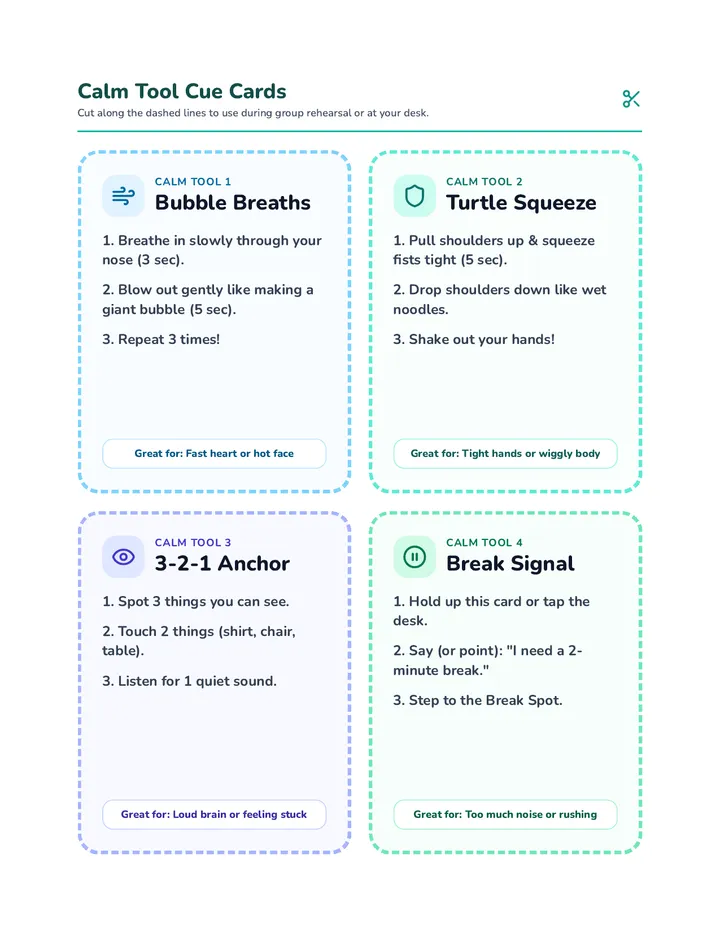
Calm Strategy Cards Calm Tool Cue Cards
Cut along the dashed lines to use during group rehearsal or at your desk.
Calm Tool 1
Bubble Breaths
1. Breathe in slowly through your nose (3 sec).
2. Blow out gently like making a giant bubble (5 sec).
3. Repeat 3 times!
Great for: Fast heart or hot face
Calm Tool 2
Turtle Squeeze
1. Pull shoulders up & squeeze fists tight (5 sec).
2. Drop shoulders down like wet noodles.
3. Shake out your hands!
Great for: Tight hands or wiggly body
Calm Tool 3
3-2-1 Anchor
1. Spot 3 things you can see.
2. Touch 2 things (shirt, chair, table).
3. Listen for 1 quiet sound.
Great for: Loud brain or feeling stuck
Calm Tool 4
Break Signal
1. Hold up this card or tap the desk.
2. Say (or point): "I need a 2-minute break."
3. Step to the Break Spot.
Great for: Too much noise or rushing
Practice Scenario Cards
Pick a card, spot the body clue, and rehearse a calm tool together.
Scenario A
The Tower Crashed!
You spent 10 minutes building a tall block tower. Someone bumps the table and it crashes down!
1. Body Clue: What happens in your body?
2. Rehearse: Show your calm tool!
Scenario B
Too Loud in Here!
Everyone is talking at once, a chair scrapes the floor, and your brain feels buzzy and overloaded.
1. Body Clue: What happens in your body?
2. Rehearse: Show or say how you get space!
Scenario C
Game Over
You really wanted to win the group game, and your piece lands on "Go Back 3 Spaces" right at the end.
1. Body Clue: What happens in your body?
2. Rehearse: Practice a tool before reacting!
Scenario D
Sudden Plan Change
You were excited for outdoor play, but it starts raining and the teacher says you have to stay inside.
1. Body Clue: What happens in your body?
2. Rehearse: Pick a tool to help reset!