"Professionalism isn't about wearing a suit; it's about signaling that you are ready for the challenge. Today, we are going to master that signal."
Facilitation: The "Mirroring" Drill
DO:
Ask students to find a partner. Give them 30 seconds to 'introduce' themselves without using words. They must use only body language and a handshake.
SAY:
"Now, look at your partner. Based on that handshake and their posture, would you hire them for a high-stakes leadership role? Why or why not?"
Instructor Pro-Tip: The Handshake
Demonstrate the "Web-to-Web" contact. Explain that a handshake is a transfer of energy. If it's too limp (the "Wet Fish"), it signals a lack of confidence. If it's too aggressive (the "Bone Crusher"), it signals a lack of awareness. Aim for the "Neutral-Firm."
Part 2: Digital Handshakes
20 MINS
Topic: The Digital Footprint
SAY: "In 2026, your interview starts on Google and LinkedIn before you ever receive the invite. 70% of employers research candidates online. Your digital presence is either a hurdle or a ladder."
DIRECTION: Walk through the checklist on Slide 5. Emphasize that 'Private' doesn't always mean invisible. Professionalism online is about curation, not just concealment.
Email Etiquette Drill
"Treatment of email is the modern barometer for detail-orientation."
"Dear [Name], I am writing to request a shift in our scheduled interview..."
Common Pitfall: The "Texting" Trap
Remind students that email is formal communication. No emojis, no shorthand (lol, thx), and always use a formal salutation. Advise them to wait 10 minutes before hitting 'Send' on any important communication to proofread for tone.
Part 2: Ethics & Scenarios
10 MINS (DISCUSSION)
Facilitation Direction
Have students open their Workbooks to Page 2. Give them 5 minutes to write their answers for Scenarios A, B, and C. Then, lead a whole-class debrief using the points below.
Scenario A: The "Reply-All" Crisis
Focus: Integrity & Crisis Management.
Discussion Point: A professional doesn't hide. They own the mistake immediately. Explain that an apology email often isn't enough; a phone call shows the level of respect required for such a significant error.
Scenario B: Public Feedback
Focus: Emotional Intelligence (EQ).
Discussion Point: Professionalism is about poise. If you get angry, you "lose." The professional move is to de-escalate the public moment and transition to a private, constructive one. This signals that you care more about the project's success than your ego.
Scenario C: The Punctuality Lapse
Focus: Transparency & Respect for Time.
Discussion Point: Being 8 minutes late is a failure of planning, but lying about it is a failure of character. Give the most accurate ETA possible. Never say "I'm right around the corner" if you are still 10 minutes away.
Key Takeaway for Students
"You are not your mistakes; you are how you handle them. Professionalism is the shield that protects your career during moments of human error."
Part 3: Behavioral Interviewing
25 MINS
SAY: Why STAR?
"Interviewer brains love structure. If you ramble, they stop listening. If you use STAR, you are handing them exactly what they need to write down on their evaluation sheet. You are doing the work for them."
S: SITUATION
The "Who, what, where." Keep this to 10% of the answer. Don't get stuck in the backstory.
T: TASK
The specific problem you were solving. Clear and concise.
A: ACTION
THE GOLD. 70% of the answer. What did YOU do? What was your thought process?
R: RESULT
The ending. Use numbers if possible (e.g., 'saved $500', 'increased efficiency by 20%').
Facilitation: Guided Drafting
DO: Direct students to Workbook Page 3. Use the prompt: "Tell me about a time you handled a difficult situation."
SAY: "I'm going to give you exactly 6 minutes to draft your story. Focus on the ACTION. I want to see specific verbs like negotiated, organized, implemented, resolved."
Common Pitfall: The "WE" Trap
Students often say "We fixed the issue..." because they want to sound like team players. Remind them: The company isn't hiring your team; they are hiring YOU. They need to hear "I decided to...", "I coordinated...", "I took the initiative..."
Part 4 & 5: Mock Interview Lab
30 MINS
Lab Structure: The Triad Rotation
Group students into 3s. Each round lasts 7 minutes (5 mins interview + 2 mins feedback).
Interviewer
Asks questions from the common list. Takes notes on professionalism markers.
Interviewee
Practices STAR method. Maintains eye contact and professional posture.
Observer
Uses the rubric to provide constructive, honest feedback after the round.
Instructor's Role During the Lab
1
Circulate & Listen: Don't just sit. Walk the room. Listen for the quality of the 'Action' statements in the STAR responses.
2
Correct Body Language: Subtly signal to students who are slouching or crossing their arms. Real-time feedback is most effective here.
3
Manage Time: Use a loud buzzer or bell to signal role swaps. Keep the energy moving; don't let rounds drag on.
The "Ask" Drill
In the final 2 minutes of the Interviewer's time, ensure the Interviewee practices asking their 2 prepared questions. It's not a real interview until they ask back.
Post-Lesson Debrief
SAY: Final Reflection
"Look back at your Workbook Cover. Look at those baseline confidence scores. Do you feel more prepared now? Professionalism isn't a final destination—it's a practice. It's the small choices you make every day that build your brand."
Extension Activity
The Thank You Note: Assign a homework task: Write a mock follow-up email to the person who interviewed them today. This must be sent/turned in within 24 hours to simulate real-world urgency.
Evaluation Criteria
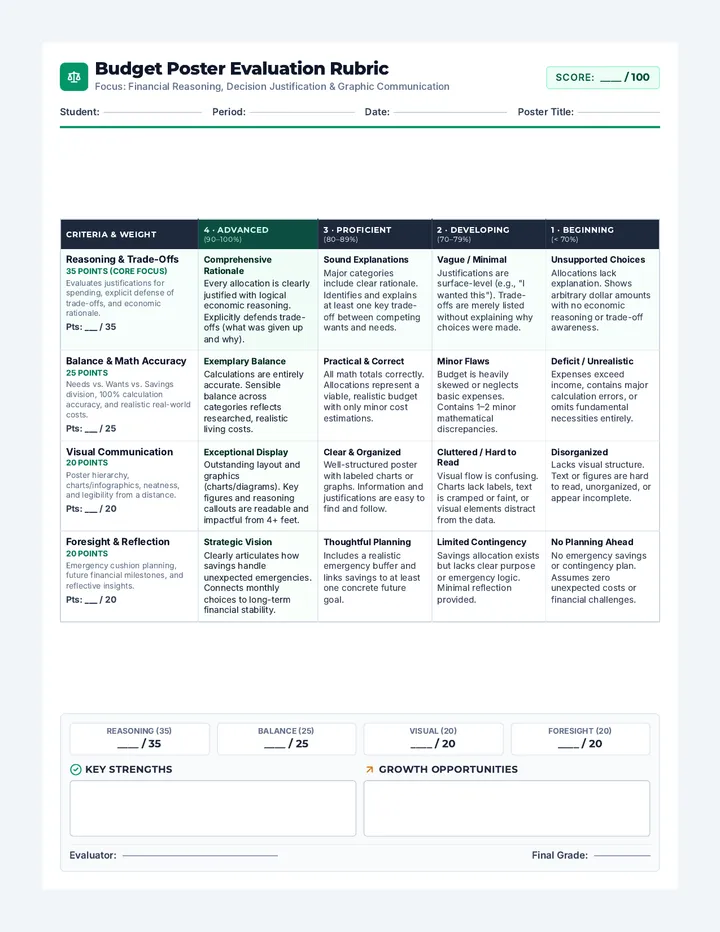
Use the Performance Rubric on Slide 8 to grade students if this is for credit. Focus primarily on their improvement from the baseline and their participation in the Triad rounds.
Final Instructor Note
The goal of this Masterclass is to replace fear with a process. When a student knows exactly what to do in the first 7 seconds, how to structure their stories, and how to handle digital communications, their anxiety drops and their authentic self shines through.