Independence Quest Slides 2ND & 3RD GRADE QUEST
Self-Advocacy & Daily Routines
Independence Quest
Level up your daily routines, use your voice to ask for help, and make smart choices!
Ready to be a Problem-Solving Pro?
Daily Routines
Asking for Help
Smart Choices
What Is Independence?
Doing What You Can
Trying your best on your own first—like packing your backpack, starting your work, and following routines.
Knowing When to Ask
Independence does NOT mean doing everything alone! Smart learners speak up when they are truly stuck.
Key Idea: Independent kids try first, use tools, and use their voice!
Superpower #1: Daily Routines
Step-by-Step Habits
Morning
Get dressed
Brush teeth
Pack folder & snack
Classroom
Put folder away
Check the board
Gather pencils
Bedtime
Put toys away
Set out clothes
Read & rest
Tip: A checklist helps your brain remember what comes next without needing reminders!
Stuck? Try Before You Ask!
Before raising your hand, check these 3 problem-solving tools:
1
Use Your Brain
Re-read the directions slowly. Look at the example on your paper.
2
Check Tools
Look at anchor charts, the whiteboard, or your desk checklist.
3
Ask a Buddy
Whisper to a table partner: "What step are we on?"
Still stuck after 1, 2, and 3? Now it is time to use Self-Advocacy!
Superpower #2: Self-Advocacy
Self-Advocacy means speaking up for what you need in a clear, kind way.
Not Helpful
"I can't do this! This is too hard!"
(Sitting quietly and doing nothing)
Self-Advocacy!
"I tried #1, and I am stuck on how to start #2. Can you show me?"
Your voice helps teachers and family know exactly how to support you!
The 3-Step Help Script
1
Say what you tried
"I already read the directions and checked the board..."
2
Name the sticky spot
"...but I don't understand what this word means..."
3
Ask clearly & kindly
"...Could you please explain it one more time?"
Works at school AND at home!
Making Smart Choices
When you have a choice to make, use Pause, Pick, Proceed:
Pause
Stop and take one calm breath before acting.
Pick
Ask: "Is this choice safe, kind, and helpful for my learning?"
Proceed
Do your smart choice and feel proud of yourself!
Example: Choosing a quiet spot to read instead of sitting next to a noisy distraction.
Let's Practice Together!
Scenario 1: Classroom
You forgot your pencil, and the class is starting independent writing.
What routine or self-advocacy step can you use?
Scenario 2: Home
It is bedtime, and you still have to pack your backpack for tomorrow.
How can you handle this without waiting for a reminder?
Turn & Talk with a partner: Share your smart choice!
Independence Quest Teacher Guide Teacher Facilitation Guide
Independence Quest
Grades: 2nd & 3rd
Time: 45 Minutes
Focus: Routines & Self-Advocacy
Learning Objectives
Follow multi-step morning and classroom routines using visual checklists.
Apply the Try Before You Ask strategy before requesting teacher help.
Use a 3-step self-advocacy script to explain needs clearly and kindly.
Materials Needed
Independence Quest Slides (projected)Voice and Choice Activity (1 per student)Home Hero Routine Pack (1 per student)Pencils, clipboards (optional), visual schedule
45-Minute Pacing Guide
Time
Segment
Teacher Actions & Key Talking Points
0–5 min
Warm-Up
Slides 1–2
Ask: "What is something you used to need help with in 1st grade that you can do by yourself now?" Define independence as trying what you can AND knowing when to speak up.
5–17 min
Direct Instruction
Slides 3–7
Walk through Daily Routines (Morning, Classroom, Bedtime), Try Before You Ask (Brain, Tools, Buddy), the 3-Step Help Script , and Pause, Pick, Proceed for smart choices.
17–27 min
Guided Practice
Slide 8
Use Slide 8 scenarios for Turn & Talk. Invite 2–3 pairs to role-play the 3-Step Help Script aloud. Reinforce calm tone and naming the exact "sticky spot."
27–40 min
Student Activity
Worksheet
Distribute Voice and Choice Activity . Circulate to coach students on writing specific help-asking sentences rather than generic phrases like "I need help."
40–45 min
Wrap-Up & Home
Take-Home Pack
Hand out the Home Hero Routine Pack . Preview the weekly tracker and challenge students to complete one evening routine step before bedtime without reminders.
Teacher Mindset: When a student asks for help too quickly, gently prompt: "Which of your 3 tools did you try first?"
Guided Role-Play Prompts (Slide 8 Extension)
Scenario A: Stuck on Math
Prompt: "You are on problem #3 and don't know what to do next."
Model Response: "I re-read the directions and checked the example, but I'm stuck on how to regroup the tens. Can you show me the first step?"
Scenario B: Sensory or Focus Need
Prompt: "The room feels too loud while you are trying to read."
Model Response: "I'm having trouble focusing because of the noise. May I use noise-reducing headphones or move to the quiet corner?"
Differentiation & Support Strategies
Emerging Readers & Multilingual Learners: Pair the 3-Step Help Script with visual cue cards (Eye = Read, Book = Check Tools, Speech Bubble = Ask ). Allow students to rehearse their sentence with a partner before writing it on the worksheet.
Executive Function / ADHD Support: Tape a mini 3-step desk checklist (Morning Arrival, Work Time, Pack-Up) to the student's desk so they can physically check off steps with a dry-erase marker.
Extension for Ready Learners: Have students design a "Classroom Helper" mini-poster illustrating one smart choice or routine tip for younger 1st-grade buddies.
Quick Observation & Follow-Up Notes
Student checks posted routine/directions before asking for adult help.
Student names the specific problem ("sticky spot") when asking a question.
Student makes an appropriate, safe choice during transitions or independent work.
Next-Day Follow-Up: Spend 2 minutes during morning meeting celebrating 2–3 students who used their morning routine checklist or the 3-Step Help Script independently.
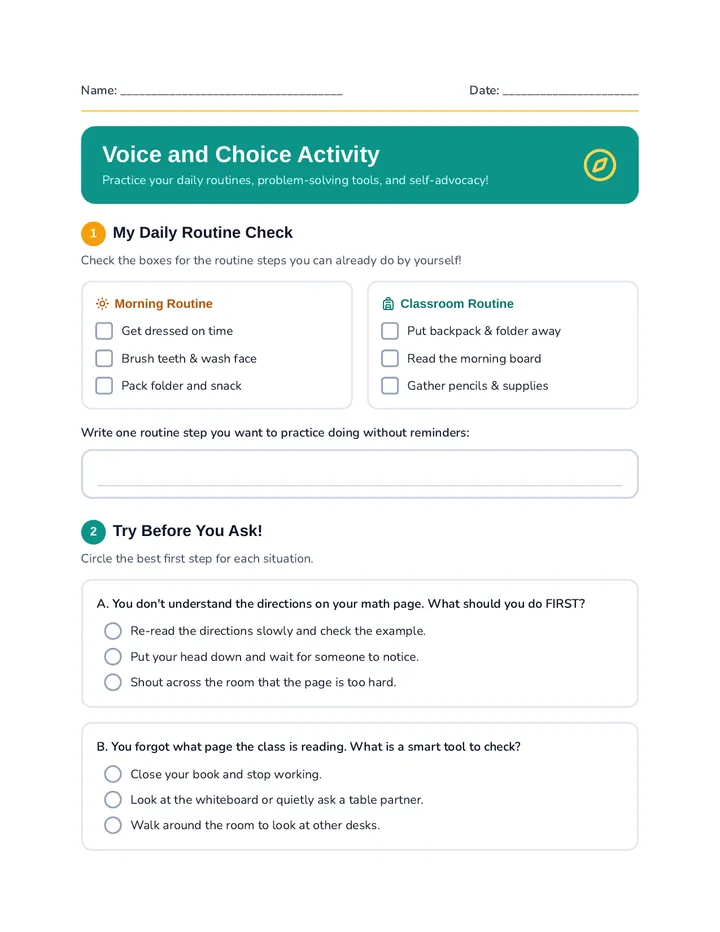
Voice and Choice Activity Name: ____________________________________
Date: ______________________
Voice and Choice Activity
Practice your daily routines, problem-solving tools, and self-advocacy!
1 My Daily Routine Check
Check the boxes for the routine steps you can already do by yourself!
Morning Routine
Get dressed on time Brush teeth & wash face Pack folder and snack
Classroom Routine
Put backpack & folder away Read the morning board Gather pencils & supplies
Write one routine step you want to practice doing without reminders:
2 Try Before You Ask!
Circle the best first step for each situation.
A. You don't understand the directions on your math page. What should you do FIRST?
Re-read the directions slowly and check the example.
Put your head down and wait for someone to notice.
Shout across the room that the page is too hard.
B. You forgot what page the class is reading. What is a smart tool to check?
Close your book and stop working.
Look at the whiteboard or quietly ask a table partner.
Walk around the room to look at other desks.
3 My 3-Step Self-Advocacy Script
Remember the 3 steps: 1. Say what you tried → 2. Name the sticky spot → 3. Ask clearly & kindly .
Scenario 1: Stuck on an Assignment
You already re-read the story, but you still don't know what the word "cautious" means. Write what you can say to your teacher:
Scenario 2: Explaining a Need
The classroom is a little loud and you need headphones or a quieter spot to finish your writing. Write what you can say:
4 Pause, Pick, Proceed: My Smart Choice
Draw or write one smart choice you can make today at school or at home to be more independent:
Home Hero Routine Pack Take-Home Family Resource
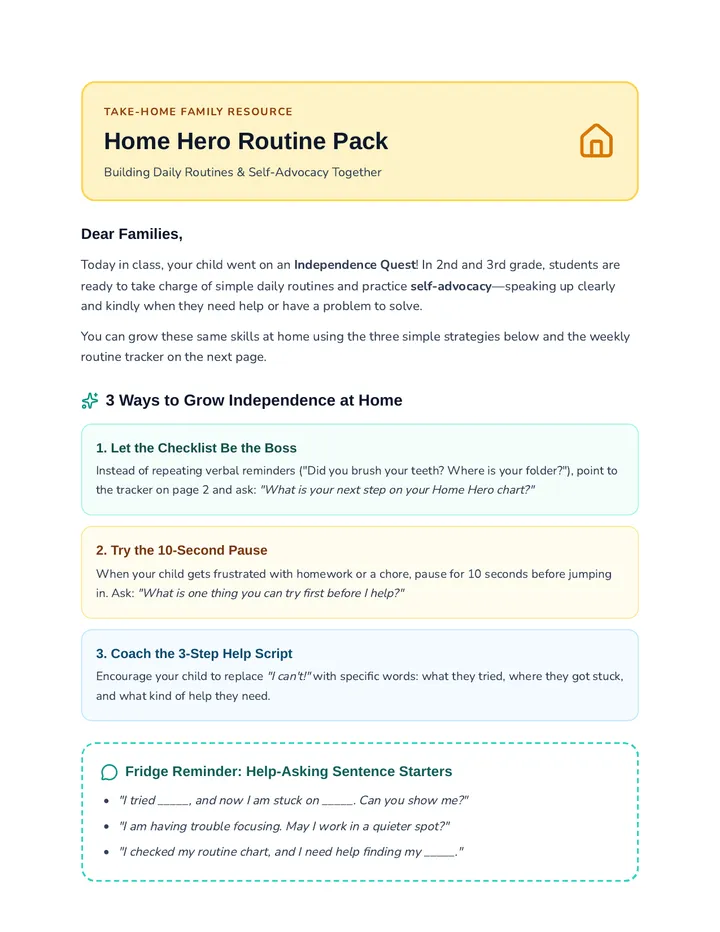
Home Hero Routine Pack
Building Daily Routines & Self-Advocacy Together
Dear Families,
Today in class, your child went on an Independence Quest ! In 2nd and 3rd grade, students are ready to take charge of simple daily routines and practice self-advocacy —speaking up clearly and kindly when they need help or have a problem to solve.
You can grow these same skills at home using the three simple strategies below and the weekly routine tracker on the next page.
3 Ways to Grow Independence at Home
1. Let the Checklist Be the Boss
Instead of repeating verbal reminders ("Did you brush your teeth? Where is your folder?"), point to the tracker on page 2 and ask: "What is your next step on your Home Hero chart?"
2. Try the 10-Second Pause
When your child gets frustrated with homework or a chore, pause for 10 seconds before jumping in. Ask: "What is one thing you can try first before I help?"
3. Coach the 3-Step Help Script
Encourage your child to replace "I can't!" with specific words: what they tried, where they got stuck, and what kind of help they need.
Fridge Reminder: Help-Asking Sentence Starters
"I tried _____, and now I am stuck on _____. Can you show me?" "I am having trouble focusing. May I work in a quieter spot?" "I checked my routine chart, and I need help finding my _____."
Home Hero: __________________________________
Week of: ___________________
My Weekly Routine Tracker
Draw a star or checkmark each day you finish a routine on your own!
Daily Routine
Mon
Tue
Wed
Thu
Fri
Morning Power-Up
Get dressed, brush teeth, eat breakfast, grab backpack.
| | | | | |
|
After-School Reset
Unpack folder, hang up coat, start homework or reading.
| | | | | |
|
Bedtime Ready
Put toys away, set out clothes, brush teeth, read & rest.
| | | | | |
|
Self-Advocacy Win
Used calm words to ask for help or explain what I needed.
| | | | | |
My Proud Independence Moment This Week:
Celebrate progress, not perfection—every independent step counts!