Fraud Files Lesson Plan High School Personal Finance • Teacher Guide
Identity Theft Defense: Lesson Plan
Duration
55 Min
Learning Objectives
Spot Warning Signs: Identify phishing, urgency traps, and suspicious requests for personal data.
Protect Data: Apply daily digital and physical habits that reduce identity theft risk.
Respond Rapidly: Sequence and apply the 4-step recovery protocol when data is compromised.
Lesson Bundle Checklist
Identity Defense Slides (projection)
Scam Spotter Worksheet (1 per student)
Case File Scenarios (1 set per group of 3–4)
Fraud Files Answer Key (teacher reference)
Warm-Up Hook: "The $400 Sneaker Text" (5 Min)
Display Slide 2 as students enter. Read the simulated text message aloud: "ALERT: A $412.80 charge at SoleVault Sneakers was just attempted on your debit card. Reply YES or click bit.ly/verify-card-now within 10 minutes to cancel."
Ask the class: "By show of hands, who clicks the link right away? Who replies? What feels off here?" Let 2–3 students share before revealing the three classic traps: manufactured urgency, shortened/spoofed URL, and prompting an immediate action instead of checking the official bank app.
55-Minute Pacing Guide
Time
Phase
Teacher & Student Actions
0–5 min
Hook: Sneaker Text
Project Slide 2. Poll students on their gut reaction; unpack urgency and fake links.
5–18 min
Mini-Lesson: 3 Pillars
Walk through Slides 3–6: Spot (Red Flags), Protect (Data Habits), Respond (4-Step Protocol).
18–32 min
Scam Spotter Practice
Students complete Parts 1–3 of the Scam Spotter Worksheet individually or in pairs.
32–48 min
Case File Investigation
Teams of 3–4 analyze 1–2 Case File Scenarios, diagnose the breach, and build a response plan.
48–55 min
Debrief & Exit Pledge
Groups share 1 key takeaway. Use Slide 7 for each student to commit to one data-protection habit.
Facilitation & Differentiation Guide
Page 2 • Teacher Notes
Common Teen Misconceptions
"I have no money, so thieves don't want my info." Explain that clean credit files and unused SSNs are prime targets for synthetic identity fraud.
"Debit cards protect me the same as credit cards." Clarify that debit fraud drains actual checking cash immediately, while credit cards offer stronger zero-liability buffers.
"If it's from a friend's account, it's safe." Compromised social accounts are frequently used to push Cash App/Venmo and gift card scams.
High-Impact Discussion Prompts
"Why do scammers almost always include a countdown timer or threat like 'account suspended in 2 hours'?"
"Which piece of personal data—your password, your debit PIN, or your Social Security Number—is hardest to replace if stolen? Why?"
"What is the difference between a fraud alert and a credit freeze, and why is a freeze free and reversible?"
Running the Case File Investigation (16 Min)
Divide students into investigative squads of 3–4. Assign each squad 1 primary case (Cases A–D) and 1 backup case if they finish early.
Assign rotating roles within each squad: Lead Detective (reads case aloud), Red-Flag Analyst (highlights clues), and Response Coordinator (maps the recovery steps).
Circulate and challenge groups with: "What is the very first phone call or website you should use in the first 30 minutes?"
Have one group per case deliver a 45-second "Case Briefing" to the class before wrapping up.
Differentiation & Extensions
Scaffolded Support
Provide a "Red-Flag Word Bank" (urgency, spoofed domain, unsolicited link, SSN request) and pre-highlight the first clue on Case A.
Extension Challenge
Have early finishers draft a 30-second TikTok-style PSA script warning peers about one scam tactic from today's lesson.
Real-World Take-Home
Encourage students to turn on 2-Factor Authentication (2FA) on their primary email and banking apps tonight.
Closure Check: The 1-Habit Pledge
Before leaving, each student names one concrete security upgrade they will make this week (e.g., unique password manager, 2FA, or never clicking bank links in texts).
Identity Defense Slides Personal Finance • Fraud Files
Identity Theft Defense
How to spot sneaky scams, lock down your personal data, and respond fast if your information is compromised.
1. Spot Warning Signs 2. Protect Your Data 3. Respond Rapidly
Case Warm-Up • Gut Check
You Just Got This Text. What Do You Do?
"ALERT: A $412.80 charge at SoleVault Sneakers was just attempted on your debit card. Reply YES or tap bit.ly/verify-card-now within 10 minutes to cancel."
A. Tap the link immediately
B. Reply "NO" to block it
C. Open your official bank app
Pillar 1 • Awareness
Why Teens Are Prime Targets
Clean Credit Files
Most teens rarely check their credit reports. Thieves can use a stolen Social Security Number for years before anyone notices.
What Thieves Want Most
Social Security Numbers (SSNs)
Debit/credit card numbers & PINs
Bank & payment app logins
Full name + date of birth + address
Pillar 1 • Spot Warning Signs
4 Red Flags of a Scam
1. Fake Urgency
"Act within 10 minutes or your account will be closed!"
2. Sketchy Links & Senders
Misspelled domains (paypa1.com) or shortened bit.ly links.
3. Requests for Sensitive Info
Real banks never text or call asking for your PIN, password, or SSN.
4. Too Good To Be True
Free scholarships, surprise prizes, or instant cash that require a fee first.
Pillar 2 • Prevention
Lock Down Your Data: Daily Habits
Online Defense
Use unique passwords (passphrases) for every account
Turn on 2-Factor Authentication (2FA) everywhere
Avoid banking or shopping on public Wi-Fi
Offline Defense
Never carry your Social Security card in your wallet
Shield the keypad when entering your PIN
Shred mail with account numbers or pre-approved offers
Pillar 3 • Rapid Response
If Your Info Is Stolen: The 4-Step Protocol
01
Lock & Call
Freeze your card in the app and call the number on the back of your card.
02
Change Logins
Reset passwords on compromised and linked accounts; enable 2FA.
03
Freeze Credit
Place a free credit freeze at Equifax, Experian, and TransUnion.
04
Report It
File an official recovery plan at IdentityTheft.gov and save documentation.
Your Fraud Investigator Mission
Complete your Scam Spotter Worksheet, then team up to crack your Case File Scenarios.
Before you leave: Name one security habit you will upgrade tonight.
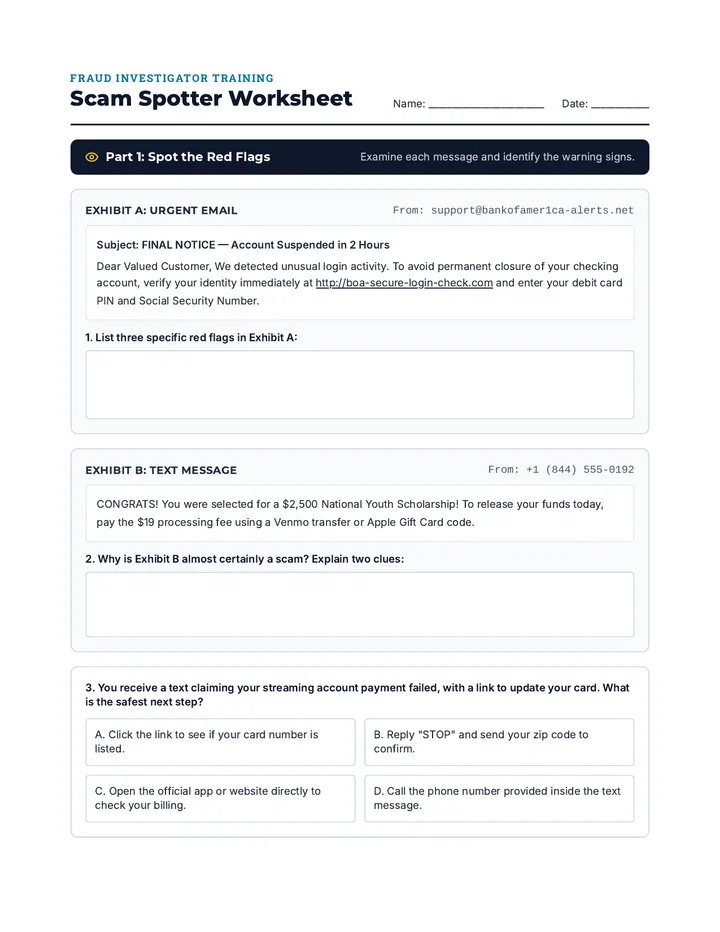
Scam Spotter Worksheet Fraud Investigator Training
Scam Spotter Worksheet
Name: ________________________ Date: ____________
Part 1: Spot the Red Flags
Examine each message and identify the warning signs.
Exhibit A: Urgent Email From: support@bankofamer1ca-alerts.net
Subject: FINAL NOTICE — Account Suspended in 2 Hours
Dear Valued Customer, We detected unusual login activity. To avoid permanent closure of your checking account, verify your identity immediately at http://boa-secure-login-check.com and enter your debit card PIN and Social Security Number.
1. List three specific red flags in Exhibit A:
Exhibit B: Text Message From: +1 (844) 555-0192
CONGRATS! You were selected for a $2,500 National Youth Scholarship! To release your funds today, pay the $19 processing fee using a Venmo transfer or Apple Gift Card code.
2. Why is Exhibit B almost certainly a scam? Explain two clues:
3. You receive a text claiming your streaming account payment failed, with a link to update your card. What is the safest next step?
A. Click the link to see if your card number is listed.
B. Reply "STOP" and send your zip code to confirm.
C. Open the official app or website directly to check your billing.
D. Call the phone number provided inside the text message.
Part 2: Protect Your Personal Data
Rate your current habits and plan an upgrade.
For each risky habit below, write a specific protective habit that reduces identity theft risk.
Risky Habit
Safer Protective Habit (Write Your Upgrade)
Using the same 8-character password for school email, banking, and social media.
Logging into a bank account while connected to free coffee shop Wi-Fi.
Keeping your Social Security card in your everyday wallet.
Tossing unopened pre-approved credit card offers straight into the trash.
Part 3: Rapid Response Drill
Know what to do in the first 24 hours.
4. Number the four response steps in logical order (1 = First, 4 = Last) if someone steals your debit card and SSN:
Place a free credit freeze with Equifax, Experian, and TransUnion.
File an official recovery report at IdentityTheft.gov and save your plan.
Lock or freeze your debit card immediately and call your bank's fraud line.
Change passwords on your banking and email accounts and turn on 2FA.
5. Explain why placing a credit freeze is especially important for a high school student whose SSN was leaked:
Case File Scenarios Squad Investigation • Evidence Packet
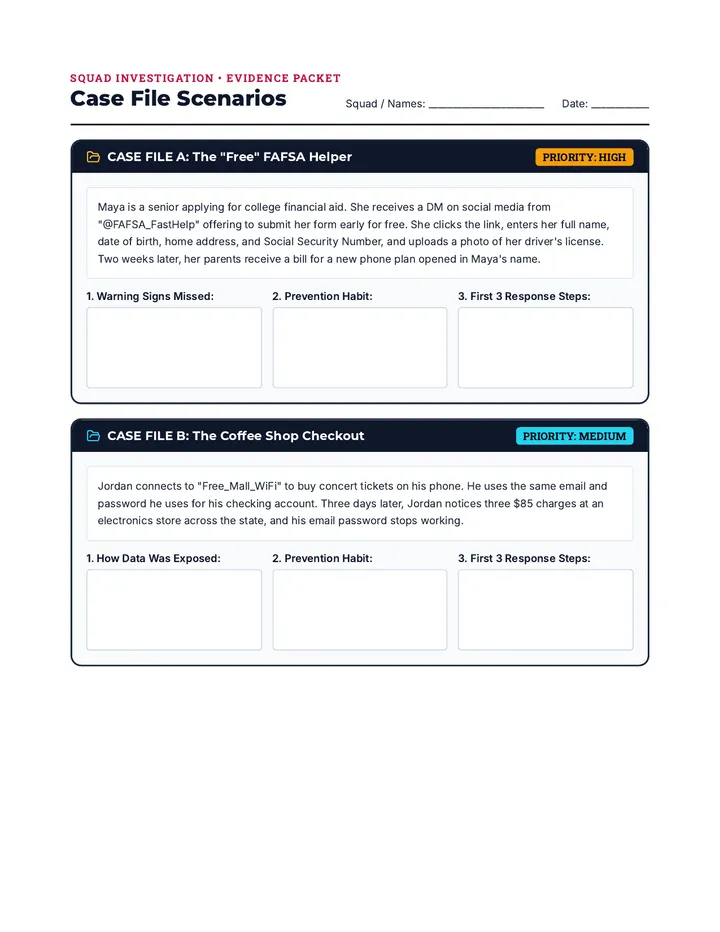
Case File Scenarios
Squad / Names: ________________________ Date: ____________
CASE FILE A: The "Free" FAFSA Helper PRIORITY: HIGH
Maya is a senior applying for college financial aid. She receives a DM on social media from "@FAFSA_FastHelp" offering to submit her form early for free. She clicks the link, enters her full name, date of birth, home address, and Social Security Number, and uploads a photo of her driver's license. Two weeks later, her parents receive a bill for a new phone plan opened in Maya's name.
1. Warning Signs Missed:
2. Prevention Habit:
3. First 3 Response Steps:
CASE FILE B: The Coffee Shop Checkout PRIORITY: MEDIUM
Jordan connects to "Free_Mall_WiFi" to buy concert tickets on his phone. He uses the same email and password he uses for his checking account. Three days later, Jordan notices three $85 charges at an electronics store across the state, and his email password stops working.
1. How Data Was Exposed:
2. Prevention Habit:
3. First 3 Response Steps:
Case File Scenarios (Continued)
Page 2 • Squad Investigation
CASE FILE C: The Hacked Friend DM PRIORITY: HIGH
Devon gets a message from his close friend's Instagram account: "Yo my phone broke and I'm locked out of my bank, can you send me $120 on Cash App and I'll pay you back $150 tonight? Also send me the 6-digit code that just texted to you so I can verify my account." Devon sends the $120 and texts back the 6-digit code.
1. What the 6-Digit Code Is:
2. Prevention Habit:
3. First 3 Response Steps:
CASE FILE D: The Missing Locker Wallet PRIORITY: HIGH
After track practice, Priya realizes her wallet is missing from her unlocked gym bag. Inside were her school ID, her debit card, a sticky note with her PIN written on it, and her paper Social Security card that she brought earlier that week for a part-time job application.
1. Risky Habits Exposed:
2. Prevention Habit:
3. First 3 Response Steps:
Squad Briefing Summary: What is the #1 rule your team learned from these cases?
Fraud Files Answer Key Teacher Reference • Confidential
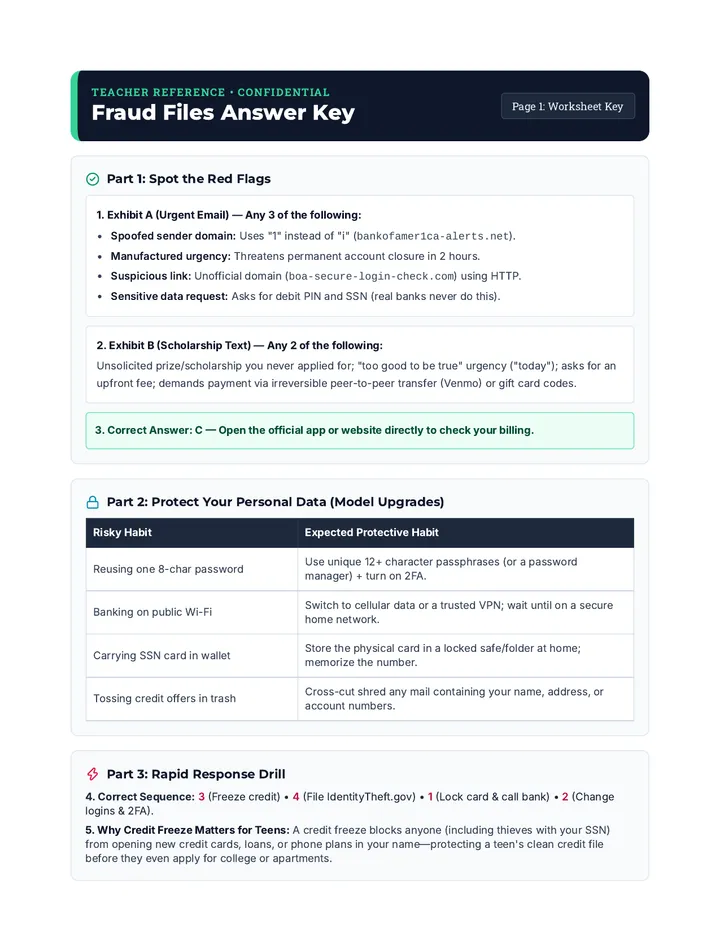
Fraud Files Answer Key
Page 1: Worksheet Key
Part 1: Spot the Red Flags
1. Exhibit A (Urgent Email) — Any 3 of the following:
Spoofed sender domain: Uses "1" instead of "i" (bankofamer1ca-alerts.net).
Manufactured urgency: Threatens permanent account closure in 2 hours.
Suspicious link: Unofficial domain (boa-secure-login-check.com) using HTTP.
Sensitive data request: Asks for debit PIN and SSN (real banks never do this).
2. Exhibit B (Scholarship Text) — Any 2 of the following:
Unsolicited prize/scholarship you never applied for; "too good to be true" urgency ("today"); asks for an upfront fee; demands payment via irreversible peer-to-peer transfer (Venmo) or gift card codes.
3. Correct Answer: C — Open the official app or website directly to check your billing.
Part 2: Protect Your Personal Data (Model Upgrades)
Risky Habit
Expected Protective Habit
Reusing one 8-char password
Use unique 12+ character passphrases (or a password manager) + turn on 2FA.
Banking on public Wi-Fi
Switch to cellular data or a trusted VPN; wait until on a secure home network.
Carrying SSN card in wallet
Store the physical card in a locked safe/folder at home; memorize the number.
Tossing credit offers in trash
Cross-cut shred any mail containing your name, address, or account numbers.
Part 3: Rapid Response Drill
4. Correct Sequence: 3 (Freeze credit) • 4 (File IdentityTheft.gov) • 1 (Lock card & call bank) • 2 (Change logins & 2FA).
5. Why Credit Freeze Matters for Teens: A credit freeze blocks anyone (including thieves with your SSN) from opening new credit cards, loans, or phone plans in your name—protecting a teen's clean credit file before they even apply for college or apartments.
Case File Scenarios Key & Rubric
Page 2 • Teacher Key
Case File
Diagnosis & Red Flags
Prevention Habit
Priority Response Steps
Case A:
"Free" FAFSA Helper
Unsolicited social media DM; official FAFSA is only at studentaid.gov; asked for SSN & ID photo.
Only enter SSN on verified .gov sites; never share ID photos via DM links.
1) Dispute fraudulent phone account. 2) Freeze credit at all 3 bureaus. 3) File at IdentityTheft.gov.
Case B:
Coffee Shop Checkout
Unencrypted public Wi-Fi interception + password reuse across email and bank.
Use cellular data for purchases; use unique passwords + 2FA on email & banking.
1) Lock card & report $85 charges to bank. 2) Recover/reset email & bank passwords. 3) Enable 2FA.
Case C:
Hacked Friend DM
6-digit code was Devon's own 2FA/password-reset code; friend's IG was compromised.
Never share 2FA codes; call/text friend directly to verify money requests.
1) Change Cash App & email passwords immediately. 2) Check bank/Cash App for unauthorized access. 3) Report scam in app.
Case D:
Missing Locker Wallet
Unlocked bag; PIN written on sticky note; Social Security card carried in wallet.
Lock gym bags; memorize PIN; leave SSN card secured at home.
1) Freeze/cancel debit card & change PIN. 2) Place credit freeze at all 3 bureaus. 3) File police/IdentityTheft.gov report.
Quick Assessment Rubric (12 Points Total)
Skill Area
Proficient (4 pts)
Developing (2–3 pts)
Needs Support (0–1 pt)
Spot Warning Signs
Identifies specific red flags (spoofed domain, urgency, data requests).
Identifies 1–2 general clues without citing message details.
Misses key scam indicators.
Protect Personal Data
Proposes concrete, realistic online and offline habit upgrades.
Gives vague advice (e.g., "be more careful").
Does not connect habit to risk.
Respond Rapidly
Sequences lock, login reset, credit freeze, and FTC report accurately.
Includes some steps but misses credit freeze or FTC report.
Steps are missing or out of order.