Thought Filter Slides Mind Filter Studio • Lesson 1
What Is a Brain Filter?
Learning how to pause, check our thoughts, and choose words that help our classroom feel safe and clear.
Your Brain Has a Built-In Filter
Thoughts Inside
Everyone has quick, random, or honest thoughts pop into their mind all day long. Having a thought is completely normal!
The Pause Gate
Your brain filter is the quick pause before you speak. It asks: “Will this help, or will it confuse or hurt someone?”
Unexpected Comments
Sometimes a comment slips out without a filter. Listeners might feel surprised, confused, or distracted—even when we did not mean to be unkind.
Our Studio Rule: Focus on the Words, Never Label People
We do not call anyone “weird” or “rude.” Instead, we notice when a comment is unexpected for the moment and practice what fits better.
Class Warm-Up: Say or Stay Inside?
Read each classroom remark. Would a brain filter let it out, or keep it inside for later?
1. “Can you repeat step two? I missed the last part.” Helpful to Say
2. “Your lunch smells really strange today.” Keep Inside
3. “Wait, I just remembered a joke about hamsters!” (during silent reading) Keep Inside
3 Quick Questions Before You Speak
1. On Topic?
Does this match what our class is doing or talking about right now?
2. Clear?
Will my listeners understand why I am sharing this right now?
3. Kind?
Does it respect the feelings and focus of the people around me?
Warm-Up Activity
On your Say or Stay Warmup sheet, sort the classroom remarks and explain how one unexpected comment might confuse a listener.
Remember: Every speaker is practicing—we focus on the words, not labels!
Say or Stay Warmup Say or Stay Warmup
Mind Filter Studio • Lesson 1
Name: ________________________
Date: ______________
Brain Filter Check: Some thoughts are great to share out loud in class. Other thoughts are unexpected for the moment and can surprise or confuse listeners—so our brain filter keeps them inside!
Part 1: Say in Class or Keep Inside?
Read each classroom remark. Circle Say in Class or Keep Inside.
“I noticed your pencil broke—do you want to borrow my extra one?”
Say in Class Keep Inside
“Why does your hair stick up like that today?”
Say in Class Keep Inside
“My dog threw up on the rug!” (shouted during a math explanation)
Say in Class Keep Inside
“I’m stuck on question three. Can we check how to start it?”
Say in Class Keep Inside
“This group project is going to be terrible because I hate drawing.”
Say in Class Keep Inside
“I like how you organized the chart—it’s really easy to read.”
Say in Class Keep Inside
Part 2: Think Like a Listener
Pick one Keep Inside remark from above. How might it surprise or confuse the people listening in class?
What is one thing you could say instead—or should it just stay an inside thought? Explain:
Launch Teacher Guide Launch Teacher Guide
Mind Filter Studio • Lesson 1 (25–30 min)
Teacher Resource
Key Framing: Non-Labeling Language
If students bring up “weird” thoughts or comments, gently reframe: “Thoughts aren’t good or bad, and people aren’t weird. We’re noticing when a comment is unexpected for the moment and surprises or confuses listeners.” Keep the spotlight on word choices and timing, never on labeling a classmate.
Lesson Pacing & Prompts
1. Hook & Slides 1–3 (8 min): Introduce the brain filter as a “pause gate.” Ask: “Have you ever had a random thought pop up during silent reading? Did you say it or keep it inside?”
2. Whole-Class Warm-Up — Slides 4–5 (7 min): Read the 3 warm-up remarks together. Use the 3 Quick Questions (On Topic? Clear? Kind?) to test each remark.
3. Independent Warmup Sheet (10 min): Students complete Say or Stay Warmup, then share one reflection with a partner.
Say or Stay Warmup — Answer Key
Best Choice
Why / Listener Impact
1
Say in Class
Helpful, kind, and directly solves a classmate’s problem.
2
Keep Inside
Personal remark about appearance; can embarrass or hurt feelings.
3
Keep Inside
Off-topic during math; surprises and distracts listeners.
4
Say in Class
Clear, on-topic, and helps everyone learn.
5
Keep Inside
Discourages the group; better to ask for a different role instead.
6
Say in Class
Specific, encouraging feedback that builds up a peer.
Impulse to Filter Slides Mind Filter Studio • Lesson 2
Impulse vs. Filtered Choice
Comparing what happens when we blurt out an immediate thought versus when we pause and choose considerate words.
Two Paths for Every Thought
Unfiltered Impulse
Blurting out the very first thought that pops into your head without checking the timing, tone, or listener’s feelings.
Filtered Choice
Pausing for two seconds to either keep the thought inside or reshape it into clear, considerate words.
Filter Detective • Practice 1
The Art Table Moment
Maya finishes painting a poster. Jordan walks past and says, “That tree looks like a giant broccoli.” Maya stares down at her paper and stops painting.
Was a Brain Filter Used?
No—Jordan blurted an immediate thought that discouraged Maya.
Considerate Upgrade
“I like the bright green you used! What else are you adding?”
Filter Detective • Practice 2
The Group Reading Circle
Devon is excited to share his weekend soccer goal while his partner is reading aloud. Devon thinks about shouting it out, waits until reading time ends, and shares at recess instead.
Brain Filter Used!
Devon noticed his impulse, paused, and saved his story for a moment when listeners were ready.
3 Ways to Use Your Brain Filter
1
Keep It Inside: Not every thought needs to be spoken out loud.
2
Save It for Later: Share your off-topic excitement at recess or lunch.
3
Rephrase Kindly: Turn a blunt reaction into helpful, respectful words.
Filter Detective Worksheet
Read each school scenario on your Brain Filter Scenarios Worksheet. Decide whether the speaker used their brain filter, explain why, and upgrade any unfiltered impulses.
Tip: Ask yourself, “How would the listener feel right after hearing those words?”
Brain Filter Scenarios Worksheet Brain Filter Scenarios Worksheet
Mind Filter Studio • Lesson 2 (Page 1 of 2)
Name: ________________________
Date: ______________
Directions: Read each scenario. Circle whether the student Used Brain Filter or Did Not Use Brain Filter. Explain how the words affected the listener, and rewrite any unfiltered comment into considerate words.
1. Science Lab: Leo accidentally spills water near his partner’s notebook. His partner takes a breath and says, “Let’s grab paper towels before it reaches the pages.”
Used Brain Filter Did Not Use Brain Filter
Why? / Considerate upgrade if needed:
2. Morning Meeting: While a classmate is sharing a story about visiting their grandma, Sam interrupts and says, “I have 142 Pokemon cards at home!”
Used Brain Filter Did Not Use Brain Filter
Why? / Considerate upgrade if needed:
3. Lunch Table: Priya opens a thermos of homemade soup. Noah wrinkles his nose and says loudly, “Ew, what is that? It smells like wet socks.”
Used Brain Filter Did Not Use Brain Filter
Why? / Considerate upgrade if needed:
Brain Filter Scenarios Worksheet Page 2 of 2
4. Math Partner Work: Elena sees her partner got a different answer. She starts to say, “You did that totally wrong,” then pauses and asks, “Want to compare our steps?”
Used Brain Filter Did Not Use Brain Filter
Why? / Considerate upgrade if needed:
5. Hallway Line: While the class is waiting quietly outside the library, Marcus blurts out, “I bet nobody here can burp the alphabet!”
Used Brain Filter Did Not Use Brain Filter
Why? / Considerate upgrade if needed:
6. Reading Group: Tessa disagrees with her classmate’s prediction about a character. She raises her hand and says, “I had a different idea because of page 12.”
Used Brain Filter Did Not Use Brain Filter
Why? / Considerate upgrade if needed:
Your Turn: Pause & Upgrade
Write one quick impulse thought someone might have in class, and show how a brain filter turns it into considerate words (or keeps it inside).
Scenarios Answer Key Scenarios Answer Key
Mind Filter Studio • Lesson 2
Answer Key
1. Science Lab (Leo’s partner) Used Brain Filter
Paused instead of blaming Leo and offered a calm, helpful solution.
2. Morning Meeting (Sam) Did Not Use Brain Filter
Why: Off-topic interruption that shifts attention away from the speaker. Upgrade: Wait until the story ends, ask a question about Grandma, and save the card count for recess.
3. Lunch Table (Noah) Did Not Use Brain Filter
Why: Insulting someone’s food can embarrass or hurt them. Upgrade: Keep the reaction inside and focus on his own lunch.
4. Math Partner Work (Elena) Used Brain Filter
Caught an unfiltered impulse (“You did that wrong”) and chose collaborative, respectful words.
5. Hallway Line (Marcus) Did Not Use Brain Filter
Why: Unexpected, off-task remark in a quiet hallway that distracts the line. Upgrade: Keep the silly thought inside until recess.
6. Reading Group (Tessa) Used Brain Filter
Disagreed respectfully using text evidence without putting down her classmate’s idea.
Teacher Debrief Tip: Celebrate Scenario 4! Students love seeing that having an unfiltered thought first is normal—what matters is the pause before speaking.
Impact Ripples Slides Mind Filter Studio • Lesson 3
Sort by Impact
Every comment sends out a ripple. Let’s practice sorting words by how they land on the people around us.
Four Ways Words Can Land
1. Helpful
Supports learning, solves a problem, or encourages someone.
2. Confusing
Off-topic or sudden remarks that make listeners wonder what you mean.
3. Hurtful
Puts someone down, embarrasses a peer, or makes them feel left out.
4. Better Left Unsaid
Not mean, just unnecessary right now—best kept as an inside thought.
Let’s Sort Together
“I noticed we both got different totals—let’s check line two.”
Helpful
“I’m bored of this book already.”
Better Left Unsaid
“Wait, why do frogs have knees?” (during a spelling test)
Confusing
Impact Sorter Activity
On your Impact Sorter Activity sheet, classify all eight classroom remarks into one of the four impact categories, then complete the exit ticket at the bottom.
Remember: Even if a thought starts as Confusing or Better Left Unsaid, your brain filter can always pause and redirect it!
Pause. Filter. Ripple Well.
When we pause before speaking, we help everyone in our classroom feel respected, focused, and understood.
On Topic • Clear • Kind
Impact Sorter Activity Impact Sorter Activity
Mind Filter Studio • Lesson 3
Name: ________________________
Date: ______________
Directions: Read each remark. Circle the impact category that best fits how it lands on listeners: Helpful, Confusing, Hurtful, or Better Left Unsaid.
“Would you like to sit with our group today?”
Helpful Confusing Hurtful Better Left Unsaid
“Nobody wants you on our team anyway.”
Helpful Confusing Hurtful Better Left Unsaid
“I have a blue toothbrush!” (during science)
Helpful Confusing Hurtful Better Left Unsaid
“I really don’t like the color of your backpack.”
Helpful Confusing Hurtful Better Left Unsaid
“You explained that fraction step really clearly.”
Helpful Confusing Hurtful Better Left Unsaid
“I’m already done and this was way too easy.”
Helpful Confusing Hurtful Better Left Unsaid
“My cousin’s cat is named Waffle!” (during math)
Helpful Confusing Hurtful Better Left Unsaid
“That was a silly mistake—everyone knows that.”
Helpful Confusing Hurtful Better Left Unsaid
Exit Ticket: Rewrite for a Helpful Ripple
Pick one remark above that was Confusing, Hurtful, or Better Left Unsaid. Write how you could respond using a brain filter instead:
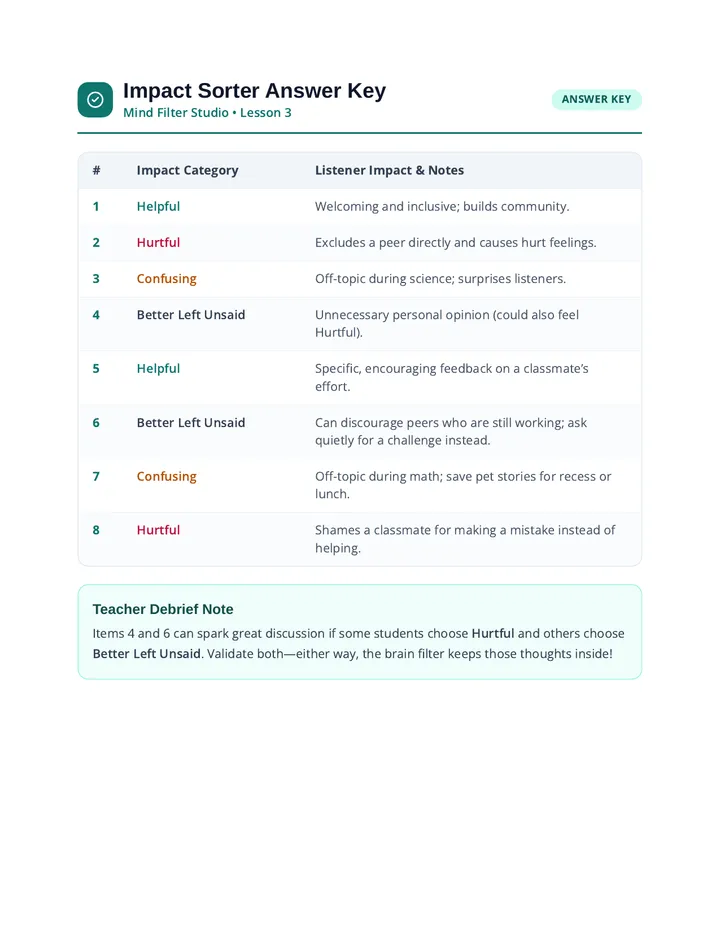
Impact Sorter Answer Key Impact Sorter Answer Key
Mind Filter Studio • Lesson 3
Answer Key
Impact Category
Listener Impact & Notes
1
Helpful
Welcoming and inclusive; builds community.
2
Hurtful
Excludes a peer directly and causes hurt feelings.
3
Confusing
Off-topic during science; surprises listeners.
4
Better Left Unsaid
Unnecessary personal opinion (could also feel Hurtful).
5
Helpful
Specific, encouraging feedback on a classmate’s effort.
6
Better Left Unsaid
Can discourage peers who are still working; ask quietly for a challenge instead.
7
Confusing
Off-topic during math; save pet stories for recess or lunch.
8
Hurtful
Shames a classmate for making a mistake instead of helping.
Teacher Debrief Note
Items 4 and 6 can spark great discussion if some students choose Hurtful and others choose Better Left Unsaid. Validate both—either way, the brain filter keeps those thoughts inside!