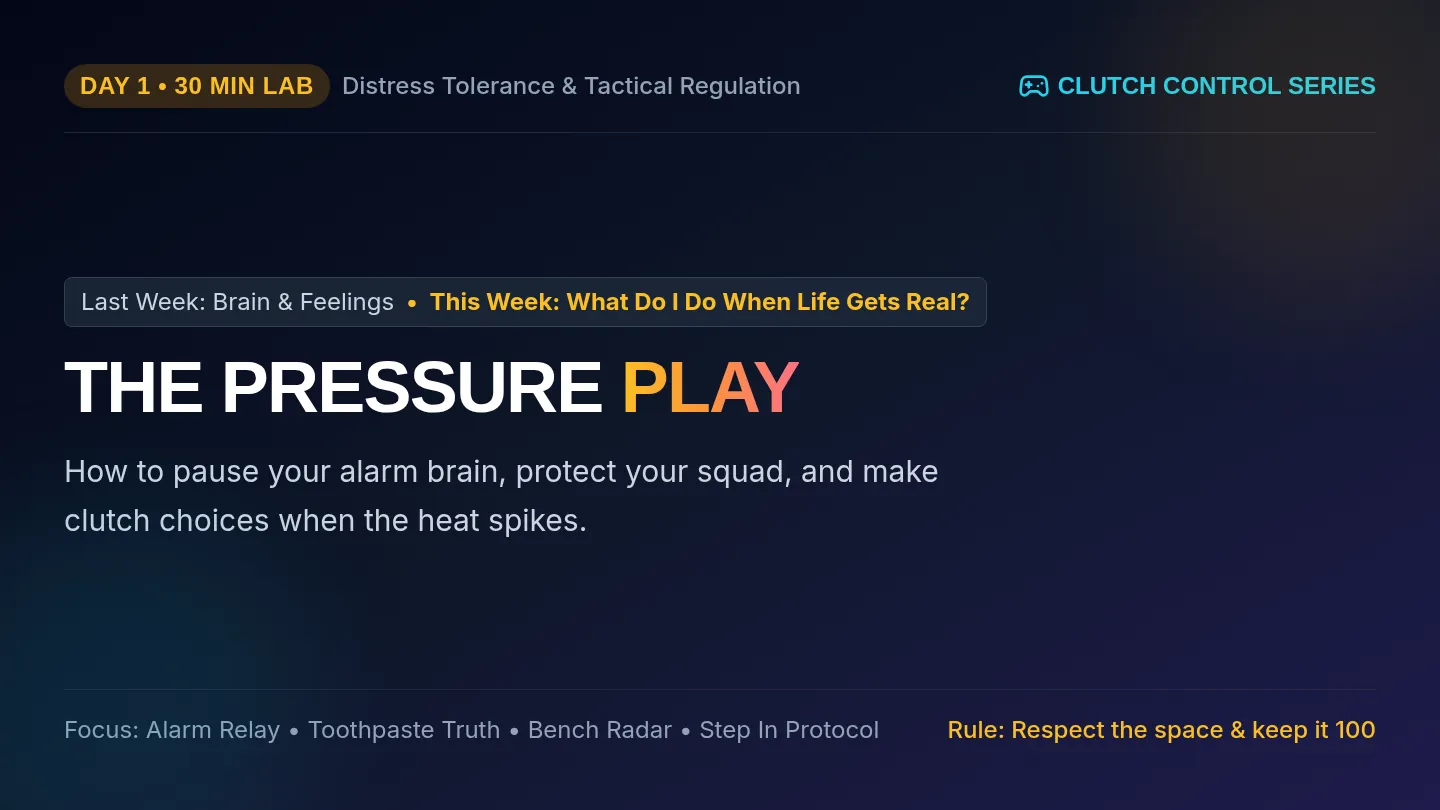
A trauma-informed social-emotional learning lesson helping students validate big feelings while assessing problem impact and choosing responses that actually help resolve situations.
Will this matter in 10 minutes, at the end of the day, or all month long?
Short moment vs. Ongoing event
3
Is Anyone Hurt?
Is anyone's physical safety or deep emotional well-being at immediate risk?
Safety emergency vs. Inconvenience
Notice: None of these 3 questions ask "how angry do you feel?" Helpful Response Lab
The Action Test
Does My Response Help or Hurt?
Unhelpful Response
✕ Does not fix the original problem
✕ Makes people angry or defensive
✕ Creates a brand-new problem (like detention or lost trust)
Helpful Response
✓ Takes steps to actually solve the issue
✓ Allows your body to reset (deep breath, pause, drink)
✓ Leaves you with fewer problems, not more
Golden Rule: Your response should shrink problems, never multiply them. Helpful Response Lab
Class Case Study
Scenario: The Lunch Line Cut
Situation: Jordan has been waiting in line for 10 minutes for pizza. Right as Jordan reaches the counter, another student cuts right in front. Jordan feels sudden Red Zone fury.
Choice A
Jordan shoves the student and yells insults.
Result: Both sent to the office. Jordan gets no pizza, a phone call home, and is still furious. Unhelpful response!
Choice B
Jordan takes one breath: "Hey, I've been waiting here."
Result: If cutter moves back, problem solved! If cutter refuses, Jordan asks the lunch monitor. Jordan gets pizza calmly. Helpful response!
Jordan's anger was 100% justified. Choice B solved the issue. Helpful Response Lab
Your Turn
Time for Partner Practice!
1
Name the Zone
Notice what feeling shows up—no judgment.
2
Check the Impact
How long will it last? Can you solve it?
3
Pick What Helps
Choose an action that shrinks the problem.
Get your Response Matchup Worksheet ready! Ready to Practicing
Blue Green Yellow Red
(Any Zone you feel is 100% valid!)
B. Sizing the Impact: Do you know for sure what they were laughing at? Yes / No Can you sit with other friends or ask calmly? Yes / No
Unhelpful Response (Makes it worse):
Helpful Response (Solves or calms):
My Personal Helpful Response Blueprint
Think of a time this week when something frustrated, annoyed, or saddened you.
1. What was the situation?
2. What Zone or feeling showed up?
3. What was the actual impact (1 min, 1 hour, big safety)?
4. What is a helpful response you chose (or could choose next time) that actually helps?
Self-Check: Did/does this response solve the problem without creating new ones?
Yes! Needs adjustment
Helpful Response Lab • Response Matchup Practice Page 2 of 2
Scenario 3: The Lunch Whispers
Common Unhelpful Responses to Identify:
Throwing food at them or yelling insults.
Running out of the cafeteria in tears without telling staff.
Spreading a rumor about them in retaliation.
Constructive Helpful Responses:
Calmly asking: "Is something funny about my lunch?"
Moving to another seat with welcoming peers.
Checking in with a counselor if this is ongoing bullying.
Exit Ticket Answer Key (Maya's Math Quiz)
Q1: Is Maya "wrong" for feeling Red Zone anger?
False. Maya is never wrong for her feelings. She worked hard and had high expectations, so feeling intense disappointment or anger is natural. Feelings are not judged by number size.
Q2: Does ripping the quiz help with the problem?
No. Ripping up the quiz does not raise the grade, prevents her from reviewing mistakes for test retakes, and might get her into disciplinary trouble. It turns one problem into two.
Q3: What is a response that actually helps?
Sample Helpful Answers: (a) Taking three deep breaths to let adrenaline drop, (b) Asking the teacher if quiz corrections are allowed, (c) Going over which questions were missed during study hall.
Misconception Alert Table
What You Might Hear Underlying Misconception Teacher Response
"A broken pencil is a Level 1 problem, so you can't be mad." Feelings must be scaled to problem severity. "Your feelings can be a 10 even if the problem is a 1. But does kicking a desk fix the lead?"
"If I'm in the Red Zone, I can't control what I do." Zones excuse hurtful behavior. "Red Zone means you need immediate regulation (breathe/space) before choosing an action."