Space Station Teacher Guide SEL Cadet Academy • Grades 2–3
Space Station Boundaries: Teacher Guide
Duration: 45–50 Mins
CASEL: Self & Social Awareness
Essential Question
How do I know my comfort zone, and how can I respectfully tell crewmates when I need space?
Cadet Objectives
Define "personal orbit bubble" (1 arm-length).
Identify body cues for space violations.
Practice 3 calm, assertive radio phrases.
Materials Needed
Orbit Radar Slide Deck
Astro Bubble Warmup (1 per student)
Rover Role-Play Cards (in pairs)
Optional: 2–3 hula hoops for visual orbit demo
1
Stage 1: Launch & The Personal Forcefield Drill (10 Mins)
Whole Group Kinesthetic
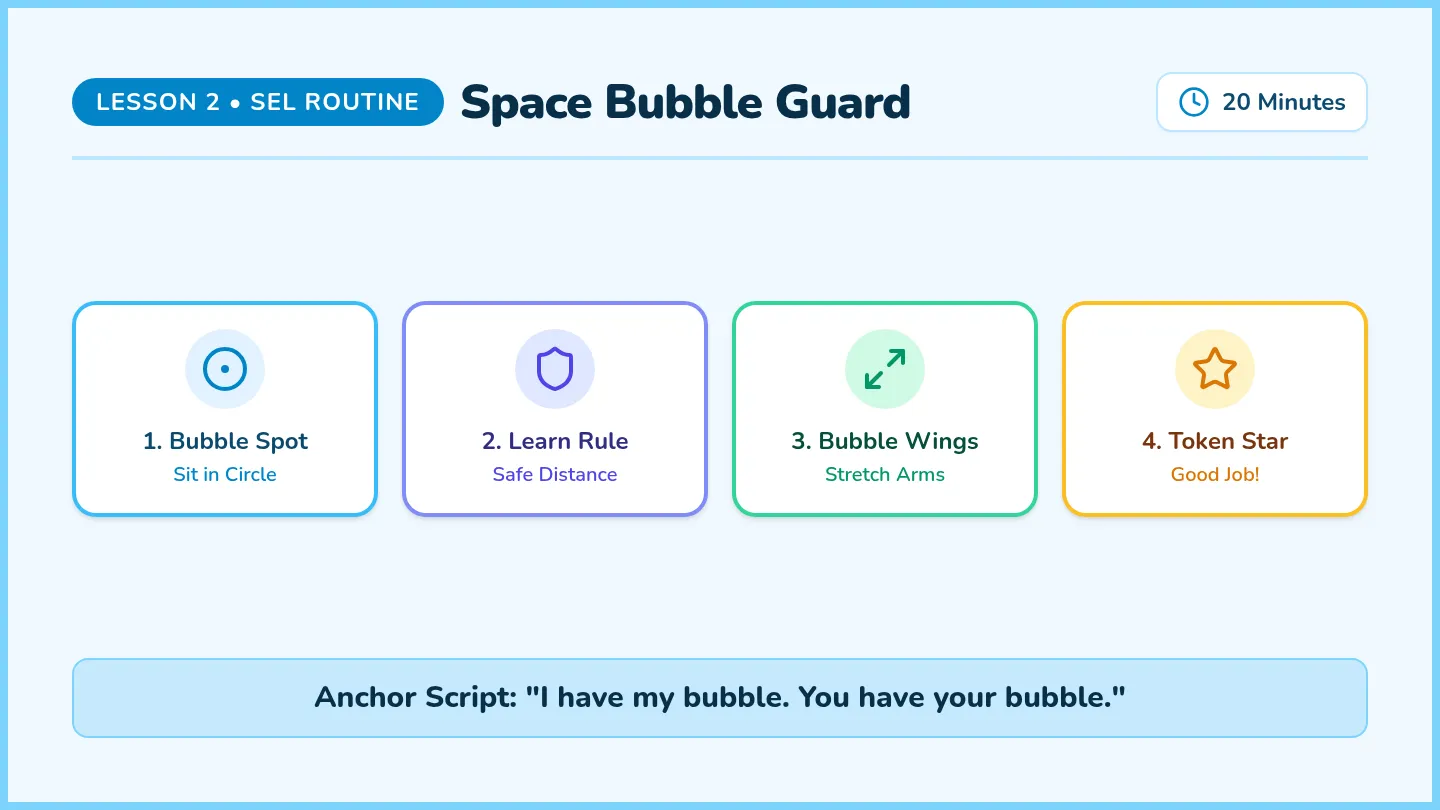
Gather students on the carpet. Explain that every astronaut operating in zero gravity needs a Personal Orbit Forcefield to work safely without colliding into mission equipment or teammates.
The "One Astronaut Arm" Drill
Have cadets stand in spot, stretch both arms out like rocket wings, and turn slowly in a 360° circle. If fingertips touch a peer, both take one step back until forcefields clear.
Teacher Script Callout
"Cadets, check radar scanners! If you can feel someone's breathing or bump their elbow, you're in their docking zone. Step back into safe orbit!"
2
Stage 2: The Three Orbit Zones & Body Scanners (12 Mins)
Slides 2–4
Green Zone: Safe Orbit
At least one arm-length away. Body feels relaxed, shoulders down, easy to breathe and focus.
Yellow Zone: Handshake/Whisper
Closer for sharing a book or secret. Requires asking permission : "May I share this space with you?"
Red Zone: Collision Alert
Touching without asking, breathing on neck, crowding. Body alarm triggers: tense shoulders, tummy flip, stepping back.
Cadet Comms Protocol (The "Stop, State, Step" Method):
1. STOP: Raise flat palm like a shield → 2. STATE: "I need one astronaut arm of space." → 3. STEP: Both crewmates step back & nod
Space Station Boundaries • Lesson Plan Page 1 of 2
Stage 3 & 4: Role-Play Practice, Differentiation & Assessment
Space Station Boundaries
3
Stage 3: Boundary Rover Role-Play Stations (18 Mins)
Partner Drills
Pair students up as Pilot & Navigator. Distribute the Boundary Rover Activity Sheet . Students rotate through 4 micro-simulations, taking turns delivering and receiving boundaries.
Scenario A: The Cafeteria Docking Line
Cadet B crowds Cadet A from behind. Cadet A turns calmly, raises palm, and says: "Please step back to safe orbit so we don't trip!" Cadet B replies: "Copy that, stepping back!"
Scenario B: The Desk Space Rover
Cadet A leans over Cadet B's drawing paper. Cadet B points to their boundary line: "I need space on my desk to finish my mission." Cadet A pulls chair back: "Got it, mission clear!"
Scenario C: The Surprise Hug / High Five
Cadet A rushes to hug Cadet B unexpectedly. Cadet B offers knuckles: "I'm not in the mood for a hug today, but I'll trade a rocket high-five!"
Scenario D: What If They Ignore the Radio?
If a crewmate doesn't move back after 2 verbal radio calls, cadets activate the Mission Commander Protocol : move away calmly and inform the teacher without screaming.
4
Stage 4: Cosmic Calm Re-entry & Debrief (10 Mins)
Lead a whole-group 30-second sensory breath ("Inhale starry calm through nose, exhale engine heat through mouth"). Have students complete the Cosmic Calm Exit Ticket and recite the Cadet Space Pledge: "My space is mine, your space is yours. We respect each orbit, in class and outdoors!"
Differentiation Strategies
Support / ELL: Provide visual hand-signal cue cards (flat palm = STOP; two fingers spread = ARM DISTANCE). Practice echoing phrases in pairs.Sensory-Sensitive Cadets: Allow students who feel overwhelmed by proximity to define a 2-arm comfort perimeter; assign quiet corner work hubs.Extension: Challenge early finishers to write a "Space Station Etiquette Manuel" rule for crowded hallway transitions.
Observation Checklist
• Physical Spacing: Maintains ~1 arm-length distance without constant reminders during transit.
• Tone & Posture: Uses calm, neutral voice instead of screaming or teasing when asking for space.
• Gracious Response: Steps back willingly without anger when a classmate asks for personal space.
Common Misconception Alert:
Students often believe saying "I need space" means they are angry or don't want to be friends. Emphasize: "Asking for space is like checking your oxygen tank—it keeps everybody safe and happy, even best friends!"
Space Station Boundaries • Lesson Plan Page 2 of 2
Orbit Radar Slides Astronaut Cadet Academy
Mission: Personal Space • Grades 2–3
Space Station Boundaries
How to power up your personal orbit forcefield and use clear radio comms with your crewmates!
Orbit Radar Active
•
Respect Personal Space
•
Speak Up with Kindness
What is a Personal Orbit?
Mission Concept 01
Your Invisible Space Shield
Every astronaut has an invisible bubble around their body. It is about one full arm-length in all directions!
Helps you feel safe, calm, and ready to learn.
Prevents accidental bumps, drops, and collisions.
Every single person gets to decide who enters their orbit!
1 Arm Length
The One-Arm Wing Test
Reach your arm out. If your fingertips can brush someone, you're inside their orbit!
Cadet Command Rule: Always check your distance before docking!
Read Your Orbit Radar
Mission Concept 02
Green Zone
Safe Orbit Distance
At least one arm-length away. Perfect for carpet time, line transitions, and listening.
Feels: Relaxed & safe
Yellow Zone
Caution • Ask First!
Close work: sharing a book or whispering. Always ask: "May I sit close to share?"
Action: Ask permission
Red Zone
Collision Warning!
Crowding, touching without asking, leaning on desks. Requires immediate polite backup!
Action: Step back now
Keep your radar tuned so nobody has an unexpected crash!
Body Radar: How Do You Feel?
Self-Awareness
Red Alert Cues
When someone gets too close without asking:
Shoulders scrunch up toward your ears
Stomach feels tight or jumpy
Feet naturally lean or step backward
Green Safe Cues
When you have enough personal orbit space:
Shoulders are low and relaxed
Breathing is slow and steady
Brain is focused on your exciting mission
Listen to your body cues: they tell you when to speak up!
Space Comms: 3 Power Phrases
Clear Speech
Phrase 01 • In the Line
“Please give me one arm of space.”
Astro Bubble Warmup Handout Mission Warm-Up • Grades 2–3
Astro Bubble Warmup Handout
Name:
Date:
Welcome to the Space Station, Cadet! Every astronaut has a Personal Orbit Bubble that keeps them safe and ready to explore. Complete this quick radar warmup to check your systems!
1
Draw Your Personal Orbit Bubble
Tool: Pencil or Crayon
Draw a wide protective shield circle around Cadet Leo. Make sure your orbit leaves one arm-length of breathing room on every side!
Cadet Leo (Draw your bubble around me!)
← Left Wingtip Right Wingtip →
2
Cadet Body Radar Scan
Check all that apply to you
What signals does your body give you when someone enters your space without asking?
My shoulders tighten up
My stomach gets butterfly twists
My feet want to step backward
I cross my arms over my chest
3
Orbit True or False Scan
Circle TRUE or FALSE
A safe personal orbit is about one astronaut arm-length away.
TRUE FALSE
Asking for personal space means you are mad at your friend.
TRUE FALSE
If a friend asks for space, the best response is to step back calmly.
TRUE FALSE
4
Cadet Radio Line
Write your words
What is one kind and clear sentence you can say when you need more room?
Space Station Boundaries • Cadet Warm-Up Mission Phase 1 Complete
Boundary Rover Activity Sheet Partner Simulation Lab • Grades 2–3
Boundary Rover Activity Sheet
Cadet 1:
Cadet 2:
Mission Directives: Take turns being the Space Pilot (sets boundary) and Rover Crew (steps back).
4 Simulations
1
Simulation 01: The Crowded Air-Lock Line
Hallway • Line-Up
The Problem: Rover Crew accidentally stands right on the Space Pilot's heels while waiting to enter the cafeteria air-lock.
Space Pilot: “Beep-beep! Please step back to safe orbit so we don't bump into each other.”
Rover Crew: “Copy that! Taking one astronaut step back.” (Steps back with a smile)
Flight Check:
Calm voice used
1 arm-length created
Friendly smile
2
Simulation 02: The Desk Console Hover
Classroom Desk Hub
The Problem: Rover Crew leans across Space Pilot's notebook and desk to grab a marker without asking.
Space Pilot: “Hold on, crewmate! I need my desk space right now. What marker do you need?”
Rover Crew: “My bad! May I borrow the blue marker please?”
Flight Check:
No shouting
Hands kept to self
Shared with permission
↑ SWITCH ROLES NOW! ↓ The Pilot becomes the Rover Crew for the next page!
Space Station Boundaries • Simulation Lab Page 1 of 2
Simulation Lab: Part 2
Boundary Rover Activity
3
Simulation 03: The Surprise Space Hug
Playground • Recess
The Problem: Rover Crew runs up excitedly to squeeze Space Pilot in a big hug, but Space Pilot does not feel comfortable being hugged.
Space Pilot: “I'm not in the mood for a hug right now, but let's do an astronaut fist-bump instead!”
Rover Crew: “Sure thing! Boom! Fist bump complete!”
Flight Check:
Offered an alternative
No hurt feelings
Body boundaries kept
4
Simulation 04: The Whisper in the Ear
Carpet Discussion
The Problem: Rover Crew leans in and whispers right next to Space Pilot's ear, making their radar alarm buzz.
Space Pilot: “Whoa, you're in my docking zone! Please back up a little so I can hear you clearly.”
Rover Crew: “Understood! Backing up to yellow zone.”
Flight Check:
Cosmic Calm Exit Ticket Cosmic Calm Exit Ticket
Mission Debrief • Cadet Radar Check
Cadet Name:
Date:
1. Rate your cadet flight radar today:
Spotting my orbit
Using calm radio voice
Stepping back kindly
2. What words will you say when you need personal space this week?
“I pledge to respect my crewmates' space and speak up with kindness!”
Cadet Signature:
Cut here for 2 student tickets
Cosmic Calm Exit Ticket
Mission Debrief • Cadet Radar Check
Cadet Name:
Date:
1. Rate your cadet flight radar today:
Spotting my orbit
Using calm radio voice
Stepping back kindly
2. What words will you say when you need personal space this week?
“I pledge to respect my crewmates' space and speak up with kindness!”
Cadet Signature: