Empathy Unlocked Lesson Plan Empathy Unlocked
Stepping into someone else's shoes
Lesson Plan
Time
55 Minutes
Audience
4th Grade Students
Approach
Discussion & Role-play
Why This Matters
Developing empathy helps students build stronger friendships, resolve disagreements peacefully, and create a more caring and inclusive environment for everyone in the classroom and beyond.
Learning Objective
Students will be able to define empathy and identify different perspectives in various scenarios. They will practice recognizing and responding to others' emotions with understanding and kindness.
Teacher Preparation
Prep Time: 15 minutes
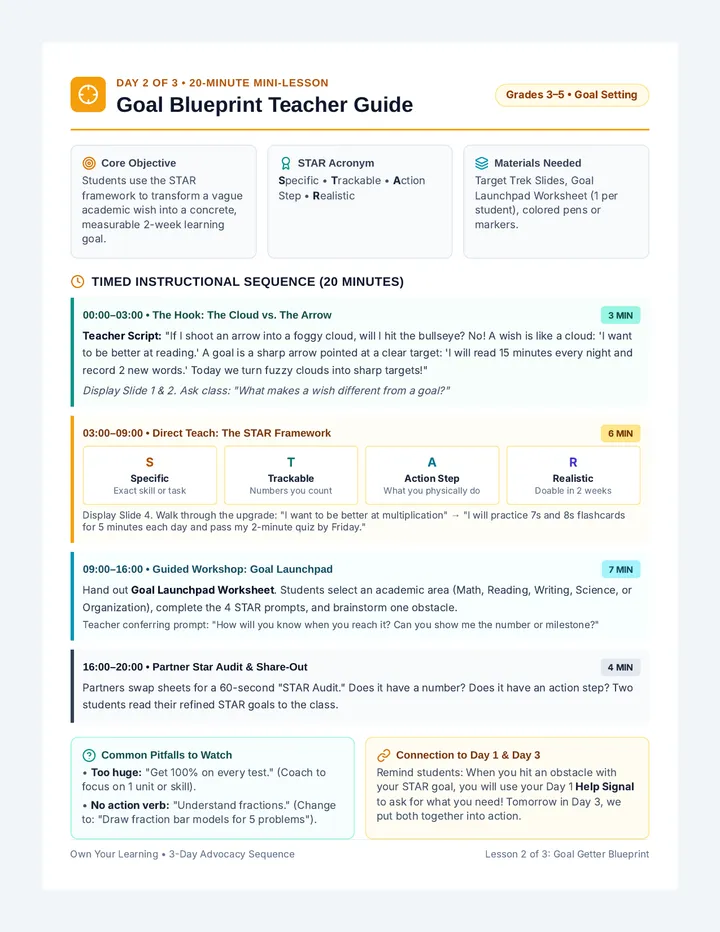
Review the Empathy Unlocked Lesson Plan and all materials.
Ensure projector is ready for the Empathy's Path Presentation .
Prepare copies of The Empathy Story Circle and What Would You Do? Worksheet .
Instructional Steps
1
Introduction: What is Empathy?
10 MIN
Begin with a quick poll: "How do you feel when someone understands you?"
Introduce empathy using the first few slides of Empathy's Path Presentation .
2
Exploring Perspectives
15 MIN
Read The Empathy Story Circle aloud.
Discuss: "How do you think Character A felt? Why?"
Use the "Stepping Into Their Shoes" slides to transition.
3
Scenario Practice: What Would You Do?
20 MIN
Distribute the What Would You Do? Worksheet .
Students work in pairs or independently to complete the scenarios.
Review using the Answer Key & Discussion Guide .
4
Wrap-Up: Empathy in Action
10 MIN
Summarize the importance of practicing empathy daily.
Share-out: One way you will show empathy this week.
Empathy's Path Presentation What is Empathy?
Have you ever felt what someone else is feeling?
Think about a time you were really happy, or really sad. What if someone else understood exactly how you felt?
Teacher Note: Welcome students and gauge their initial understanding.
Defining Empathy
Empathy is when you understand and share the feelings of another person.
It's like you can imagine what it's like to be them for a moment.
It helps us connect with others and show we care.
Teacher Note: Distinguish between empathy (understanding/sharing) and sympathy (feeling sorry).
Stepping Into Their Shoes
Imagine you can literally "step into someone else's shoes."
How would the world look from their height?
What might they be thinking or feeling?
This helps us understand their perspective.
Spotting Empathy
Who showed empathy?
Think about Maya's actions.
Who needed empathy?
How did Leo feel?
What if no empathy was shown?
How would the day end?
Discussion: Did you notice moments where characters understood each other?
Showing You Care
Empathy isn't just about feeling; it's about showing it !
Listen
Listen carefully to what they say.
Ask
Ask how they are feeling.
Offer Help
Offer help if they need it.
Be Kind
Use kind words and actions.
What Would You Do?
Now, let's put our empathy skills to the test!
Think about:
Empathy Everywhere!
When we understand others, we build a happier and more supportive community.
Weekly Challenge:
Try to show empathy to someone new this week!
Empathy Story Circle Reading The Empathy Story Circle
A story about seeing through someone else's eyes
Part 1
Leo Loses His Lunch
It was a bustling Tuesday morning, and Leo, a fourth-grader with a bright imagination, skipped to school with a new comic book clutched in his hand. At lunch, he couldn't wait to show his friend Maya the latest adventure of "Captain Comet." As he opened his backpack, his heart sank. His carefully packed lunch—a peanut butter and jelly sandwich, apple slices, and a chocolate chip cookie—was gone! He must have left it on the kitchen counter in his excitement.
Leo felt a hot flush spread across his face. His stomach rumbled loudly, and tears pricked at his eyes. He tried to hide it, but a small sniffle escaped. He looked around the noisy lunchroom, feeling suddenly very small and very alone.
Part 2
Maya's Observation
Across the table, Maya was happily munching on her carrots. She glanced at Leo and noticed his usually cheerful face was scrunched up. He wasn't talking about Captain Comet, and he hadn't even touched his backpack for food. Maya remembered a time last year when she forgot her lunch. Her stomach had growled, and she felt embarrassed, just like Leo looked now.
Maya stopped eating. She thought about how awful it felt to be hungry and upset at school. She looked at her own lunch. She had an extra apple and a granola bar. It wasn't a peanut butter sandwich, but it was something.
Part 3
A Small Act of Kindness
Quietly, Maya slid her extra apple and granola bar across the table towards Leo. "Hey Leo," she said softly, "I have more than enough today. Do you want these?" She didn't ask if he forgot his lunch, or make a big deal out of it. She just offered.
Leo looked up, surprised. He saw the kindness in Maya's eyes. "Really?" he whispered, his voice a little shaky. Maya nodded, giving him a small, reassuring smile.
As Leo gratefully took the food, a warm feeling spread through him, much better than the rumbling in his stomach. He realized Maya understood without him having to say a word. And Maya, watching him eat, felt a happy flutter in her chest. She knew she had made a difference by simply stepping into his shoes for a moment.
Circle Reflection
Take a moment to talk with your group. How did Maya use her own memory of a bad day to help Leo? What did she see that others might have missed?
What Would You Do Worksheet What Would You Do?
Empathy Worksheet
Name:
Date:
Instructions
Read each scenario below. Imagine you are "stepping into the shoes" of the person in the situation. Answer the questions to show how you can understand and care for others.
Scenario 1: The Broken Tower
During free play, Jamal spends a long time carefully building a tall, intricate tower with blocks. Just as he places the very last block on top, another student, Chloe, accidentally bumps into the table, and the tower crashes to the floor. Jamal's face turns red, and he looks like he's about to cry.
How do you think Jamal feels?
Why might he be feeling that way?
What could you say or do to show Jamal empathy?
Scenario 2: New Kid Nerves
A new student, Elena, joins your class today. During lunch, you see her sitting alone at a table, quietly eating her sandwich. She keeps looking around the room, but she doesn't talk to anyone. When the teacher asks her a question, her voice is very soft, and she quickly looks down.
How do you think Elena feels?
Why might she be feeling that way?
What could you say or do to show Elena empathy?
Scenario 3: Missing the Game
Your friend, David, loves soccer more than anything. He's been practicing all week for a big game on Saturday. On Friday, he finds out he has a fever and won't be able to play. You see him looking really sad and kicking at the ground during recess.
How do you think David feels?
Why might he be feeling that way?
What could you say or do to show David empathy?
What Would You Do Answer Key What Would You Do?
Answer Key & Discussion Guide
Teacher Resource
Scenario 1: The Broken Tower (Jamal)
How Jamal Feels:
Frustrated, sad, angry, disappointed, or overwhelmed.
Why:
He worked very hard and for a long time on his creation, and it was destroyed in an instant, even if it was an accident.
Empathetic Responses:
"I'm so sorry, Jamal. I saw how hard you worked on that tower."
"That is so frustrating. Would you like some help building it again?"
Give him space if he looks like he needs a moment to breathe.
Scenario 2: New Kid Nerves (Elena)
How Elena Feels:
Lonely, nervous, shy, out of place, or intimidated.
Why:
Being in a new place where you don't know anyone is scary. She doesn't have friends yet and isn't sure where she fits in.
Empathetic Responses:
"Hi Elena, I'm [Name]. Would you like to sit with us today?"
"It's my first year here too/I remember being new. It gets easier!"
Smile and make eye contact to show she is welcome.
Scenario 3: Missing the Game (David)
How David Feels:
Sad, left out, disappointed, frustrated, or bored.
Why:
He put in a lot of effort practicing and was looking forward to the excitement of the game. Now he's missing the fun and letting his team down.
Empathetic Responses:
"That really stinks, David. I know how much you wanted to play."
"I'll tell the team you're rooting for them! Hope you feel better soon."
"Want to hear what happened at school today to take your mind off it?"
Facilitation Tips
Validation: Remind students there are no "wrong" feelings in these scenarios.Role-Play: If time allows, have students act out their empathetic responses to practice the tone of voice and body language.Personal Connection: Ask if anyone has ever felt like Jamal, Elena, or David.