Empathy Observation Plan Lesson Plan Empathy Observation Plan
5th Grade Small Group (Tier 2) • 55 Minutes
Empathy Lens
Why This Matters
Understanding and identifying emotions in others is a fundamental skill for building healthy relationships and navigating social situations successfully. This lesson will help students develop empathy and improve their ability to connect with peers.
Objective
Students will be able to identify emotions in others by analyzing body language, tone of voice, and context, thereby enhancing their social awareness and interpersonal skills.
Materials
Small whiteboards/markers
Non-Verbal Cues Slides
Emotion Charades Game
Discussion Guide
Prep Time: 15m
Review all materials. Prepare whiteboards and markers for each student. Fold emotion slips for the charades game.
Instructional Sequence
05
MIN
Warm-Up: Emotion Check-In
Students share one current emotion and why using descriptive words.
Explain that understanding emotions is key to being good friends.
10
MIN
Reading Non-Verbal Cues Slides
Discuss body language (posture, gestures) and tone (speed, pitch).
Practice identifying emotions from simple non-verbal examples.
20
MIN
Emotion Charades Challenge
Students act out emotions without speaking.
Classmates guess and identify the specific non-verbal clues observed.
15
MIN
Discussion: What Would You Do?
Analyze real-world scenarios where empathy is required.
Discuss appropriate and supportive social responses.
05
MIN
Cool-Down: Empathy Reflection
Reflect on one new thing to notice about others' emotions tomorrow.
Reinforce: "Empathy builds stronger relationships."
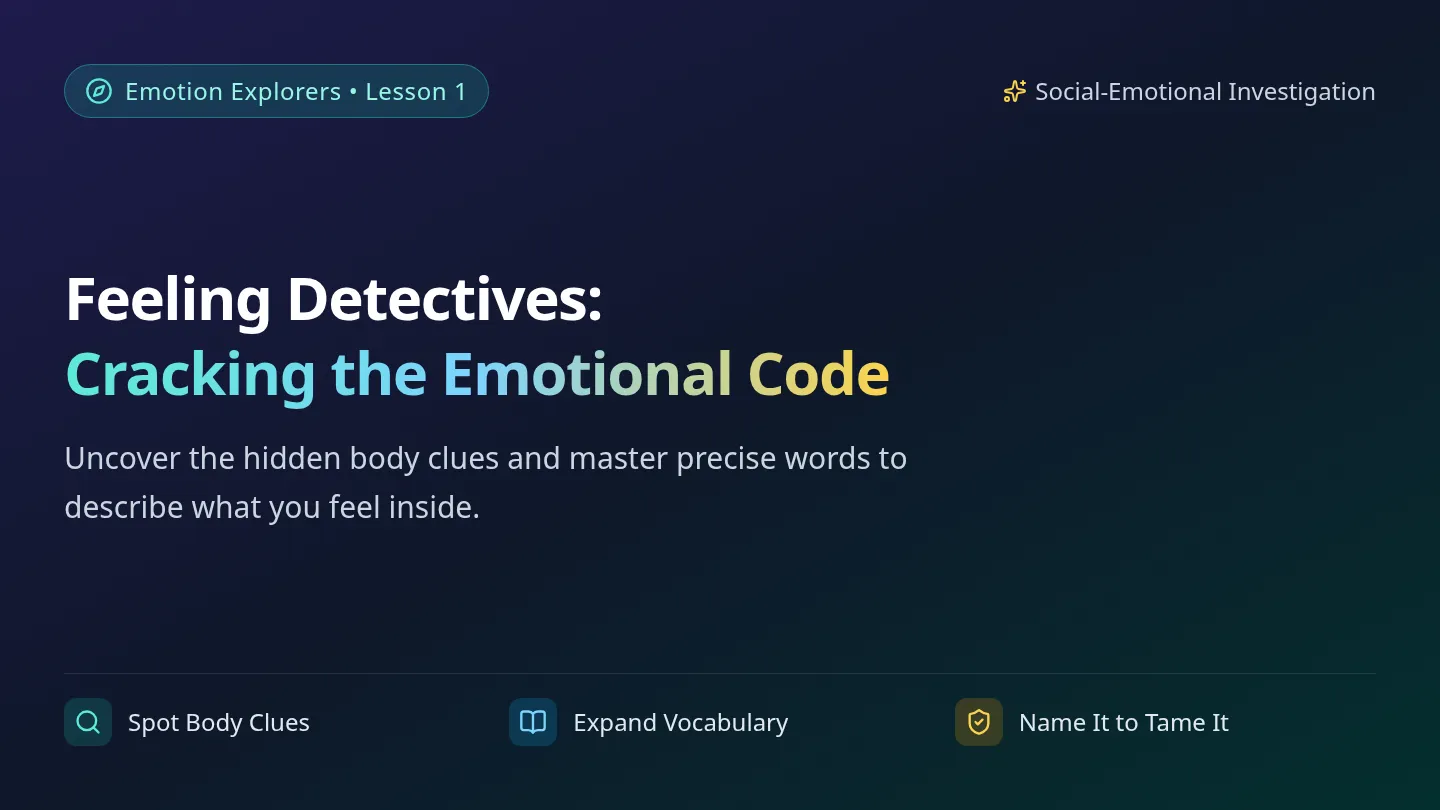
Reading Non-Verbal Cues Slides Welcome to Empathy Lens!
Today, we're becoming emotion detectives ! We'll learn how to "read" people and understand what they're feeling, even when they don't say a word.
Slide 1
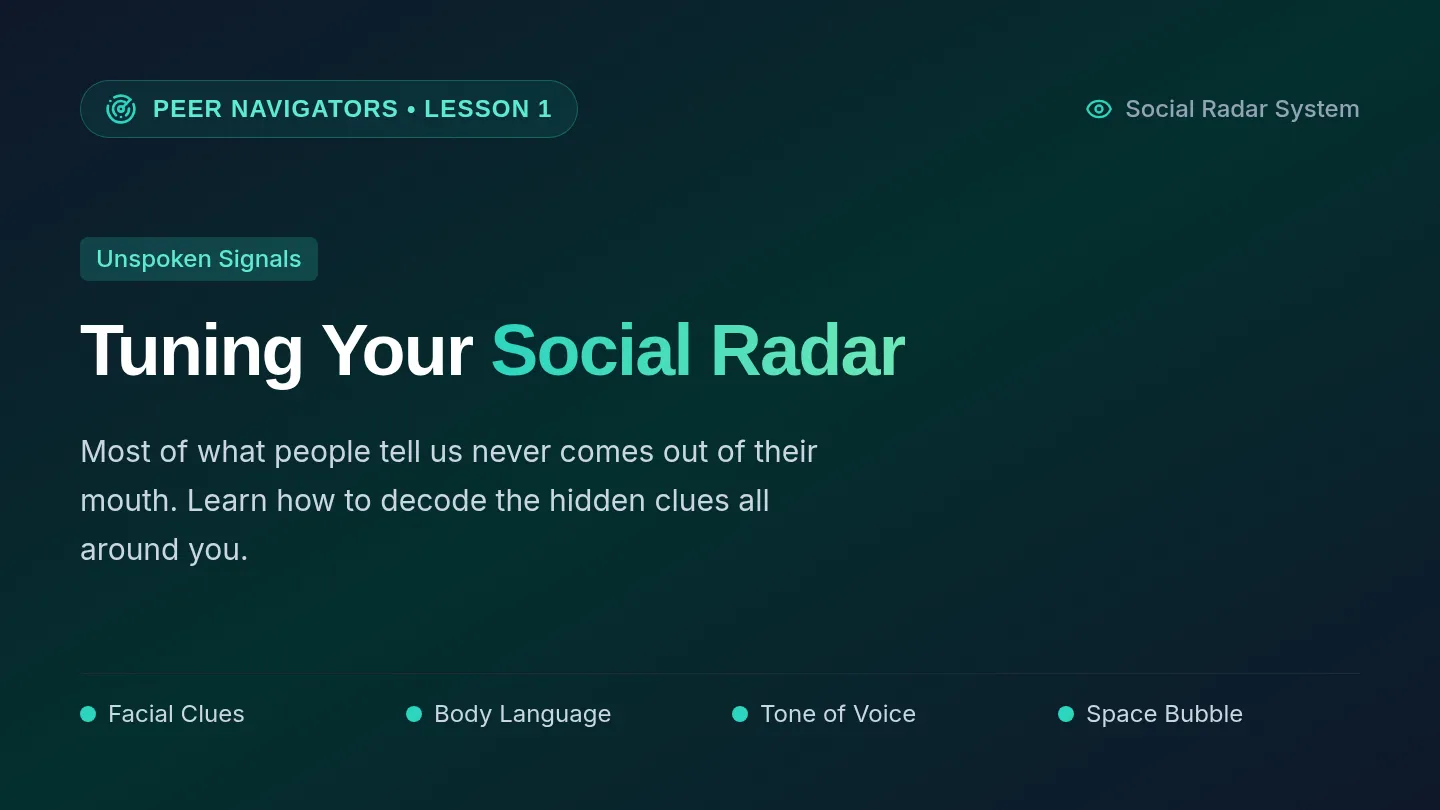
More Than Just Words
How do you know if someone is happy without them saying, "I'm happy!"?
Our bodies give us clues!
Body Language
Tone of Voice
Slide 2
Body Language: The Silent Storyteller
Facial Expressions
Are eyebrows up or down? Mouth smiling or frowning?
Posture
Are they slumped or standing tall? Are arms crossed?
Gestures
Are they fidgeting? Waving hands? Using a lot of energy?
Slide 3
Tone of Voice: How We Say It
1
Pitch: High or low?
2
Volume: Whisper or shout?
3
Speed: Fast or slow?
Voice Challenge
Try saying "I'm fine" in a:
Slide 4
Detective Case File #1
"Your friend's shoulders are slumped, their eyes are looking down, and they are speaking very softly."
Identify the Emotion
Name the Clues
Slide 5
Let's Play:
Emotion Charades!
Ready to practice?
No talking allowed!
Use only body language and face
Classmates guess the emotion
Slide 6
Real-Life Challenges
What Would You Do?
How would you use your new "empathy lens" to respond to a friend in need?
See the clues
Feel the emotion
Act with kindness
Slide 7
Empathy Experts
Observe
Watch and Listen
Think
How do they feel?
Respond
Show Kindness
Keep investigating!
Slide 8
Emotion Charades Challenge Game Emotion Charades Challenge
Mastering the Art of Non-Verbal Communication
Mission Objective
To practice identifying and expressing complex emotions through non-verbal cues like body language, facial expressions, and energy levels without using a single word.
How to Play
1
The Actor: Pick a slip from the hat. No talking or making any sounds at all!
2
The Performance: Use your whole body. Think about your eyebrows, your posture, and how much energy you have.
3
The Guessers: Watch for specific clues. When you guess, explain why (e.g., "I see you're slumped and looking down").
4
Discussion: After each round, talk about which clues were most helpful and when these skills matter in real life.
Teacher Tips
• If students are shy, model the first emotion (like "frustrated") yourself.
• Encourage guessers to be specific: "Your clenched fists make you look angry."
• Ensure everyone gets a chance to be the actor once.
Emotion Bank
Cut into slips for the game
Happy
Sad
Angry
Surprised
Scared
Confused
Excited
Bored
Shy
Proud
Frustrated
Calm
Disappointed
Curious
What Would You Do Discussion Guide Worksheet What Would You Do?
Empathy In Action Case Files
Name: __________________________
Date: __________________________
"We've just practiced being emotion detectives! Now, let's think about how we can use these skills in real life to be supportive friends and classmates. Read each case file and consider the clues."
01
Case: The Quiet Friend
Your friend Alex usually talks a lot and laughs loudly. But today, Alex is sitting quietly at their desk, drawing slowly, and not making eye contact. When you ask, "Are you okay?" they just shrug.
Likely Emotion:
Observed Clues:
Empathetic Response:
02
Case: The Frustrated Teammate
During a group project, Maya is trying to put together a model, but a piece keeps breaking. They sigh loudly, clench their fists, and their voice is tight when they say, "This is impossible!"
Likely Emotion:
Observed Clues:
Empathetic Response:
03
Case: The Excited News
Your classmate Sam rushes into the classroom with a huge smile, bouncing on their toes, and practically shouting, "You won't believe what happened!"
Likely Emotion:
Observed Clues:
Empathetic Response:
04
Case: The Confused Learner
During math, Jamie has furrowed eyebrows, is biting their lip, and keeps looking between their textbook and the board. When the teacher asks for questions, Jamie looks down.
Likely Emotion:
Observed Clues:
Empathetic Response:
Final Detective Reflection
Why is it important to try and understand how others are feeling? How can noticing these clues help us be better friends? What's one thing you'll try to pay more attention to tomorrow?