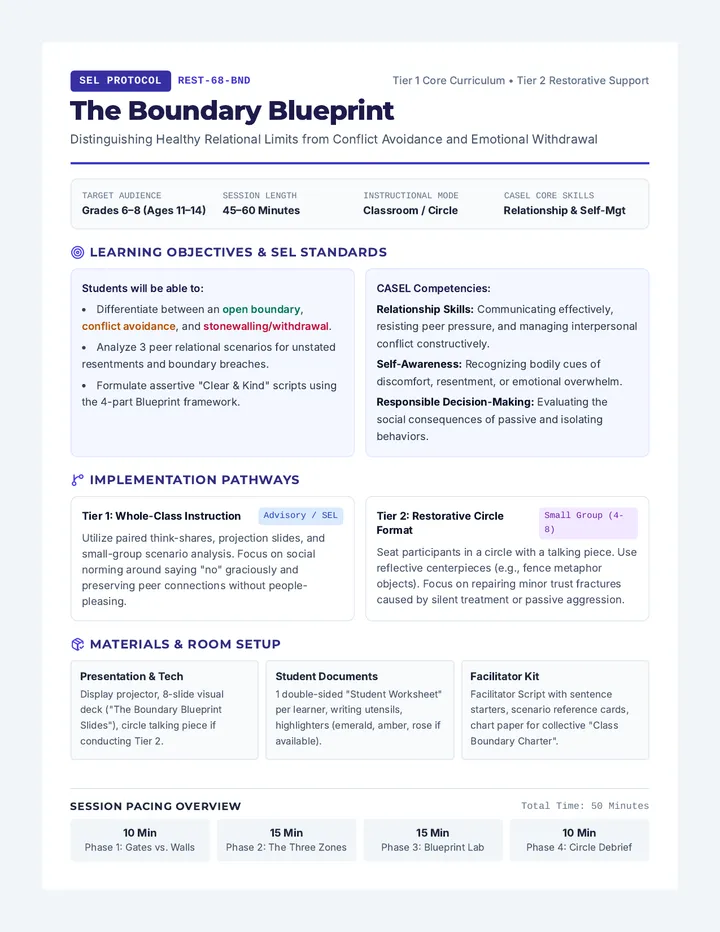
Tone Detective Lesson PlanTone Detective Lesson Facilitation Guide 45 Minutes 7th Grade Learning Objective Students will learn to identify emotions conveyed through vocal tone, pitch, and volume, enhancing their ability to understand non-verbal communication. The "Why" "Being able to 'decode the tone' is crucial for effective communication, building empathy, and navigating social situations successfully." Teacher Prep Review Slide Deck, Scenario Activity, and Quiz. Set up projector/whiteboard for visual presentation. Print Scenario Activity sheets for small groups. Prepare digital or physical copies of the exit quiz. Required Materials Slide Deck Scenario Worksheets Exit Quizzes Whiteboard Markers Lesson Timeline TimeActivity SegmentKey Instructional Steps5mIntro: What's in a Sound? Hook: "Ever heard someone say something, but their voice meant something else?" Define vocal tone, pitch, and volume as non-verbal messages. Introduce the role: Tone Detectives. | | 10m | Exploring Vocal Cues | Use slides to define Tone, Pitch, and Volume. Live Demo: Ask students to say "Hello" or "Okay" using different emotions. Discuss how subtle shifts change the entire meaning. | | 15m | Activity: Scenarios | Divide into pairs/small groups. Roleplay: One reads the line with a secret emotion; others guess. Facilitate discussion on which cues (pitch vs volume) gave it away. | | 10m | Real-Life Discussion | Relate to real life: Friends, family, teachers, media. Ask: "How does decoding tone help you respond more thoughtfully?" | | 5m | Cool Down & Quiz | Administer the assessment. Final recap: Listening with more than just ears. | "Teaching students to listen to the space between the words builds a lifetime of emotional intelligence."
Sound of Feelings SlidesNon-Verbal Communication Decode the Tone Ever heard someone say one thing, but their voice told you something completely different? Today, we are Tone Detectives The Voice's Secret Language Tone The quality or character of a sound (e.g., harsh, soft, warm, cold) Pitch How high or low a voice sounds Volume How loud or soft a voice is Teacher Note: Encourage students to think about how these elements change based on emotion. Tone in Action: "Hello" 😊 Happy Bright tone Slightly higher pitch Medium volume 😠 Angry Harsh tone Lower pitch Louder volume 😔 Sad Soft tone Lower pitch Quieter volume 🤔 Confused Rising pitch at the end Questioning tone Practice Time! Now, let's put on our detective hats and practice decoding emotions in different scenarios! Show & Tell Your Voice Why Does it Matter? Better Understanding Hear the true meaning behind words. Clearer Communication Match your voice to your message. Stronger Relationships Develop empathy and trust through active listening. "It's all about listening with more than just your ears!"
Tone Scenarios ActivityTone Detective Scenarios Decoding Vocal Cues in Action NAME: DATE: Mission Briefing In your groups, read each scenario. One person will act out the spoken line using specific tone, pitch, and volume to convey an emotion. The rest of the group will guess the emotion. Use the Detective Notes to explain which vocal cues helped you solve the case. Case File #01 Topic: Cancelled Trip Situation: The annual amusement park trip is cancelled. "Oh... okay." Possible Emotions Disappointment Anger Resignation Detective Notes: How did you know? Case File #02 Topic: Success! Situation: You finally solve a challenging math problem. "I got it!" Possible Emotions Excitement Relief Triumph Detective Notes: How did you know? Case File #03 Topic: The Secret Situation: A classmate overhears a secret and asks what you were saying. "Nothing." Possible Emotions Secretive Embarrassed Annoyed Detective Notes: How did you know? Case File #04 Topic: The Bump Situation: You accidentally bump into someone and their books fall. "Oops, sorry." Possible Emotions Apologetic Insincere Frantic Detective Notes: How did you know? Case File #05 Topic: The Pop Quiz Situation: Teacher announces a pop quiz for tomorrow. "Are you serious?" Possible Emotions Frustration Exhaustion Dread Detective Notes: How did you know?
Mood in the Room QuizWhat's the Mood? Quiz Post-Lesson Assessment NAME: DATE: Section 1: Concepts 1. Which of the following describes the pitch of a voice? How loud or soft a voice is. How high or low a voice sounds. The quality or character of a sound. The speed at which someone speaks. 2. If someone says "Fine!" in a very loud voice with a harsh, low tone, what emotion are they most likely expressing? Happiness Indifference Anger Confusion 3. When a voice is very quiet and the tone is soft and slow, what emotion might be conveyed? Excitement Sadness Surprise Confidence Section 2: Analysis 4. Imagine your friend tells you a story about something amazing that happened to them, but their voice is monotone and quiet. What might be confusing about their communication, and why? 5. Give an example of a time you used your tone of voice, pitch, or volume to convey an emotion without explicitly stating it. What was the situation and what emotion did you convey?
Mood Quiz Answer KeyAnswer Key What's the Mood in the Room? Quiz Teacher Resource Section 1: Multiple Choice Which of the following describes the pitch of a voice? Correct: How high or low a voice sounds. If someone says "Fine!" in a very loud voice with a harsh, low tone... Correct: Anger When a voice is very quiet and the tone is soft and slow... Correct: Sadness Section 2: Open Response Guidelines 4. Monotone/Quiet Story Confusion Ideal Answer: The words and the vocal cues are "mismatched" or contradictory. While the words describe something "amazing" (which usually has high energy, bright tone), the monotone/quiet voice suggests boredom, sadness, or lack of interest. This makes the speaker's true feelings unclear. Scoring: Look for terms like "contradiction," "mismatch," or "non-verbal cues don't match words." 5. Personal Example Ideal Answer: Any personal anecdote where the student identifies a specific situation and connects it to a specific vocal cue (e.g., "I whispered 'thanks' but used a harsh tone to show I was actually annoyed."). Scoring: 1pt for the situation, 1pt for identifying the cue (tone, pitch, or volume), 1pt for identifying the emotion. Grading Tip This quiz is designed as a formative assessment. Focus more on whether students can articulate why a certain tone conveys an emotion rather than just getting the right label.