An interactive character and ethics lesson where students explore integrity through realistic dilemmas, role-playing, and reflective writing. Students examine how core values guide actions when no one is watching and collaborate to solve complex ethical challenges.
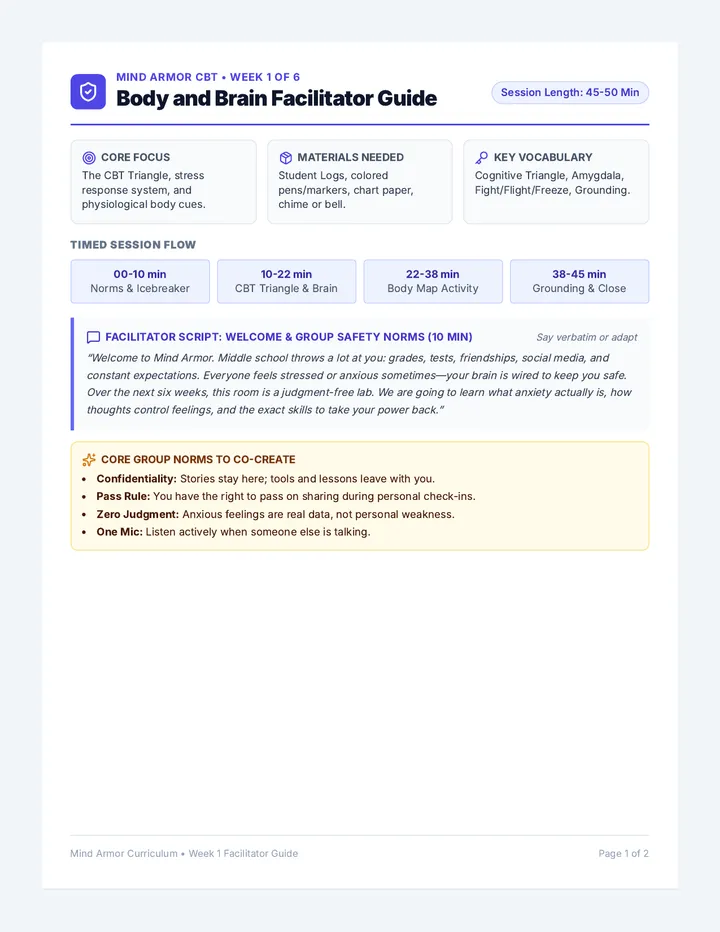
"Students often confuse friendship with blind complicity. Say to them: 'True loyalty never asks a friend to sacrifice their honor or future. When someone pressures you to cheat or lie for them, they are asking you to carry their risk while they reap the reward. That isn't friendship; it's exploitation.'"
Moral Compass Teacher Facilitation Guide Page 1 of 2
Role-Play Dynamics & Pedagogy
Deepening Engagement, Handling Nuance, and Differentiated Coaching
Section 2: Protocols
The 3-Role Collaborative Structure
A The Instigator
Applies realistic emotional levers: "Everyone is doing it," "You're ruining our team's chance," or "Don't be a goody-two-shoes."
B The Responded (Compass)
Must respond in first-person without apologizing for their stance. Replaces "I guess I can't" with "I won't do this because my word matters."
C The Observer-Coach
Takes notes on tone, eye contact, and conviction. Evaluates whether the responder compromised or successfully stood firm.
Addressing Critical Misconceptions
Misconception 1: "It doesn't hurt anyone, so it isn't an integrity issue."
Teacher Reframing: Integrity is about who you become when you choose deceit, not just the visible victim. Devaluing your own honesty alters how you handle bigger stakes later in life.
Misconception 2: "Snitching vs. Speaking Up."
Teacher Reframing: Tattling seeks to get someone into trouble for petty advantage. Ethical reporting protects the community from harm or systematic dishonesty that ruins opportunities for everyone.
Misconception 3: "Integrity means you never make mistakes."
Teacher Reframing: The highest expression of integrity is owning a mistake, telling the truth before you are caught, and actively making restitution.
Differentiation & Inclusive Supports
Support / English Learners:
Provide sentence stems on index cards ("I hear what you want, but I value...").
Allow non-verbal observation notes before spoken debrief.
Pair with supportive, high-empathy peers during the role-play.
Advanced / Extension:
Introduce "Whistleblower Paradoxes" where speaking out brings personal penalty.
Challenge students to draft an enforceable Honor Code clause for school activities.
Facilitate ethical debate on digital AI tools and academic attribution.
Formative Assessment Success Indicators
Look for students moving away from fear-based answers ("I won't do it because I'll get suspended") toward values-based answers ("I won't do it because false achievement cheapens my actual work and breaks trust with teammates").
Moral Compass Teacher Facilitation Guide Page 2 of 2
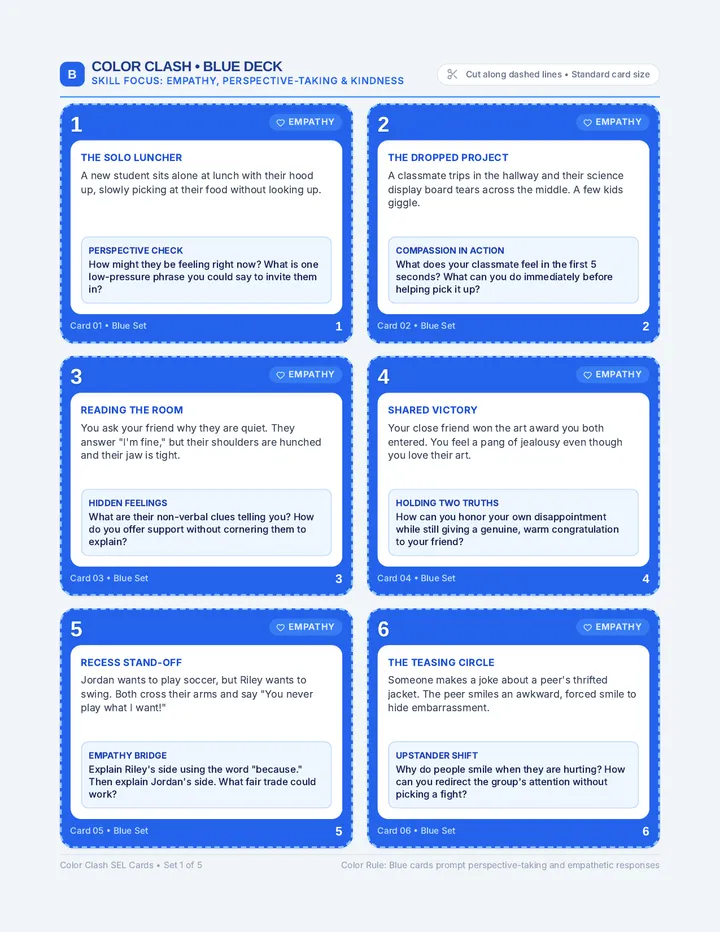
Dilemma Challenge Activity Cards Page 1 of 2
Dilemma Challenge Activity Cards
Collaborative Role-Play & Decision-Making Cards • Set 2
Cards 04 – 06
Group Protocol: Switch roles so each student experiences playing the Defender with conviction. Observer coaches delivery
CARD 04
The Shift Manager Discount
Workplace & Financial Ethics
The Dilemma: You work the evening counter at a local sandwich and smoothie shop. Your coworker rings up high-school friends as $0.00 "promotional voids" and pocketing the tip money, telling you: "The franchise makes millions; this is just our bonus." They tell you to do the same for your friends.
Role A (The Coworker): "If you ring them up regular, you're making me look bad. Don't be a hero for a corporation that pays minimum wage."
Role B (The Defender): Refuse to take part in theft; protect your personal standard of workplace honesty and self-respect.
Observer Prompt: Did the defender address the false rationale that "big companies don't feel it"?
CARD 05
The Grade Rounding Favor
Fairness & Conflict of Interest
The Dilemma: You are a student teaching assistant (TA) entering quiz grades for a history teacher. Your best friend is sitting at an 89.2% and needs a 90% to maintain honor roll and car privileges. They beg you to "accidentally" change a 14/20 to an 18/20 in the grading portal.
Role A (The Best Friend): "Nobody audits quizzes from two months ago! You have the password. If you really cared about our friendship, you'd help me out."
Role B (The Defender): Refuse to abuse position of trust; separate friendship from academic fraud; offer study help instead.
Observer Prompt: Did the defender offer a healthy alternative (e.g., retake study plan)?
CARD 06
The AI Ghostwriter
Digital Ethics & Authentic Voice
The Dilemma: A state scholarship essay competition has a strict rule: "All essays must be original student writing; no generative AI permitted." Your friend generates a complete essay, uses a paraphrase tool to evade detectors, and wins runner-up ($1,500). They urge you to do the same for the next round.
Role A (The AI Winner): "The prompt was dumb anyway. AI is just a tool, and everyone in college uses it. You're giving away free money if you don't."
Role B (The Defender): Articulate why authentic achievement matters, and why taking money under false pretenses is fraud.
Observer Prompt: Did the defender articulate pride in authentic personal growth?