Clear Signals Visual Slides
Communication & Self-Advocacy Skills
Skill Set #1
Clear Signals:
What to Say & How to Say It
What to do and how to ask politely when directions don't make sense.
Step 1
Pause & Breathe
Step 2
Pinpoint The Need
Step 3
Politely Ask
Truth Check 02 / 10
Everyone Gets Stuck Sometimes!
Confusion is not a failure—it's just a sign that your brain is ready to learn.
What Shuts Down Learning
- ✕ Freezing up and doing nothing
- ✕ Giving up or shutting your binder
- ✕ Blurting out: "This is impossible!"
The Clear Signals Habit
- ✓ Noticing: "Wait, I don't know step 2."
- ✓ Calmly raising a hand at the right moment
- ✓ Using a polite phrase to get back on track
⭐ Asking for help politely is a sign of confidence and leadership.
The Core Routine 03 / 10
The 3-Step Clear Signal System
Three simple moves to get the exact help you need.
1. Pause
Stop & Re-read
Take one slow breath. Look at the board or page one more time before speaking.
Signal: Hands still, eyes ready
2. Pinpoint
Name the Gap
Figure out what is confusing: a word? the page number? the next step?
Signal: Point to where you stopped
3. Politely Ask
Speak with Respect
Raise your hand quietly and use a clear starter sentence at a normal speaking volume.
Signal: Calm, respectful tone
Pause → Pinpoint → Politely Ask
Delivery & Demeanor 04 / 10
How You Say It Matters Just As Much
Body language and timing turn a complaint into a polite request.
1. Wait for a Pause
Wait until the speaker finishes their sentence before raising your hand. Avoid interrupting.
2. Friendly Eye Contact
Sit upright and look toward the teacher. An attentive posture shows you are ready to listen.
3. Calm Conversational Tone
Use an even, polite volume. No whining, dramatic sighing, or aggressive muttering.
💡 Quick Rule of Thumb: "Raise your hand like a bookmark—quiet, patient, and marking your spot."
Skill Drill: Pinpointing 05 / 10
Replace "I Don't Get It"
Help the teacher help you by naming the exact puzzle piece.
Ask Yourself Before Raising Hand:
The Words? "Is there a vocabulary word I don't know?"
The Steps? "Do I know where to start or what comes next?"
The Location? "Am I looking on the correct page or file?"
Why Pinpointing Works Like Magic:
When you say:
"I did step 1, but I'm unsure where step 2 goes",
The teacher knows you are trying and can give you a 10-second answer instead of re-explaining the entire 15-minute lesson!
Specific questions get fast, helpful answers.
Word Weapons: Sentence Starters 06 / 10
4 Polite Sentence Starters
Keep these in your mental pocket for whenever you feel stuck.
When you missed a detail:
"Could you please repeat the last step?"
Short, polite, and respectful of the teacher's time.
When a word is confusing:
"Could you please clarify what that word means in this problem?"
Shows you are actively reading the directions.
When you need a model:
"Would you please show one quick example on the board?"
Often helps the entire room, not just you!
When you want to verify:
"May I check if I'm on the right track before I continue?"
Demonstrates initiative and careful thinking.
✨ Magic Words Included: "Could you please...", "Would you mind...", "May I check..."
Phrasing Makeover 07 / 10
Level-Up Your Language
Notice how changing 3 or 4 words changes how people hear you.
🚫
Rude / Frustrated:
"I don't get this, it makes zero sense!"
⭐
Polite Power Upgrade:
"Could you explain this part in another way?"
🚫
Impulsive / Interrupting:
"Wait! What did you just say?!" (Blurting out)
⭐
Polite Power Upgrade:
"Excuse me, would you mind repeating that step?"
🚫
Passive Disconnect:
(Staring at desk or doing wrong assignment)
⭐
Polite Power Upgrade:
"Can you show me where to record our answers?"
Polite language makes people happy to assist you.
Live Practice • Scenario 1 08 / 10
The Speed Demon Teacher
Partner Role-Play: What is your move?
The Situation:
Your teacher explained four steps in 30 seconds. You wrote down Step 1 and Step 2, but they moved so quickly you missed Steps 3 and 4 completely.
Step 1 & 2: Pause & Pinpoint
"I have steps 1 & 2. I need steps 3 & 4. Teacher is finished talking now."
Step 3: What do you say?
"Excuse me, I have steps 1 and 2. Could you please repeat steps 3 and 4?"
Turn to your elbow partner: Rehearse this line right now! (30 seconds)
Live Practice • Scenario 2 09 / 10
The Mystery Vocabulary Word
Partner Role-Play: You know the task, but not the word.
The Situation:
The worksheet prompt says: "Synthesize the two central arguments using textual evidence." You don't know what "Synthesize" means in this sentence.
Avoid saying:
"I don't get ANY of this worksheet, it's way too hard."
Say instead:
"Could you please explain what 'synthesize' means for question 1?"
Switch roles with your partner: Speak the line with calm, respectful confidence!
Your Clear Signals Pocket Rule 10 / 10
Keep Your Clear Signals Ready
Remember your three moves whenever directions feel unclear:
1
PAUSE
Take a breath. Re-read the directions once quietly.
2
PINPOINT
Name what is missing: word, step, location, or example.
3
POLITELY ASK
Hand up, calm voice, and use a polite starter sentence.
"Smart learners don't know everything. Smart learners know how to ask!"
Clear Signals Lesson Plan
Instructional Lesson Plan
Clear Signals: What to Say & How to Say It
Page 1 of 2
Grade Band Grades 3–8 (Adaptable)
Duration 45–50 Minutes
Domain Self-Advocacy / SEL
Materials Slide Deck & Desk Guide
Student Learning Objectives (SWBAT)
- Identify moments of task confusion without shutting down or acting out.
- Apply the 3-step routine: Pause, Pinpoint, and Politely Ask.
- Deliver clear clarification requests using polite sentence starters and respectful nonverbal body language.
Essential Question
"How do confident learners advocate for themselves when instructions are unclear?"
The 3-Step Clear Signals Framework
1 Pause & Breathe
Stop, take a breath, and re-read the board or prompt once before reacting.
2 Pinpoint the Need
Identify the exact missing link: a word definition, next step, location, or example.
3 Politely Ask
Raise hand silently, wait for the green light, and use an empowered starter script.
Phase 1 The "Muddled Mission" Hook Simulation
8–10 Minutes
Teacher Action: Speak in an intentionally rapid, vague manner: "Okay class, grab your supplies, cross-correlate items on item B, and place them where we agreed yesterday in three minutes."
Debrief the Feeling: Freeze the class. Ask: "Show me with thumbs—up, middle, or down—how clear was that direction?" Validate the universal brain freeze: "When directions are muddy, our natural instincts can be giving up, shutting down, or blurting. Today we learn a high-power alternative."
Phase 2 Direct Instruction: The Anatomy of a Polite Request
15 Minutes
Body Language & Delivery ("The HOW")
- • Wait for the Green Light: Hand stays still until the teacher pauses speaking; no wave or snap.
- • Attentive Posture: Head up, looking at speaker, pencil down.
- • Volume 2 Voice: Calm, respectful tone without frustration.
Sentence Starters ("The WHAT")
- • "Could you please repeat step [number]?"
- • "Could you clarify what [word] means here?"
- • "Would you mind showing one quick example?"
- •
Clear Signals Visual Guide
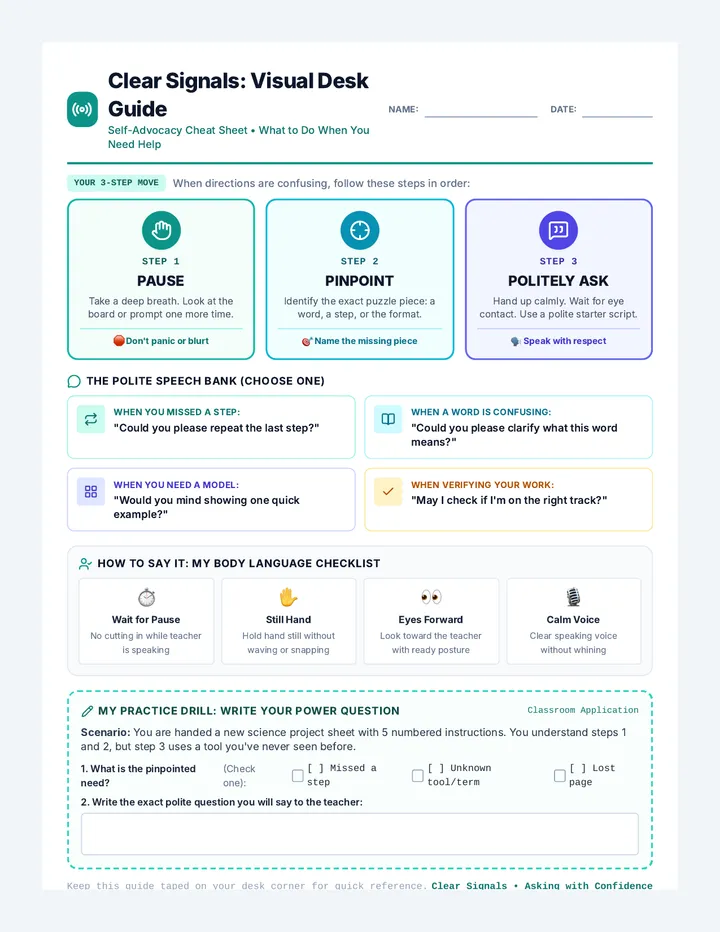
Clear Signals: Visual Desk Guide
Self-Advocacy Cheat Sheet • What to Do When You Need Help
Name:
Date:
Your 3-Step Move When directions are confusing, follow these steps in order:
Step 1
PAUSE
Take a deep breath. Look at the board or prompt one more time.
🛑 Don't panic or blurt
Step 2
PINPOINT
Identify the exact puzzle piece: a word, a step, or the format.
🎯 Name the missing piece
Step 3
POLITELY ASK
Hand up calmly. Wait for eye contact. Use a polite starter script.
🗣️ Speak with respect
The Polite Speech Bank (Choose One)
When you missed a step:
"Could you please repeat the last step?"
When a word is confusing:
"Could you please clarify what this word means?"
When you need a model:
"Would you mind showing one quick example?"
When verifying your work:
"May I check if I'm on the right track?"
How to Say It: My Body Language Checklist
⏱️
Wait for Pause
No cutting in while teacher is speaking
✋
Still Hand
Hold hand still without waving or snapping
👀
Eyes Forward
Look toward the teacher with ready posture
🎙️
Calm Voice
Clear speaking voice without whining
My Practice Drill: Write Your Power Question
Classroom Application
Scenario: You are handed a new science project sheet with 5 numbered instructions. You understand steps 1 and 2, but step 3 uses a tool you've never seen before.
1. What is the pinpointed need? (Check one): [ ] Missed a step [ ] Unknown tool/term [ ] Lost page
2. Write the exact polite question you will say to the teacher:
Keep this guide taped on your desk corner for quick reference. Clear Signals • Asking with Confidence