Career Launchpad Slides Preparing for College & Careers • Grade 8
Labor Market Intelligence
DATA-DRIVEN CAREER EXPLORATION
Career Launchpad:
Deciphering BLS & DWD Data
Learn how real-world economists track careers, evaluate wages, and predict tomorrow's fastest-growing industries.
Investigate
Discover job duties & salaries
Compare
National vs. regional demand
Plan Ahead
Align high school & degrees
The Big Picture
Why Not Just "Google It"?
Common Pitfalls
Guessing Your Future
Relying on social media influencers for salary expectations
Preparing for careers with shrinking workforce demand
Not knowing the required degree, debt, or licensure requirements
Result: Surprise barriers after high school graduation
Data-Driven Strategy
Using LMI Research
Actual median wages collected directly from employers
10-year job growth projections and annual openings
Clear prerequisite courses, certifications, and apprenticeships
Result: High school course choices that save you time & money
LMI = Labor Market Information: Hard statistical evidence about jobs, wages, and industries.
National Data Source
www.bls.gov/ooh
Bureau of Labor Statistics (BLS)
The federal agency inside the U.S. Department of Labor that measures labor market activity, working conditions, and price changes.
Primary Tool: Occupational Outlook Handbook (OOH)
What You Will Discover on BLS OOH:
Median Pay
The exact wage where half of workers earned more and half earned less.
Entry-Level Education
High school diploma, certificate, associate degree, or bachelor's degree.
10-Year Job Outlook
Projected % change in employment over a decade (Faster vs. Slower than average).
💡 Pro Tip: BLS profiles over 80% of all jobs in the United States economy!
State & Regional Data Source
State Workforce Agencies (e.g., Indiana DWD)
Dept of Workforce Development (DWD)
State government agencies that track local employer hiring trends, regional salary differences, and state-funded training programs.
Primary Tool: Hoosier Hot 50 / State In-Demand Rankings
Why Check State Data (DWD)?
Demand Star Ratings (1 to 5 Stars)
5-Star jobs have high local wages AND large numbers of regional openings.
Regional Industry Clusters
Biotech, advanced manufacturing, healthcare, or logistics near your hometown.
Next Level Jobs & Free Training
State grants that pay 100% tuition for qualifying high-demand certificates!
⚖️ Key Takeaway: BLS tells you what's happening nationwide; DWD tells you what's hiring down the road.
Data Literacy
How to Read the Stats
Median vs. Starting Salary
Don't expect the median wage on day one!
Starting (Entry 10%): What beginners earn right out of high school or college.
Median (50th percentile): What mid-career workers with 5-10 years of experience make.
Growth Rate vs. Openings
Both numbers matter when looking for future jobs!
Percent Growth: How fast an occupation expands (Average is about 3-4% over 10 yrs).
Annual Openings: New slots created by growth PLUS openings from retirements!
📌 Rule of Thumb: Look for fields with steady growth AND high replacement openings.
Research in Action
Two Different Pathways Compared
Pathway 1 BLS SOC: 15-1252
Software Developer
Designs computer applications & mobile software systems.
Median Pay: $132,270 / yr
10-Yr Job Growth: 17% (Much faster than avg)
Entry Education: Bachelor's Degree (4 yrs)
DWD Demand: ★★★★★ (5 Stars)
Pathway 2 BLS SOC: 47-2111
Electrician
Installs, tests, and repairs electrical power & wiring systems.
Median Pay: $61,590 / yr
10-Yr Job Growth: 11% (Faster than avg)
Entry Education: Apprenticeship (Paid training!)
DWD Demand: ★★★★★ (5 Stars)
Notice: Both have 5-Star demand , but their education, debt levels, and daily environments are completely different!
Student Mission
Career Detective Worksheet
Your Turn: 3 Steps to Completing Your Investigation
1
Select 2 Careers
Pick one career you already know and love, plus one unexpected career in a growing industry.
2
Gather Stats
Search BLS OOH and DWD portals to record median wage, growth percentage, and schooling needed.
3
Evaluate Fit
Compare pros, cons, required hard and soft skills, and lifestyle fit for your personal future.
🔍 Open your worksheets now and start with the BLS Occupational Outlook Handbook!
The Final Product
College & Career Roadmap
AFTER YOUR RESEARCH IS DONE
Transforming Data into Action
You will pick your favorite career option and draft your personal 4-Year High School & Postsecondary Plan.
Grade 9
Explore foundations & join career clubs (FFA, DECA, HOSA)
Grade 10
Select CTE pathway courses & explore job shadowing
Grade 11
Earn dual college credit & prep for entrance exams
Grade 12
Complete certifications, work-based learning, & applications
Ready to launch? Keep your research accurate, honest, and specific. Let's Get Started! →
Career Detective Worksheet Career Detective Worksheet
Preparing for College & Careers • Labor Market Analysis
Name:
Date:
Period:
Mission: Use the BLS Occupational Outlook Handbook (bls.gov/ooh) and your state DWD Labor Portal to investigate two careers that interest you. Record verified data below to make an informed comparison.
Data Metric
Career Option A
Career Option B
Official Job Title & SOC Code
National Career Cluster
BLS Median Annual Salary ($) 50% earn more, 50% earn less
$
$
BLS Median Hourly Wage ($)
$
/hr
$
/hr
BLS 10-Year Growth Rate (%) e.g., +8% (Faster than avg)
State DWD Demand / Star Rating Star level (1-5) or In-Demand status
Minimum Entry Education HS, Certificate, Associate, Bachelor's, Grad
Required Apprenticeship or License On-the-job training, state board exam, etc.
Projected Annual Openings New jobs + replacement retirements
Concept Check: Why does BLS report the median salary instead of the average ?
Explain in 1-2 complete sentences below:
Unit 1: Labor Market Exploration Page 1 of 2
Part II: Skills & Reality Check
Comparing Work Environment & Personal Fit
Option A: Core Duties & Environment
What do they actually do every day? (Indoors, field, travel, hours?)
Option B: Core Duties & Environment
What do they actually do every day? (Indoors, field, travel, hours?)
Essential Skills Comparison (List 2 Hard Skills & 2 Soft Skills for Each)
Career Option A Skills
Technical / Hard Skills (tools, coding, equipment):
Soft / Transferable Skills (communication, teamwork):
Career Option B Skills
Technical / Hard Skills (tools, coding, equipment):
Soft / Transferable Skills (communication, teamwork):
Part III: Synthesis & Decision Analysis
1. Education Investment vs. Earnings: Consider the years of schooling, training cost, and median salary. Which career appears to offer a better Return on Investment (ROI) for your lifestyle goals?
2. Data Surprise or Reality Check: What is one surprising fact you discovered in the BLS or DWD data (e.g., projected growth rate, work hours, licensing requirements)?
3. Selected Career for Capstone Plan: Which career will you focus on for your College & Career Roadmap, and what is the #1 reason for your choice?
College Career Roadmap College & Career Roadmap
Preparing for College & Careers • Postsecondary Action Plan
Name:
Date:
HS Grad Year:
Planning Objective: Connect your labor market findings into a concrete preparation strategy. Ground your high school coursework, certifications, and postsecondary education in real-world workforce requirements.
Section 1: Target Career Summary Based on BLS/DWD Data
Focus Career Title:
BLS SOC Code:
Median Annual Wage
10-Year Growth Rate
State Demand Rating
Personal Motivation ("My Why"): Why is this career an ideal match for your strengths and interests?
Section 2: Postsecondary Educational Route Training Beyond High School
Required Training Type (Check all that apply):
Registered Apprenticeship
Technical / Trade Certificate
Military Enlistment / Training
2-Year Associate Degree
4-Year Bachelor's Degree
Graduate / Medical / Law
Target School / Program #1:
Target School / Program #2:
Key Industry Certifications / State License Required:
Funding Strategy (Scholarships, Grants, 21st Century, Savings):
Preparing for College & Careers • Four-Year Educational Blueprint Page 1 of 2
Part II: High School Course Matrix (Grades 9–12)
Prerequisites & Pathway Planning
Target Diploma Type:
Standard / Core 40
Technical Honors
Academic Honors
Grade 9: Foundation Year Freshman
Core Academics & Key Math/Science:
Intro CTE / Career Elective:
Club / Activity to Join (FFA, DECA, HOSA, etc.):
Grade 10: Concentrator Year Sophomore
Pathway Concentrator Course A:
Career Exploration Activity (Job Shadow / Fair):
Academic Target / GPA Goal:
Grade 11: Acceleration Year Junior
Pathway Concentrator Course B:
Dual Credit / AP College Prep Course:
Postsecondary Visits / College Search Milestone:
Grade 12: Transition Year Senior
CTE Capstone / Work-Based Learning:
Target Credential / Certification Exam:
Applications & Financial Aid (FAFSA):
Immediate Next Steps: My 8th Grade Commitments
Write 2 specific actions you will take before the end of middle school to prepare for this pathway:
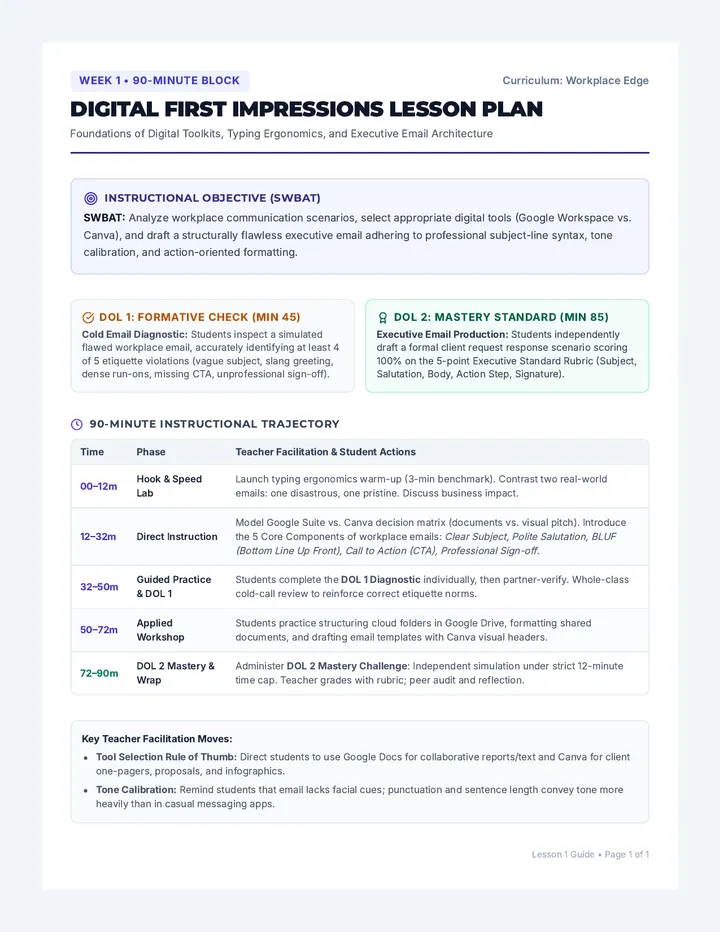
Career Launchpad Facilitator Guide Career Launchpad Facilitator Guide
Teacher Instructional Framework • Grade 8 PCC
Instructional Sequence
3-Day Modular Unit
Unit Pacing & Activity Flow
Day 1: Direct Instruction
Present Career Launchpad Slides . Model live queries in BLS OOH and your state DWD portal. Deconstruct median vs. entry wage.
Day 2: Career Investigation
Distribute Career Detective Worksheet . Students independently or in pairs research 2 careers (one familiar, one emerging/unfamiliar).
Day 3: Roadmapping
Students select their top pathway and complete the College Career Roadmap , aligning 9-12 high school courses, CTE electives, and postsecondary targets.
BLS OOH Navigation Tips
Direct students to bls.gov/ooh.
Use the "Select an Occupation by" dropdown (by pay, growth rate, or cluster).
Highlight the "Similar Occupations" tab if a student's chosen career has low projected growth.
DWD & Regional Data Tips
Search state-specific tools (e.g., Indiana INDemand Jobs / Hoosier Hot 50).
Emphasize that 4-Star and 5-Star occupations qualify for state tuition grants (Next Level Jobs).
Compare rural vs. metropolitan regional demand where applicable.
Anticipated 8th-Grade Misconceptions
"I'll earn the median wage immediately." Remind students median reflects 5-10+ years of experience; entry wages are typically 20-30% lower.
"A 4-year degree is always better than a trade." Highlight high-wage registered apprenticeships and 2-year technical degrees with zero student debt.
Student Portfolio Evaluation Rubric (20 Points Total) Worksheet & Roadmap
Criteria Exemplary (5 pts) Proficient (3-4 pts) Developing (1-2 pts) Data Accuracy (BLS & DWD) All data points (SOC, wages, outlook, stars) precisely cited from verified sources. Most data accurate; minor omissions or estimates without sources. Multiple fields missing or based on unverified internet claims. Comparative Analysis Deep, thoughtful contrast of work environment, hard/soft skills, and lifestyle ROI. Basic comparison provided; skills identified with limited detail. Superficial answers; does not distinguish differences between options.