Yet Power Anchor Chart
Mindset Playbook Level Up!
The Yet Power
How to stretch your brain when things get tough!
Explorer:
Date:
Mindset Makeover: Flip the Script!
Stuck Talk (Fixed)
“
I can’t do this!
“
This is way too hard.
“
I made another mistake.
Yet Talk (Growth)
“
I can’t do this YET!
“
This is stretching my brain to grow bigger!
“
Mistakes mean my brain is practicing!
Remember: A hard problem is like a heavy dumbbell in a gym. It's not supposed to feel easy. If it's heavy, your muscles (and your brain) are growing!
The Stuck Solver: Step-By-Step
1
Reread & Look
Read the directions one more time. Look for hints, board notes, or visual examples.
2
Try Something
Write down whatever you think is the first step. Even an incorrect try is a useful clue!
3
Ask with Power
Use a specific request! Don't just say "I can't do this." Name what you tried!
Stuck-Buster Script Bubbles:
If you need another approach:
"Could you please show me a different way to think about this part?"
If you're stuck in the middle:
"I got stuck after trying this step. Can you help me find the next move?"
Unit: Self-Advocacy & Resilience Post it • Read it • Practice it
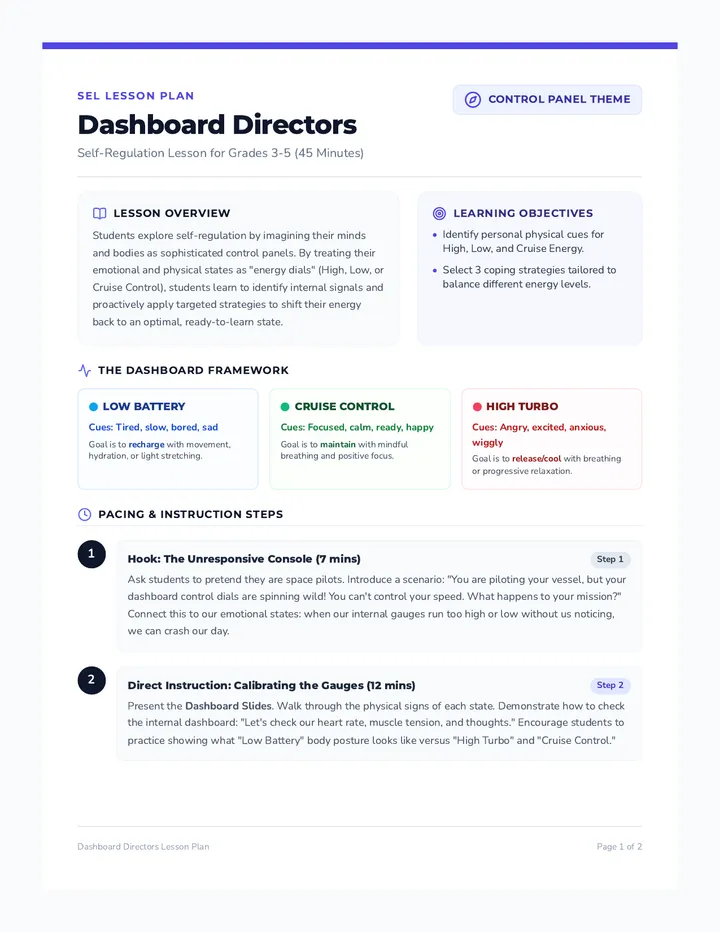
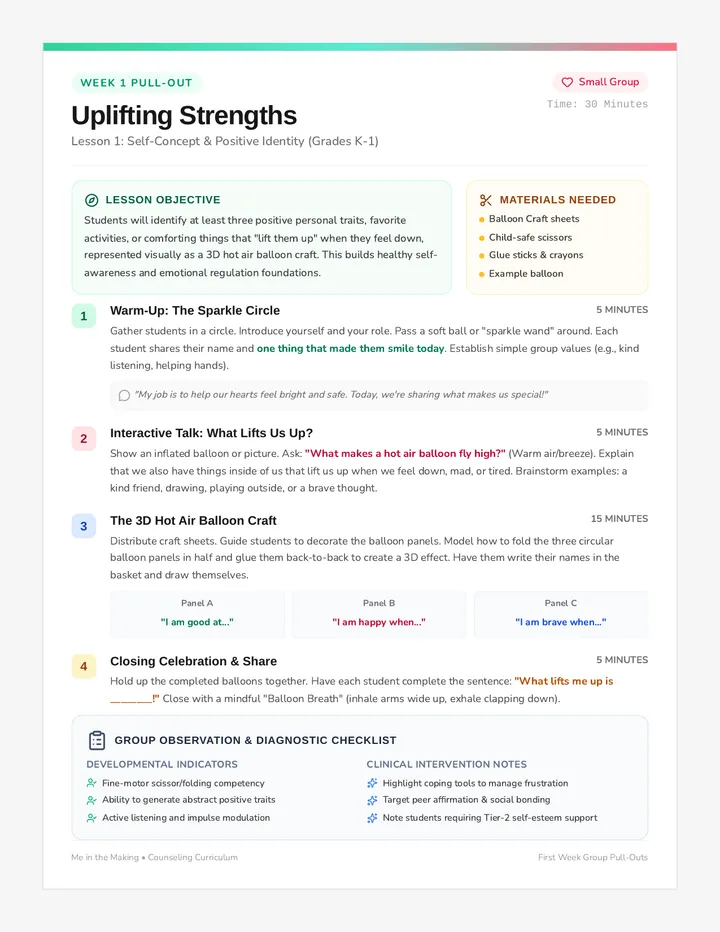
Brain Stretchers Facilitation Guide
Facilitator Tool Small Group Intervention
Brain Stretchers Guide
Step-by-Step Facilitation Guide • Focus: Yet Power & Self-Advocacy
Duration: 30 Minutes
Group Size: 1 to 6 Students
Materials Needed: Anchor Chart, Paper
Lesson Purpose & Goals
Students frequently hit points of academic frustration and default to negative self-talk ("I can't do this"). This lesson is engineered for small-group instruction led by paraprofessionals to explicitly train students in (1) flipping the mental script using "YET", and (2) applying a 3-step actionable sequence to ask for support instead of shutting down.
1
Preparation & Materials Checklist
One printout of the Yet Power Anchor Chart
One blank sheet of paper per student
Pencils and one color highlighter per student
Positive attitude & supportive small-group table
2
The Hook: Origami Crumple Challenge (10 Mins)
FRUSTRATION TRIGGER
The goal is to briefly put students in a mildly challenging situation to experience "stuck" emotions in real-time, then label them.
Action:
Give each student a blank square sheet of paper. Tell them: "We are going to make a highly complex, 24-step origami jumping frog without talking. Ready? Fold!"
The Twist:
Give them three incredibly fast, confusing verbal directions (e.g., "Fold the bottom corner to the opposite third, then double pinch the vertical crease..."). Allow them to struggle for 45-60 seconds.
Intervene Before Real Tears/Meltdowns:
"Stop! Take a deep breath. Crumple your paper into a loose ball, but don't throw it. Keep it in your hands."
🗣️ Facilitator Script:
"When I gave those directions, what went through your mind? Did anyone feel like saying 'I can't do this'? That crumpled paper is exactly what our brain feels like when it is trying to grow. Let's unfold our papers. Look at those creases—those are neural pathways stretching! Let's learn how to guide that stretch."
Brain Stretchers Facilitation Guide Page 1 of 2
Facilitator Tool Skills Application
Active Coaching Guide
Interactive Walkthrough • Practice Scenarios • Adult Scaffolding Prompts
3
Interactive Chart Walkthrough (10 Mins)
Introduce the Yet Power Anchor Chart to students. Point directly to the sections as you speak.
Introduce the Makeover: Let's read the first column ("Stuck Talk"). When you say "I can't do this!", your brain locks up. Highlight the word YET on your charts. Say it out loud together. Practice whispering it, then shouting it.
Deconstruct "The Stuck Solver": Point to Step 1 & 2 on the chart. "Before you call for help, what should you do?" Guide them to locate the "Reread & Look" and "Try Something" steps. Emphasize that making a wrong fold or drawing a bad circle is still an attempt!
Script Play: Choose two students to read the "Stuck-Buster Script Bubbles" out loud using their most confident voices.
4
Practice Scenarios (10 Mins)
SKILLS APPLICATION
Provide students with these quick real-life scenarios. Have them act out the "Stuck" behavior, then use the Anchor Chart to correct it!
Math Obstacle
Scenario: You're doing subtraction and forget where to regroup. You throw your pencil down and cross your arms.
Fix: Try 1 step, then use Script Bubble 2.
Writing Block
Scenario: You have to write a topic sentence for a summary. Your page is blank. You say "I don't know what to write."
Fix: Reread prompt, use Script Bubble 1.
Real-Time Scaffolding Toolkit (For You)
When supporting students during independent work, never give them the answer immediately. Use these tiered questions instead:
Tier 1: Redirect "Show me what your chart says step 1 is. Did we read the top directions?"
Tier 2: Isolate "Point to the exact word or step where you got stuck. What happened right before?"
Tier 3: Script "I want to help! Use one of our Script Bubbles to tell me what you need."
Brain Stretchers Facilitation Guide Page 2 of 2