Emotion Thermometer Lesson Plan Am I Overreacting
Lesson Plan: Emotion Thermometer
Duration
45 Minutes
Grade 6 • Tier 1 Instruction
Why This Matters
Understanding emotional intensity helps students develop proportional responses, manage feelings effectively, and avoid unnecessary escalation, leading to healthier interactions and better problem-solving.
Learning Objective
Students will be able to identify different levels of emotional intensity and match their reactions to the size of a given problem.
Prep (15 min)
Review the Emotion Thermometer Lesson Plan.
Set up Big Problem, Big Feeling Slides.
Prepare scenarios for the Size of the Problem activity.
Ensure whiteboard/projector is functional.
Materials
Whiteboard or projector
Markers or pens
Big Problem, Big Feeling Slides
Size of the Problem Scenarios
When Is It Too Much Discussion
Instructional Steps
5'
min
Warm-Up: How Are You Feeling?
Begin by asking students to share one word that describes how they are feeling today. No explanation needed. Introduce the concept of emotions having different "sizes" or "intensities."
10'
min
Introducing the Emotion Thermometer
Use the Big Problem, Big Feeling Slides. Explain that like temperature, emotions range from cool (small) to hot (big).
Discuss small problems (missing pencil) vs. big problems (serious argument).
Match emotions to thermometer levels (Annoyed = 2, Frustrated = 5, Furious = 9).
15'
min
Activity: Size of the Problem Scenarios
Distribute or display the scenarios. In groups or individually, students identify:
The size of the problem (Small, Medium, Large).
A proportional reaction (How would they feel/what would they do?).
Encourage discussion on why certain reactions fit the problem size.
10'
min
Class Discussion: When Is It Too Much?
Lead a discussion using prompts from the worksheet. Focus on what happens when reactions are bigger than problems and strategies to respond proportionally.
"It's okay to feel big emotions, but the key is how we choose to react."
5'
min
Cool-Down: One Takeaway
Each student shares one strategy or idea they learned about emotional regulation. Reinforce that these skills help everyone navigate challenges effectively.
Big Problem Big Feeling Slides Am I
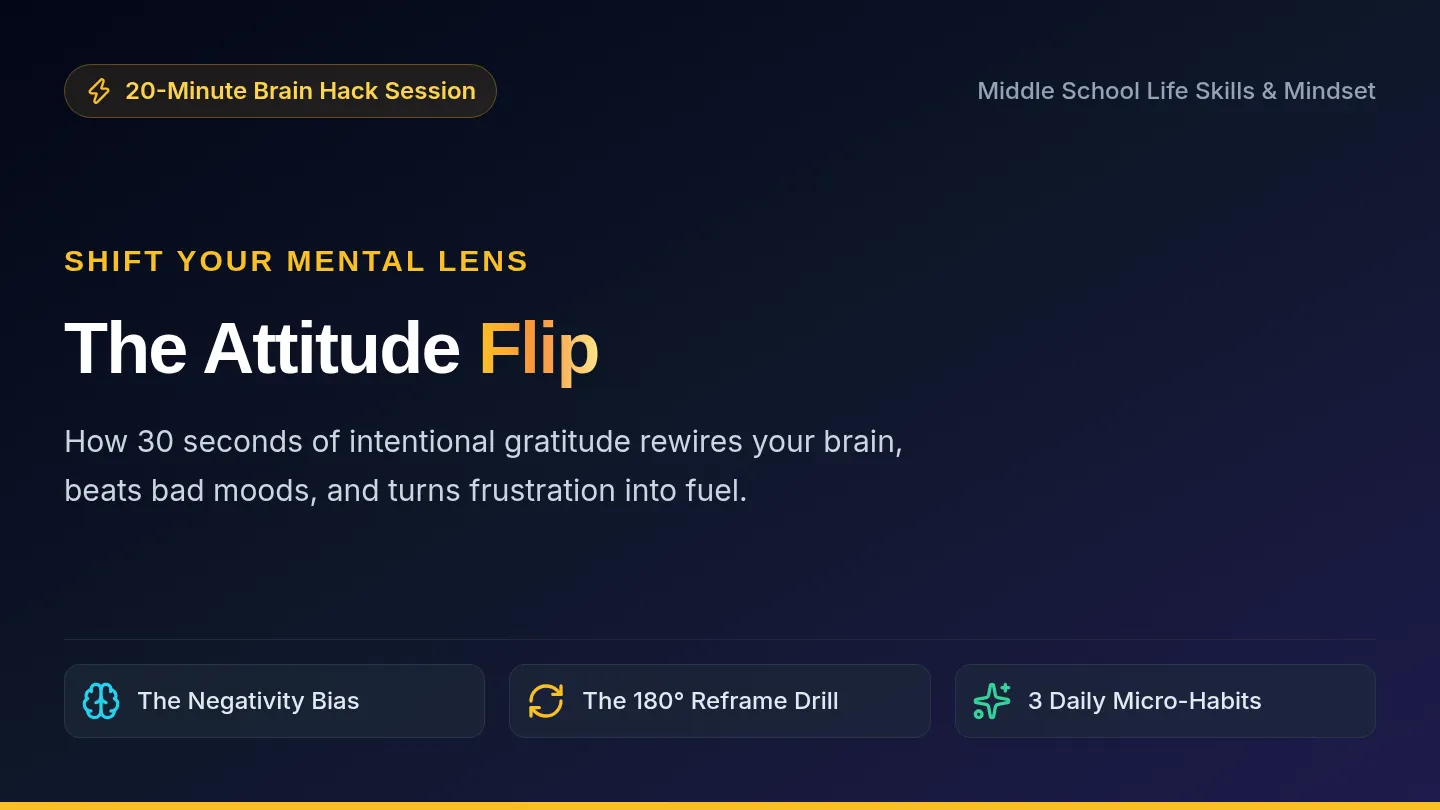
Overreacting?
Understanding Emotional Intensity & Proportional Reactions
Grade 6 SEL Strategy
How do YOU feel today?
Emotions Have a "Size"
Just like problems, our feelings can be big or small.
Have you ever felt...
A little annoyed?
Really, really angry?
What's the
Teacher Note: Introduce the idea that emotions aren't just 'good' or 'bad' but have different strengths.
The Emotion Thermometer
10
8
5
3
1
8-10: Big Problem, Big Feeling
Serious argument, heartbroken, furious.
4-7: Medium Problem, Medium Feeling
Friend cancels plans, feeling frustrated.
1-3: Small Problem, Small Feeling
Forgetting a pencil, feeling a little annoyed.
Our reactions should match the "temperature" of the problem.
Why Does It Matter?
When our reactions match the size of the problem, things go more smoothly.
Solve problems more easily
Avoid making things worse
Feel more in control
Think About It...
Small Problem +
Big Problem +
Let's Practice!
We're going to look at some different situations. For each one, ask yourself:
1
How big is this problem?
Small, Medium, or Big?
2
How would I feel?
Use the Thermometer
3
What is a proportional reaction?
What would I do/say?
You've Got This!
It's okay to feel your feelings! The goal is to choose reactions that fit the situation.
Final Reflection:
What is one thing you will remember from today?
Size of the Problem Scenarios Size of the Problem
Student Name
Date
Instructions:
Read each scenario below. Decide if it's a Small Problem (1-3), Medium Problem (4-7), or Big Problem (8-10) on the Emotion Thermometer. Then, describe how you might feel and what a proportional (fitting) reaction would be.
1
Missing Homework
You realize you left your completed math homework at home on your desk, and it's due today.
Size of the Problem
How I Might Feel
Proportional Reaction
2
Broken Toy
Your younger sibling accidentally breaks your favorite toy that you've had for a long time.
Size of the Problem
How I Might Feel
Proportional Reaction
3
Spilled Milk
At lunch, you accidentally knock over your milk carton, and it spills all over your tray and a little on the table.
Size of the Problem
How I Might Feel
Proportional Reaction
4
Friend is Upset
You accidentally hurt your friend's feelings by saying something without thinking, and now they are really quiet and look sad.
Size of the Problem
How I Might Feel
Proportional Reaction
5
Group Project Disagreement
Your group for a class project can't agree on an idea, and everyone is getting frustrated, making it hard to start the work.
Size of the Problem
How I Might Feel
Proportional Reaction
When Is It Too Much Discussion When Is It Too Much?
Student Name
Date
Class Discussion Guide
Let's explore how our reactions affect ourselves and others. Use the space below to record your personal thoughts and key ideas from our group discussion.
1. What does it mean to "overreact" to a problem? Can you think of a general example?
2. Why do you think people sometimes react with a bigger emotion than the problem calls for? What makes it hard to match our reaction?
3. What happens when someone overreacts to a small problem? How does it affect them and the people around them?
4. What are some strategies you can use to calm down or think before reacting when you feel a "big" emotion starting for a "small" problem?
5. Is it ever okay to have a big emotion for a small problem? When might that be the case?
6. How can practicing "proportional reactions" help you in school, at home, or with friends?
Pro Tip:
Take a deep breath and count to five before responding to a level 1-3 problem. It gives your brain time to catch up to your feelings!