The cue column turns your notebook into instant flashcards.
Zone 3 in Action
Sentence 1: The Core Claim
What is the absolute main concept or discovery discussed in this section?
Sentence 2: The "So What?"
Why does this matter, or what does it explain about how the world works?
Example Summary:
"Deep sea creatures adapt to total darkness using chemical bioluminescence for hunting, defense, and mating. Without this adaptation, complex life could not survive in the high-pressure midnight zone."
Never just list topics ("I learned about sleep"). State the actual conclusion!
Superpower Routine
1
Fold your paper backward along the vertical dividing line so only Zone 1 shows.
2
Read each cue question aloud and answer from pure memory without peeking.
3
Unfold to verify your recall. Put a star next to anything you missed and repeat tomorrow.
Now open your Practice Packet: Page 1 Mentor Text. 5 Minutes a day = A's on unit exams.
One leading explanation is memory consolidation. During waking hours, the brain absorbs sensory data in short-term storage (the hippocampus). During sleep, neural replay transfers critical lessons and skills into long-term cortical networks while pruning away trivia, similar to defragmenting a computer hard drive.
A second key role is emotional calibration. In REM sleep, neurochemicals like noradrenaline (the stress chemical) plummet to near-zero levels. This unique state allows the brain to process traumatic or distressing memories without the physical feeling of panic, effectively "taking the sting out" of painful experiences.
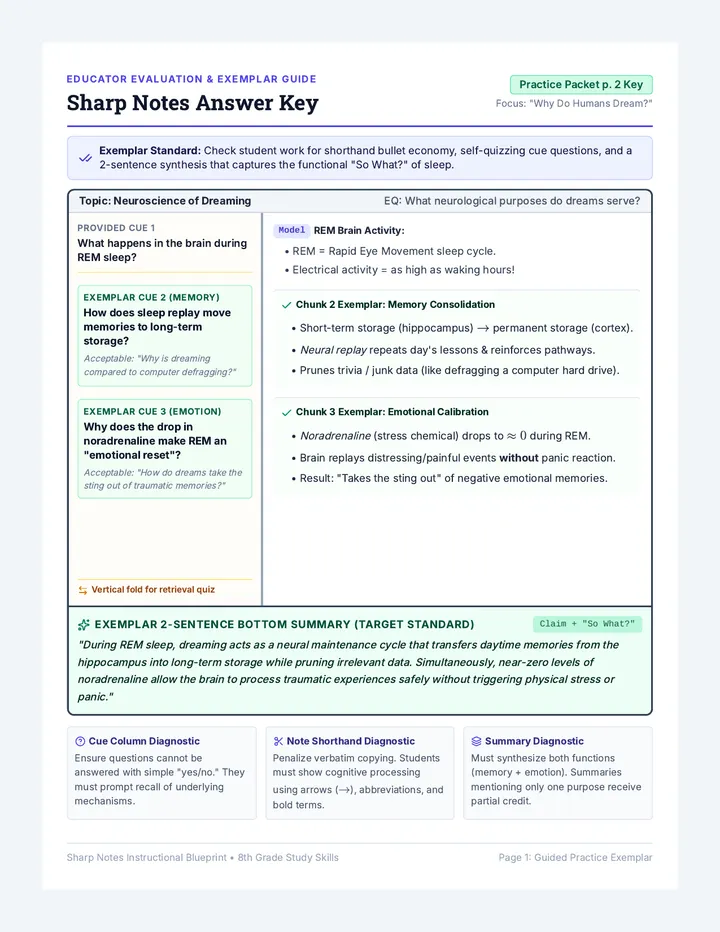
Topic: Neuroscience of Dreaming EQ: What neurological purposes do dreams serve?
Scaffolded Cue (Model)
What happens in the brain during REM sleep?
Your Cue 2 (Memory Theory)
Write a test question about how sleep saves memories:
Your Cue 3 (Emotional Reset)
Write a test question about stress chemicals in REM:
Fold line: |
Sample REM Brain Activity:
Take Bullets: Memory Consolidation (Use abbreviations/symbols):
Take Bullets: Emotional Calibration & Stress Chemicals:
Bottom Summary (Complete 2 Sentences: Main Claim + "So What?") No filler words
Sharp Notes • 8th Grade Study Skills Page 2: Guided Practice
Part 3: Independent Application
Independent Use
Topic:
Class/Subject:
Essential Question:
Zone 1: Cues & Questions
Write 3–4 test questions that your right-side notes answer.
Zone 2: Notes & Evidence Bullets • Symbols • Indents
Capture key terms, cause & effect (\(\rightarrow\)), and main facts.
Zone 3: Big-Picture Summary (2 Sentences) Sentence 1: Central Finding | Sentence 2: Significance
Self-Monitoring Quality Checklist (Check each box before turning in)
Brevity: No long run-on sentences; notes rely on abbreviations and bullet fragments.
Question Quality: Left column cues serve as quiz prompts without reading the answers.
True Synthesis: Summary captures the "So What?" instead of merely restating bullet points.
Fold & Test Ready: Paper can be folded vertically to self-quiz without seeing notes.
Sharp Notes • 8th Grade Study Skills Page 3: Independent Template
Assessment & Feedback Guide
Formative & Summative Scoring
| Criterion | 1 • Incomplete / Novice | 2 • Developing | 3–4 • Proficient & Exemplary |
|---|---|---|---|
| Zone 1: Cue Formulation (Left Column) | Left column blank, or contains only passive topic tags (e.g., "Memory", "Sleep"). | Questions are surface-level or simple yes/no prompts that do not foster active recall. | Creates robust, inquiry quiz questions testing causal mechanisms without revealing answers. |
| Zone 2: Shorthand & Economy (Right Column) | Copies verbatim full sentences; no indentation, bullets, or visual hierarchy. | Uses bullets but writes narrative clauses; relies minimally on symbols or abbreviations. | Aggressive shorthand: concise fragments, clear hierarchy, symbols (\(\rightarrow\), \(\Delta\)), and bold terms. |
| Zone 3: Synthesis Summary (Bottom Box) | Omitted entirely, or writes a vague non-statement (e.g., "This text was about sleep"). | Merely repeats bullet #1 or only addresses one subtopic; lacks big-picture cohesion. | Concise 2-sentence synthesis integrating both concepts and explaining cognitive significance. |
Non-Exemplar Sample (Score: 1.5) Common Pitfall
Cue: Dreams and memories?
Notes: During waking hours the brain absorbs sensory data in short-term storage which is the hippocampus and then sleep moves it.
Summary: Dreams are when our brain sleeps and it helps us remember things and not be sad.
Critique: Cue is a vague phrase rather than a study question; notes copied word-for-word; summary misses scientific terminology.
Exemplar Sample (Score: 4.0) Mastery Model
Cue: How does neural replay defrag memory during REM?
Notes: • Short-term (hippocampus) \(\rightarrow\) long-term (cortex)
• Prunes trivial info; protects key lessons
Summary: REM sleep preserves crucial learning through cortical transfer while chemically buffering against emotional trauma.
Commendation: High-utility test question; compressed bullet structure; sophisticated vocabulary synthesis linking both pillars.
For Passive / Copied Notes:
"Rule of 5: Compress each bullet point to 5 words or fewer. Replace linking phrases with arrows (\(\rightarrow\)) and abbreviations."
For Vague Cue Columns:
"Turn your topic tags into quiz prompts. If your cue doesn't start with 'How', 'Why', or 'What causes', rewrite it!"
For Disconnected Summaries:
"Use the synthesis formula: Sentence 1 answers the EQ; Sentence 2 explains why this finding matters in the real world."
For Fold-and-Test Readiness:
"Fold your sheet down the vertical line. Quiz your partner using only your cue questions for 2 minutes to verify note quality."
Sharp Notes Instructional Blueprint • 8th Grade Study Skills Page 2: Rubric & Feedback Stems