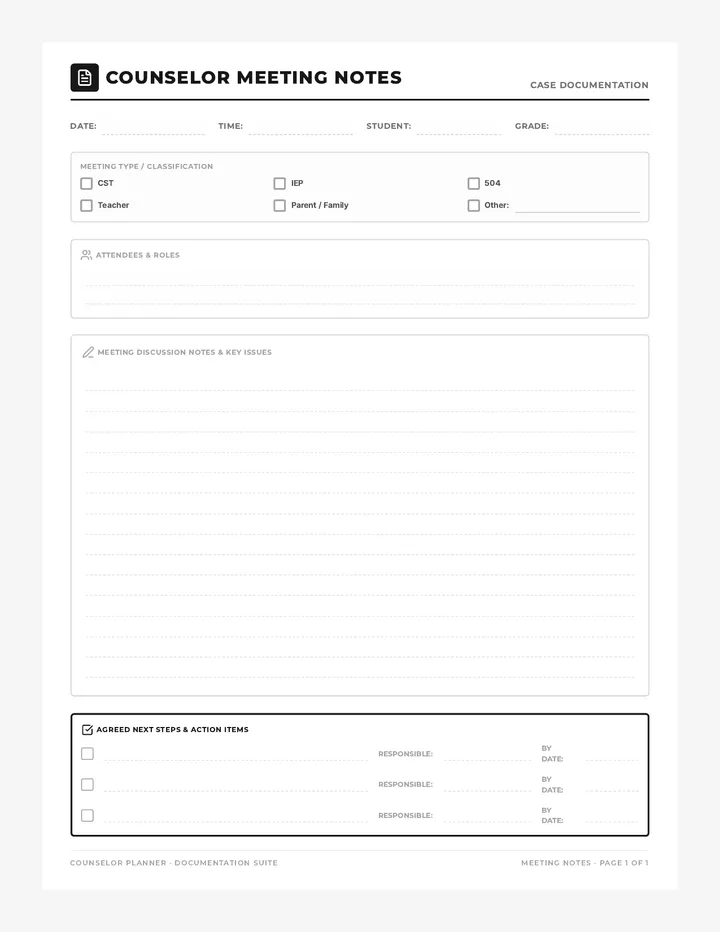
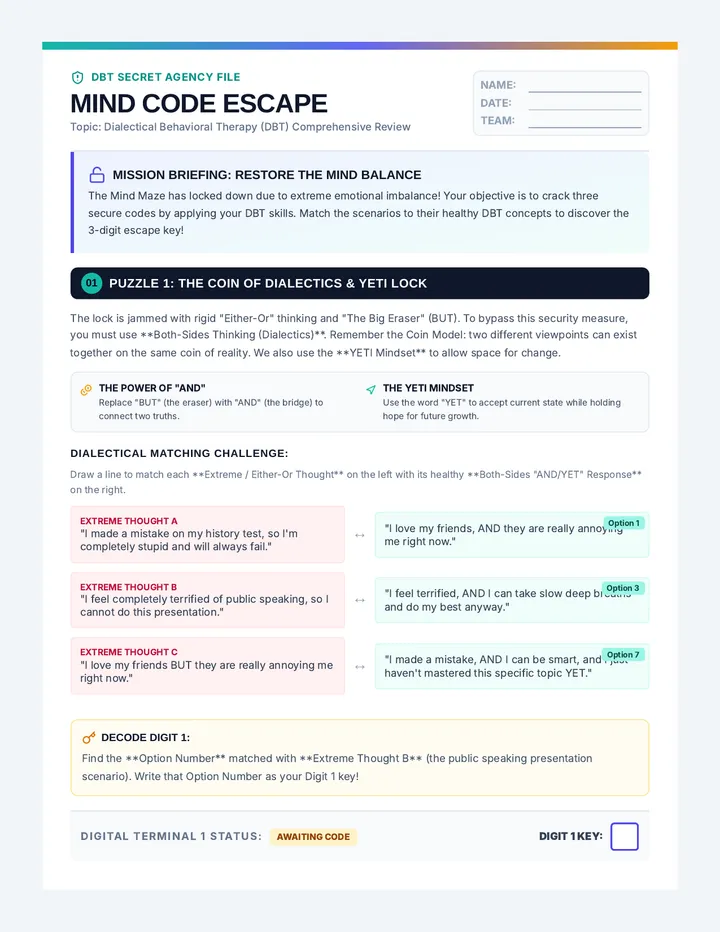
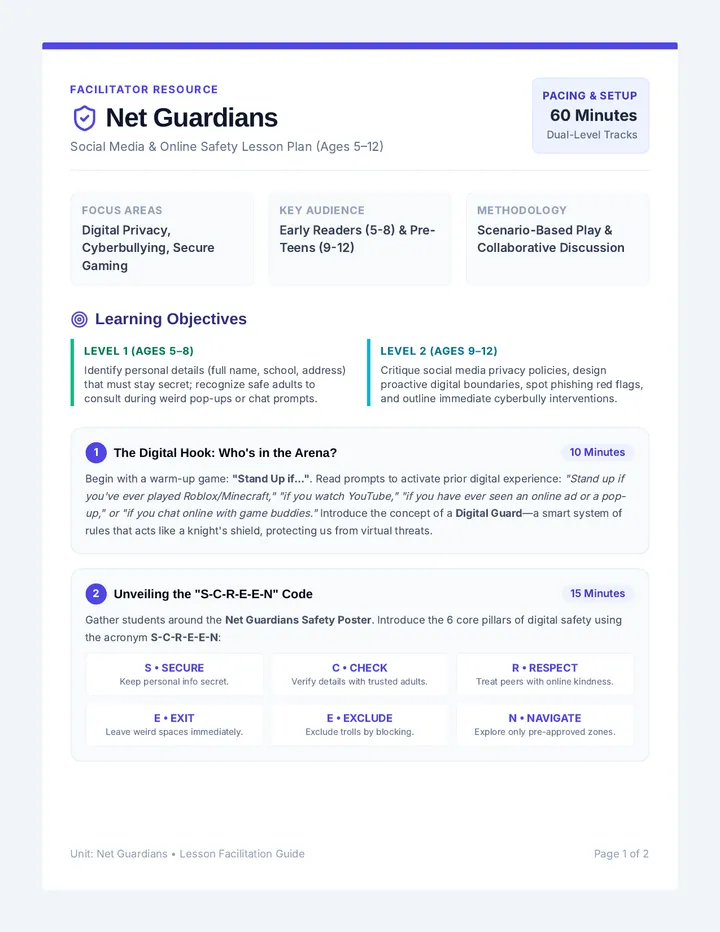
Body Map Worksheet Body Map of Resistance
Lesson 1: Somatic Signs of Resistance
Name:
Date:
LABEL YOUR SENSATIONS ON THE BODY MAP
Instructions
Color in or mark the areas where you felt tension during the "Body Freeze" activity. Use different symbols or colors for tightness , heat , numbness , or shaking .
The Resistance Radar
1. Where was the strongest feeling?
2. Describe the feeling (clenched, hot, heavy, etc.):
3. What "Bad News" was playing in your head?
The Somatic Connection
"Resistance is like a 'No' from your body. Before your brain even speaks, your muscles often signal that you aren't ready to accept what is happening."
Check any others you noticed:
Short breath
Tight jaw
Fists clenched
Heavy chest
Fast heart rate
Stiff neck
Reflection: Mind-Body Warning System
If your body was a car's dashboard, what "check engine light" usually comes on first when you are resisting a situation?
Somatic Signs Slides Somatic Signs of Resistance
Learning how your body says "NO" before your mind does.
Somatic Strategies Workshop
The "Body Freeze" Hook
Imagine this scenario...
You just found out your favorite event was cancelled. Your first thought is:
"NO! This isn't fair! I refuse to let this happen!"
INSTRUCTION: Freeze exactly where you are right now. Don't move a muscle!
While Frozen, Scan Your:
Jaws (Are they clenched?)
Hands (Are they fists?)
Shoulders (Are they near your ears?)
Breath (Is it shallow or fast?)
"Somatic" = Body
Your body has its own language for stress.
The Wall
Your body builds a "physical wall" of tension to keep the bad news out.
The Alarm
This tension is a warning signal. It tells your brain: "I am in danger!"
The Loop
Tense body = Anxious brain. Anxious brain = Tense body. It's a cycle!
Radical Acceptance
Accepting reality exactly as it is, without trying to fight it or hide from it.
"Acceptance does not mean you like it. It means you stop fighting it."
Why start with the body?
It is almost impossible to accept something mentally if your body is in a "Fight" posture.
To change the mind, we first change the body.
Activity: The Body Map
Finding your personal check-engine lights.
1
Close your eyes and recall a time you were really resisting something.
2
Where did you feel the "heat" or the "tightness" in your body?
3
Mark those spots on your Body Map Worksheet.
Sensation Legend Ideas:
Heat / Fire
Icy / Numb
Tingling
Heavy / Rock
Resistance Recognition Teacher Guide Teacher Facilitation Guide
Lesson 1: Somatic Signs of Resistance
7th Grade | Counseling
Objective
Students will identify their personal physical "warning signs" of resistance to difficult news or emotions, creating a somatic baseline for radical acceptance practice.
Pacing
Total: 45 Minutes
Hook (Freeze): 10 min
Direct Instruction: 10 min
Body Mapping: 15 min
Reflection: 10 min
Key Concept: The Feedback Loop
"Our bodies are not just containers for our feelings; they are active participants in creating them. When we physically resist (clench, tighten), we signal to the amygdala that we are under threat, making mental acceptance nearly impossible."
Activity 1: The Body Freeze (The Hook)
Teacher Script
"I'm going to describe a scenario. As I describe it, I want you to let your body react naturally. When I say 'FREEZE', I want you to hold your exact position, like a statue. Ready? Imagine you just opened an envelope or saw a text... your favorite concert or sports event has been cancelled. There's no refund, and your parents say you can't go to the next one either. You feel that 'No!' building up inside you... FREEZE."
Guiding Questions
"Without moving, where do you feel the most 'locked up'?"
"Is anyone holding their breath? That's the first sign of resistance."
"Who has their fists clenched? Who has their teeth pressed together?"
Activity 2: Body Mapping
Distribute the Body Map Worksheet . Encourage students to use colors to represent different intensities or types of sensations.
Common Misconceptions
Students may think "tension" only means muscles. Remind them to look for temperature (feeling hot), internal sensations (butterflies), or even "numbness" as signs of resistance.
Differentiation
For students who struggle to identify internal sensations, offer specific prompts: "Is your stomach tight like a knot or fluttery like a wing?"
Debrief & Wrap Up
The Big Takeaway:
"Your body is like an early warning system. Today we learned how to read the dashboard. In the next few lessons, we'll learn how to 'turn the steering wheel' to move from resistance to acceptance."
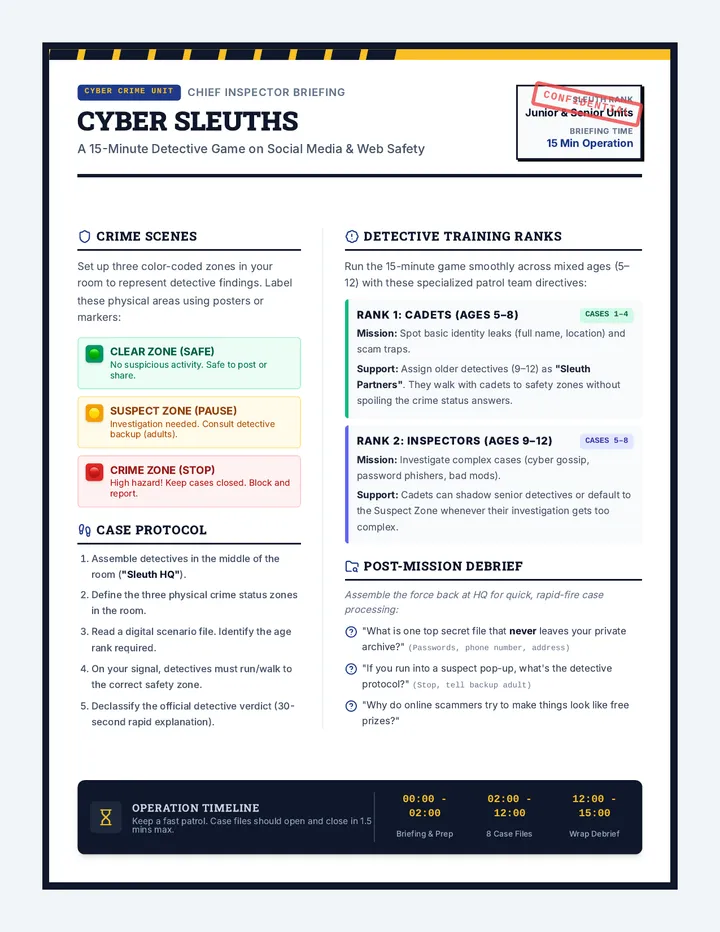
Half-Smile Slides The Half-Smile Technique
Hacking your brain's safety signals through the muscles in your face.
Somatic Strategies: Lesson 2
The Pencil Challenge
How to do it:
Place a pencil sideways between your teeth (don't bite hard!).
Make sure your lips don't touch the pencil. This forces your "smile muscles" to engage.
Hold this for 60 seconds while we look at some images.
Does the cartoon seem funnier now?
Science says it might!
Facial Feedback Loop
Your face is a two-way street.
BRAIN
Feels happy or feels stressed.
FACE
Smiles or frowns.
Trigeminal Nerve
When your brain is stressed, it makes your face tense. But when you manually change your face, it sends a signal back: "Hey Brain, we must be safe. Look at our face!"
The Half-Smile Steps
01
Relax all your facial muscles.
02
Let your lips go slightly apart.
03
Up-turn the corners of your mouth just a tiny bit.
It's a "Mona Lisa" smile.
It shouldn't be a big, fake grin. People shouldn't even necessarily know you are doing it. It's for YOU, not them.
Pro Tip:
"Imagine your face is a calm lake."
Practice Simulation
The Stressor:
"Listen to this annoying sound (high pitched beep) or imagine you are late for something important. Feel that tension in your forehead and jaw."
Your Mission:
Drop your jaw.
Relax your eyes.
Adopt the Half-Smile.
Notice if the "urgency" changes.
Smile Science Activity Sheet Smile Science Experiment
Lesson 2: The Half-Smile Technique
Name:
Date:
1
Phase 1: The Baseline
Current Mood Radar
Before we start, how are you feeling on a scale of 1-10?
Stressed
Calm
The Prediction
Do you think forcing a smile will actually change your mood?
2
Phase 2: The Pencil Challenge
OBSERVATION LOG (While pencil is in teeth)
Describe the feeling in your cheeks and eyes after 30 seconds:
When you look at a neutral image (or out the window), does it feel "lighter" or the "same"?
3
Phase 3: The Half-Smile Master
Now, remove the pencil. Try the "Mona Lisa" Half-Smile (small, upturned corners, relaxed face). Practice this during a mild stressor (like holding your breath or a loud noise).
Final Reflection
Could you use a Half-Smile to "trick" your brain during a test or an argument? Why or why not?
The Science Fact
The Trigeminal Nerve detects facial muscle movement and reports it directly to the brain's emotional center. A smile—even a tiny one—sends a "safe" signal that inhibits the fight-or-flight response.
Facial Feedback Teacher Guide Teacher Facilitation Guide
Lesson 2: The Half-Smile Technique
7th Grade | Counseling
Objective
Students will understand the bidirectional relationship between facial expression and emotion, and demonstrate the "Half-Smile" as a tool to modulate autonomic stress responses.
Pacing
Total: 45 Minutes
Pencil Challenge: 15 min
Science Discussion: 10 min
Half-Smile Practice: 10 min
Application Simulation: 10 min
Activity: The Pencil Challenge
Logistics Note
Ensure students have clean pencils. If pencils aren't available, students can use their index fingers horizontally between their teeth.
The Experiment Script
"The brain and face talk to each other constantly. We're going to use the pencil to 'lie' to the brain. By holding it with your teeth and NOT touching it with your lips, you engage the zygomaticus major—the primary smile muscle. Hold this for 60 seconds while looking at these images of neutral landscapes or slightly boring cartoons."
Observation Tip:
"Ask students if the images seem more pleasant or if they feel a slight 'buzz' of positivity that doesn't match their actual thoughts."
Skill: The Half-Smile (Internal Smile)
Transition from the forced pencil smile to the subtle Half-Smile. Explain that this is a distress tolerance skill, not an acting skill.
Instructions for Students
"Adopt a serene facial expression. If you've seen a statue of the Buddha or the Mona Lisa, that's the vibe."
"Up-turn the corners of your mouth just 1 millimeter. It's so small that if someone was looking at you, they might not even notice."
"Pair it with a soft jaw. Let your teeth be slightly apart behind your lips."
Simulation: Under Pressure
To test the skill, create a mild stressor in the room. This helps students move from "calm practice" to "real-world application."
Simulation Ideas:
The Annoying Beep: Play a slightly annoying, persistent sound for 60 seconds. Instructions: "Accept the sound. Use the Half-Smile to tell your brain the sound is not a threat."
The Breath Hold: Have students hold their breath (safely, for 15-20 seconds). Instructions: "Notice the panic build. Use the Half-Smile to soften the edges of that panic."
Troubleshooting
"This feels fake/stupid."
Response: "It IS fake! We are literally hacking your nervous system. You don't have to believe in the smile for the muscles to send the signal to your brain."
Willing Hands Slides Willing Hands & Open Posture
Changing your stance to change your chance of staying calm.
Somatic Strategies: Lesson 3
The Body's Vocabulary
Closed
Arms crossed tight
Fists clenched
Shoulders hunched
Legs tightly crossed
"I am fighting reality."
Open
Arms relaxed at sides
Palms turned upward
Chest un-shielded
Uncrossed feet
"I am accepting reality."
Willing Hands
This is a specific posture where you place your hands with palms facing up and fingers relaxed.
If Standing:
Arms by your sides, palms turned slightly forward and outward.
If Sitting:
Hands resting on your thighs, palms facing the ceiling.
"You cannot catch a ball with a clenched fist.
You cannot catch new information with a closed heart."
The "Argument" Challenge
Try to have a heated argument with someone while lying on your back with your palms up.
Hard to be angry?
Your brain gets confused when the posture doesn't match the emotion.
The Discovery
Posture can force the brain to downshift into acceptance.
Safety Signal
Palms up is an ancient sign of "I have no weapons."
Activity: Posture Roleplay
1
Work with a partner. One person is the "News Giver," one is the "Receiver."
2
Round 1: Receive bad news in a CLOSED posture.
3
Round 2: Receive the same news with WILLING HANDS.
Ask Yourself:
"Did the news feel 'heavier' in the closed posture? Did it feel more 'possible to handle' in the open posture?"
Mind
Body
Willing Hands Role-play Cards Willing Hands Roleplay Cards
Practice shifting from Resistance to Acceptance
Scenario A
The Surprise Quiz
"Your teacher just announced a pop quiz on the chapter you forgot to read last night. It's worth 20% of your grade."
The Receiver's Task:
First, respond with Closed Posture (crossed arms, scowl). Then, shift to Willing Hands (palms up, deep breath). Notice the difference in your panic levels.
Scenario B
The Wi-Fi Outage
"You are in the middle of a gaming match or a group project and the Wi-Fi goes down. Your parents say it won't be fixed until tomorrow."
The Receiver's Task:
Notice where the "No!" hits your body. Practice dropping your shoulders and opening your palms while listening to the news.
Scenario C
The Dinner Disaster
"You've been looking forward to pizza all day, but your parents decided to cook something you really don't like instead."
The Receiver's Task:
Observe the physical urge to complain or push back. Instead of speaking, simply sit in Willing Hands for 10 seconds before replying.
Scenario D
The Friendship Flake
"Your best friend cancels your weekend plans at the last minute because they 'just don't feel like hanging out'."
The Receiver's Task:
Don't cross your arms! Keep your posture open and palms up while you imagine this. Does it change how personal the rejection feels?
Debrief Prompt
After each roleplay, discuss: "Which posture made it easier to stay in control of your response? Which one made you feel more defensive?"
Posture Shift Worksheet The Posture Shift
Lesson 3: From Shielding to Opening
Explorer:
Date:
Closed Stance
Cross your arms tight, hunch your shoulders, and imagine refusing to listen.
How does your heart feel?
What word describes your mind?
Willing Hands
Drop your hands, palms facing up, relax your jaw, and uncross your legs.
How does your heart feel now?
What word describes your mind?
Roleplay Reflection
When receiving "Bad News" during the roleplay, what was the hardest part about holding "Willing Hands"?
Did changing your hands actually change how you felt about the "Bad News"? Explain.
Planning Your Next Shift
Think of one specific situation where you usually get closed off (e.g., when a teacher corrects you, when chores are assigned, during a conflict with a sibling).
The Situation:
The Somatic Plan:
"When this happens, I will immediately..."
Breath Flow Slides Breathing Into Discomfort
Using your breath as a anchor when reality feels like a storm.
Somatic Strategies: Lesson 4
Anxiety vs. Acceptance Breathing
Chest Breathing
Short, shallow breaths into the upper chest. This signals PANIC to the nervous system.
"I'm in danger! I need to fight or run!"
Belly Breathing
Deep, slow breaths into the diaphragm (belly). This signals SAFETY to the brain.
"I am safe. I can handle this."
"Breathing Into" Tightness
When we feel resistance, our body clamps down in specific areas (remember your Body Map!).
The Technique:
"Imagine your breath is a warm light. Instead of avoiding the tightness in your jaw or chest, send the breath DIRECTLY to that spot."
The Big Shift
Fighting the pain = more pain.
"Breathing into" the sensation = acceptance.
The 4-7-8 Strategy
4
Inhale
Through nose
7
Hold
Wait it out
8
Exhale
Slow "Whoosh"
"This rhythm forces your heart rate to slow down, making acceptance easier."
Practice: The Deep Dive
Your Mission:
1. Find a spot of tension in your body.
2. Place one hand on your belly.
3. Inhale into that belly hand.
4. On the exhale, imagine the breath "softening" the edges of the tension.
The Goal isn't to fix it.
"The goal is to sit with the discomfort and say, 'I can feel this, and I am still okay.'"
This is Radical Acceptance in action. You are accepting the sensation instead of fighting it.
Breath Tracker Journal Breath Tracker
Lesson 4: Breathing Into Discomfort
Name:
1. The Resistance Scan
Sit quietly for 30 seconds. Where do you feel "locked" or "tight" right now? (Refer back to your Body Map if needed).
Location of Tension:
Type of Feeling (Tight, heavy, hot?):
2. The Acceptance Trials
A
Diaphragmatic "Belly" Breaths
Practice 10 breaths focusing ONLY on the rise and fall of your belly.
Observation:
B
The "Breathing Into" Technique
Direct your breath like a warm light to the spot you identified in Section 1.
Did the tension change (soften, move, or stay the same)?
C
The 4-7-8 Strategy
Inhale (4), Hold (7), Whoosh (8). Repeat 4 times.
How does your heart rate feel now?
Reflection: Sitting in the Storm
Most people try to "run away" from discomfort. How does "breathing into" it feel different than "running away"?
When is a time this week you could use the 4-7-8 breath to stay in "Acceptance Mode"?
Breathing Mechanics Teacher Guide Teacher Facilitation Guide
Lesson 4: Breathing Into Discomfort
7th Grade | Counseling
Objective
Students will master diaphragmatic breathing and the "breathing into" technique to physically soften somatic resistance and increase distress tolerance during emotional pain.
Pacing
Total: 45 Minutes
Balloon Demo: 10 min
Breathing Mechanics: 10 min
Guided "Breathing Into": 15 min
Journaling: 10 min
Activity: The Balloon Demo (The Hook)
You will need 2 balloons for this demonstration.
Teacher Script
"Look at this balloon. If I blow it up just in the 'neck' of the balloon, it's tight, unstable, and ready to pop. This is Chest Breathing . It's what our body does when we are terrified. Now, look at this balloon. I'm filling it from the bottom. It expands evenly and stays flexible. This is Belly Breathing . To accept reality, we need to be flexible like this balloon, not tight and ready to pop."
Skill: The "Breathing Into" Method
This is the most advanced somatic skill in the sequence. It requires students to move toward discomfort rather than away from it.
Instructions for Students
"Identify the physical 'knot' of resistance in your body."
"Imagine your inhale is a stream of air moving like water directly toward that knot."
"As the air hits the knot, imagine it loosening slightly. You aren't trying to make it go away; you are making space for it to be there."
"Exhale slowly, visualizing the resistance flowing out with the breath."
The 4-7-8 Emergency Brake
Explain that the 4-7-8 count is a biological "hack." By making the exhale twice as long as the inhale, we force the Vagus Nerve to activate the parasympathetic nervous system (the "Rest and Digest" mode), which is the physical requirement for radical acceptance.
Common Challenges
"I feel lightheaded."
Response: "That can happen when we start taking deeper breaths than usual. Slow it down. Don't force the breath; just encourage it. Take a break and breathe normally."
"The pain gets worse when I focus on it."
Response: "It might feel more 'intense' at first because you stopped ignoring it. That's okay. Keep sending the 'warm breath' to it. Acceptance means saying, 'I see you there, and I'm letting you be there.'"
Somatic Toolkit Slides Creating Your Somatic Toolkit
Compiling your physical skills for rapid-fire resistance reduction.
Somatic Strategies: Final Lesson
Your Somatic Arsenal
Body Scan
Identifying the "Check Engine" lights of tension.
Half-Smile
Signaling safety through the face muscles.
Willing Hands
Dropping the "shield" of closed posture.
4-7-8 Breath
The biological "brake" for the nervous system.
"Knowing the tools is 10%. Using them when you are UPSET is 90%."
The Acceptance Fire Drill
In an emergency, you don't have time to think. You have to REACT with your body.
"Don't think your way out of resistance. Physical your way out."
The Rules:
I describe a stressor.
You have 10 SECONDS.
Choose ONE somatic skill and apply it immediately.
READY?
When you hear the buzzer, adopt your skill.
Round 1:
"Your phone just broke and all your photos are gone forever."
Round 2:
"Someone just made an embarrassing joke about you in the cafeteria."
Your Mission: 24h Challenge
In the next 24 hours, you WILL face something you don't like.
Instead of fighting it mentally...
LEAD WITH THE BODY.
Open your hands. Soften your face. Breathe deep.
Personal Somatic Toolkit Card My Somatic Toolkit
A Quick-Reference Guide for Radical Acceptance
The Half-Smile
How to deploy:
Relax face muscles. Let lips go slightly apart. Upturn the corners of the mouth 1 millimeter. Imagine a calm lake.
Signals the Brain:
"We are safe. We can accept this moment."
Willing Hands
How to deploy:
Uncross arms and legs. Turn palms upward and outward. Relax fingers. If sitting, rest hands on thighs.
Signals the Brain:
"I am not fighting. I am open to reality."
4-7-8 Breath
How to deploy:
Inhale for 4. Hold for 7. Exhale for 8 with a whoosh. Focus on the belly rising, not the chest.
Signals the Brain:
"Biological emergency brake: ACTIVATE."
Breathing Into
How to deploy:
Find the knot of tension. Visualize the breath moving directly into the knot. Soften the edges of the feeling.
Signals the Brain:
"We can coexist with discomfort. It is just a sensation."
My Somatic Pledge
"When I feel my check-engine light (tension) come on, my first move will be to..."
Acceptance Fire Drill Guide Teacher Facilitation Guide
Lesson 5: The Somatic Fire Drill
Final Session
Objective
Students will consolidate somatic skills into a personal toolkit and demonstrate rapid recall and application of these skills during a high-engagement simulation.
Pacing
Total: 45 Minutes
Toolkit Creation: 15 min
Fire Drill (Practice): 10 min
Fire Drill (Final): 10 min
Final Reflection: 10 min
The Somatic "Fire Drill" Simulation
The "Fire Drill" is designed to mimic the rapid onset of a stressor. Students must move from a neutral state to an "Acceptance Posture" in under 10 seconds.
Drill Prompts (Read Aloud)
"A teacher just told you that you have to stay after school for something you didn't do."
10 SECONDS... GO!
"Your favorite takeout place is closed and you have to eat leftovers from three days ago."
10 SECONDS... GO!
"You just realized you spent all your money on something that doesn't even work."
10 SECONDS... GO!
"Your project partner just texted to say they haven't started their half of the work."
10 SECONDS... GO!
Observation Checklist
Success Looks Like:
Immediate release of clenched fists.
Visible shift in shoulder height (dropping).
The "Mona Lisa" smile (subtle, not forced).
Audible slow exhale (the "whoosh").
Common "Stalls":
Freezing in tension (Body Map check).
Eye rolling or defensive verbalizing.
Rushed, shallow breathing.
Clenched jaw despite open hands.
The Final Debrief
Key Question to Ask:
"Is radical acceptance something you FEEL or something you DO?"
Help students reach the conclusion that Acceptance is an action we take with our bodies to allow our minds to follow. We don't have to wait for the feeling of "being okay" to act in an accepting way.