Safety Protocol Slides Mastering the Sequence
Why Experts NEVER Wing It
READ
DO
CHECK
The Pre-Flight Check
Imagine you are a pilot with 20 years of experience. You've flown this plane 1,000 times.
The Big Question:
"Do you still use a checklist for every single flight?"
Why or why not?
Checking 100% of the steps, 100% of the time.
What is Working Memory?
The Sticky Note
Your brain's ability to hold information while you are using it.
The Problem
It's small! Most people can only hold 3-5 steps at once. If you get distracted, it disappears.
The Solution
Checklists act as an "external brain" so you never lose your place.
One Step + One Action = Zero Mistakes
Who Else Uses Single-Steps?
Surgeons
Count all sponges before and after surgery.
Confirm the patient's name three times.
Astronauts
Follow 500+ steps to launch.
Check one switch at a time.
Our Golden Rule: Read, Do, Check
1. READ
Read only ONE step. Don't look ahead.
2. DO
Perform the action for that step.
3. CHECK
Mark it off before moving on.
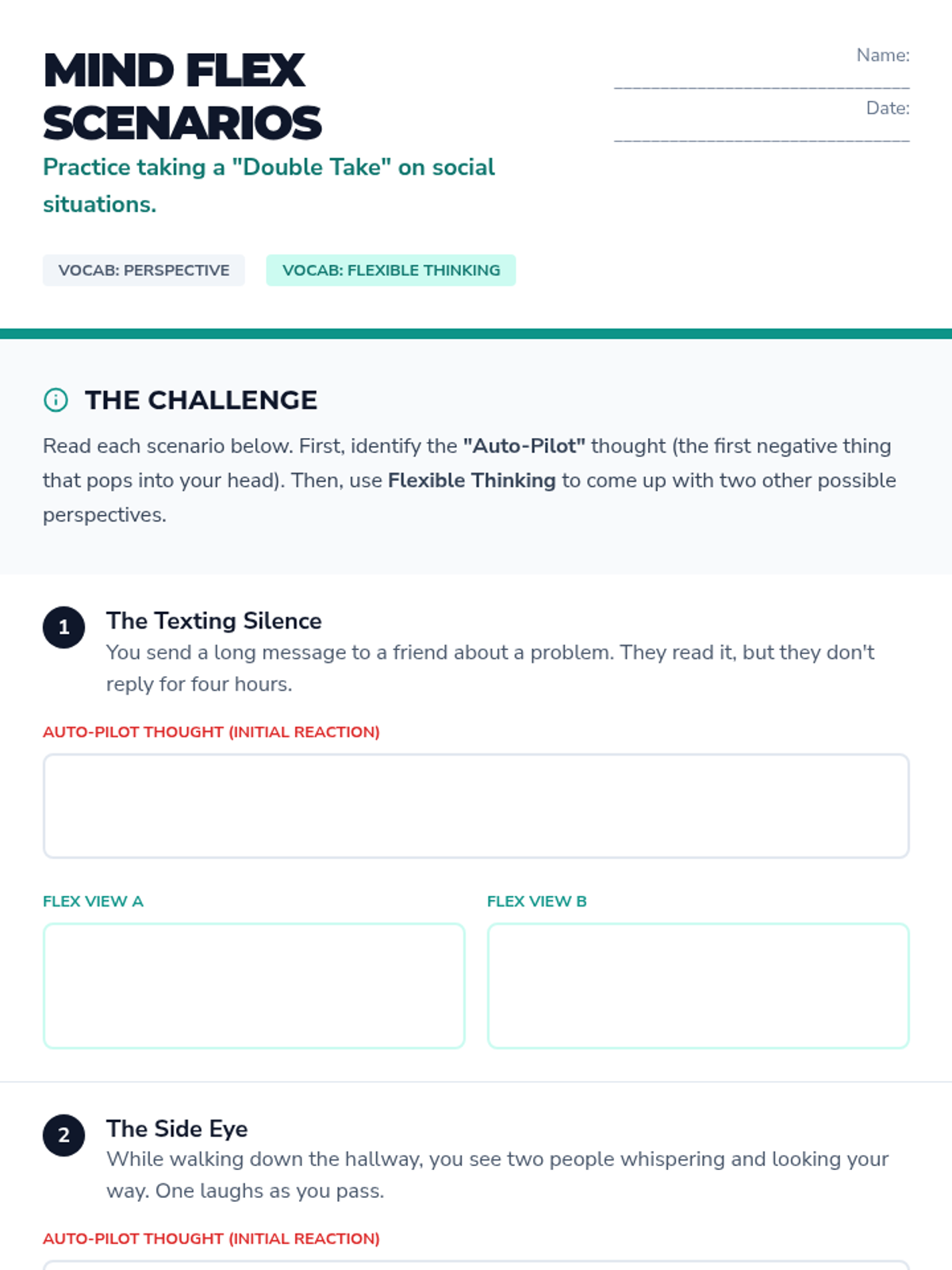
Expert Checklists Worksheet Expert Checklist Analysis
Safety Protocol Practice
Name: ___________________
Date: ____________________
1 READ
2 DO
3 CHECK
Scenario 1: The Experienced Pilot
"Pilot Sarah has flown the same route for 10 years. Today, she is in a hurry because the flight is late. She decides to skip the 15-step 'Engine Start' checklist because she knows it by heart. Halfway through the checklist in her head, she gets a radio call from the tower. She answers the call, then turns the key. The engine starts, but a warning light immediately begins flashing because she forgot to check the fuel valve."
1. What distracted Sarah and made her lose her place in the sequence?
2. Why did Sarah's working memory fail her in this moment?
Part 2: Practice the Method
Break this complex task into 4 single steps. Use simple words.
Task: Safely crossing a busy four-way intersection.
1
2
3
4
Instructor Note: Check the box after writing and verifying each step.
Final Thought
Complete this sentence:
"I use a checklist not because I'm not smart enough, but because..."
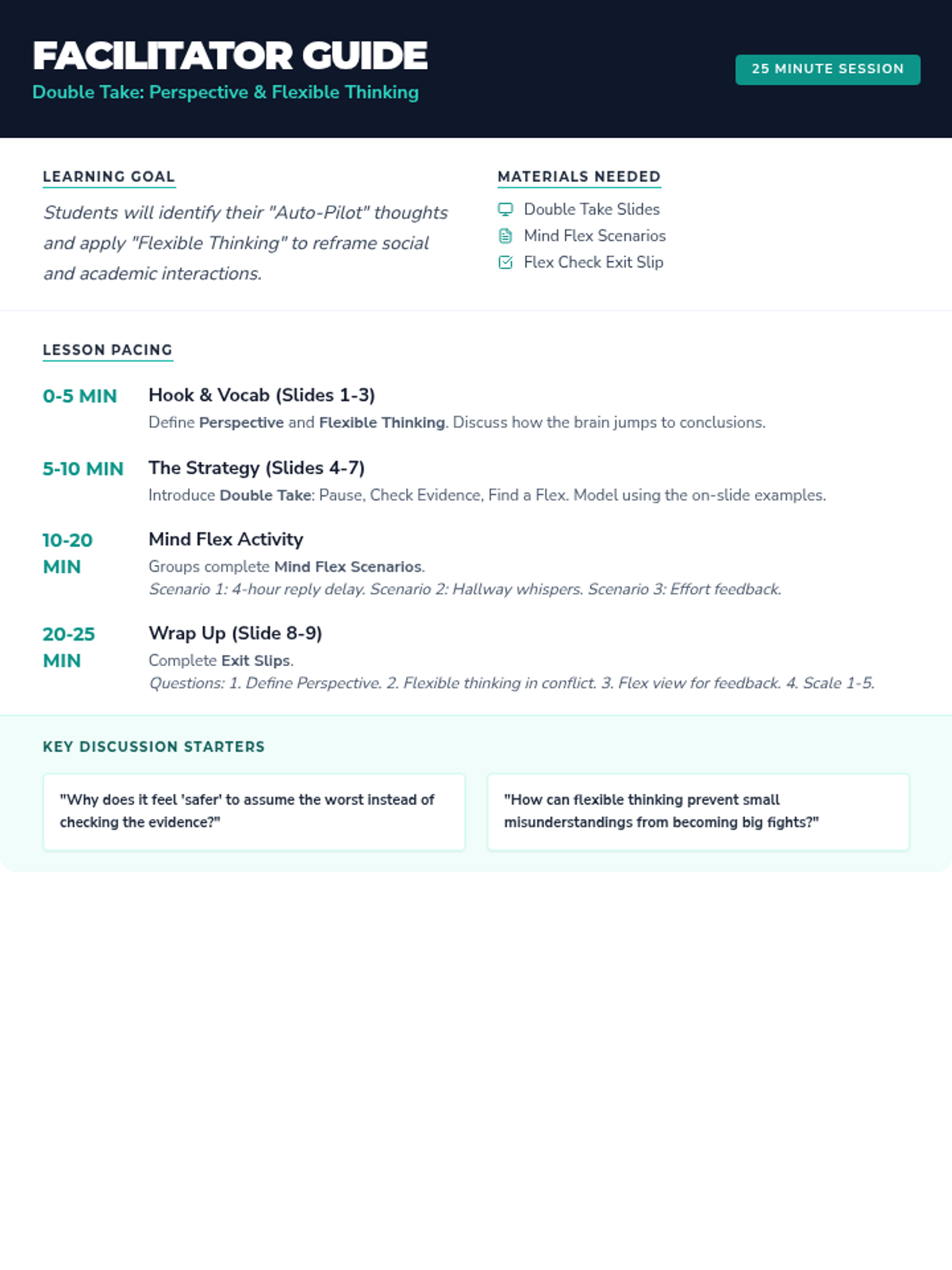
Safety Protocol Teacher Guide Safety Protocol
Teacher Pacing & Facilitation Guide
Duration
50 min
Essential Question
Why is strict adherence to single-step sequencing critical for safety and success?
Learning Objective
Students will identify the role of checklists in supporting working memory and practice breaking tasks into single steps.
Time Activity Phase Teacher Actions & Prompts 0-10m The Hook Pilot Scenario
|
Show Slide 2 (The Pilot).
Prompt: "Why do you think Sarah skipped the steps? Was she lazy or just confident?"
Discuss the "radio call" as a distraction that clears working memory.
|
| 10-25m | Direct Instruction
Memory & Protocols
|
Explain "Working Memory" using the Sticky Note analogy (Slide 3).
Introduce the "Read, Do, Check" method (Slide 5).
Model: Demonstrate a simple task (like sharpening a pencil) using the method loudly: "READ: I'm picking up the pencil. DO: [Picks it up]. CHECK: [Checks off imaginary box]."
|
| 25-40m | Guided Practice
Case Study Worksheet
|
Distribute Expert Checklists Worksheet .
Work through Scenario 1 as a whole group.
Circulate as students attempt Part 2 (Crossing the Street).
Correction Tip: If a student writes "Look both ways and cross," point out that this is TWO steps. Force them to separate them.
|
| 40-50m | Closure
Reflection
|
Have students share their "Reflection" sentence.
Preview next lesson: Applying this to a chemical reaction (Cooking).
|
Working Memory Support
Use a physical physical check-off list on the board during the whole lesson. Keep the "Read, Do, Check" slide visible during the worksheet portion.
Extension
Ask early finishers to create a 5-step protocol for a more complex task, like "Checking out a library book" or "Logging into a computer."
Kitchen Chemistry Slides Kitchen Chemistry
One Ingredient at a Time
Today's Protocol: Mise en Place
What Could Go Wrong?
Scenario: The Slime Disaster
Chef Jo decided to dump the glue, water, and activator all into the bowl at once and stir like crazy.
The Result:
A lumpy, sticky mess that never turned into slime. The activator didn't mix properly because it wasn't added in the right order.
Wrong Order
Chemistry is about timing.
Missing Steps
Skipping one detail ruins the batch.
Mise en Place
French for: "Everything in its place."
Step A: Prep
Gather every ingredient BEFORE you start mixing.
Step B: Measure
Measure into separate containers. Do not measure over the bowl.
Step C: Execute
Follow the single-step checklist: Read, Do, Check.
"When the kitchen is ready, the food is perfect."
The Mission: Non-Sticky Slime
4 oz White Glue
1/2 tsp Baking Soda
1.5 tbsp Contact Solution
Why Single Steps?
If you add the contact solution before the baking soda, the glue will clump immediately and won't mix.
Follow the sequence exactly!
Recipe Action Plan Worksheet Recipe Action Plan
Task: The Perfect Slime Sequence
Scientist Name: ______________
Station #: ____________________
PHASE 1: Mise en Place (Prep & Measure)
Read each step. Complete the action. Check the box.
1. READ: Place one empty mixing bowl on your station.
2. READ: Measure 4 ounces of glue into a separate small cup.
3. READ: Measure 1/2 teaspoon of baking soda into a small cup.
4. READ: Measure 1.5 tablespoons of contact solution into a small cup.
PHASE 2: The Reaction Sequence
1
Pour the 4 oz of glue into the empty mixing bowl.
2
Add the 1/2 tsp of baking soda to the glue.
3
Stir the glue and baking soda together until smooth.
4
Pour in the 1.5 tbsp of contact solution .
5
Stir slowly until the mixture pulls away from the bowl.
Quality Control Check
Did your slime turn out correct? (Check one)
Yes, it is stretchy.
No, it is too sticky/hard.
If you skipped step #3 (stirring glue/soda first), what might happen?
Kitchen Chemistry Teacher Guide Kitchen Chemistry
Teacher Prep & Facilitation Guide
Duration
60 min
Material Prep (Teacher mise en place)
Time Step Key Actions & Prompts 0-10m The Hook Show Slide 2 (Failed Slime). Perform a "speed run" demo: dump all ingredients at once and stir poorly. Let students observe the clumpy, failed result. Ask: "Why didn't it work even though I used the right ingredients?" 10-20m Introduction Introduce Mise en Place (Slide 3). Explain that professionals in kitchens don't measure as they go; they prep everything first to reduce mistakes and stress. 20-45m The Lab
Students receive Recipe Action Plan .
Rule: No one moves to Phase 2 until their Phase 1 (Mise en Place) is checked by a partner or teacher.
Monitor Phase 2: Ensure students add baking soda before the contact solution.
|
| 45-60m | Clean & Reflect | Strict cleanup sequence: 1. Store slime. 2. Rinse bowl. 3. Dry bowl. 4. Wipe table. Discuss how cleaning is also a sequence. |
Common Errors
Too Sticky: Usually means they didn't stir long enough or skipped the baking soda step.
Too Hard: Too much contact solution. Remind them to measure exactly.
Working Memory Support
If a student is overwhelmed, cover the bottom half of their worksheet with a sheet of paper, revealing only one step at a time.
Digital Security Slides 01011101 10101011 00011011 11001100 01010101 11110000 01011101 10101011 00011011 11001100 01010101 11110000 01011101 10101011 00011011 11001100 01010101 11110000
Digital Security Setup
One skipped step is a doorway for a hacker.
The Cost of a Skipped Step
Scenario: The "Save" Button
Marcus sets up Two-Factor Authentication. He enters his phone number, receives the code, and types it in. He is so happy it worked that he closes the window without clicking "Save & Finish."
"What happened? Is his account protected?"
Security Failures:
The setup didn't complete.
The "secret key" was never saved.
The account is still wide open.
Modern Digital Protocols
Biometrics
Scanning 5-10 times for one print.
2FA Codes
Wait. Read. Type. Confirm.
Verification
Check email. Click link. Return.
Save Steps
The most forgotten single step.
"Following the protocol is the password."
The Mission: "System Lock"
You will follow a simulated setup guide on paper. It looks like a real screen.
Challenge Rules:
No skipping "OK" or "Next" buttons.
Every box must be checked in order.
Precision is everything.
Setup in progress...
Digital Security Setup Guide Security Wizard 2.0
Status: Awaiting Setup...
USER ID: _________________
DATE: 01-18-2026
Protocol: Account Verification
"Follow every step in order. Do not look ahead. Your working memory is the key to a secure account."
SCREEN 1 OF 3 SYSTEM LOCK
1. ENTER RECOVERY EMAIL
example@email.com
I agree to the Security Terms & Conditions.
NEXT STEP
SCREEN 2 OF 3 VERIFICATION CODE
Enter the 6-digit code sent to your phone:
9
2
0
7
_
_
Wait 10 seconds for the next step...
Confirm Code
SCREEN 3 OF 3 FINALIZE
VERIFICATION SUCCESSFUL
Do not exit yet!
Write down your Master Security Key:
____________________
SAVE & EXIT
Teacher Script (Read steps one by one)
"Step 1: Check the box for terms and conditions. [Pause] Step 2: Write your name in the User ID field. [Pause] Step 3: Complete the 6-digit code using the numbers '4' and '1' in the empty boxes. [Pause] Step 4: Write 'LOCK-2026' in the Master Security Key box. [Pause] Step 5: Circle the SAVE & EXIT button."
Emergency Response Slides 911 PROTOCOL
One Answer at a Time
Panic vs. Working Memory
The Danger
When we are scared, our brain's "Sticky Note" (Working Memory) shrinks.
We want to scream everything at once:
"HELP! FIRE! MY HOUSE! THE CAT! PLEASE HURRY!"
The Problem:
The Dispatcher cannot help you if you give all the information at once. They need a precise sequence.
Rule #1:
Listen to the question. Answer ONLY that question. Wait.
The Essential Sequence
1. LOCATION "Where is your emergency?"
2. CALLBACK "What is your phone number?"
3. PROBLEM "Tell me exactly what happened."
4. PATIENT "Is everyone awake and breathing?"
"Answering out of order slows down the ambulance."
Mission: The Dispatch Call
A
The Dispatcher
Reads the card. Asks ONE question at a time. Waits for the answer.
B
The Caller
Answers ONLY the question asked. Does not give extra info until asked.
Stay Calm. Follow the Sequence.
Emergency Roleplay Cards Emergency Dispatch Cards
Activity: The Power of the Single Question
Role: 911 Dispatcher
Your Script (Read one by one):
1. "911, what is the exact location of your emergency?"
2. "What is the phone number you are calling from?"
3. "Tell me exactly what happened."
4. "Is the person awake and breathing?"
Note: DO NOT move to the next question until the Caller finishes their answer.
Role: Caller (Scenario A)
Your Emergency Facts:
Location: 425 Maple Street, Apartment 4B.
Phone: 555-0123
Situation: You came home and found your grandmother on the floor. She isn't moving.
Status: She is breathing, but she won't wake up.
RULE: Only answer the question asked. Even if you are "panicked," follow the sequence!
Role: Caller (Scenario B)
Your Emergency Facts:
Location: The City Park, near the swings.
Phone: 555-9988
Situation: You see a small trash can fire near the playground. It's getting bigger.
Status: No one is hurt yet.
RULE: Stay on the line until the Dispatcher says it's okay to hang up.
Role: Safety Inspector
Watch the pair and check boxes:
Did they stay in order (1, 2, 3, 4)?
Did the Caller wait for the question?
Did the Dispatcher speak clearly?
Total Quality Control Score: ____ / 3
Vocational Task Slides Vocational Training Day
From Learning to Earning
Standard Operating Procedure
What is Quality Control?
In a real job, doing the work fast is not the goal. Doing the work correctly is the goal.
"If you skip a step in an assembly line, the final product is broken. The company loses money. The customer is unhappy."
High Quality
Every step followed. 100% success.
Rejected
Steps skipped. Item is garbage.
Today's Work Stations
Station 1: Mailroom
- Sort mail by color.
- Check address for zip code.
- Place in correct bin.
Station 2: Supply Kit
- Follow the count list.
- Double-check contents.
- Seal the bag.
Read the Station Poster FIRST!
Peer Quality Control
When you finish a task, a "Quality Inspector" will check your work.
They will look at your Sequence Log. If you didn't check every box, they won't even look at your product!
APPROVED
Workplace Procedure Posters Standard Operating Procedure
Station 01: Mail Sorting
1
Gather
Pick up the unsorted stack of 10 envelopes.
2
Inspect
Look at the COLOR of the envelope.
3
Filter
If White: Place in "INTERNAL" bin.
If Yellow: Place in "EXTERNAL" bin.
4
Verify
Count the envelopes in each bin. Mark your total on the log.
"Precision is the foundation of professionalism."
Standard Operating Procedure
Station 02: Assembly Line
1
Prepare
Open one plastic assembly bag.
2
Load
Place 2 pencils and 1 eraser inside the bag.
3
Insert
Place one "Welcome Note" inside the bag.
4
Finalize
Press the seal closed. Place in "FINISHED" crate.
"Quality work leads to bigger opportunities."
Quality Control Report Worksheet Quality Control Report
Employee Final Assessment
STAFF NAME: ___________________
ID #: QC-07-2026
WORK LOG
STATION 1: MAILROOM
Read Poster
Followed Steps
Verified Bins
INSPECTOR SIGNATURE: ____________________
STATION 2: SUPPLY KITS
Read Poster
Followed Steps
Sealed Bag
INSPECTOR SIGNATURE: ____________________
Final Performance Review
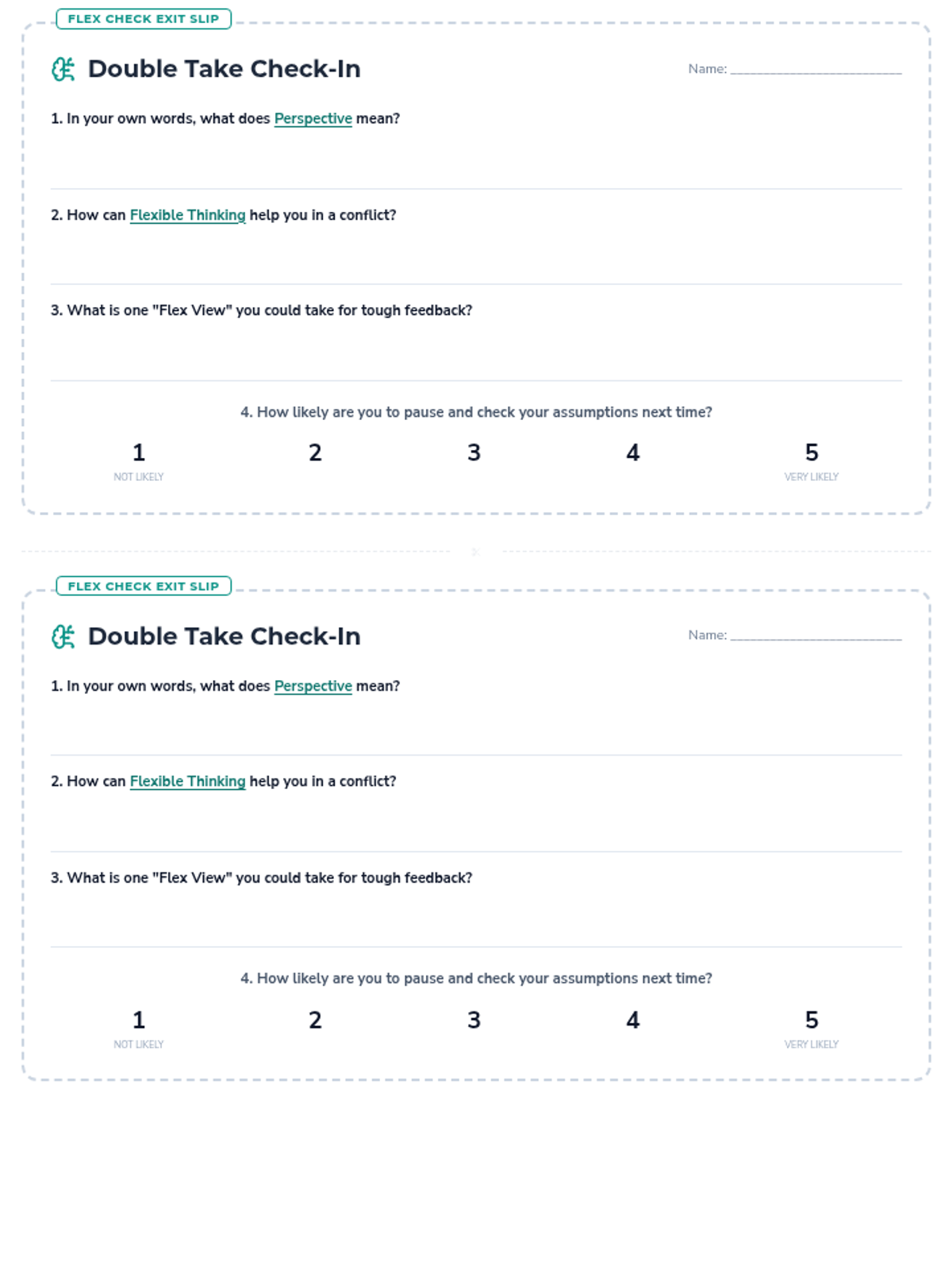
1. Which task was the hardest to follow one step at a time? Why?
2. How does the "Read, Do, Check" method help your working memory stay organized?
Career Connection
Name one job you might like to have one day. How would using a checklist make you better at that job?
Total QC Score
____ %
Certified Professional