Praise vs Encouragement Slides Praise vs.
Encouragement
Reinforcement Revolution: Lesson 1
The Feedback Experiment
Option A
"Good job on that drawing. It looks great!"
Option B
"I noticed how you used cross-hatching to create shadows on the side of the house."
Which feedback tells you exactly how to repeat your success?
Evaluative Praise
Judgment-Based
Focuses on the person or the outcome as "good" or "bad".
Dependency-Building
The person starts working for the "sticker" or the approval, not the skill.
Common Examples:
"You're so smart!"
"Great work!"
"Best in the class!"
"I'm so proud of you."
Descriptive Encouragement
Evidence-Based
Describes the specific action or process you observed.
Growth-Oriented
Provides information the person can use to repeat their success.
The Transformation:
"Good work" "I noticed you stayed focused even when the room got loud."
"You're a leader" "You made sure everyone in your group had a chance to speak."
Why Specificity Wins
Clarity
The receiver knows exactly what they did right.
Trust
Specific feedback feels more sincere than generic praise.
Mastery
Focusing on the process builds long-term competence.
"Vague feedback produces vague results."
Feedback Flip Worksheet Feedback Flip
Leadership Lab 01
Student Name
Date
The Mission
In leadership, generic praise like "Good job!" often falls flat because it doesn't tell the person what they actually did right. Your task is to flip the evaluative praise below into descriptive encouragement. Focus on the process, effort, or specific behavior you might have seen.
Generic Praise (The Evaluative) Descriptive Encouragement (The Specific) "You're so smart!"
Focus: Student solving a hard math problem.
| |
|
"Great game today!"
Focus: Teammate passing the ball often.
| |
|
"You're a natural leader."
Focus: Peer facilitating a group debate.
| |
|
"Thanks for being good."
Focus: Employee staying late to clean up.
| |
|
"Your presentation was awesome."
Focus: Speaker using clear visuals.
| |
Leadership Reflection
Why might an employee or student stop trying if they only ever receive generic praise like "Good job"?
Think of a time you received specific feedback. How did it change your next steps compared to receiving generic praise?
Praise vs Encouragement Teacher Guide Teacher Facilitation Guide
Praise vs. Encouragement
Lesson 01
Reinforcement Revolution
Duration
45-60 Minutes
Objective
Identify and deliver descriptive feedback.
Materials
Slides, Feedback Flip Worksheet, Drawing Paper.
The Hook: The Drawing Lab
1
Give students 3 minutes to draw a simple object (e.g., a "dream house" or a "super-car").
2
Walk around and give half the class generic praise ("Great house!", "You're a good artist!") and the other half descriptive encouragement ("I see you added solar panels," "I noticed the way you drew the perspective on those tires").
3
Debrief: Ask students who received descriptive feedback if they feel they know what to do next to improve. Compare their answers to the "generic praise" group.
Instructional Pacing
Slide Deep Dive (20 mins)
Focus on the "Dependency" aspect of praise. Students often crave the "hit" of being told they are "smart." Explain that if they are only "smart" when they succeed, they feel "dumb" when they fail. Descriptive encouragement removes the judgment and focuses on the work.
Question: "If a boss says 'Good job' every day, what happens when they forget to say it for one day?"
Worksheet: Feedback Flip (20 mins)
Ensure students aren't just adding "Good job" to a descriptive sentence. The goal is to replace the judgment entirely with an observation. Encourage them to use phrases like "I noticed..." or "I see that you..."
Feedback Flip: Exemplars
"You're so smart!" Flip:
"I noticed how you tried three different formulas before finding the one that worked for this problem."
"Natural leader" Flip:
"I saw you specifically asked the quietest person in the group for their opinion during the brainstorm."
"Thanks for being good" Flip:
"Thank you for staying 15 minutes late to help reorganize the supply closet; it’s much easier to find everything now."
Social Recognition Slides Social
Reinforcement
Public vs. Private: The Leader's Dilemma
The Power of the Peer
Definition
Behavior is reinforced by the reactions of others—approval, attention, status, or inclusion.
It's about visibility:
Who saw the reward?
How did the group react?
What message did it send?
In Teams:
Recognition is more than a "thanks"—it's a culture builder.
The Public Stage
The Upside
• Sets a clear example for the entire group.
• Boosts the individual's social status.
• Validates the group's collective values.
• "Secondary Reinforcement": Others want the recognition too.
The Downside
• Can cause embarrassment for introverts.
• Risk of perceived favoritism ("The teacher's pet").
• Can trigger envy or competition in peers.
• Feels insincere if it's too frequent or fake.
The Private Word
Why it works:
• High intimacy and sincerity.
• Safe space for correcting or refining behavior.
• Best for employees/students who dislike the spotlight.
• Avoids group politics or resentment.
"A leader's quiet whisper of 'I saw that effort' can be louder than a stadium's roar."
— Leadership Wisdom
The Favoritism Trap
"If you only reinforce the stars, the team will die."
Reinforcing the same 2-3 people consistently creates a 'caste system' where the rest of the team feels invisible and demotivated.
Rotate Focus
Look for 'quiet contributors' to recognize.
Diversify Criteria
Praise effort, attitude, and teamwork—not just results.
Ask Preferences
Some people hate public praise. Know your team.
Recognition Radar Worksheet Recognition Radar
Leadership Lab 02
Field Agent Name
Operation Date
Case Study: The Silent Superstar
"Marco is the lead developer on a high-stakes team project. He is quiet, focused, and consistently delivers his code ahead of schedule. During the weekly all-hands meeting, the team leader, Sarah, announces: 'Everyone, let's give Marco a standing ovation for his incredible work this week!' Sarah beams as the room claps loudly. Marco turns bright red, stares at his feet, and doesn't say a word for the rest of the meeting. The next week, his productivity drops significantly, and he starts avoiding Sarah."
1. Analysis: What was Sarah's intended effect? What was the actual impact on Marco?
2. Identification: Identify three risks of "Public Reinforcement" that Sarah triggered in this scenario.
Risk 1:
Risk 2:
Risk 3:
3. The Pivot: How could Sarah have reinforced Marco's behavior differently to achieve a positive outcome?
Personal Preference Survey
Effective leaders know that recognition isn't one-size-fits-all. Mark where you fall on the scales below.
I hate being the center of attention I thrive in the spotlight
Quiet Private Note Public Shout-Out
Your Leadership Rule:
Based on your own preferences, what is one rule you would follow when recognizing others?
Social Reinforcement Teacher Guide Teacher Facilitation Guide
Social Reinforcement Power
Lesson 02
Reinforcement Revolution
Duration
45-60 Minutes
Grouping
Small Group & Whole Class
Focus
Navigating social dynamics of recognition.
The Hook: Hollywood Highlights
Recommended Clip: The Office (S2, E1: "The Dundies") or Remember the Titans (The "Left Side/Strong Side" drill).
Facilitation: Play a clip where a leader gives a public award or recognition. Ask: "Who else in the room is watching this? How does their face look compared to the person receiving the award?"
Goal: Shift the focus from the giver/receiver to the audience . Reinforcement in a team is never just between two people.
Key Discussion Points
The "Introvert Tax"
Explain that for some, public praise is actually a punishment because it triggers anxiety. When a leader forces an introvert into the spotlight, they are inadvertently punishing the very behavior they wanted to reinforce.
Perceived Favoritism
Ask: "What happens if a coach only praises the high-scorer?" The "favoritism trap" leads to other players sabotaging the star or giving up. Effective leaders recognize support roles publicly to balance the social scales.
Worksheet Guide: The Silent Superstar
Analysis Exemplar:
Sarah intended to build Marco's confidence and show the team what success looks like. The actual impact was social anxiety and alienation . Marco now associates high performance with a negative social experience (the embarrassment).
The Pivot Exemplar:
Sarah could have sent a personalized email copying her own manager, left a sticky note on his desk, or simply pulled him aside for a 30-second "one-on-one" to thank him specifically for the early delivery.
The Golden Rule of Social Reinforcement:
"Praise in public if they love it; praise in private if they don't. But ALWAYS recognize the quiet contributors."
The Shaping Strategy Slides Shaping
Complex Behaviors
The Secret Art of Successive Approximations
The Perfection Trap
If you wait for the "Perfect Result" to give reinforcement...
The learner gets frustrated and quits.
They don't know if they are on the right track.
The gap between "zero" and "mastery" is too wide.
Mastery
Zero
What is Shaping?
"Reinforcing successive approximations of a terminal behavior."
Successive
One step after another in a logical sequence.
Approximation
A behavior that gets closer and closer to the final goal.
Terminal
The final, complex skill you want the learner to master.
The Shaping Playbook
1
Identify the Starting Point
What is the learner already doing that looks a little bit like the goal?
2
Raise the Bar Slowly
Once they master Step A, stop reinforcing Step A and only reinforce Step B.
3
Keep the "Wins" Frequent
If they get stuck, go back one step. Never let them go too long without reinforcement.
Shaping in Action
Coaching a Sport
Don't coach the full golf swing yet. Reinforce:
1. Proper grip on the club.
2. Stance and alignment.
3. The backswing height.
4. The follow-through.
Teaching Software
Don't expect a finished video. Reinforce:
1. Opening the project file correctly.
2. Importing raw footage.
3. Making the first basic cut.
4. Adding a simple transition.
Shaping Blueprint Activity Shaping Blueprint
Leadership Lab 03: Coaching Module
Lead Coach
Date
1 The Terminal Behavior
What is the complex skill you want to teach?
(Example: Cooking a 3-course meal, executing a perfect backhand in tennis, coding a basic website)
2 Successive Approximations
Break the skill down. Each step must be reinforced with descriptive encouragement before moving to the next.
S
The Baseline (Starting Point)
1
First Approximation
2
Second Approximation
3
Third Approximation
Terminal Behavior (Mastery)
The Stuck Learner
If your learner stops making progress or gets frustrated, what is your "Backstep Plan"? Which previous step will you return to, and how will you adjust your encouragement?
Shaping Teacher Guide Teacher Facilitation Guide
Shaping Complex Behaviors
Lesson 03
Reinforcement Revolution
Duration
45-60 Minutes
Methodology
Experimental & Project-Based
Goal
Break skills into tiny, winnable steps.
The Hook: Shaping Hot & Cold
This is a variation of the classic "Hot and Cold" game to demonstrate the power of instant reinforcement .
Select a volunteer (the "Learner") to leave the room.
The class decides on a simple but specific terminal behavior (e.g., "pick up a specific blue pen and put it in the trash can").
The Learner returns. The "Coach" (you) can ONLY say "Yes" or "Closer" . No other words.
Reinforce any movement toward the object. If they turn toward it, say "Yes." If they step toward it, say "Yes." If they look at it, say "Yes."
Debrief: Ask the Learner: "How did it feel when I stopped saying 'Yes' for steps you already mastered and only said it for getting even closer?"
Key Facilitation Concepts
Differential Reinforcement
This is the heart of shaping. You must stop reinforcing the old behavior to encourage the new one. If the student keeps getting praised for a 1-sentence answer, they won't try for a 3-sentence answer. You have to "raise the bar" specifically.
The "Frustration Gap"
If the jump between steps is too big, the learner will stop performing. If a student is failing a math test, don't reinforce "Getting an A." Reinforce "Completing the homework" first. This shrinks the frustration gap.
Coaching the "Shaping Blueprint"
When checking student plans, look for:
Specificity:
"Play basketball" is too broad. "Execute a layup from the left side" is a terminal behavior.
Logical Progression:
Steps should build. You can't reinforce "putting on the saddle" (Step 3) if you haven't reinforced "approaching the horse" (Step 1).
The Reset Plan:
Ensure they have a plan to "go back" one step if the learner fails. This prevents discouragement.
Reinforcement in Conflict Slides Reinforcement
in Conflict
De-escalating Heat with Positive Signals
The Conflict Impulse
In a conflict, we usually focus on what is wrong.
Most leaders respond to conflict with coercion or punishment :
• "Stop shouting!"
• "If you don't agree, you're off the project."
• "That's a ridiculous idea."
The Result: High defensiveness and zero cooperation.
Catching Cooperation
"The fastest way to de-escalate is to reinforce the first sign of cooperative behavior."
The "Listen"
"I appreciate that you stopped to hear my point of view."
The "Volume"
"Thank you for lowering your voice so we can figure this out."
The "Pivot"
"I like that you offered an alternative instead of just saying no."
Strategic Affirmation
Acknowledge the Emotion
"I can see that this project means a lot to you, which is why you're so frustrated."
Reinforce the Common Goal
"I'm glad we both want the best outcome for the team. Let's start there."
"When you reinforce the good parts of a bad conversation, you provide a bridge for the other person to walk across."
— Conflict Strategy
The Catch Challenge
Your Goal: Reinforce to De-escalate
You are about to enter high-conflict role plays . Your only weapon is positive reinforcement of cooperative behaviors.
Look for: Eye contact, listening, lower volume, sharing ideas.
Avoid: Sarcasm, "I told you so," or attacking back.
Conflict Role Play Cards Conflict Catching Cards
Leadership Lab 04: Role-Play Scenarios
Scenario 01
The Disengaged Peer
The Situation:
Alex is on your project team but hasn't opened the shared doc in three days. When you bring it up, Alex says, "It's just a school project, chill out."
Leader Goal:
Reinforce Alex's first sign of engagement (e.g., if they look at the doc, offer a small idea, or even just stop being defensive).
Scenario 02
The Perfectionist Critic
The Situation:
Jordan is picking apart everyone's work. "This font is ugly, the layout is messy, and we're going to fail." Jordan is clearly stressed.
Leader Goal:
Reinforce Jordan's underlying high standards without agreeing with the criticism. Pivot the negativity toward a solution.
Scenario 03
The Interrupter
The Situation:
Every time someone speaks in the group meeting, Casey cuts them off to tell a related (but irrelevant) personal story.
Leader Goal:
Reinforce Casey only when they are listening . Catch the 5-second window where they are quiet and validate their focus.
Scenario 04
The Sarcastic Scorcher
The Situation:
You suggest a new meeting time. Taylor rolls their eyes and says, "Oh sure, let's meet at midnight, why don't we? That's so smart."
Leader Goal:
Reinforce Taylor's literal willingness to meet while ignoring the sarcasm. Keep the focus on the cooperative act.
Session Reflection
Which behavior was the hardest to reinforce positively? Why?
What happened to the "Peer's" attitude when you caught them "doing something right"?
Conflict Reinforcement Teacher Guide Teacher Facilitation Guide
Conflict Resolution
Lesson 04
Reinforcement Revolution
Duration
45-60 Minutes
Style
Simulation & Role-Play
Focus
De-escalation via Reinforcement.
The Hook: Catching the Calm
"Find a way to reinforce someone you are currently arguing with."
Activity: Set up a mock argument with a student about something trivial (e.g., "Which is better: Apples or Oranges?"). Be slightly annoying/stubborn. As soon as the student makes a valid point or listens for a second, stop arguing and say: "I really liked how you waited for me to finish before you made that point."
Debrief: Ask the class: "What happened to the energy of the argument as soon as I reinforced them?"
Managing the Simulation
Tip for the "Difficult Peer"
Instruct students playing the "Difficult Peer" to be realistic, not impossible. They should start "hot" but be instructed to soften their stance as soon as they receive genuine reinforcement. This proves the technique works.
Identifying the "Cooperative Sign"
Students often struggle to find something positive in a heated moment. Help them look for:
Nodding (acknowledgment)
Lowering volume
Eye contact
Pausing before speaking
Asking a clarifying question
Debrief Questions
"Why does it feel so unnatural to praise someone who is being difficult?"
"How does reinforcing cooperative behavior prevent the 'Escalation Ladder'?"
"Is this 'manipulation' or 'leadership'? What is the difference?"
Incentive System Design Slides Team Incentive
Design
The Culminating Challenge
Consultant Briefing
The Mission:
You are management consultants. You've been hired by "Apex Innovations," a tech company where team morale is at an all-time low because of a cut-throat reward system.
The Problem:
The current system rewards the "Top Seller" with a massive bonus. This has led to employees stealing leads from each other, hiding information, and refusing to help new hires.
Your Task:
Redesign the reinforcement system to:
Encourage collaboration
Sustain high performance
Build a positive social culture
Balancing the Scales
Individual Rewards
Focuses on "Me." Great for motivation but high risk for competition.
"If I help you, I might lose my bonus."
Team Rewards
Focuses on "Us." Great for culture but high risk for "Social Loafing."
"I'll get rewarded even if I do nothing."
A Great System Needs BOTH.
The 3 Pillars of Design
Behaviors
What specific behaviors do you want to see? (e.g., peer-mentoring, documentation sharing, error reduction)
Frequency
How often will reinforcement happen? (Daily peer-shoutouts? Monthly team bonuses? Immediate "spot" awards?)
Social Layer
How will others know about it? (A digital leaderboard? A private lunch? A company-wide email?)
Ready to Build?
!
Remember: Avoid dependency . Use descriptive encouragement as the foundation of your system.
Consultants: Start Your Blueprint
Team Culture Blueprint Project Culture Blueprint
Management Consultant Report: Apex Innovations
Project ID
RR-505
Consultant Names
Submission Date
1. Targeted Behaviors
List 3 specific behaviors you want to reinforce to fix the toxic competition at Apex Innovations.
01
02
03
Individual Reinforcement
How will individuals be recognized for their own growth?
Team Reinforcement
What common goal will trigger a collective reward?
3. Delivery Mechanism
Social Layer (Public/Private Mix)
How will rewards be communicated to the group?
Descriptive Encouragement Strategy
How will you ensure feedback is specific, not generic?
4. Pitfall Prevention
Potential Risk: Favoritism
How will you ensure the same 2-3 people aren't the only ones reinforced?
Potential Risk: Reward Dependency
How will you move from external rewards to internal motivation over time?
Incentive Design Rubric Assessment Tool
Incentive Design Rubric
Lesson 05
Final Assessment
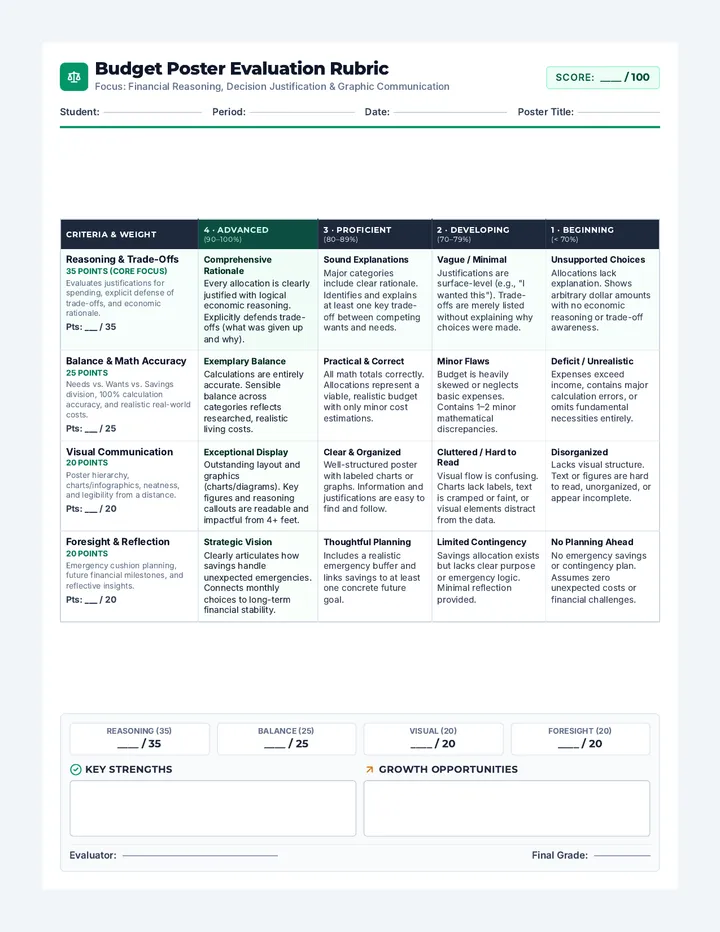
Criterion Exceptional (4) Proficient (3) Developing (2-1) Behavioral Specificity Targets are highly specific, observable, and directly address the cultural issues at Apex. Targets are observable but slightly broad (e.g., "be helpful" instead of "peer mentoring"). Targets are vague or not easily observable. System Balance Exceptional balance between individual and team rewards that actively discourages toxic competition. Includes both team and individual elements, though one may overshadow the other. Relies solely on one type of reward; fails to address the competitive nature of the company. Social Mechanism Communication plan is detailed, sincere, and uses descriptive encouragement instead of generic praise. Communication plan is clear but relies somewhat on generic praise or evaluative terms. Plan is unclear or missing a social delivery component. Risk Analysis Demonstrates deep understanding of behavioral pitfalls (favoritism, dependency) and provides realistic solutions. Identifies potential risks but solutions are somewhat vague or idealistic. Does not identify risks or provide any mitigation strategies.
Feedback Notes
Total Score
/16
Instructor Signature