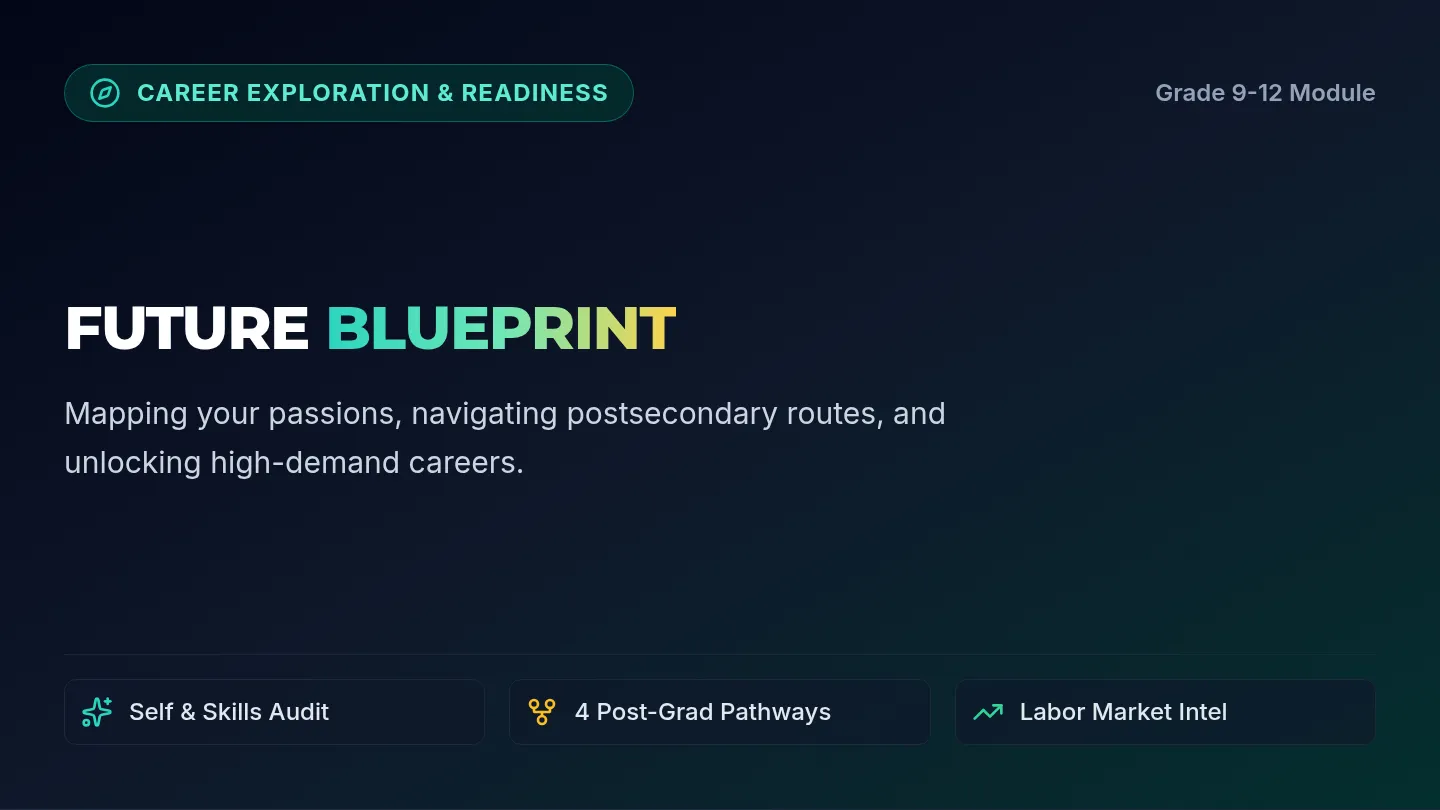
Your Future Way Teacher Guide Your Future, Your Way
Lesson Plan & Implementation Guide
Target Audience
12th Grade Seniors
Duration
320 Minutes (Multiple Sessions)
Learning Objective
Students will explore various career paths, identify personal interests and skills, and develop a personalized action plan for post-graduation, fostering self-awareness and proactive planning for their future.
The "Why"
Understanding career options and aligning them with personal strengths is crucial for making informed decisions about life after high school. This lesson empowers students to take ownership of their future.
Teacher Preparation
Review all generated materials: Lesson Plan, Slide Deck, Worksheet, Reading, and Project resources.
Print copies of the Career Exploration Worksheet and Beyond High School Reading (one per student).
Prepare Vision Board supplies: Magazines, scissors, glue, poster board, or digital collage tools.
Cut and organize Career Connection Game cards for small group use.
Familiarize yourself with the Future Blueprint Project Rubric to clarify expectations.
Materials Checklist
Your Future Slide Deck
Career Exploration Worksheet
"Beyond High School" Reading
Post-Grad Discussion Guide
Vision Board Activity Guide
Game Cards
Project Guide & Rubric
Warm Up & Cool Down
Career Readiness Quiz
Instructional Sequence
1. Warm Up & Introduction
30 Minutes
Begin with the Warm Up: Future Thoughts to activate prior knowledge and get students thinking about their future.
Introduce the lesson using the Your Future Slide Deck (Slides 1-3). Discuss the importance of exploration in senior year.
Facilitate a brief discussion using prompts from the Discussion Guide to gauge anxieties and initial thoughts. Briefly introduce the Blueprint Project.
2. Exploring Interests & Skills
60 Minutes
Lead a self-assessment using Slides 4-6 and the first section of the Worksheet.
Students complete Part 1: Understanding Yourself and Part 2: Initial Career Ideas based on reflection and presentation content.
3. Understanding the World of Work
45 Minutes
Explore career options using Slides 7-8. Distribute the Beyond High School Reading.
Allow time for reading (individual or pairs). Facilitate discussion using the guide to explore pathways and research resources (O*NET, BLS).
4. Career Connection & Research
75 Minutes
Divide into small groups for the Career Connection Game to link skills and interests to professions.
Follow with Part 3: Researching Pathways of the Worksheet, using reading and online tools to gather specific data on career ideas.
5. Visualizing & Planning
110 Minutes
Vision Boards (50m): Use Slide 9 to introduce vision boards. Guide students through the creation process, thinking broadly about career and life.
Blueprint Project (60m): Explain the project in detail using the Project Guide and Rubric. Dedicate class time for synthesis and initial drafting.
6. Assessment & Wrap-up
20 Minutes
Administer the Career Readiness Quiz. Conclude with the Cool Down Reflection to summarize learning and next steps.
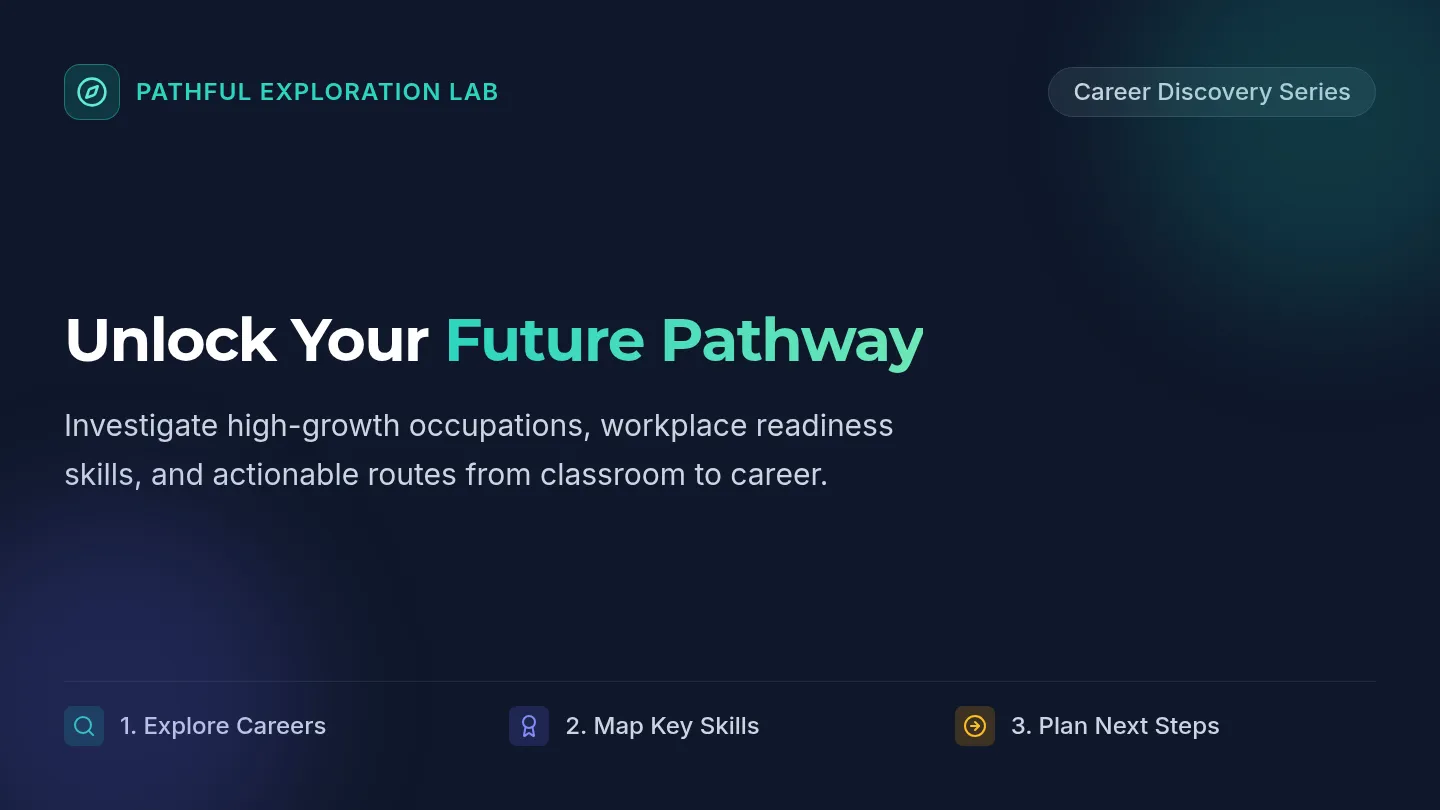
Your Future Way Slide Deck YOUR FUTURE, YOUR WAY
Navigating Career Exploration for Seniors
Session 1
What are your dreams for after high school?
What is Career Exploration?
It's a journey of discovery, not just a search for a job.
1
Understanding yourself (interests, skills, values)
2
Investigating different jobs and industries
3
Planning your path after graduation
Teacher Note: Emphasize that this is about finding what truly excites them.
Why Explore Careers NOW?
Informed Decisions
Make smarter choices about college, vocational training, or immediate entry into the workforce.
Discovery
Discover exciting opportunities you never knew existed in emerging fields.
Roadmap
Set realistic goals and build a clear roadmap for success after senior year.
It's YOUR future.
Understanding YOU: Interests
What truly excites you?
What subjects do you love?
What hobbies do you enjoy?
What problems do you like to solve?
Activity Time
Open your Career Exploration Worksheet and complete Part 1: Interests.
Understanding YOU: Skills & Values
Skills
What are your natural talents and learned abilities?
Values
What is important to you in a workplace? (e.g., helping others, creativity, high salary)
Self-Reflection Question:
If you could do any job regardless of pay, what would it be? Why?
Exploring the World of Work
Traditional
Established industries like Healthcare, Construction, and Education.
Emerging
Fast-growing fields in Tech, Green Energy, and AI.
The Arts & Trades
Crafting, performing, and technical skilled work.
What sparks your curiosity? Let's read "Beyond High School".
Researching Your Options
Online Databases
O*NET, Bureau of Labor Statistics (BLS), and CareerOneStop.
Interviews
Talk to people already working in the fields that interest you.
Knowledge is Power
Effective research helps you avoid costly mistakes and find paths you didn't know existed.
Making Informed Decisions
It's a process, not a single choice. Consider:
Interests & Skills
Values & Lifestyles
Research & Data
Flexibility is key!
Most people change careers 5-7 times in their life.
Visualizing Your Path: Vision Boards
Bring your dreams to life through a visual representation of your life goals.
Clarifies what you want
Inspires and motivates
Connects career to lifestyle
Dream Big Dream Big Dream Big
My Career Vision Board
Session Activity
Your Future Blueprint
Your personalized roadmap to success combining self-assessment, research, and vision.
1
Self-Reflection
2
Career Research
3
Action Plan
4
Presentation
Review the rubric and project guide for details.
WHAT'S NEXT?
Your journey is just beginning. Career exploration is a lifelong process.
Complete the Cool Down Reflection
See you next session!
Future Thoughts Warm Up Warm Up: Future Thoughts
Starting the journey of exploration
Career Exploration
Session 1 Entry Ticket
Student Name
Date
Take a few minutes to think about your future after high school. Don't worry about being "right" or having all the answers. This is just a chance to get your ideas flowing!
1 In three words, how do you feel about your future after high school?
2 What is one thing you are excited about for your future?
3 What is one question you have about life after high school or your career path?
"The best way to predict the future is to create it." — Peter Drucker
Career Exploration Worksheet Career Exploration
Student Worksheet
Name
Date
PART 1
Understanding Yourself
My Interests
What topics do you love to learn about? What activities do you enjoy in your free time?
My Skills
Academic skills (writing, math) and personal skills (leadership, creativity, teamwork).
My Values
What is important to you in a job? (Helping others, salary, independence, work-life balance)
PART 2
Initial Career Ideas
Based on your reflection in Part 1, identify 2-3 careers that spark your interest right now. Explain why they appeal to you.
01
Career Idea
Why it appeals to me
02
Career Idea
Why it appeals to me
03
Career Idea
Why it appeals to me
PART 3
Researching Pathways
Chosen Career for Deep Dive
1. Required Education/Training
Degrees, certifications, or apprenticeships needed.
2. Common Tasks & Responsibilities
What does a typical day look like?
3. Typical Salary Range
Entry level vs. experienced.
4. Job Outlook & Growth
Is the field growing? Future opportunities?
5. Personal Alignment Reflection
Does this career truly align with your interests, skills, and values? Why or why not?
Beyond High School Reading Post-Secondary Guide
Beyond High School
A World of Opportunities Awaits
As you stand on the brink of graduating high school, a vast world of possibilities opens up before you. The path you choose after graduation is a significant step, and understanding your options is the first key to making a confident decision. This reading explores common post-high school pathways and introduces you to valuable resources for career exploration.
Pathway 01
Higher Education
Many students choose to pursue a degree at a two-year or four-year college or university. This pathway often leads to careers that require specialized knowledge and advanced skills.
Associate's Degree (2-year): Often offered at community colleges, these degrees prepare you for entry-level positions or serve as a stepping stone to a bachelor's degree.
Bachelor's Degree (4-year): Typically offered at universities, providing a broader education in a chosen major (e.g., BA, BS, BFA).
Graduate Degrees: Advanced study after a bachelor's, such as Master's (MBA, M.Ed) or Doctoral degrees (Ph.D., M.D., J.D.).
Considerations: Cost, academic rigor, campus life, and specific program offerings.
Pathway 02
Vocational & Technical
If you're interested in hands-on learning and acquiring job-ready skills in a shorter timeframe, vocational schools focus on practical training for skilled trades.
Examples: Electrician, automotive technician, paralegal, dental hygienist, welding, cosmetology.
Considerations: Program length (months to 2 years), hands-on training, and direct entry into specialized workforce roles.
Pathway 03
Military Service
Joining the military combines career training, leadership development, and service. Each branch (Army, Navy, Air Force, Marines, Coast Guard, Space Force) offers unique specializations and educational benefits like the GI Bill.
Considerations: Physical requirements, commitment length, travel, discipline, and potential for combat or technical roles.
Pathway 04
Direct Entry & Workforce
Some students choose to enter the workforce directly through entry-level jobs or apprenticeships. This is an opportunity to build professional networks and discover strengths in real-world settings.
Apprenticeships: Structured programs combining on-the-job training with technical instruction. You earn wages while you learn.
Entry-Level Jobs: Positions offering opportunities for on-the-job advancement without immediate degree requirements.
Valuable Exploration Resources
O*NET OnLine
onetcenter.org
Comprehensive database of occupational information, skills, and salary data.
Bureau of Labor Statistics
bls.gov
Detailed data on occupations, employment projections, and training requirements.
CareerOneStop
careeronestop.org
U.S. Dept. of Labor tools for exploration, job search, and training information.
Pro Tip: Try informational interviews and job shadowing for firsthand experience!
Post-Graduation Discussion Guide Teacher Facilitation Guide
Post-Graduation Pathways
Class Discussion Framework
Target: Senior Reflection
Objective
To provide a safe space for students to share their initial thoughts, fears, and aspirations regarding life after high school, and to consider the diverse paths available.
Teacher Instructions
1
Remind students that there are many valid paths after high school. Validate that it's okay not to have all the answers right now.
2
Encourage respectful listening and highlight that diverse perspectives are valuable to the group.
3
Facilitate the discussion by acting as a moderator, ensuring all students who wish to share have the opportunity without pressure.
Discussion Prompts
1. Initial Reactions
What are some of your immediate thoughts or feelings when you hear the phrase "life after high school"?
Teacher Key: Listen for "excited," "nervous," "overwhelmed," or "curious."
2. Current Considerations
What is one pathway you've already considered (college, trade school, military, workforce)? What drew you to that idea?
3. Expanding Horizons
Based on the "Beyond High School" reading, were there any pathways or resources you hadn't considered before? Which ones?
4. Challenges & Solutions
What do you think is the biggest challenge for seniors planning their post-high school future? How can we overcome it?
5. Unanswered Questions
What's one question you have about exploring career options or preparing for your future right now?
End of Discussion Guide • Refer to Lesson Plan for Pacing
My Career Vision Board Guide My Career Vision Board
Visualizing Your Future Path
Activity Objective
To visually represent your aspirations, goals, and desired future career and lifestyle after high school graduation.
Materials Needed
Poster board (or digital tool), magazines, printed images, scissors, glue, markers, and pens.
1
Reflect and Dream
Think about your interests, skills, and values. What does your ideal future look like? Consider where you want to live, what work you'll do, and what impact you want to make on the world.
2
Gather Inspiration
Look through magazines or search online for images and words that represent your dreams. Don't limit yourself to just jobs—include hobbies, lifestyle goals, and learning aspirations.
3
Create Your Board
Arrange and glue your collection onto the board. There's no right or wrong way—let your creativity flow! Divide it into sections (e.g., "Career," "Life") or create a free-form collage.
4
Add Explanations
Add short captions or notes to highlight specific goals. This helps clarify your intentions and makes the board a more powerful tool for your future planning.
Preliminary Thoughts (Briefly list 3-5 keywords for your board) Career Connection Game Cards Career Connection Game Cards
Cut along the dotted lines • Organize by color/category
Category: Interests
Helping animals
Solving puzzles
Being creative
Working outdoors
Building things
Performing
Analyzing data
Technology
Category: Skills
Communication
Problem-solving
Teamwork
Leadership
Technical skills
Artistic ability
Critical thinking
Empathy
Category: Education & Training
4-year degree
(Bachelor's)
2-year degree
(Associate's)
Vocational Training
(Trade School)
Apprenticeship
(On-the-job training)
Military Training
(Armed Forces)
Certification
(Professional cert)
On-the-job Experience
Graduate Degree
(Master's/Ph.D.)
Category: Career Paths
Veterinarian
Software Engineer
Graphic Designer
Chef
Police Officer
Teacher
Electrician
Journalist
My Future Blueprint Project Guide My Future Blueprint
Personalized Career Action Plan
Project Code
SR-2026-FUT
Project Objective
To synthesize your self-assessment, career research, and vision into a comprehensive, personalized plan for your post-high school journey. This blueprint will serve as your actionable roadmap for the next 1-3 years.
Project Components
1
Self-Reflection Summary (25 Points)
Summarize your key interests, skills, and values identified in the course.
Explain how these specific personal attributes will influence your post-graduation choices.
2
Career Pathway Exploration (30 Points)
Choose two potential careers that genuinely interest you. For each, provide:
A brief description of the career and daily tasks.
Typical education/training required.
Projected job outlook and average salary range.
A reflection on why this career aligns with your self-assessment.
3
Post-Graduation Action Plan (30 Points)
Outline a realistic plan for your first 1-3 years after graduation for your primary career choice.
Education Steps
Specific schools, programs, or apprenticeship goals.
Financial Plan
Scholarships, FAFSA, part-time work, or savings.
Skill Development
Additional certifications or volunteer experience.
Networking
Informational interviews or internships.
4
Vision Board Connection (15 Points)
Include your Career Vision Board.
Write a reflection connecting your visual goals to your tactical action plan.
The Presentation
Be prepared to present your blueprint to the class. Communicate your self-reflection and your roadmap clearly and concisely. Refer to the rubric for specific grading criteria.
Future Blueprint Project Rubric Project Rubric
My Future Blueprint
Grading Standards
Student Name
Date
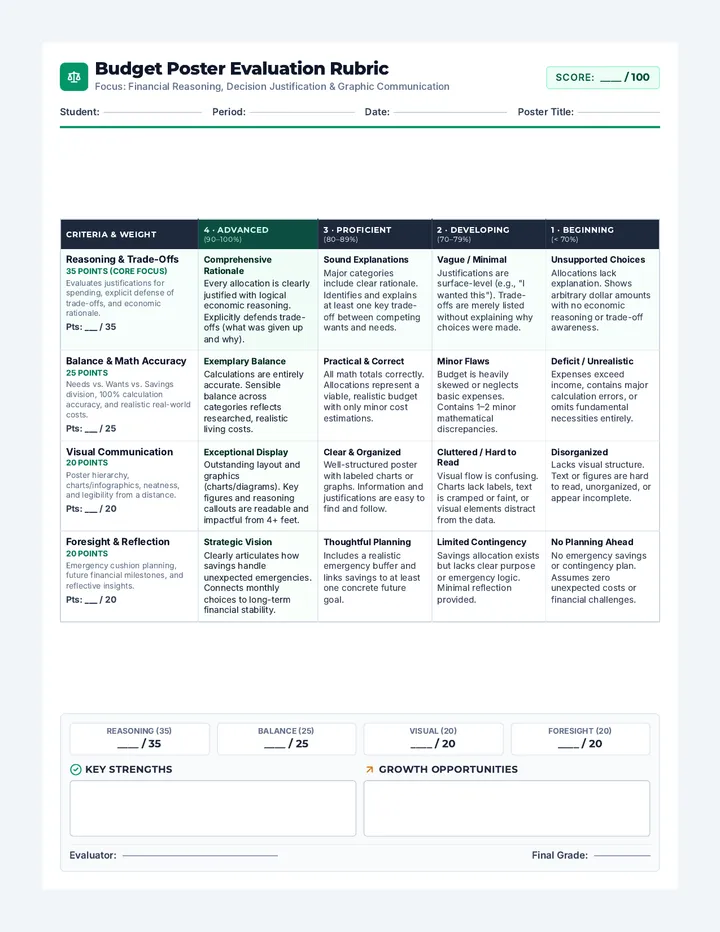
Category 4 - Exceeds 3 - Meets 2 - Approaches 1 - Needs Dev. Self-Awareness & Reflection Exceptional insight into interests/skills; clear, thoughtful connections to chosen pathways. Good understanding of interests/skills; logical connections to chosen pathways. Basic understanding shown; connections to career pathways are somewhat unclear. Limited demonstration of self-awareness regarding interests, skills, and values. Career Research Thoroughly researched options; detailed, accurate data from multiple reliable sources. Researched two options; mostly accurate information from relevant sources. Researched one option or has significant data gaps/inaccuracies. Minimal or no career research evident in the final project. Action Plan Highly detailed, realistic plan with clear, logical steps and identifiable milestones. Clear and realistic action plan with identifiable goals and practical steps. Basic action plan provided but lacks specific details or realistic timeframes. Action plan is missing or lacks clear goals and actionable steps. Vision Board Creative, compelling visual that thoughtfully illustrates complex aspirations and goals. Clear and relevant visual representation that reflects personal goals. Basic visual; connection to career/life aspirations is somewhat vague. Visual representation is missing or lacks connection to project goals. Presentation Presented with exceptional clarity, confidence, and highly effective communication. Presented clearly and confidently, effectively communicating main ideas. Presentation was somewhat unclear or lacked confidence in communication. Presentation was unclear, disorganized, or not delivered.
Teacher Comments
Student Reflection
SCORE
/ 20
Total Score = Sum of ratings (Max 20 pts)
Career Readiness Quiz Career Readiness Quiz
Final Assessment
Score
_____ / 10
Name
Date
1. Which of the following is NOT typically a part of self-assessment in career exploration?
Identifying personal interests
Determining your skills and strengths
Researching salary ranges for specific jobs
Understanding your core values
2. A two-year degree often offered at community colleges is called a/an:
Bachelor's Degree
Master's Degree
Associate's Degree
Doctoral Degree
3. Which online resource is best for finding detailed occupational information, including job descriptions and required skills?
Wikipedia
Social Media
O*NET OnLine
Online shopping sites
4. Name two different post-high school pathways you learned about today, besides attending a 4-year university.
5. Why is it important to consider your personal values when exploring career options?
Cool Down Reflection Exit Ticket Cool Down
Your Next Step
Student
Date
1 What is one new thing you learned or one career idea that sparked interest today?
2 What is one small action step you can take in the next week?
3 What is one question you still have about your post-high school plans?
Success is a Journey
Career Readiness Quiz Answer Key Answer Key
Career Readiness Quiz
Teacher Resource
Multiple Choice
1. Which is NOT typically part of self-assessment?
Answer: Researching salary ranges for specific jobs
(Self-assessment focus is internal—interests, skills, values—whereas salary research is external occupational research.)
2. A two-year degree at a community college:
Answer: Associate's Degree
3. Best resource for detailed occupational information:
Answer: O*NET OnLine
Open Response
4. Two pathways besides 4-year university:
Accept any two of the following:
Vocational/Technical School (Trade School)
Military Service (Army, Navy, etc.)
Direct Entry into the Workforce (Job)
Apprenticeships
2-year Associate's Degree (Community College)
5. Why consider personal values?
Sample High-Quality Answer:
"Considering personal values ensures that your career aligns with what you find meaningful and fulfilling. This leads to higher job satisfaction and prevents burn-out. For example, if someone values 'independence,' they might struggle in a highly restrictive corporate environment but thrive as an entrepreneur."
Scoring Breakdown
Q1 - Q3
2 points each
Q4 - Q5
2 points each