Feelings Detective Script Feelings Detective Script
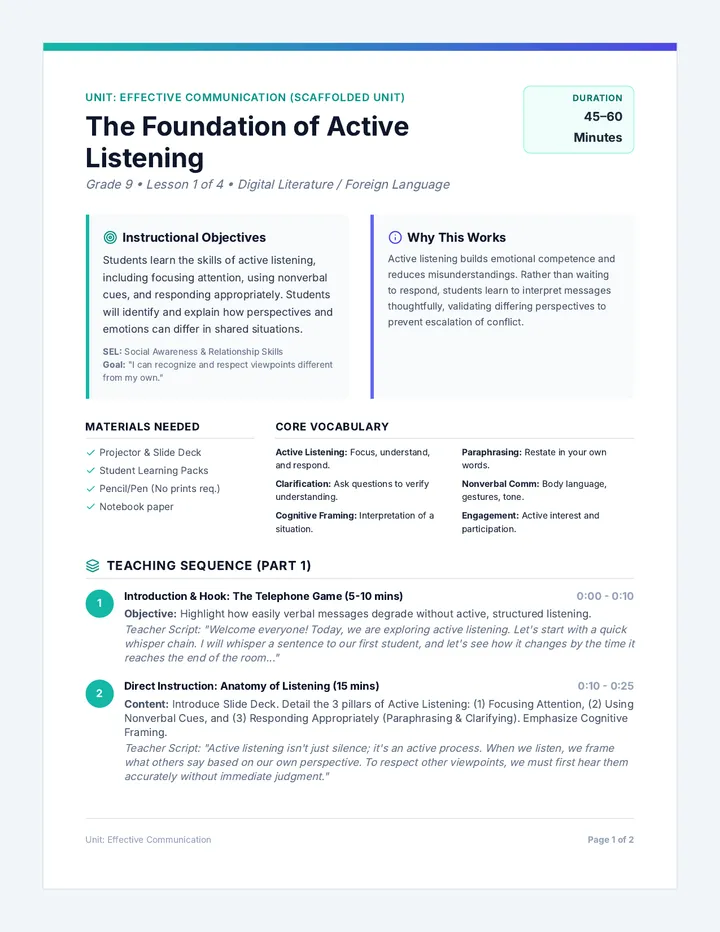
Week 1: Emotional Identification
Session 1
Duration
20 Minutes
Goal
Name feelings & find body clues.
Needs
Magnifying glass (toy), Mirror.
The Hook (5 Mins)
"Hi Explorer! Today we are starting a special mission. We are becoming Feelings Detectives . Detectives look for clues. Did you know our bodies give us secret clues about how we feel inside? If we find the clues, we know what the feeling is!"
The Body Scan (10 Mins)
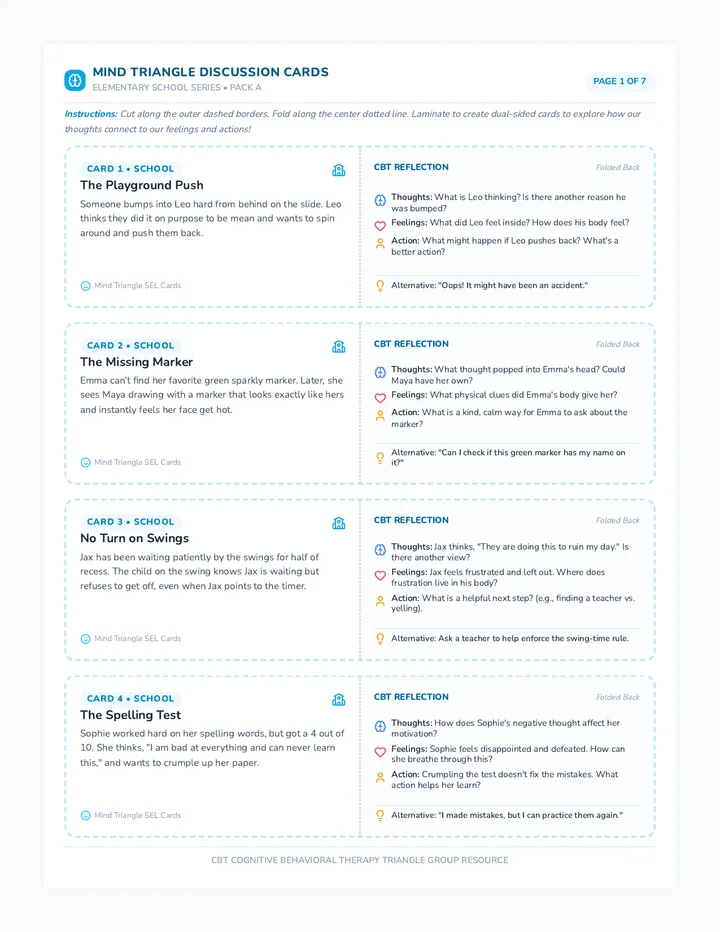
Playfully "scan" the child with a toy magnifying glass or your hands. Check their heart, stomach, and hands.
"Let's check our Heart Clue . When we are worried or excited, our heart goes thump-thump-thump fast! Can you feel yours?"
"Let's check our Tummy Clue . Sometimes feelings like worry feel like butterflies or a 'uh-oh' knot in our belly."
"Let's check our Hand Clue . When we are mad, our hands might turn into tight fists. When we are scared, they might feel shaky."
The Mirror Face (5 Mins)
Use a mirror to practice making "Mad," "Scared," and "Happy" faces. Point out eye and mouth shapes.
Parent Co-Pilot Tip
Model the Detective: When you feel a feeling, narrate it out loud.
"I'm feeling a bit frustrated because I can't find my keys. My hands feel tight and my face feels hot. That's a 'Mad' clue!"
Goal: Don't just ask "how are you?" - ask "what clues do you find in your body?"
Clue Hunter Worksheet Body Clue Hunter
Week 1: Find the secret clues in your body!
Name:
Date:
My Body
Circle where you feel "scared" clues
(like a fast heart or butterfly tummy!)
Detective Checklist
Fast Heart
Thump-Thump-Thump!
Butterfly Tummy
Flutter-Flutter!
Tight Hands
Super Squeeze!
Sweaty Face
Drip-Drip-Drip!
What does a "MAD" face look like?
You're a great Feelings Detective!
Brave Explorers Workbook Cover CBT Adventure Program
Brave
Explorers
My Personal Mission Log
This Workbook Belongs To:
Parent Coaching Guide Parent Coaching Guide
Brave Explorers CBT Program
Your Role as a Co-Pilot
In CBT for 6-year-olds, you aren't just an observerβyou are the primary therapist . This program works because you model the language and reinforce the skills in the "messy" moments of real life.
1. Model Calm Language
Instead of saying "It's fine," try narrating your own feelings and tools.
"My engine is going Red Zone fast right now. I'm going to take a bubble breath before I drive."
2. Avoid Over-Reassurance
Saying "Nothing bad will happen" can accidentally increase worry. Instead, validate the feeling and focus on the tool.
"I see your heart is fast. Use your Brave Talk. I'm right here while you try."
3. Reinforce Brave Action
Focus your praise on doing it anyway rather than 'not being scared.'
"I saw you were scared but you walked in anyway. That was a huge Brave Rep!"
4. Consistent Scripts
Use the program metaphors consistently:
Worry Bug (Anxious thoughts)
Energy Engine (Regulation state)
Brave Reps (Exposure practice)
Troubleshooting
Q
What if they refuse to do a 'Brave Rep'?
Don't force it. Instead, take a "half-step" back. Can they watch you do it? Can they do it for 1 second? Always end on a "win," no matter how tiny.
Q
They say 'I don't know' for body clues.
Use a mirror or play a "freeze" game. Run fast in place and then stopβask "Where is your heart beating?" This makes abstract body awareness concrete.
Helping children become heroes of their own story.
Scale Seekers Script Scale Seekers Script
Week 2: The Feel-O-Meter
Session 2
Duration
20 Minutes
Goal
Measure the size of feelings.
Needs
"Feel-O-Meter" visual (in workbook).
The Big Question (5 Mins)
"Welcome back, Detective! Last week we found body clues. Today we have a new tool: The Feel-O-Meter . Did you know feelings can be different sizes? Some are tiny like a pebble, and some are giant like a mountain!"
Sizing Up Scenarios (10 Mins)
Give the child scenarios and ask them to show the "size" with their arms (tiny squeeze vs giant stretch).
"Scenario 1: You drop one single Cheerio on the floor. Is that a Tiny mad, or a Giant mad? Show me with your hands!"
"Scenario 2: You want to go to the park, but it starts raining. Is that a Medium sad or a Giant sad?"
"Scenario 3: A big dog barks WOOF right at you! Is that a Small worry or a Big worry?"
The Feel-O-Meter (5 Mins)
Open the workbook to the Feel-O-Meter. Practice moving a finger or a toy up and down the scale based on how a "big jump" or a "quiet sit" feels.
Parent Co-Pilot Tip
Validate & Scale: When your child is upset, try to help them "scale it" before fixing it.
"I see you're feeling sad. Is this a little sad or a giant sad? Let's check the Feel-O-Meter."
Goal: This builds the bridge between 'having a feeling' and 'regulating a feeling'. Small feelings need small tools; big feelings need big tools!
Feel O Meter Worksheet The Feel-O-Meter
Week 2: How big is that feeling?
Name:
Date:
5
Giant
"I need help now!"
4
Big
"I'm really struggling."
3
Medium
"I'm feeling it a lot."
2
Small
"Just a little bit."
1
Tiny
"I feel calm & cool."
Where do these land?
Draw a line from the picture to the size on the Feel-O-Meter!
π¦
My ice cream fell down!
What size is that SAD?
πΆ
A dog barked at me!
What size is that WORRY?
π§©
I can't find the last piece!
What size is that MAD?
Draw a TINY feeling vs. a GIANT feeling!
Tiny
Giant
Calm Commanders Script Calm Commanders Script
Week 3: The Regulation Toolbox
Session 3
Duration
20 Minutes
Goal
Learn "Bubble Breathing" for calm.
Needs
Bubbles (wand), a feather.
The Mission (5 Mins)
"Explorer, you've done amazing! You found the clues and you measured the size. But sometimes, when a feeling gets to a 4 or a 5 on our Feel-O-Meter, we need to become Calm Commanders . That means we give our body an order to slow down. Our first order is: Bubble Breathing!"
The Bubble Wand (10 Mins)
Use a bubble wand or pretend to hold one. Practice "Slow Breaths" vs "Fast Breaths".
"If we blow too fastβwhoosh! βthe bubbles pop right away. But if we blow slow and steady , we get the biggest, shiniest bubbles. Let's try together."
"Smell the flower (breathe in through your nose for 3 seconds)... and blow the bubble (blow out slowly for 3 seconds). Watch them float away!"
"Do you feel your shoulders getting heavy and relaxed? That's your body following the Calm Commander's orders."
The Feather Challenge (5 Mins)
"Can you blow this feather so it stays in the air, but doesn't fly away? Use your Calm Commander breath. One... two... three..."
Parent Co-Pilot Tip
The Power of Choice: At 6, kids love control. Instead of saying "Calm down!", ask:
"Commander, which calm tool should we use? Bubble Breathing or a Giant Squeeze?"
Goal: Practice breathing when they are ALREADY calm. It's like a fire drill; you practice when there's no fire so you know what to do when there is!
Calm Toolbox Worksheet The Calm Toolbox
Week 3: Commander, choose your tool!
Name:
Bubble Breathing Guide
ππΈ
1. Smell the flower
Breathe in slow through your nose.
π«§
2. Blow the bubble
Breathe out slow through your mouth.
My Favorite Tools
Circle the ones you like to use!
π§Έ
Squeeze a Bear
π
Hold a Stone
π§±
Build Legos
π§
Listen to Music
Draw your own Calm Tool!
Remember Commander: "I am in charge of my breath!"
Energy Engines Script Energy Engines Script
Week 4: Choosing the Right Tool
Session 4
Duration
20 Minutes
Goal
Match motor tools to body needs.
Needs
Cushion, Wall space.
The Engine Check (5 Mins)
"Explorer, today we're talking about our Energy Engine . Sometimes our engine is going Red Zone Fast βour body feels like it wants to jump and wiggle and zoom! Other times it's in the Blue Zone Slow βwe feel tired or sad. We want to get back to the Green Zone , which is just right for playing and listening."
The Motor Tools (10 Mins)
Practice two different types of tools: Heavy Work (to slow down a fast engine) and Calm Touch .
"If your engine is too fast, we need a Power Tool . Let's do a Wall Push ! Push the wall as hard as you can for 5 seconds. Ready? 1... 2... 3... 4... 5! Feel that power in your muscles?"
"Now let's try a Squeeze Tool . Take a big cushion and give it a giant hug. Squeeze it tight like a bear! This helps our engine feel safe and slow."
"When your body is wiggly, do you think a Wall Push or a Bubble Breath would help more? Let's test both!"
The Engine Shift (5 Mins)
"Let's pretend your engine is super-duper fast! Run in place! Zoom zoom! Now... STOP . Use your Wall Push. Shift back to Green Zone... and breathe."
Parent Co-Pilot Tip
Match the Energy: If a child has high physical energy (Red Zone), sitting still for 'calm breathing' is often impossible.
"I see your engine is going really fast! Let's do 10 frog jumps to help it slow down before we read our book."
Goal: 'Heavy work' (pushing, pulling, jumping) provides proprioceptive input that naturally calms the nervous system more effectively than verbal prompts alone.
Energy Engine Worksheet The Energy Engine
Week 4: Check your speed!
Name:
My Engine Check
π’
Blue Zone
Slow
Tired, Sad, or Bored
π²
Green Zone
Just Right
Ready to Learn & Play
π
Red Zone
Too Fast
Wiggly, Mad, or Excited
Power Tools
Good for Red Zone engines!
π§±
Wall Pushes
πΈ
Frog Jumps
π»
Bear Hugs
Slow Tools
Good for Blue Zone engines!
π«§
Bubble Breath
π§
Cool Water Sip
β¨
Glitter Jar
"I am the boss of my engine!"
Thought Bubbles Script Thought Bubbles Script
Week 5: Simple Thought Work
Session 5
Duration
20 Minutes
Goal
Identify "Brain Sentences".
Needs
Empty paper "bubbles", tape.
The Brain Radio (5 Mins)
"Explorer, you are a master of body clues. But did you know your brain is like a little radio that never turns off? It's always talking! We call these Thought Bubbles . They aren't feelings, they are the sentences our brain says about our feelings."
Heart vs. Head (10 Mins)
Help the child distinguish between a one-word feeling and a sentence thought.
"A Feeling is in our heart/body. It's just one word, like 'Scared' or 'Mad' ."
"A Thought Bubble is a sentence in our head. It says: 'I can't do this!' or 'That dog might bite!' "
"Let's practice! If I say 'Sad', is that a feeling or a thought bubble? (Feeling). If I say 'Nobody wants to play with me', is that a feeling or a thought bubble? (Thought Bubble!)."
Catch the Bubble (5 Mins)
"Let's catch a bubble! If you are about to go down a big slide, what does your brain radio say? Tape a paper bubble to your head and tell me the sentence!"
Parent Co-Pilot Tip
Label the Thought: When your child is anxious, try to help them find the 'sentence'.
"I see you're feeling worried (feeling). What is your brain radio saying right now? What's in your thought bubble?"
Goal: This externalizes the thought. If it's just a 'bubble', we can look at it, talk about it, and eventually, change it.
Thought Bubbles Worksheet The Brain Radio
Week 5: Catch your Thought Bubbles!
Name:
Heart = Feeling
1 Word
"Scared"
Head = Thought Bubble
1 Sentence
"The dark is too scary!"
Catch a Bubble!
Think about something that makes you feel a little bit "uh-oh".
Draw the 1-word feeling in the heart and the "Brain Sentence" in the bubble!
My brain has thoughts, but I am the Boss!
Worry Wranglers Script Worry Wranglers Script
Week 6: Bossing Back the Worry Bug
Session 6
Duration
20 Minutes
Goal
Use "Brave Talk" to shift thoughts.
Needs
A toy bug or puppet.
The Worry Bug (5 Mins)
"Explorer, you've caught those thought bubbles. But sometimes, a sneaky Worry Bug gets into our brain radio. It whispers things that make our Feel-O-Meter go up to a 5! It says things like, 'You're going to fail' or 'Don't go in there!' Today, we are going to be Worry Wranglers and boss that bug back!"
Brave Talk (10 Mins)
Show the toy bug and make it "whisper" a worry. Teach the child to say a "Brave Sentence" back in a loud, proud voice.
"The Bug whispers: 'You can't do the slide, it's too high!' "
"Wrangler, we say back: 'Go away, Worry Bug! I am brave and I can try!' "
"The Bug whispers: 'What if Mom doesn't come back?' "
"Wrangler, we say back: 'Mom always comes back! I can wait and play!' "
"Let's try a superhero pose while we say it. Put your hands on your hips. Stand tall. Tell that bug who is the boss!"
The Squelch (5 Mins)
"Every time we use Brave Talk, the Worry Bug gets smaller and smaller. Let's pretend to squish the bug with our feet while we say our Brave Sentence one more time!"
Parent Co-Pilot Tip
Praise the 'Bossing Back': When your child is scared, don't just say 'It's okay.' Praise their effort to boss back the worry.
"I love how you told that Worry Bug to go away! That was such a brave sentence."
Goal: We are moving from 'distraction' to 'active coping'. We want them to feel like they have power over the scary thoughts.
Worry Bug Wrangler Worksheet Worry Bug Wrangler
Week 6: Boss back that bug!
Name:
Sneaky
πͺ²
What does the bug say?
Draw or write the sneaky worry here!
Brave
π¦Έ
My Brave Talk:
"Go away, Worry Bug! I am ________!"
Fill in your Brave Power word!
Wrangler Skills
Loud Voice
Tall Pose
Quick Shift
Worry Wrangler Level: Master βοΈ
Bravery Road Script Bravery Road Script
Week 7: Small Steps to Big Brave
Session 7
Duration
20 Minutes
Goal
Build a "Bravery Road" hierarchy.
Needs
Toy cars or figures.
The Secret of Brave (5 Mins)
"Explorer, I have a secret. Being brave doesn't mean you aren't scared. It means your body feels the 'uh-oh' clues, your brain says a worry sentence, but you do it anyway ! We're going to build a Bravery Road today to help us practice being brave in small steps."
Building the Road (10 Mins)
Use the workbook. Help the child pick one "Big Brave" goal and break it into 3 small stops on the road.
"Let's think of something that is a little bit scary. Maybe... saying hi to a new friend? Or sleeping with the door just a tiny bit closed?"
"Stop 1 is a Tiny Brave . What's something so small it's easy? Maybe just waving from far away?"
"Stop 2 is a Middle Brave . Maybe saying 'Hi' but staying near Mom?"
"Stop 3 is the Goal Brave ! That's when we use our tools to do the whole thing!"
Drive the Road (5 Mins)
"Take your toy car. Let's drive to Stop 1. If we feel a worry clue, what do we do? (Bubble breath!). Drive to Stop 2... boss back that bug! You're moving on the Bravery Road!"
Parent Co-Pilot Tip
Wait and Watch: When your child is about to do something brave, avoid over-reassuring (e.g., 'It's fine, nothing will happen'). This can actually increase anxiety by suggesting there *was* something to fear.
"I see you're being a brave explorer. I'm right here watching. Go ahead."
Goal: We want the child to learn that the feeling of anxiety is uncomfortable but not dangerous, and that they can handle it.
Bravery Road Map Worksheet Bravery Road Map
Week 7: My plan to be big brave!
Name:
3
My Big Brave Goal:
π°
π²
2
A Middle Step:
1
A Tiny Start:
π
How to build your road:
Pick one thing that feels a little bit scary (like the Worry Bug).
Break it into 3 steps. Step 1 should feel like a 2 on the Feel-O-Meter!
Use your tools as you drive up the road!
Small Steps Script Small Steps Script
Week 8: The First Brave Rep
Session 8
Duration
20 Minutes
Goal
Complete Stop 1 on the Road.
Needs
Bravery Road Map, Stickers.
Ready for Takeoff (5 Mins)
"Explorer, you've built your map. You've got your tools. Today is the day we do our first Brave Rep ! We are going to drive to Stop 1 on our Bravery Road. It's just a tiny step, but every tiny step makes your Brave Muscle grow stronger!"
The Doing Phase (10 Mins)
Execute the exposure planned in Stop 1 of Week 7. Use all tools sequentially.
"Let's do a Detective Check . Any clues? Is your heart fast? That's okay, that just means your body is getting ready for a mission."
"Now, Calm Commander , give the order! One bubble breath... in through the nose, out through the mouth."
"Lastly, Worry Wrangler , tell that bug to go away! Say: 'I can do this! I am brave!' "
"Now... let's do it! 1... 2... 3... Go!" (Complete the small task together).
The Celebration (5 Mins)
"YOU DID IT! You did something even while feeling a little scared. That is the true secret of being a Hero. Let's put a giant sticker on Stop 1. How does your Brave Muscle feel now?"
Parent Co-Pilot Tip
Praise the Action, Not the Lack of Fear: Avoid saying 'See, that wasn't scary!' Instead, focus on their effort.
"I am so proud of you for doing that even though your body felt scared. You are a true Brave Explorer!"
Goal: We want them to value 'bravery' (action in the face of fear) rather than 'fearlessness'.
Brave Rep Tracker Worksheet Brave Rep Tracker
Weeks 8-9: Training your Brave Muscle!
Name:
Every Rep Counts!
Color in a star every time you do a step on your Bravery Road!
Week 8: Stop 1 Reps
Tiny Brave
Week 9: Stop 2 Reps
Middle Brave
How does it feel?
πͺ
Stronger
π
Proud
π¦
Brave
"I can do hard things!"
Hero Hops Script Hero Hops Script
Week 9: Leveling Up Your Bravery
Session 9
Duration
20 Minutes
Goal
Complete Stop 2 on the Road.
Needs
Bravery Road Map, Stop 2 task.
The Level Up (5 Mins)
"Hero! Last week you conquered Stop 1. Your Brave Muscle is looking huge! Today is a 'Level Up' day. We are driving to Stop 2 on the Bravery Road. This one is a little bit bigger than the last one, but you already know exactly what to do."
The Hero Hop (10 Mins)
Prepare for and execute the "Middle Brave" task from the hierarchy.
"Let's do our pre-mission check. Check your Energy Engine ... is it Red, Green, or Blue? (Adjust if needed)."
"What's the Brain Sentence the radio is saying about Stop 2? (Identify the thought). Let's wrangler it! Boss that bug back!"
"Okay, take a big Hero Breath... in for 3... out for 3... and let's go! We're hopping to Stop 2!"
(Support the child as they attempt the slightly more challenging task. If they stall, offer a 'half-step' or use a motor tool like wall pushes together first.)
The Badge of Brave (5 Mins)
"Whoa! Did you see that? You just hopped right over that worry! Let's color in Stop 2 on your map. You are officially a Master Wrangler now. Only one stop left until you reach the goal!"
Parent Co-Pilot Tip
Encourage Repetition: Bravery is a muscle. Doing a 'brave thing' once is great, but doing it three times makes it permanent!
"You did Stop 2 so well today! Let's try to do it one more time before dinner so your brain remembers it's safe."
Goal: Repetition lowers the 'threat level' in the brain (habituation). The more they do it, the smaller the Feel-O-Meter goes.
Master Explorer Script Master Explorer Script
Week 10: Graduation & Celebration
Session 10
Duration
20 Minutes
Goal
Celebrate and recap tools.
Needs
Certificate, Workbook, Treat.
The Master Review (5 Mins)
"Master Explorer, welcome back! Today is a very special day. You have completed all 10 missions! You've grown your Brave Muscle so big that you are now a Master. Let's look back at all the tools you've collected in your explorer pack."
Toolbox Recap (10 Mins)
"I'm going to say a tool, and you show me how it works!"
"Show me... Detective Body Clues ! Where does worry hide? (Heart/Tummy)."
"Show me... Bubble Breathing ! Give your body the order to calm."
"Show me... Brave Talk ! Tell that sneaky Worry Bug to hit the road!"
"Show me... Red Zone Power ! Do a giant Wall Push!"
The Graduation (5 Mins)
Present the certificate with fanfare (you can play music or clap!).
"It is my honor to name you a Master Brave Explorer . Even when you feel scared, you know what to do. You are the boss of your feelings, your thoughts, and your body. I am so proud of you!"
Parent Co-Pilot Tip
Keep the Language Alive: Graduation isn't the endβit's just the beginning of 'Brave Life'. Continue to use the metaphors (Bug, Engine, Clues) in daily life.
"You're a Master Explorer now! Which of your Master tools do you want to use for this scary thing today?"
Goal: Maintain the child's identity as someone who is 'brave' rather than someone who 'has anxiety'.
Master Explorer Certificate The Brave Explorers Program
Certificate of Bravery
This award is proudly presented to:
____________________________________
For mastering the tools of the Feelings Detective , the Calm Commander , and the Worry Wrangler . You have shown true courage on the Bravery Road !
Chief Explorer Guide
Official Master Explorer
Date of Achievement