Voice Your Feelings Slides
Social-Emotional Skills
Voice Your Feelings:
The Power of "I Feel" Statements
How to take a breath, find your words, and get what you need when situations feel frustrating or tough.
Stay in Control
Express Needs Clearly
Solve Problems Safely
Body & Brain Signals
When Emotions Start Running High
Body Clues
Clenched fists, fast heartbeat, tight jaw, or a sudden urge to push away or leave the room.
Common Triggers
Hearing "no," finishing computer time, hard assignments, or annoying comments from peers.
The Goal
All feelings are okay! What matters most is how we choose to handle them and share what we need.
💡 Remember: Having big feelings is normal. You can be upset and still make safe, powerful choices.
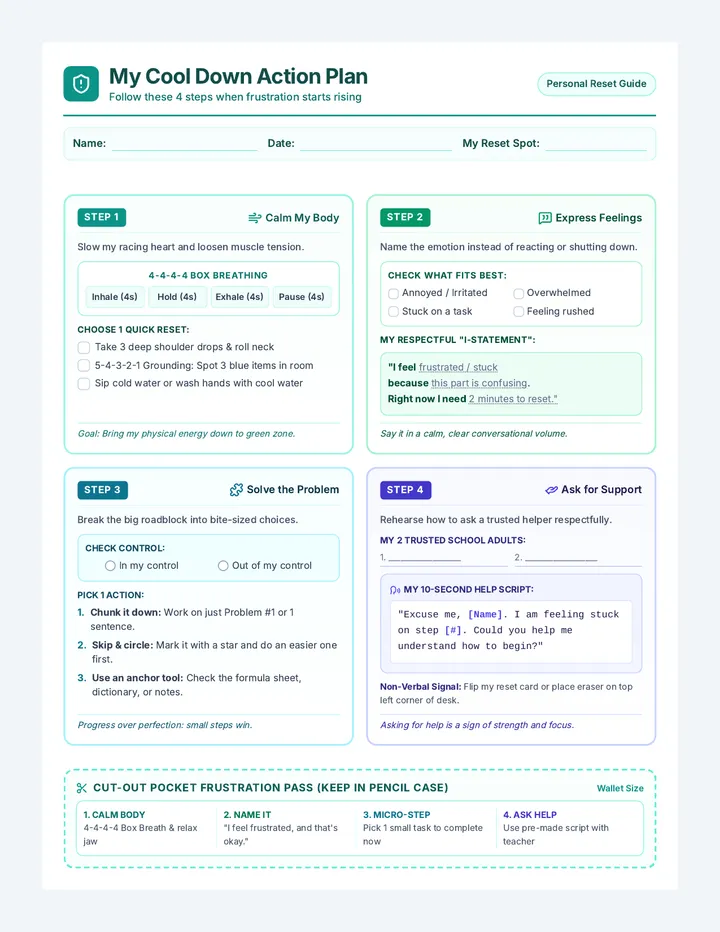
First Step
Hit the Pause Button First
Cool Down Your Engine
When we feel angry or overwhelmed, our thinking brain goes offline. We must calm our body before we speak.
1 Take 3 slow belly breaths in and out
2 Count backwards slowly: 5, 4, 3, 2, 1
3 Drop your shoulders and loosen your hands
Why This Works
Pausing prevents unexpected reactions like yelling, pushing, or running away.
"When my body feels calmer, my brain can find the right words to tell adults and friends what I need."
Breathe in calm... breathe out frustration. Now you're ready to speak!
The Communication Formula
The 3-Part "I Feel" Statement
1
I Feel...
Name your exact emotion without blaming or attacking.
Examples:
Frustrated, overwhelmed, left out, or mad.
2
When...
Describe the specific event or situation clearly.
Examples:
"When I have to stop playing" or "When this math is confusing."
3
I Need / Can I...
Ask for a coping tool, a short break, or adult help.
Examples:
"Can I take a 2-minute break?" or "Can you help me start?"
"I feel [Emotion] when [Event]. Can I please have [Need/Solution]?"
Making the Choice
Words Get You What You Need Faster
Unexpected Reactions
• Running away (elopement) leaves you unsafe and does not solve the task.
• Yelling or physical aggression leads to consequences and lost privileges.
• Shutting down keeps frustration trapped inside.
Using "I Feel" Statements
• Teachers understand immediately and can give you a break or help.
• You keep your privileges, trust, and calm environment intact.
• You stay in charge of your own choices and actions.
✨ When you use your words, adults and friends can actually help you succeed!
Scenario 1: Told "No" / Access Denied
When You Can't Have What You Want Right Now
The Situation
You ask to play your favorite computer game, but the teacher says: "Not right now, it is time for science."
❌ Instead of Reacting With:
Yelling "That's not fair!", slamming the desk, or walking out.
✅ Take a Breath and Say:
"I feel disappointed when I can't play the computer. Can you tell me when I can earn it next?"
💬 Discussion: Why does asking "When can I earn it?" help more than arguing?
Scenario 2: Hard Work & Demands
When an Assignment Feels Too Hard
The Situation
The teacher hands out a multi-step writing prompt. Looking at the blank page makes your stomach drop and head feel hot.
❌ Instead of Reacting With:
Ripping the paper, refusing to do it, or putting your head down in anger.
✅ Take a Breath and Say:
"I feel overwhelmed when there are so many writing steps. Can you please help me start the first sentence?"
🛠️ Alternative Request: "Can I take a 2-minute break or do the first 2 questions first?"
Scenario 3: Peer Interactions
When a Classmate Annoys or Upsets You
The Situation
At recess or group work, a classmate grabs the equipment without asking or makes an unkind comment about your work.
❌ Instead of Reacting With:
Shoving them, yelling insults back, or leaving the play area angrily.
✅ Take a Breath and Say:
"I feel annoyed when you grab the ball without asking. Please ask me first so we can take turns."
🤝 If they don't listen: "I'm going to ask the teacher to help us solve this."
Scenario 4: Unexpected Transitions
When the Schedule Suddenly Changes
The Situation
It starts raining, so outdoor recess is canceled, or the teacher announces an unexpected room change right in the middle of your work.
❌ Instead of Reacting With:
Refusing to move, kicking a locker, or escaping down the hallway.
✅ Take a Breath and Say:
"I feel stressed when the routine changes without warning. Can I have 1 minute to wrap up my thoughts?"
🔄 Pro Tip: Having a visual schedule check or timer helps make transitions smoother.
Quick Reference
Your "I Feel" Pocket Toolkit
1. Emotion Words
Frustrated Overwhelmed Disappointed Confused Upset Worried
2. Situation Words
Told "no" Work is tricky Computer time over Surprise change Peer bothered me
3. Needs / Requests
Take a 2-min break Adult help Quiet corner Do 2 problems first Drink of water
Pause • Breathe • State Your Feeling • Ask for Your Need!