Reset And Speak Up Slides
8th Grade Coaching Toolkit
Volume Down.
Power Up.
Practicing positive self-talk and self-advocacy when classrooms get loud or chaotic.
Steady Thoughts
•
Clear Scripts
•
Real Scenarios
Today's Game Plan
What We're Practicing
1. Spot the Overload
Notice early signs when a room starts feeling too loud or chaotic.
2. Positive Self-Talk
Swap spiraling thoughts for steady, realistic reminders.
3. Self-Advocacy
Ask for a break, quiet space, or reset before hitting a 10/10.
4. Scenario Practice
Test these skills on real 8th-grade classroom situations.
The Brain Science
Why Loud Classrooms Feel Overwhelming
When everyone talks at once, your brain tries to process every sound at the same time.
Your nervous system hits the alarm button—that's why your chest feels tight or you want to shut down.
It's not a flaw. It just means your brain needs a quick reset and a clear plan.
Skill 1 • Positive Self-Talk
Not Fake Cheerleading—Just Steady Truth
Overwhelmed Brain Says...
"I can't handle this. Everyone else is fine except me."
"If I ask for a break, people will stare or judge me."
"This whole class is ruined. I'm going to lose it."
Steady Self-Talk Says...
"My brain is overloaded right now. Taking a reset helps me focus."
"Most people are focused on themselves. Asking for what I need is smart."
"I don't have to fix the noise. I just need my next calm step."
Quick Anchors
3 Phrases to Keep in Your Pocket
01
"It's loud in here, and that's why I feel tense. Let me take three slow breaths first."
02
"I am allowed to take a break. Stepping away for 3 minutes helps me reset and come back stronger."
03
"One minute at a time. I don't need to finish everything right this second."
Going Deeper • Positive Self-Talk
How to Shift a Spiral in 3 Moves
Your inner voice shapes how fast your nervous system calms down.
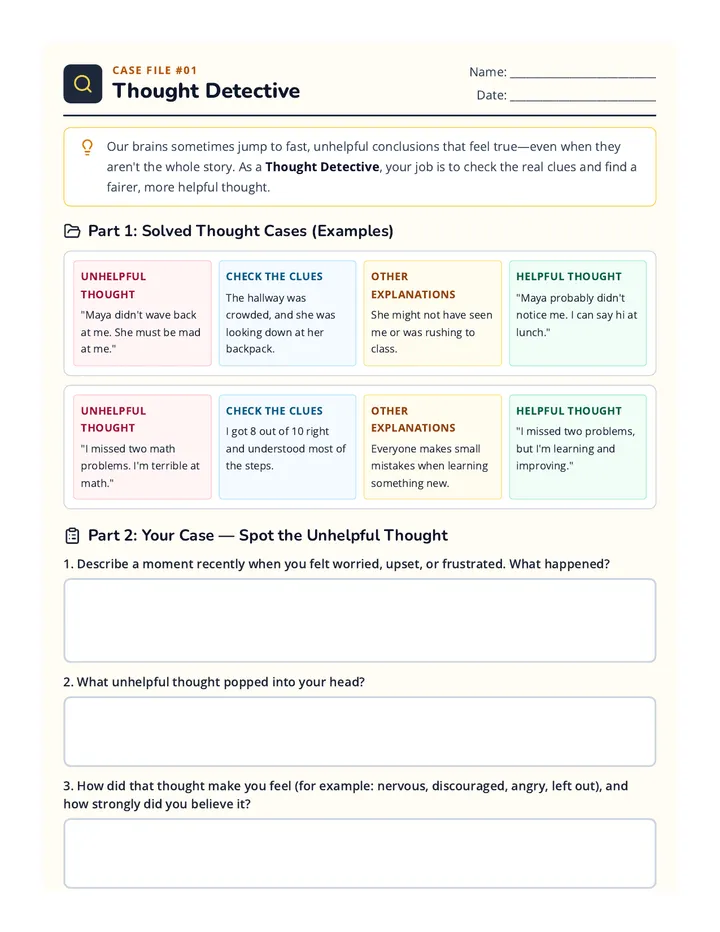
1. Spot Extreme Words
Notice words like always, never, or everyone—they signal stress, not truth.
2. Fact vs. Feeling
Fact: "The room is loud." Feeling: "I'm tense." Separate the noise from your worth.
3. Friend Filter
Ask: "What would I tell my closest friend right now?"—then say that exact thing to yourself.
Skill 2 • Self-Advocacy
Speak Up Before You Hit a 10/10
Self-advocacy means telling an adult or peer what you need clearly and respectfully.
1. Catch It Early
Advocate at a 5 or 6—when you can still think clearly and use your words.
2. Keep It Short
You don't need a long speech. One clear sentence or a quiet signal works.
3. Name the Return
Teachers love hearing when you'll be back: "Can I take 3 minutes and come right back?"
Your Script Menu
Ways to Ask for What You Need
Quick Teacher Check-In
"It's getting really loud for me right now. Can I step into the quiet spot for 3 minutes?"
Non-Verbal / Discreet Option
Place your break pass on the corner of your desk or use your agreed hand signal—no talking needed.
Workspace Adjustment
"May I put on my noise-reducing headphones or move to the back table while we work independently?"
Going Deeper • Self-Advocacy
What Self-Advocacy Really Means
Self-Advocacy IS...
- • Knowing what helps your brain focus
- • Asking calmly before you shut down
- • Taking charge of your own learning
Self-Advocacy IS NOT...
- • Being rude, dramatic, or "difficult"
- • Trying to get out of doing classwork
- • Waiting until you're in tears to speak up
Pro Tip: Agree on a quiet signal with your teacher before class gets loud—then you never have to explain in the moment.
Scenario 1 of 3 8th Grade Science
Chaotic Group Lab
Six lab groups are talking loudly at once. Two students near you start arguing over supplies, and the teacher is across the room. Your shoulders tense up and your thoughts start racing.
Positive Self-Talk
What is one steady phrase you can tell yourself right now instead of spiraling?
Self-Advocacy Move
What can you say or do to ask for a reset or quieter space?
Scenario 2 of 3 8th Grade Social Studies
Loud Substitute Day
There's a substitute teacher who doesn't know your class routines. People are walking around, laughing, and ignoring directions. You feel your brain shutting down and want to put your head down.
Thought Swap
What might your overwhelmed brain say—and what's a realistic swap?
Sub-Day Advocacy
How can you advocate for a break or quiet corner with a teacher who doesn't know you well?
Scenario 3 of 3 Hallway to Classroom
Noisy Transition Rush
You just walked out of a crowded, noisy hallway into a packed classroom. The bell rings and the teacher immediately starts giving fast, multi-step directions while kids are still rustling backpacks.
First Reset Step
What grounding or self-talk step helps you steady yourself in the first 30 seconds?
Clarify & Advocate
How can you politely ask for the directions to be repeated or written down?
Your 3-Step Playbook
When the Room Gets Loud
Step 1
Pause & Ground
Notice early tension (tight shoulders, racing thoughts). Take 3 slow breaths or plant both feet on the floor.
Step 2
Steady Self-Talk
Catch spiraling thoughts and swap in truth: "I am allowed to take a break. One calm step at a time."
Step 3
Speak Up / Signal
Advocate at a 5 or 6—not a 10. Use your short script, break pass, or headphones and name when you'll return.