Investigator Briefing Guide
Part 1 // Counselor Lesson Plan
Investigator Briefing Guide
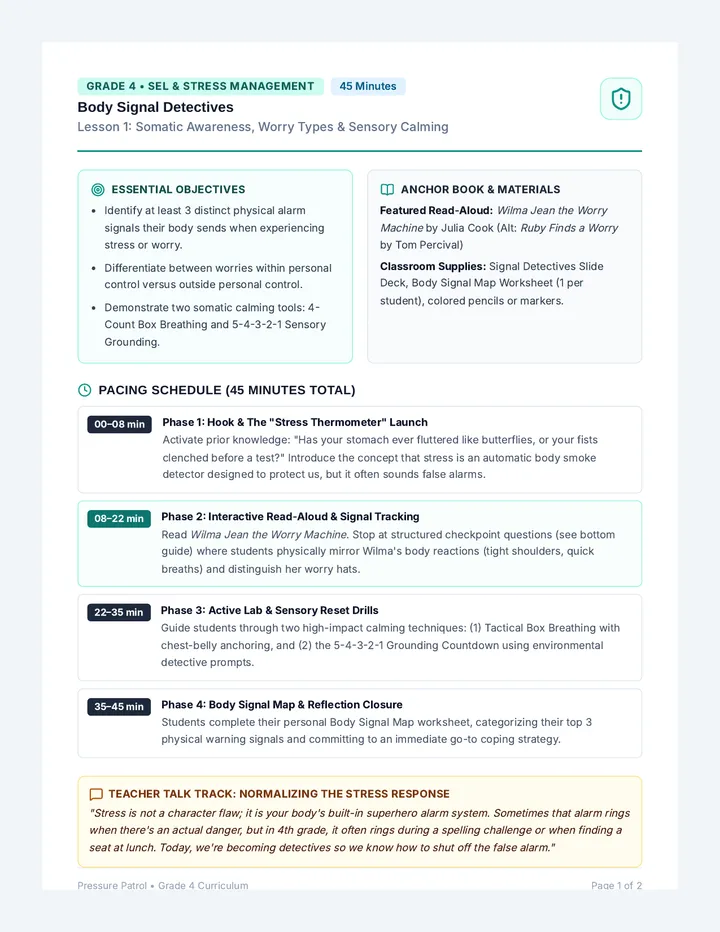
Lesson: Anatomy of My Anxiety Alarm (4th-5th Grade Specialist)
Class Kit 5-Page Bundle
Core Objective
Students will differentiate between cognitive (mind) and somatic (body) anxiety alerts and map physical sensations.
SEL Standard
Recognize complex emotions, label physiological cues, and evaluate self-regulation strategies.
Lesson Details
Duration: 45 Minutes
Vocabulary Focus: Amygdala, Somatic, Cognitive, Physiological
Nuanced Mind-Body Vocabulary
- •Cognitive: Worry loops, repetitive "what-if" thoughts, dread, and anticipatory anxiety.
- •Somatic: Direct, physical bodily sensations (constricted breathing, elevated heart rate, muscle tension).
- •Physiological: Automatic biological changes triggered by fight-or-flight survival mechanisms.
Phase 1: The Biological Alarm System (10 mins)
0:00 - 0:10
Engage 4th/5th graders by respecting their intellectual maturity, explaining the evolutionary role of the amygdala.
Facilitator Script (Talking Points): "Welcome, Mind-Body Investigators! Today we are examining a highly specialized emotion: anxiety. At your age, you might experience more complex worries—like social stress, grades, or changes at home. To solve these mysteries, we need some neuroscience. Inside your brain is an almond-shaped control center called the amygdala. It acts as your physiological smoke detector. If an ancient human met a saber-toothed cat, the amygdala fired instantly, dumping adrenaline into the blood so they could run or fight. Today, there are no tigers, but your amygdala still treats modern stressors (like presenting a slide deck to the class) like physical threats. Let's trace how these psychological worries transform into biological responses!"
Phase 2: Cognitive vs. Somatic (10 mins)
0:10 - 0:20
Present the split between thoughts and bodily reactions to build emotional awareness and specific somatic categorization.
Facilitator Script (Talking Points): "As investigators, we classify anxiety clues into two departments: 1. Cognitive alerts (mental clues, like circular worrying, imagining worst-case scenarios, or feelings of dread). 2. Somatic alerts (physical body clues, like heart palpitations, tense shoulder muscles, cold fingertips, or shallow breathing). Why does our blood flow away from our hands and toward our legs when we are anxious? It’s called vascular constriction—your body prepares to sprint! Let's examine some case files to see these dual alarms in action."
ANXIETY INVESTIGATORS • GRADES 4-5 FACILITATOR GUIDE Page 1 of 5
Part 2 // Counselor Lesson Plan
Investigator Briefing Guide
Lesson: Anatomy of My Anxiety Alarm (4th-5th Grade Specialist)
Class Kit 5-Page Bundle
Phase 3: Deep Dive Investigation (10 mins)
0:20 - 0:30
Examine the Anxiety Investigator Log page 4. Challenge students to categorize findings as "Cognitive Clues" (CC) or "Somatic Clues" (SC) inside the case studies.
Facilitator Script (Talking Points): "Open your investigator logs to Page 4. Let's look at Leo and Maya. Note that they don't just feel 'sad' or 'scared'—they have complex, overlapping symptoms. Underline the parts where their physical bodies react, and circle where their mental focus changes. Everyone's physiological profile is unique. Some of us are 'mind worry loops' (cognitive), while some of us feel it instantly in our digestive systems or chest walls (somatic). Identifying your personal primary profile is a superpower."
Phase 4: Precise Body Mapping (10 mins)
0:30 - 0:40
Students map their somatic symptoms on Page 5. Encourage specific anatomical labeling rather than vague descriptions.
Facilitation Guidelines:
1. Use Precise Sensory Terms: Prompt students to describe sensations precisely: *throbbing, shallow, cold constriction, muscle rigidity, butterflies/digestion freeze*.
2. Distinguish Intensity: Use different colors for high-arousal zones (hot adrenaline rushes) and low-arousal/withdrawal zones (freeze, numb fingertips).
Phase 5: Vagal Regulation Resets (5 mins)
0:40 - 0:45
Teach grounding not just as a 'distraction,' but as a scientific way to send safety cues back up the vagus nerve to the brain.
Facilitator Script (Talking Points): "If your amygdala starts a false alarm, how do we shut it down? We can't just yell 'Stop!' at our brains. We have to speak the body's language. We use somatic resets. When you take a slow, extended exhalation, you activate your parasympathetic nervous system. It sends a direct signal back up your vagus nerve to your brain that says: 'The threat is gone. You can stand down.' Let's execute an 'Anchor Press' to instantly ground our nervous system right now."
Advanced Differentiation Guidelines (4th-5th Grade)
Supporting Highly Analytical Minds
Some students thrive on biological explanations. Offer them terms like "sympathetic nervous system activation" (the gas pedal) and "parasympathetic" (the brakes).
Differentiating Somatic Blends
Help students see that feeling worried is an active connection: "Thoughts produce chemicals, chemicals change breathing, breathing alters your energy." It is all connected.
ANXIETY INVESTIGATORS • GRADES 4-5 FACILITATOR GUIDE Page 2 of 5
Part 3 // Classroom Anchor Chart Reference
The Anxiety Anatomy
Lab Blueprint Mind-Body Axis
The Biological Alarm: Amygdala Response
Your amygdala is the brain’s built-in smoke detector. When it senses a stressor (like public speaking or an exam), it triggers an instant physiological fight-or-flight response. This shifts your nervous system, immediately converting cognitive worries (mind thoughts) into real, automatic somatic reactions (physical sensations).
Cognitive Alerts (The Mind)
Repetitive "what-if" loops, difficulty concentrating, feelings of dread, or anticipatory fear of future scenarios.
Somatic Alerts (The Body)
Physical responses triggered by adrenaline, including localized tension, temperature spikes, or digestive stalls.
01
Cerebral Shift (Head)
Blood flows away from critical decision-making zones, causing mild dizziness, racing cognitive alerts, or a tight "headband" headache.
02
Constricted Breath (Lungs)
Respiration becomes shallow and rapid. Your lungs attempt to maximize oxygen supply, preparing muscle fibers for explosive motor response.
03
Cardiac Surge (Heart)
Adrenaline initiates rapid contractions (palpitations) to deliver blood to your core limbs, creating a heavy thumping sensation in your chest.
04
Digestive Freeze (Stomach)
Your enteric nervous system slows down digestion to redirect survival energy. This manifests as fluttering "butterflies," cold knots, or nausea.
05
Vascular Shift (Hands)
Capillaries in your extremities constrict to prevent bleeding during impact. Fingers feel cold, sweaty, or experience active trembling.
06
Motor Priming (Legs)
Lower limb muscles contract heavily, filling them with potential energy. This is felt as restless tension or the urgent desire to run.
Physiological Reset Tools (Somatic Calming)
01 // Parasympathetic Breath
Inhale through your nose for 4 counts, then exhale twice as slow (8 counts) with slightly parted lips. This triggers your vagal nerve to reduce heart rate.
02 // Proprioceptive Release
Press your feet firmly into the floor while tightening your calf muscles for 5 seconds, then release. This expels pent-up adrenaline safety locks.
03 // Cognitive Grounding
Audit your current space: identify 3 structural textures (proprioception), 2 specific wavelengths of green (visual), and 1 ambient tone (auditory).
SEL STRATEGY ANCHOR CHART • ANXIETY INVESTIGATORS Page 3 of 5
Part 4 // Official Student Case File
Anxiety Investigator Log
Student Logbook Somatic Study
Lead Investigator Name:
Date of Investigation:
Activity 1: Examine the Case Files
Read the case files. Underline the somatic (body) signals and circle the cognitive (mind) signals showing how anxiety activates each person's alarm.
FILE 01
Leo & the Book Report
"When Mr. Davis calls Leo’s name to present his book report, Leo’s hands immediately feel cold and shaky. As he walks up to the chalkboard, he notices his heart is thumping like a drum, his mind races with 'what-ifs,' and his stomach has a heavy, tight knot inside."
Write 1 Somatic Clue:
FILE 02
Maya & the Cafeteria
"Maya walks into the crowded, loud lunchroom. Her mind loops with worry about where to sit. Suddenly, her throat feels dry, her thoughts spin, her face gets hot, and her legs feel bouncy and restless, like they are desperate to run away."
Write 1 Cognitive Clue:
Activity 2: The Personal Alarm Survey
When your amygdala alarm system goes off, what alerts do you receive? Place a checkmark [✓] next to every somatic warning sign your body has experienced.
Mind & Head
Mind Spinning / Loops Dizzy or Lightheaded Hot or Flushed Ears/Face Dry Mouth or Throat
Chest & Breathing
Rapid, Short Breathing Heavy Thumping Heart Tightness in Chest Whole-Body Heat / Sweat
Tummy & Limbs
Stomach Butterflies Cold / Numb Fingertips Shaky or Trembling Hands Tense / Rigid Muscles
ANXIETY INVESTIGATOR WORKBOOK • STUDENT COPY Page 4 of 5
Part 5 // Sensory Anatomy Blueprint
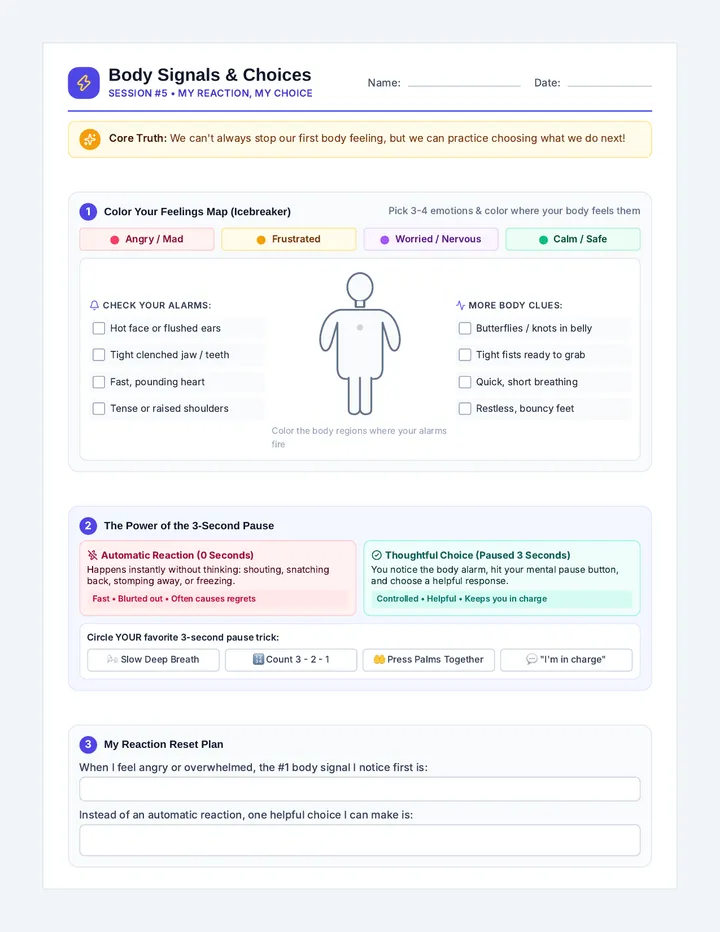
My Anxiety Body Map
Activity 3: Drawing Canvas
Draw, color, and label your anxiety signals on this silhouette. Use warm colors (red/orange) for spots that feel hot, thumping, or active, and cool colors (blue/purple) for spots that feel shaky, cold, or tense. Write exact descriptive words near each zone!
Color-Code Guide
Hot / Racing Shaky / Cold Rigid / Tense Empty / Knot
Cognitive Worries (Loops)
Respiration & Heart Rates
Enteric/Digestive Tension
Motor Energy & Tremors
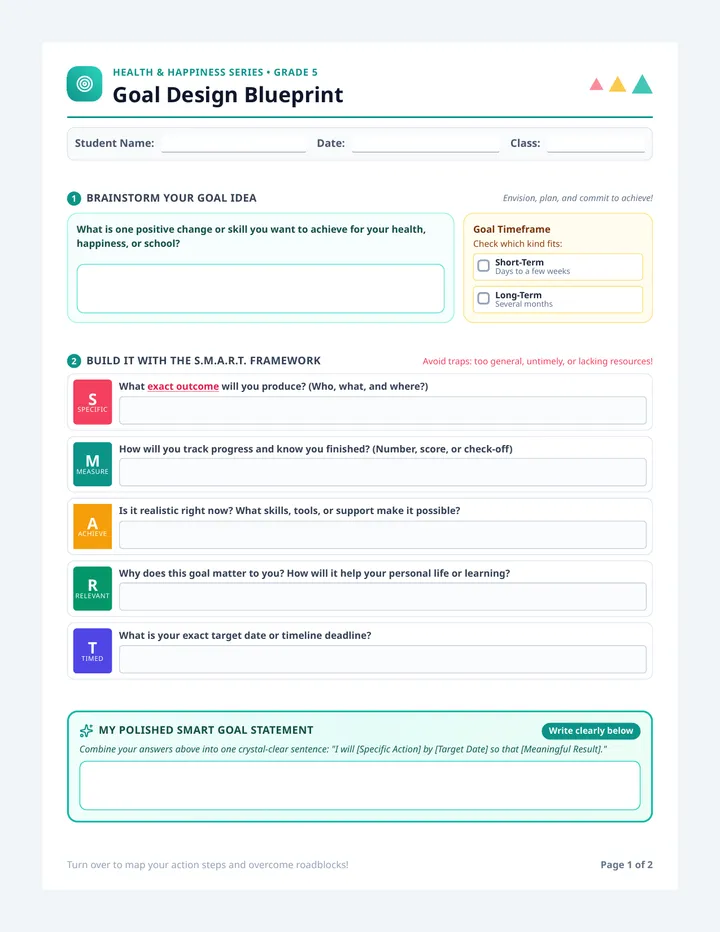
Activity 4: Investigator's Conclusion
1. When my mental anxiety alarm starts to trigger, my body reacts by: (List your top 2 sensations)
2. My favorite somatic rescue tool to reset my alarm and show my body I'm safe is:
ANXIETY INVESTIGATOR WORKBOOK • STUDENT COPY Page 5 of 5