Inner Radar Slides
SEL Masterclass • 2-Day Series
Middle School Life Skills
INNER RADAR
The Science of Self-Awareness
Noticing what is happening inside you and understanding how it drives everything you do.
01
Day 1: The 4 Clues & The Radar
Emotions, physical body cues, and the 1–5 scale
02
Day 2: Rewiring Your Reactions
Breaking habits, self-advocacy, and real-life scenarios
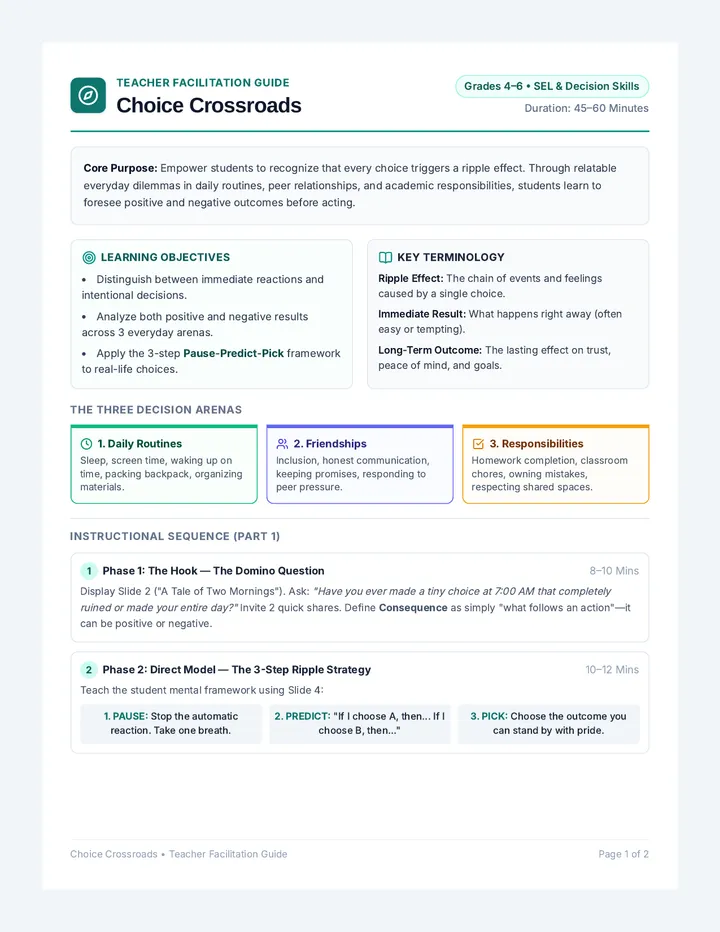
Ground Truth Part 1 • The Definition
Myth: Self-awareness is just asking "How do you feel?"
Our Real Definition
"Noticing what is happening inside me and understanding how it affects what I do."
Without Self-Awareness
You operate on autopilot. You snap, freeze, or shut down, then wonder later: "Why did I do that?"
With Self-Awareness
You spot physical warnings and runaway thoughts early—giving yourself the superpower to choose your move.
Rule of thumb: You can't steer a reaction you don't even notice.
Internal Radar System The 4 Concrete Clues
Notice These 4 Clues Inside You
Self-awareness isn't vague guesswork. Train yourself to track these four channels in real time.
1. What am I feeling?
EMOTION
Label it precisely: mad, worried, embarrassed, bored, frustrated, overwhelmed, excited.
2. What is my body doing?
PHYSICAL
Notice the hardware: tight fists, fast heart, burning cheeks, tense jaw, heavy chest, fidgety legs.
3. What is my mind saying?
THOUGHTS
Listen to the script: "This is stupid," "I can't do this," "They're laughing at me," "I have to get out."
4. What do I need right now?
ACTION
Pick your tool: take 3 breaths, ask for clarification, drink water, take a break, reframe my thought.
When these 4 clues light up together, your radar gives you full control.
Activity 1 • Investigation Body Detective
Your Body Sounds the Alarm First
Your body reacts up to 5 seconds before your conscious brain realizes what emotion you are feeling.
Head & Face
- • Hot or flushed cheeks
- • Clenched teeth/jaw
- • Tight temples / headache
- • Eyes avoiding eye contact
Chest & Heart
- • Heart beating fast/loud
- • Rapid, shallow breathing
- • Tightness across chest
- • Throat feeling constricted
Stomach
- • "Stomach dropped"
- • Nausea / fluttery butterflies
- • Heavy knots in gut
- • Loss of appetite or cramps
Hands & Muscles
- • Balling fists tightly
- • Shoulders pulled to ears
- • Tapping pencil or foot
- • Shaky or sweaty palms
Detective Question: When you get stressed in class, which body signal always fires first for you?
The Core Framework 3-Step Action Engine
The Notice → Understand → Choose Model
Memorize this sequence. It turns a knee-jerk reaction into an intentional decision.
1
NOTICE
"What is happening with me right now?"
Spot the feeling and physical clues. Name the state without judging yourself.
Radar detects the signal
2
UNDERSTAND
"What might be causing this? What are my thoughts telling me?"
Connect the trigger to your inner script. Unpack what your brain is saying.
Radar decodes the message
3
CHOOSE
"What move would actually help me handle this?"
Pick a smart coping tool, ask for help, or change your thought so you stay in charge.
You pilot the vehicle
Notice stops the slide. Understand provides clarity. Choose gives you power.
Case Study Walkthrough Putting The 3 Steps to Work
The Real-World Situation
The teacher hands back your packet: "You need to redo this assignment."
STEP 1: NOTICE
Emotion: Frustrated & defensive.
Body Clue: Cheeks feel flaming hot, chest is tight, fists clench.
STEP 2: UNDERSTAND
Automatic Thought: "I already did this! She's picking on me."
Underlying Root: Embarrassed about looking incompetent in front of peers.
STEP 3: CHOOSE
Self-Regulation Move: Take 1 slow exhale to drop physical tension.
Self-Advocacy Ask: "Can you show me specifically what I need to fix?"
The Autopilot Alternative: Roll eyes, slam notebook, mutter an insult, get sent to the office. Which gets you a better outcome?
Internal Thermometer The 1–5 Intensity Scale
The Self-Awareness 1–5 Scale
Know your number before you react. Where are you operating right now?
1
Calm / Ready
Body relaxed, breathing normal, focused, ready to work or listen.
2
Slightly Uncomfortable
Tapping fingers, slight tension in shoulders, mild annoyance or distraction.
3
Definitely Frustrated
Heart rate up, face warm, thinking negative scripts: "This is annoying."
4
Control Slipping
Fists clenched, urge to snap or completely shut down. Filtering is very hard.
5
Overwhelmed / Redline
Full flight/fight/freeze. Cannot problem-solve. Immediate break or support needed.
Pro Tip: It is 10x easier to steer yourself when you catch yourself at a 2 or 3 than waiting until a 5.
Discussion & Reflection The 1 vs. 3 Shift
How Do You Know You Shifted?
Most people say, "I went from 0 to 100 in two seconds!" In reality, your body gave you 4 distinct warnings at Level 2.
What Level 1 Looks Like
- • Jaw is unclenched, shoulders are dropped
- • Can hear what others are saying clearly
- • Thinking: "Okay, what's next?"
- • Feels in full control of voice volume and posture
Clues You're Actually at a Level 3
- • You stopped hearing instructions; you're rehearsing comebacks
- • Your grip on your pencil or mouse is white-knuckled
- • Your breathing is shallow in your upper chest
- • Thinking: "Everyone is staring at me / this is unfair."
Partner Prompt: Turn to your neighbor. What is one undeniable clue that proves you hit Level 3?
60 SECONDS
Day 1 Mission
Body Detective Live Practice
The "Cold Call" Scenario Challenge
Test your radar right now on this common school moment:
The Situation
"You were daydreaming or reading something else, and the teacher suddenly calls your name to answer question #4 out loud."
Emotion?
Panic, shock, embarrassed
Body Clue?
Heart jump, hot face, freeze
Thought?
"I look stupid! Where are we?"
Smart Choose?
"Could you repeat the question?"
Tonight's Radar Assignment: Catch yourself at Level 2 at least once before tomorrow. Notice which body signal fired first.
End of Day 1
Day 2 • Deep Rewiring
The Domino Chain
The Domino Chain: Events Don't Control You
Most people believe the situation directly causes their actions. Science proves there is a hidden link in between.
01 • TRIGGER
Situation
What actually happened. The objective camera footage.
"Teacher asks for phone"
02 • INTERPRET
Thought
The internal story your mind tells you about the event.
"They're picking on me!"
03 • PHYSICAL
Feeling & Body
Emotions flare, muscles tighten, adrenaline surges.
Angry + Hot face
04 • OUTCOME
Action
What you say or do next, and the consequences.
Argue back / detention
The Secret Lever: If you change Step 2 (Your Thought), the Feeling and Action completely transform!
Scenario Breakdown Rewiring in Real Time
Two Paths From The Same Situation
Situation: Teacher says, "Put your phone away and put it in your backpack."
Path A: Autopilot Reaction ESCALATION
Thought: "Everyone else has theirs out! They always target me."
Feeling: Disrespected, furious, defensive.
Body Clue: Stiff shoulders, clenched teeth.
Action: Argue back: "Why are you only looking at me?!"
Result: Referral, confiscated phone, ruined period.
Path B: Self-Aware Response POWER MOVE
Thought: "Standard class rule. Not worth a fight or a phone call home."
Feeling: Mildly annoyed, but calm.
Body Clue: Quick exhale, relaxed grip.
Action: Put it away silently; ask teacher later if needed.
Result: Problem solved in 3 seconds; day continues smoothly.
The situation was identical. The thought and self-awareness changed the whole outcome.
Activity 2 • Behavioral Autopsy "What Happens Before I..."
Decoding Behaviors You Regret
Pick a habit you want to understand: shutting down, snapping at friends, laughing when nervous, or giving up instantly.
Q1
The Pattern
What usually happens right before I shut down or explode?
Trigger identification
Q2
Body Clue
What physical sensation showed up first in my body?
Hardware warning
Q3
The Script
What exact sentence was playing on repeat in my head?
Mental narration
Q4
Old Action
What did I habitually end up doing in the past?
Knee-jerk move
Q5
New Move
What is one different choice I could make next time?
Power upgrade
Stop saying: "I don't know why I did that." Start saying: "Here are the clues I missed before it happened."
Actionable Skills Self-Awareness ➔ Self-Advocacy
Ask For What You Actually Need
When you understand your internal state, you can advocate for yourself with mature clarity.
When You're Overwhelmed (Level 4/5)
"I'm not doing this stupid work!"
"I'm feeling overloaded right now. Can I have 2 minutes to get a drink of water and reset?"
When You're Lost / Stuck (Level 2/3)
"I don't get it." (Gives up)
"I understand step 1, but I'm stuck on step 2. Could you model one example for me?"
When You're Embarrassed / Hurt
Insulting them back loudly in class
"That comment wasn't funny to me. Cut it out," or checking in with a counselor.
When You're Bored or Restless
Distracting neighbors and making noise
Quietly stand at the back of the room, stretch, or track key points with sketch notes.
Self-advocacy replaces drama with solutions.
Group Practice Radar Showdown
Put the Inner Radar to the Test
With your team, pick one scenario and map: Notice ➔ Understand ➔ Choose.
SCENARIO A
The Slacking Partner
You are working on a group presentation. Your partner is watching gaming videos and hasn't written a single slide.
Notice: Anger, hot neck
Understand: "I'm doing all the work"
Choose: Divide slides clearly
SCENARIO B
The Low Test Score
You studied for an hour, but you get back a 64%. The person next to you says, "That test was so easy, I got a 98%."
Notice: Stomach drop, shame
Understand: "I'm bad at this"
Choose: Review mistakes with teacher
SCENARIO C
The Lunch Table Whispers
You walk up to your usual lunch table. As soon as you sit down, two classmates whisper to each other and laugh.
Notice: Embarrassed, fast heart
Understand: Paranoia / assuming the worst
Choose: Don't jump to conclusions
Team Challenge: Choose one scenario. Be ready to share your team's best rewiring move in 3 minutes.
Mastery Checkpoint
Your Inner Radar Playbook
The 3 Unbreakable Truths
Take these three principles with you into the halls, classrooms, and your life:
1
The Body Never Lies
Physical clues show up first. Listen to your clenched jaw, fast pulse, or hot face before words even form.
2
Thoughts Aren't Facts
Just because your brain screams "Everyone is against me" does not make it true. Challenge the script.
3
Notice ➔ Choose
Between the trigger and your action lies a split-second pause. That pause is where your power lives.
Final Reflection Prompt:
What is one specific situation where you will turn on your Inner Radar this week?