A visual presentation for the 'Success Story Goals' lesson, guiding students through the concept of goal setting with interactive prompts and an embedded video.
A teacher-facing guide for the Regulation Station unit, revised for better layout and a complete scenario troubleshooting table.
Printable task cards for coping strategy practice, revised to ensure all 6 cards fit on a single page for easy cutting.
A two-page graphic organizer packet for student scenario analysis, revised to ensure all sections fit properly and provide adequate workspace.
A printable set of six social scenario cards for students to analyze triggers, feelings, and coping strategies, revised for better fit and usability.
A visual slide deck introducing four key coping strategies: naming emotions, taking breaks, positive self-talk, and asking for help, featuring a "Regulation Station" theme.
A reflection sheet for 2nd and 3rd graders that encourages both drawing and writing. It focuses on the emotional experience of giving and receiving 'Magic Words'. Features standard primary lines (dashed midlines) and watermark icons. Consolidated to a single page.
A worksheet for 2nd and 3rd graders with large writing lines (32px+ height) and simplified prompts. It includes a Magic Word Bank to help younger students identify strengths in their peers. Consolidated into a single page with space for 2 friend reflections.
A facilitation script tailored for 2nd and 3rd grade teachers. It uses simplified metaphors ('Heavy vs. Shiny' words) and a clear 3-step formula. Consolidated into a single-page layout for easy classroom use.
A 5-slide presentation designed for 2nd and 3rd graders. It uses high-contrast colors, large fonts (min 28px), and simplified concepts to teach the difference between generic and specific appreciation. Includes a new word bank slide and improved text contrast.
A teacher's guide for the 2nd-3rd grade version of the 'Appreciation Alchemists' lesson. It simplifies the core concepts of specific feedback into 'Magic Words' and provides a clear pacing guide for younger learners. Optimized for a single-page layout.
A reflection journal page called 'The Crucible', designed for students to introspect on their experience giving and receiving high-quality feedback. It emphasizes the long-term social benefits of these skills for upcoming transitions.
A structured activity sheet for students to practice the 'Transmutation Formula'. It now includes 'The Alchemist's Vocabulary' word bank, alongside dedicated space to draft specific, impact-focused appreciation for three different classmates.
A detailed read-aloud script for the 'Appreciation Alchemists' lesson, providing teachers with narrative hooks, modeling examples, and transitions to guide students through the SEL activities.
An immersive slide deck with a dark, mystical alchemy theme. It introduces students to the concept of 'Lead vs. Gold' feedback and the specific 'Transmutation Formula' for giving meaningful appreciation.
A comprehensive teacher's guide for 'The Appreciation Alchemists' lesson, featuring a vintage laboratory theme. It includes learning objectives, a detailed pacing guide, and pedagogical tips for facilitating meaningful feedback sessions.
A final reflection document for students to self-assess their growth in social skills and plan for future social initiations.
Final slide deck for the 'Level Up' mission, celebrating student progress and framing the final assessment as an 'Achievement Unlocked' moment.
Final lesson teacher guide for 'Level Up Challenge', providing a structured assessment gauntlet for students to demonstrate mastery of social skills in role-play scenarios.
A planning worksheet for lesson 3 where students script and track three social initiations (comments and questions) during a collaborative task.
Lesson 3 slides focusing on 'Relevant Chat' and providing examples of comments vs. questions to initiate social interactions during collaborative tasks.
Teacher guide for lesson 3, detailing a collaborative building mission where students practice initiating conversations with relevant comments and questions.
A hands-on sorting activity where students cut and order the steps of the 'Help Recipe'. Includes a work area for handwriting practice and ordering.
A slide deck for lesson 2, illustrating the 'Help Recipe' (Attention, Ask, Wait) and contrasting clear vs. blurry requests using Minecraft-inspired visuals.
A teacher guide for the second lesson, focusing on the steps of asking for help using a 'crafting recipe' analogy to make the social skill concrete for 4th grade students.
A student worksheet for practicing and tracking the 'Spawn Protocol' steps during social initiation activities. Includes checklists and scripted work areas.
A presentation for the first lesson, introducing the 'Spawn Protocol' for initiating social interactions in a visually engaging Minecraft-themed format.
A teacher facilitation guide for the first lesson of the Social Craft series, providing clear instructions for teaching initiation skills through a Minecraft-inspired 'Spawn Protocol'.
A set of printable task cards featuring social 'kitchen mishaps' (conflicts) that students must solve. Revised for better page breaks, consistent styling, and improved student work areas.
A creative worksheet designed like a recipe card where students define the ingredients (traits) and steps (actions) needed for positive social interactions. Revised for ink-saving and improved writing space.
An engaging visual presentation for the Kindest Kitchen lesson, using a consistent culinary theme to introduce SEL concepts like empathy, patience, and conflict resolution.
A detailed lesson plan for teachers, outlining the cooking metaphor for social interactions, including objectives, materials, and a step-by-step facilitation guide.
A student worksheet for identifying personal boundaries, featuring a 'Circles of Trust' mapping activity, a checklist for bodily signals of boundary violations, and a section for practicing assertive communication.
A visually striking presentation for a group session on boundaries, featuring definitions, types of boundaries (physical, emotional, digital), and scenario-based discussion prompts with a 'confidential agent' theme.
A facilitator guide for a group counseling session on boundaries, featuring a pacing guide, icebreaker activities, and discussion prompts with a 'confidential agent' theme.
A student worksheet for individual reflection and application of the 'Empathy Engine' metaphor, featuring vocabulary matching and a personal incident report to practice perspective-taking.
A set of four scenario cards designed for group discussion, prompting students to diagnose social friction in common peer conflicts and propose empathetic solutions.
A student-facing reading passage titled 'Social Mechanics' that uses a narrative scenario to illustrate the concept of social friction and how empathy can de-escalate peer conflict.
A visual slide deck that introduces the 'Empathy Engine' metaphor, explaining social friction, the role of empathy as lubrication, and providing a diagnostic checklist for students to analyze peer behavior.
A comprehensive teacher guide for the Empathy Engine lesson, outlining learning objectives, terminology using the mechanical metaphor, and a step-by-step instructional procedure to address end-of-year social friction.
A student worksheet for identifying personal anger cues, selecting parent support strategies, and practicing I-statements. Revised to fit on a single page with improved layout and icons.
A comprehensive teacher guide with core discussion questions, roleplay scenarios, and facilitation tips for the Anger Allies lesson. Revised to fix layout, page breaks, and improve note-taking area legibility.
A vibrant slide deck for teaching students how to identify physical anger cues and communicate their needs to parents using I-statements.
A teacher-facing answer key for the Social Solver Scenario Cards. It includes a 1-5 problem-sizing scale, identifying specific sizes for each scenario, and provides suggested responses for the reflection prompts to guide classroom discussion.
Cut-out scenario cards for role-playing appropriate language. Each card presents a social setting and an unfiltered thought for students to analyze and transform into a respectful response.
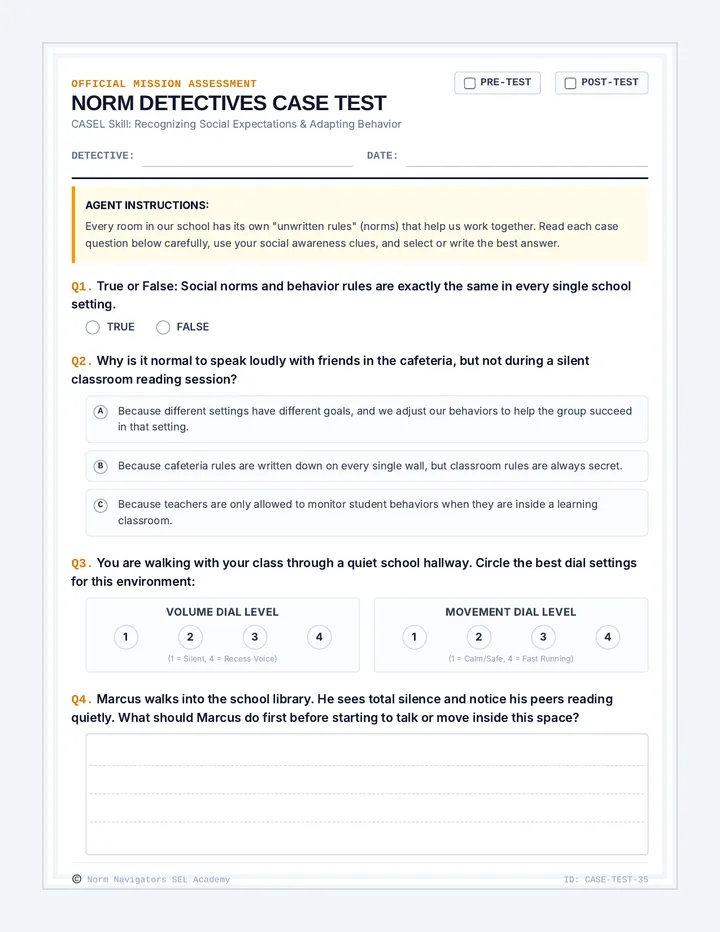
Student practice worksheet for the Filter Lab lesson. Includes identifying 'Think It' vs. 'Say It' thoughts, rewriting unfiltered phrases to be appropriate, and analyzing language choice based on environment.
Visual presentation for the Filter Lab lesson, teaching students the concept of the social filter, the difference between thoughts and speech, and how context influences appropriate language choices.
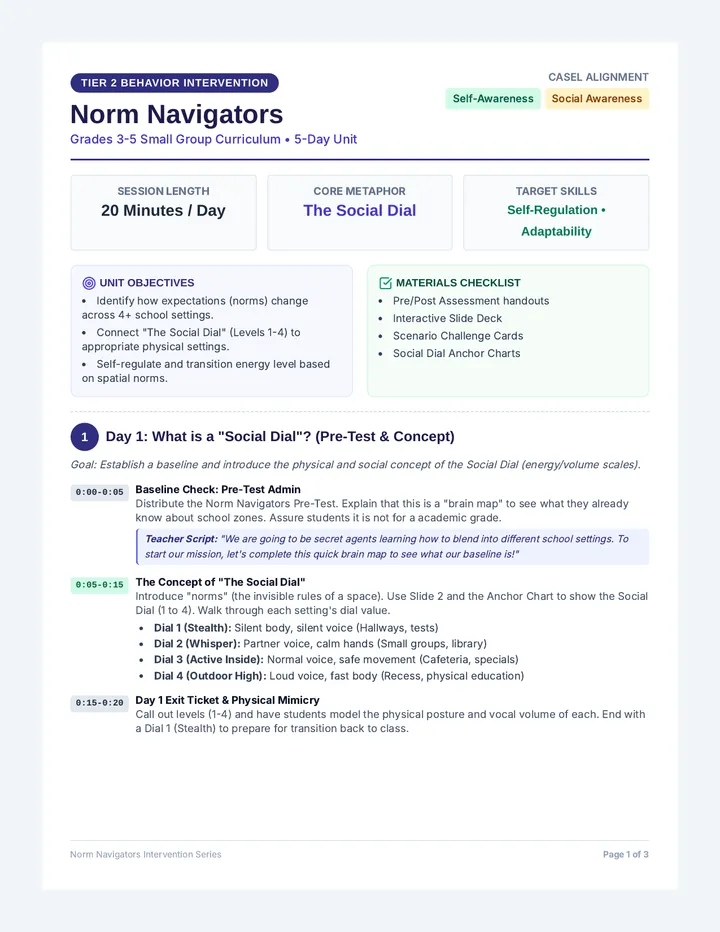
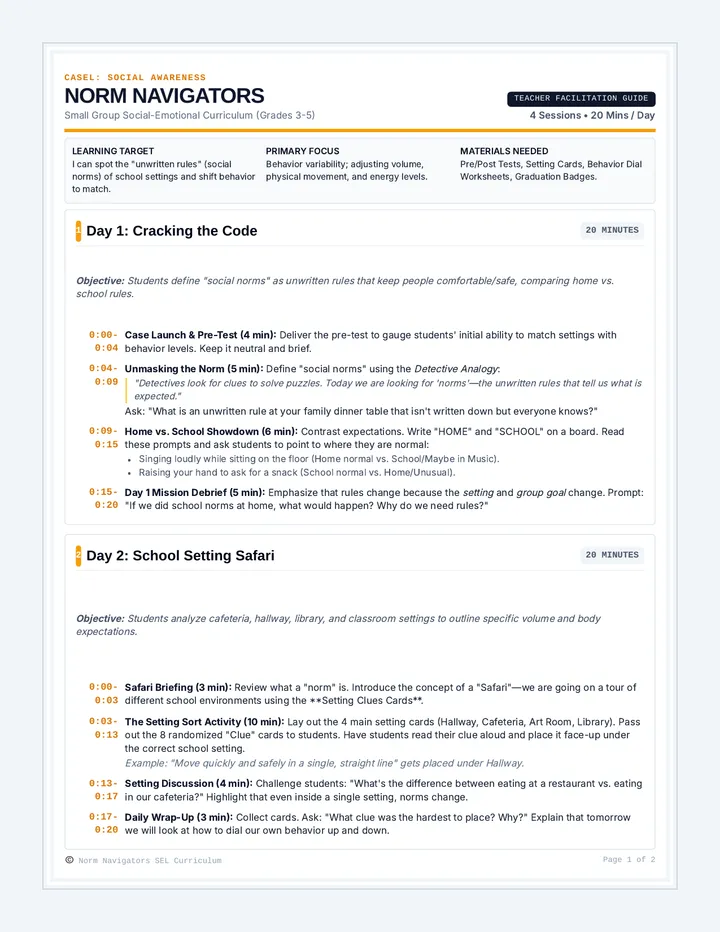
A comprehensive teacher's guide for the Filter Lab lesson, featuring a step-by-step instructional sequence, discussion prompts, differentiation strategies, and an answer key for scenario analysis.
A comprehensive teacher guide for facilitating the Social Solver Academy lesson. It includes objectives, a timeline, modeling tips, and differentiated extension activities with optimized layout for print.
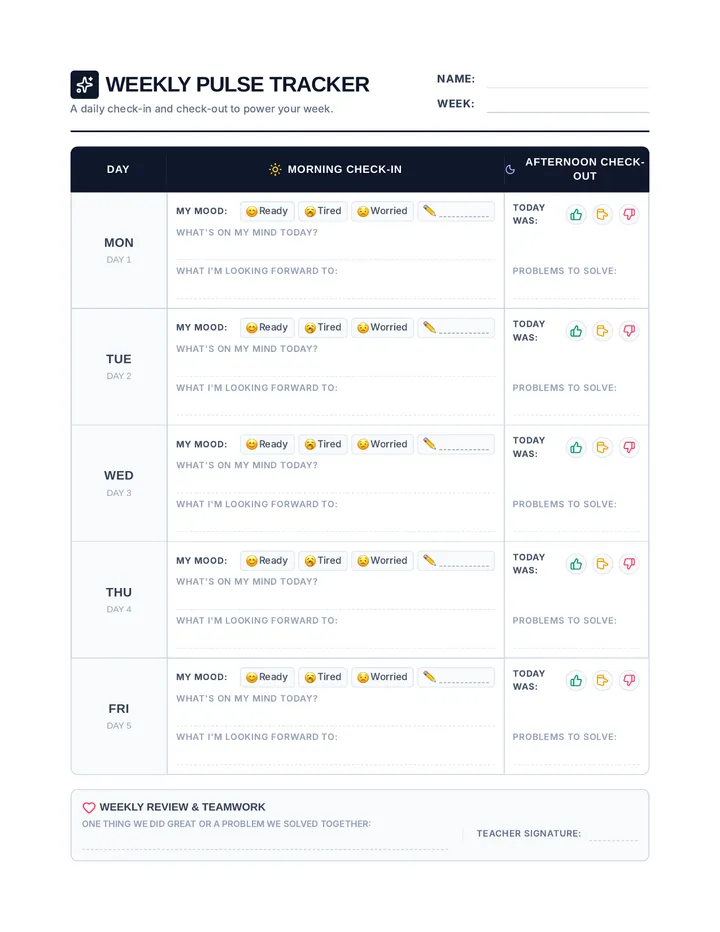
A reflection worksheet for students to process social scenarios. It guides them through describing the situation, identifying feelings, and planning a solution with clear writing lines and high-contrast work areas.
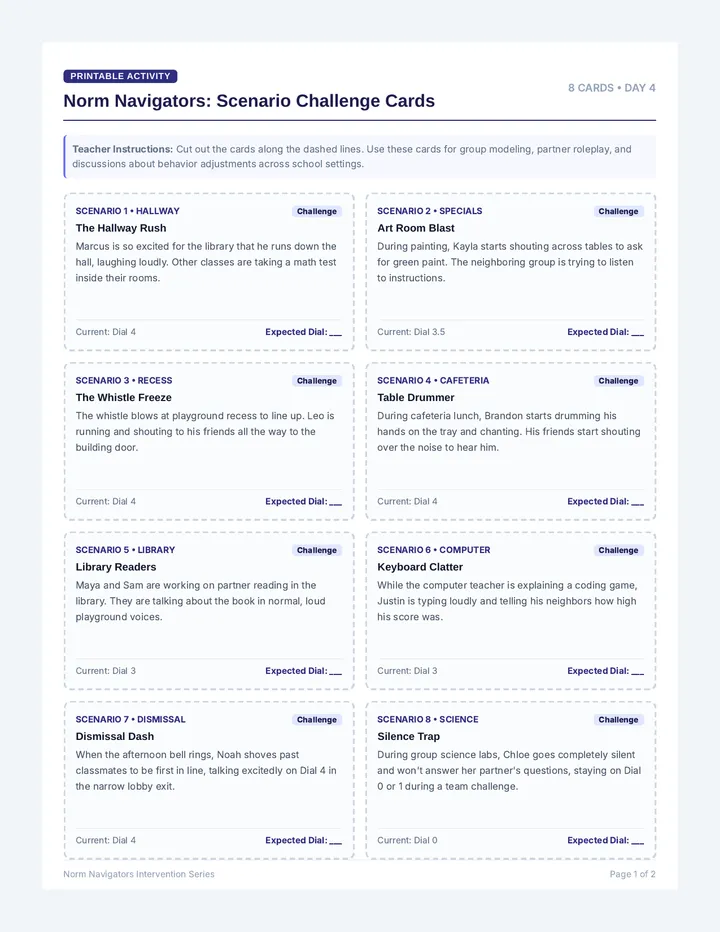
A set of 8 printable scenario cards featuring common school-based social challenges. Each card includes a relatable situation, reflection prompts, and a notes area for students to plan their response.