Talk Tracks Cards Talk Tracks
Discussion Cards for Mindful Communication
Professionalism
"When is slang a tool for connection, and when might it be a barrier to being understood in a school or work setting?"
Professionalism
"How does shifting your language based on your audience (code-switching) make you feel? Is it a skill or a burden?"
Harmful Language
"Can a 'joke' be harmful even if the person who said it didn't mean to offend? Why does 'impact' matter more than 'intent'?"
Harmful Language
"What is a microaggression you’ve witnessed? How did it affect the atmosphere of the room or the group?"
Conflict Resolution
"Compare saying 'You always interrupt me' to 'I feel frustrated when I can't finish my thought.' Which one invites conversation?"
Conflict Resolution
"Why is it harder to use 'I' statements when we are angry? How can we pause before reacting with 'You' statements?"
Identity & Impact
"How does the way we talk about others' identities (race, gender, ability) shape how we value those people?"
Identity & Impact
"If someone tells you a word you used hurt them, what is the most respectful way to respond, even if you disagree?"
Professionalism
"Does using professional language mean you have to lose your personality? How can you be 'you' and professional at once?"
Harmful Language
"Why is 'casual' usage of slurs or derogatory terms harmful, even if used among friends who don't 'mind'?"
Conflict Resolution
"How can an 'I' statement help you set a boundary without making the other person defensive?"
Identity & Impact
"What does 'inclusive language' mean to you? How can we make everyone feel they belong through our words?"
Print on cardstock and cut along the dashed lines for small group use.
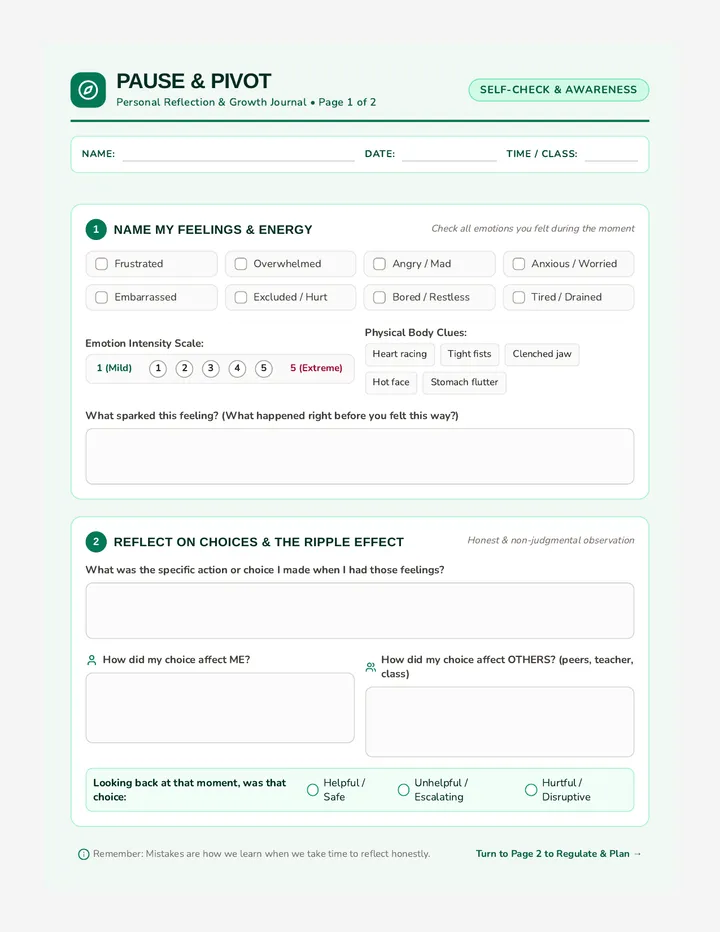
Word Wisdom Reflection Worksheet Word Wisdom
Personal Reflection Worksheet
Name:
Date:
Language & Context
Think about a time you used different language (slang vs. formal) depending on who you were with. Why did you make that choice, and how did it affect the conversation?
Impact over Intent
Reflect on the idea that "impact matters more than intent." Describe a situation (observed or experienced) where a word or "joke" caused harm even if it wasn't intended to.
The Power of "I"
Turn this "You-Statement" into a respectful "I-Statement":"You never listen to me when I'm trying to help you!"
Word Wisdom Commitment
What is one specific change you want to make in how you use language this week? (e.g., stopping a specific word, practicing 'I' statements, etc.)
Word Wisdom Slides Mindful Communication
Word Wisdom
Exploring the impact of our words in school, conflict, and community.
Context Matters
Connection
Slang and informal language help us bond with friends and family. It creates shared culture and belonging.
Clarity
Professional language ensures everyone is on the same page. It signals respect for the setting and the goals.
"Code-switching is the skill of navigating different social worlds."
Impact vs. Intent
The Intent
"I was just joking!"
The Impact
Someone felt excluded or hurt.
Microaggressions are small, everyday comments that reinforce stereotypes or make others feel like "outsiders." Even if not meant to be harmful, their cumulative impact is real.
Mastering "I" Statements
The Blame Game
"YOU-statements"
"You are so annoying when you talk over me!"
Result: The other person gets defensive and stops listening.
The Wise Way
"I-statements"
"I feel frustrated when I can't finish my thought."
Result: You share your perspective without attacking, inviting solutions.
Talk Tracks Time
Break into small groups. Use the cards to guide your discussion. Listen to understand, not just to respond.
Professionalism Harmful Language Conflict Resolution
Word Wisdom Facilitator Guide Facilitator Guide
Word Wisdom
This guide provides educators with the framework, definitions, and discussion prompts needed to lead sensitive conversations about language, impact, and conflict resolution.
Learning Objectives
Understand the difference between slang and professional language context.
Define microaggressions and recognize the importance of "impact over intent."
Differentiate between harmful jokes and inclusive language.
Construct effective "I-Statements" for non-confrontational conflict resolution.
Key Vocabulary
Code-Switching
Adjusting one's style of speech, appearance, behavior, and expression in ways that will optimize the comfort of others in exchange for fair treatment, quality service, and employment opportunities.
Microaggression
A statement, action, or incident regarded as an instance of indirect, subtle, or unintentional discrimination against members of a marginalized group.
Impact vs. Intent
The recognition that even if someone does not intend to cause harm (intent), the resulting pain or exclusion felt by the other person (impact) is what must be addressed.
Lesson Flow
Phase Activity Time Direct Instruction Use the Word Wisdom Slides to introduce concepts of professionalism, impact vs. intent, and I-statements. 15 min Small Group Work Distribute Talk Tracks Cards . Groups discuss 2-3 cards, focusing on sharing personal experiences and perspectives. 20 min Practice Students complete the Reflection Worksheet . Focus on the "I-Statement" conversion exercise. 15 min Debrief Bring the group together. Ask: "What is one 'Word Wisdom' takeaway you will use today?" 10 min
Facilitation Tips
Handling Resistance
If students argue "it's just a joke," acknowledge that humor is subjective but steer back to Impact . Use an analogy: "If I step on your foot by accident (intent), your foot still hurts (impact). I still need to apologize for the pain caused."
Validating Code-Switching
Acknowledge that code-switching can be exhausting and is often a survival mechanism for marginalized groups. Frame it as a