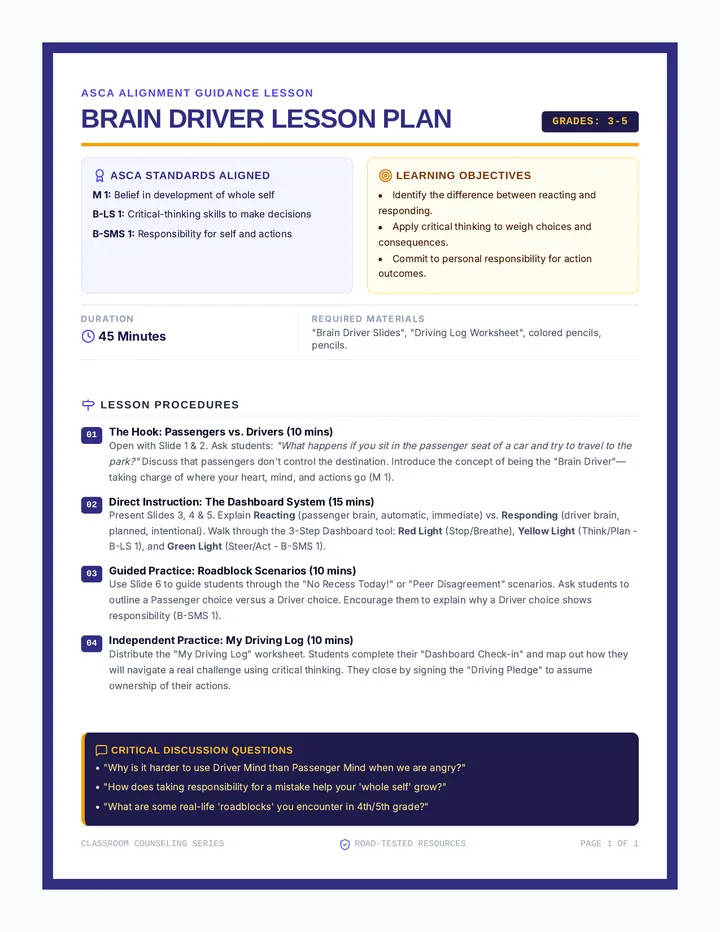
Truth or Trouble Lesson PlanTruth or Trouble Lesson Plan • 3rd Grade Character Education 15 Minute Lesson Objective Students will understand the definitions of lying and spreading rumors, identify their negative consequences, and practice choosing honesty and kindness in their interactions. Why It Matters Teaching students about lying and spreading rumors is essential for developing strong character, building trust with peers and adults, and creating a safe, respectful, and positive learning environment where everyone feels valued. Prep Review slide deck content Print/cut Scenario Cards Print True Colors Exit Tickets Set up whiteboard/projector Materials Truth or Trouble Slide Deck Scenario Cards Exit Ticket: True Colors Instructional Sequence 2 min Introduction: What's the Scoop? Ask: "Have you ever heard something about someone that wasn't true? How did that make you feel?" Introduce lesson: "Today, we're going to talk about 'Truth or Trouble?' – understanding why being honest and kind with our words is super important." 4 min Defining Lying and Rumors Slide 2: What's a Lie? Read definition and discuss examples (e.g., homework excuses, blaming others). Slide 3: What's a Rumor? Read definition and discuss examples (e.g., hearsay about friends). Highlight hurt feelings and damaged trust. 5 min The Impact of Our Words Slide 4: Consequences. Discuss hurt feelings, broken trust, strained friendships, and negative atmosphere. Activity: Scenario Cards. Small groups/partners read cards and discuss the kind and honest choice. 2 min Choosing Truth and Kindness Share-out: A few groups share one scenario and their honest/kind solution. Slide 5: Choose Truth, Choose Kindness. Emphasize thinking before speaking and building others up. 2 min Cool Down: True Colors Exit Ticket Distribute Exit Ticket: True Colors. Students write/draw one way to show truth and kindness today. Collect as students transition. Approach: Interactive discussion and scenario-based thinking. © 2026 Character Counts
Truth or Trouble SlidesTruth or Trouble? How Our Words Matter Why is it important to think before we speak? What's a Lie? A lie is when you say something that you know isn't true. Discussion Why do people sometimes tell lies? Connect What happens when you find out someone has lied to you? What's a Rumor? A rumor is a story or piece of information that is spread, even though it might not be true. Discussion Why do you think rumors start? Connect How can a rumor make someone feel? What Happens When We Lie or Spread Rumors? Feelings get hurt It can make others sad, angry, or embarrassed. Trust is broken People won't believe you or count on you. Friendships suffer It's hard to be friends with someone you don't trust. Problems grow bigger One lie can lead to more problems later. It creates a negative feeling for everyone! Choose Truth, Choose Kindness! You have the power to use your words for good! Think Before You Speak Is it true? Is it kind? Is it necessary? Be a Truth-Teller Share what you know to be real and honest. Be a Kindness-Spreader Use words that build others up, not tear them down. Stop the Rumor Mill If you hear a rumor, don't spread it. Ask if it's true!
Scenario Cards ActivityScenario Cards: Truth or Trouble? Read each scenario with your group. Discuss what the honest and kind thing to do would be. What would you say or do? Scenario 1 The Missing Crayon You are working on an art project, and you notice your friend, Sam, accidentally took your favorite blue crayon. Sam quickly puts it in their pencil case. When the teacher asks, "Has anyone seen _____'s blue crayon?", Sam looks at you, hoping you won't say anything. What would you do or say? Scenario 2 The Whispered Secret You overhear two classmates whispering that another student, Maya, said something mean about you. You feel a little upset, and your friend asks, "What are they talking about?" What would you do or say? Scenario 3 The Broken Toy During recess, you were playing with a classroom toy and it accidentally broke. No one else was around. The teacher asks the class if anyone knows how the toy got broken. What would you do or say? Scenario 4 The Cool Kids Club Some popular kids in your class start a "secret club" and tell you that to join, you have to tell them a funny (but not true) story about another classmate, Alex, so they can all laugh. What would you do or say? Scenario 5 The Test Answer You are taking a quiz, and you notice your friend next to you is struggling with a question. They quietly whisper, "What's the answer to number 3?" You know the answer. What would you do or say?
True Colors Exit TicketTrue Colors Exit Ticket: Choosing Truth and Kindness Name: Date: My Honest Words Think about what we discussed today. What is one specific way you can show truth and kindness with your words today? Picture It! Draw a picture that reminds you to choose kind and truthful words. Maybe it's a person being a friend, a heart, or a "truth shield"! Truth or Trouble
Scenario Discussion GuideScenario Discussion Guide Teacher Resource • Truth or Trouble Lesson Use this guide to facilitate the small-group discussions during the "Impact of Our Words" section. These talking points help redirect students toward honesty and kindness. 1 The Missing Crayon Goal: Encouraging peer-to-peer honesty without "tattling" aggressively. Key Takeaway: "Sam, I think you accidentally grabbed my crayon. Can I have it back?" If Sam lies to the teacher, the honest choice is to calmly state the truth: "I saw it in Sam's case, maybe it was a mistake." 2 The Whispered Secret Goal: Stopping a rumor before it spreads further. Key Takeaway: Don't repeat what you heard. Instead, tell your friend: "I don't know if that's true, so I don't want to talk about it." Or, go directly to Maya to clarify: "I heard something, but I wanted to check with you first." 3 The Broken Toy Goal: Taking responsibility even when no one is watching. Key Takeaway: Honesty builds trust. "I was playing with it and it broke by accident. I'm sorry." Remind students that teachers usually aren't as mad when we tell the truth right away. 4 The Cool Kids Club Goal: Resisting peer pressure to lie or spread rumors. Key Takeaway: "I don't want to tell a story that isn't true about Alex. That wouldn't be kind." A club that requires hurting others isn't a club worth being in. 5 The Test Answer Goal: Understanding that honesty applies to schoolwork too. Key Takeaway: "I can't tell you the answer, but maybe the teacher can help you after." Helping someone cheat is a lie about what they actually know. The Golden Question: "Would you want someone to do or say that to YOU?"