The Empathy Lens Lesson Plan The Empathy Lens
Lesson Plan • 8th Grade SEL
60 Minutes
OBJECTIVE
Students will practice perspective-taking, recognize different emotional responses to shared situations, and understand how background influences worldview.
MATERIALS
Empathy Warm-Up Worksheet
Empathy Lens Presentation
Scenario Cards Activity
Perspective Talk facilitation Guide
Empathy Insights Answer Key
PREP
• Review slide deck and discussion prompts.
• Print/cut Scenario Cards for small groups.
• Print Warm-Up activity for each student.
• Arrange desks for small group collaboration.
The "Why"
Developing empathy is an essential social-emotional skill that helps students build stronger relationships, resolve conflicts peacefully, and navigate a diverse world with greater understanding and compassion.
Instructional Steps
5 min
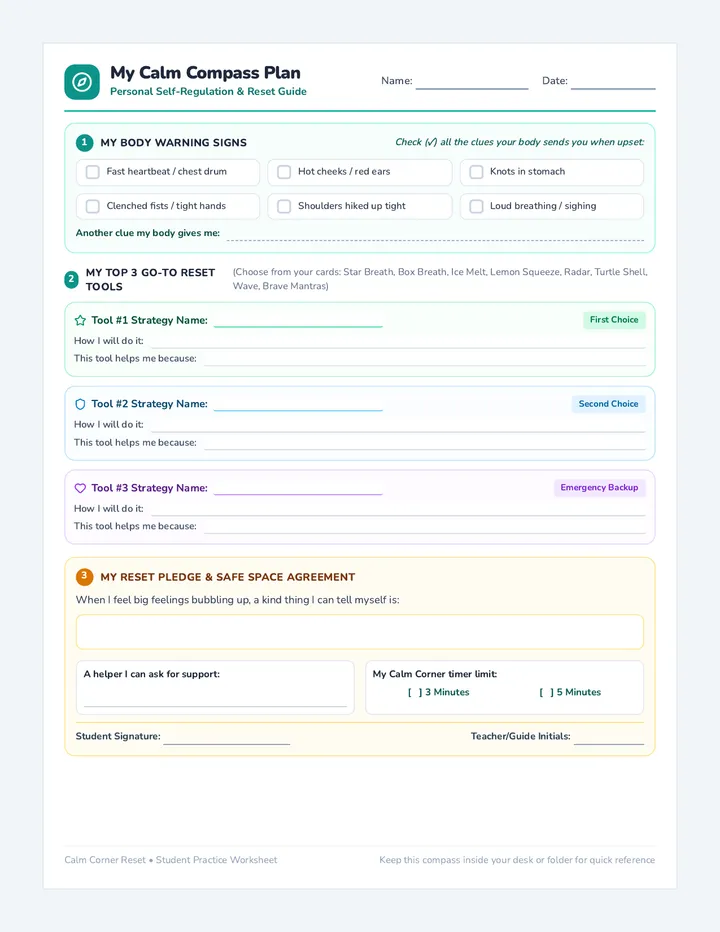
Warm-Up: Empathy Check-in
Distribute the Empathy Warm-Up . Give students 3-5 minutes to complete it individually. Briefly discuss responses as a class to set the emotional tone.
10 min
Introduction: What is Empathy?
Use the Empathy Lens Presentation (Slides 1-3). Introduce the definition of empathy and the concept of "The Empathy Lens"—viewing life through others' experiences.
20 min
Exploring Perspectives Activity
Divide into groups of 3-4. Distribute Scenario Cards . Groups discuss how different individuals feel and why, considering their potential backgrounds. Encourage students to "step into their shoes."
15 min
Whole Class Discussion
Bring the class together. Use the Perspective Talk Facilitation Guide to lead the conversation. Emphasize that backgrounds shape reality differently for everyone.
10 min
Closing & Reflection
Ask students to identify one way they can use their "Empathy Lens" this week.
Empathy Warm Up Worksheet Empathy Warm-Up
The Empathy Lens Series
Name:
Date:
Instructions
Read the following short scenarios and answer the questions below. Think deeply about how these situations would feel and what thoughts would cross your mind. Be ready to share your insights with the class.
SCENARIO 1
Lost Homework
Imagine you worked really hard on a big assignment, and then you accidentally left it at home on the day it's due. Your teacher has a strict no-late-work policy.
How would you feel in this situation?
What thoughts might be going through your head?
SCENARIO 2
New in Town
Imagine you just moved to a new town and started at a brand new school where you don't know anyone. It's your first day at lunch.
How would you feel sitting alone?
What would you hope someone might do?
Empathy Lens Presentation The Empathy Lens
Seeing Beyond Our Own Story
Objective: To practice seeing the world through different eyes and understand how our experiences shape us.
Teacher Note: Welcome students and introduce the topic. Ask them what empathy means to them before revealing the definition.
What is Empathy?
"The ability to understand and share the feelings of another person."
Teacher Note: Discuss the definition of empathy. Emphasize that it's not just sympathy (feeling sorry FOR someone) but understanding what they are going THROUGH.
Why an Empathy Lens?
Connection
To build stronger friendships and deeper bonds.
Peace
To resolve conflicts peacefully and find middle ground.
Perspective
To navigate a diverse world and understand global events.
Empathy makes us more compassionate individuals.
Teacher Note: Explain why developing empathy is crucial in their lives, both inside and outside of school. Connect it to conflict resolution, friendship, and understanding global events.
Scenario Cards Activity
1
Work in small groups (3-4 members).
2
Read each scenario carefully together.
3
Discuss: How might different people feel? Why?
4
Consider background and experiences.
5
Be ready to share your group's insights!
Focus on the "Why" behind the feelings.
Teacher Note: Clearly explain the instructions for the Scenario Cards Activity. Make sure students understand they will be working in groups and discussing different perspectives.
Perspective Scenarios Handout Scenario Cards Activity
In your small groups, read each scenario carefully. Step into the shoes of every character mentioned. Discuss how their background might shape their feelings and actions.
Case Study #1
The Group Project
Your group has a big project due tomorrow. One member, Alex , hasn't contributed much and seems disengaged. Another member, Maya , is frustrated and has done most of the work. The third member, Sam , is trying to keep the peace but is also worried about the grade.
Perspective Check: Alex
How might Alex be feeling? What could be reasons for their lack of engagement?
Perspective Check: Maya
How might Maya be feeling? Is her frustration justified?
Perspective Check: Sam
How might Sam be feeling? What challenges is Sam facing?
Case Study #2
The School Fundraiser
The school is holding a fundraiser for a new playground. Sarah , who loves sports, is excited to participate. David , whose family is struggling financially, feels anxious about asking neighbors for money. Ms. Chen , a teacher, is stressed about reaching the goal.
Perspective Check: Sarah
How might Sarah be feeling? Why is she so enthusiastic?
Perspective Check: David
How might David be feeling? What challenges might he be facing?
Perspective Check: Ms. Chen
How might Ms. Chen be feeling? What pressures might she be under?
Case Study #3
The New Student
A new student, Omar , just moved to town mid-year. He sits alone at lunch and is very quiet. Some students are curious, some are unsure how to approach him, and a few are making jokes about his accent.
Perspective Check: Omar
How might Omar be feeling on his first few days?
Perspective Check: Curious Students
How might they be feeling? What might they do?
Perspective Check: Joke-Makers
How might they be feeling/thinking? Why might they act that way?
Perspective Talk Facilitation Guide Perspective-Taking
Facilitation & Discussion Guide
Opening the Discussion
Deepening Understanding
Background Influence
How did considering someone's background or past experiences change your understanding of their feelings or actions?
Jumping to Conclusions
Was there a time you jumped to conclusions about someone, only to realize later that you didn't have the full picture? What happened?
Active Seeking
How can we actively seek out and understand perspectives that are different from our own?
Connecting to Real Life
The Daily Lens
Why is it important to practice empathy in our daily lives, both at school and at home?
Practical Steps
What are some practical ways we can show empathy to our classmates, friends, and family?
Conflict Resolution
How can using an "empathy lens" help us resolve conflicts or misunderstandings?
Concluding Thought
"What is one thing you will try to do differently this week to be more empathetic?"
Encourage students to write this down or share with a neighbor.
Empathy Insights Answer Key Empathy Activity Insights
Suggested Discussion Points & Answer Key
Note to Teacher: These activities encourage open discussion and perspective-taking. There are no single "right" answers. These points are designed to facilitate deeper student understanding and bridge diverse viewpoints.
Warm-Up: Empathy Check-In
Scenario 1: Lost Homework
Feelings: Frustrated, anxious, stressed, helpless, angry at self.Thoughts: "My grade is ruined," "Teacher won't believe me," "I worked so hard for nothing."
Scenario 2: New in Town
Feelings: Lonely, nervous, invisible, hopeful for connection.Hopes: "I hope someone asks me to join them," "I wish I had a friend."
Scenario Cards Activity
Case Study #1: The Group Project
Alex
May be overwhelmed, confused, or distracted by personal issues. Feeling excluded or lacking confidence can also cause disengagement.
Maya
Angry, resentful, and unappreciated. Frustration is justified but can be tempered by understanding the "why" behind Alex's actions.
Sam
Stressed mediator. Caught in the middle, Sam faces the challenge of balancing harmony with fairness and grade concerns.
Case Study #2: School Fundraiser
Sarah
Excited and community-minded. Her family stability may make fundraising feel like a game rather than a burden.
David
Anxious and ashamed. Fears judgment or exposing family struggles. Financial contributing might not be an option.
Ms. Chen
Pressured and responsible. Managing administrative expectations and ensuring student resources while feeling overwhelmed.
Case Study #3: The New Student
Omar
Nervous, homesick, and overwhelmed. Language barriers and cultural differences make mid-year transition difficult.
Curious Students
Welcoming but uncertain. They may want to reach out but don't know the best way to bridge the initial gap.
Joke-Makers
Insecure or seeking attention. Acting out of ignorance or discomfort with difference. Seeking social "clout" through cruelty.