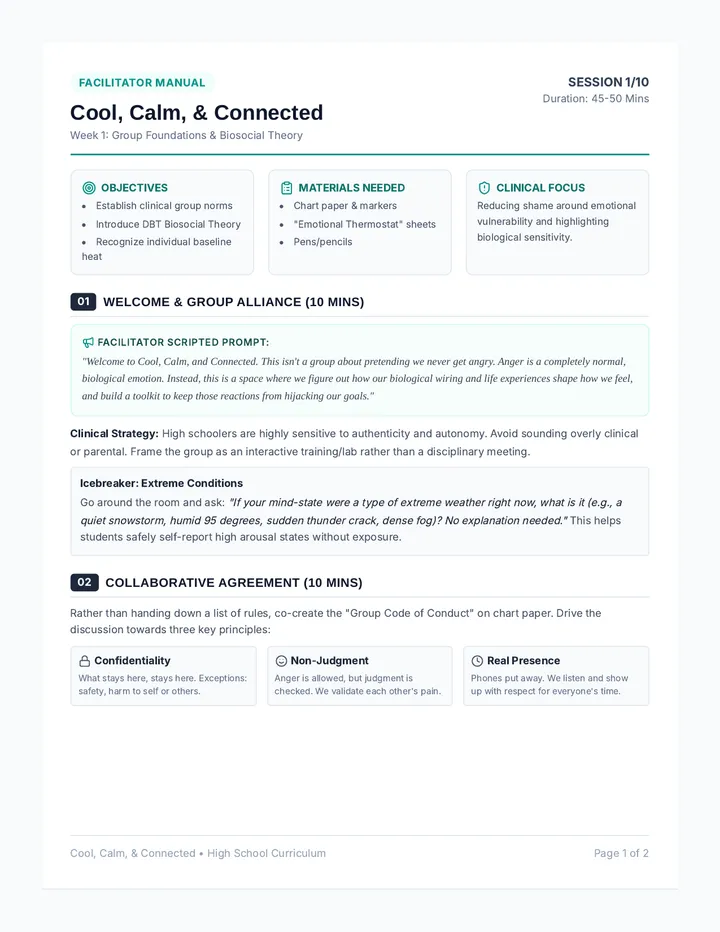
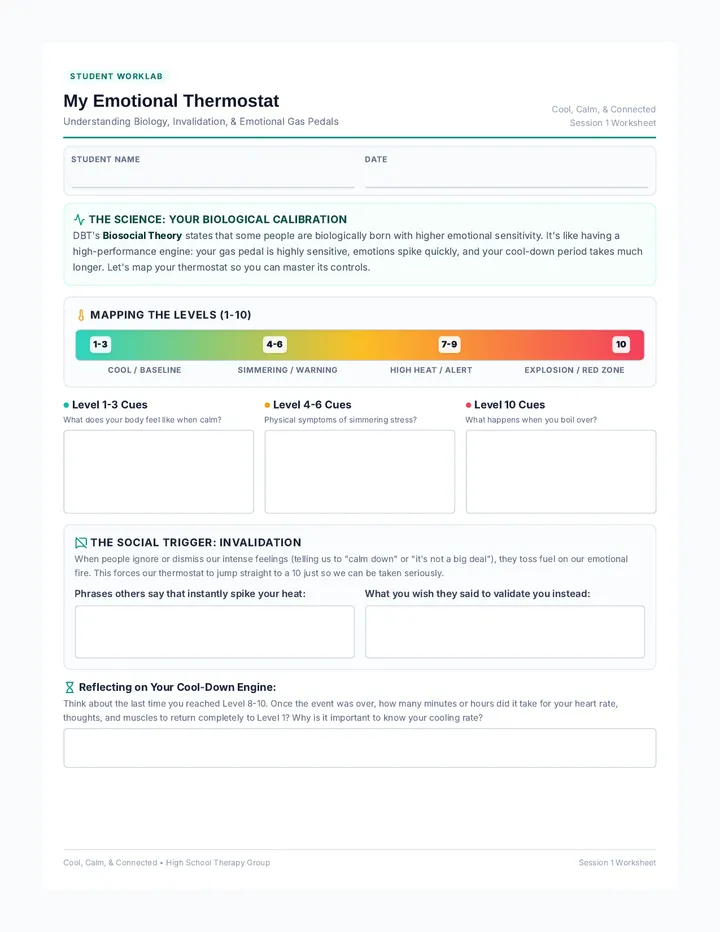
Brain Glitch Slides SYSTEM RESET
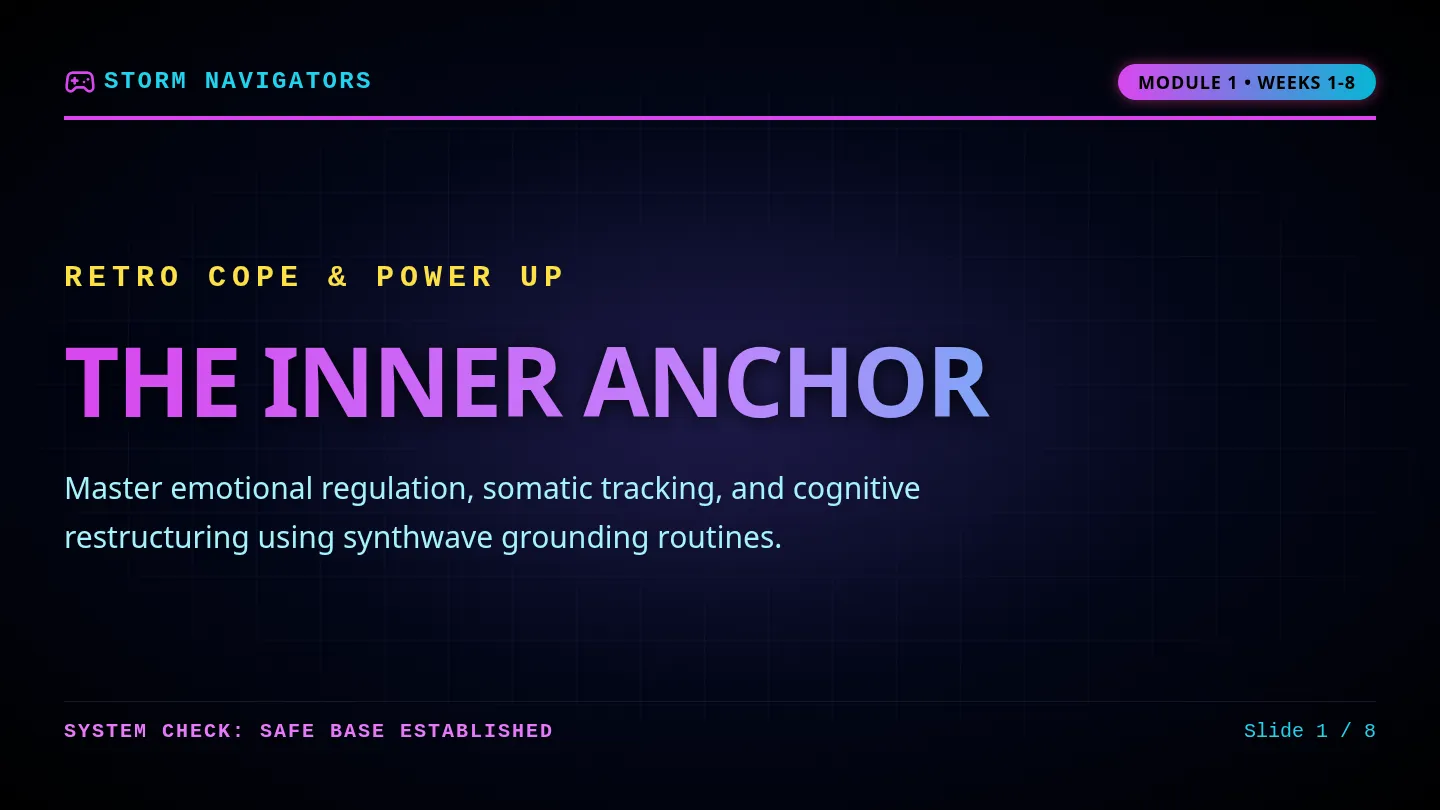
CBT: Cognitive Restructuring & Regulation
The Stress Cycle
01. Antecedent / Trigger
External event or internal sensation that initiates the sequence.
02. Cognitive Appraisal
The brain interprets the event as a threat (Glitch/Distortion).
03. Physiological Response
Activation of the sympathetic nervous system (fight/flight).
Avoidance Pattern
Avoidance provides Negative Reinforcement—temporary relief that increases long-term anxiety levels.
Reinforcement Loops Signal Threat.
Facts vs Distortions
Objective Fact
Information that is neutral, observable, and empirically verifiable.
// CLINICAL DATA
"I have four text messages from this person."
Cognitive Distortion
Irrational thought patterns that reinforce negative emotions and anxiety.
// ERROR LOG
"They are definitely mad at me and hate me."
Cognitive Glitches (Distortions)
Dichotomous Thinking
"All-or-Nothing." Viewing things in only two extreme categories.
Fortune Telling
Predicting a future negative outcome without evidence.
Mind Reading
Believing you know what others are thinking without proof.
Catastrophizing
Expecting the worst possible outcome in any given situation.
Mental Filtering
Focusing exclusively on negatives while ignoring positives.
Personalization
Believing you are responsible for external events or others' emotions.
Protocol Active
Cognitive Restructuring
System Update: Adaptive Reframing.
1
Identify
Notice the ANT (Automatic Negative Thought) and its trigger.
2
Verify
Analyze evidence for and against the distortion.
3
Restructure
Develop a more balanced, evidence-based appraisal.
"I am currently experiencing discomfort, but there is no evidence this event is a failure."
System Regulation
When physiological arousal is high,
target the hardware (the body) first.
5
Visual
4
Tactile
3
Auditory
2
Olfactory
1
Gustatory
BREATH WORK: 4 IN / 4 HOLD / 6 OUT
SYSTEM READY
Status: Operational
"The user manages the system; the system does not manage the user."
— Protocol Concluded.
Glitch Scenario Cards Glitch Detector Cards
Cognitive Reframing Scenarios • Unit 1.2
Page 1 of 2
Cutting & Usage Guide: Cut along the dashed outer lines. For each real-world scenario, read the situation, identify the active cognitive distortion (Mind Glitch), and draft an evidence-based, restructured thought in the spaces provided.
FILE: ERROR_01
ALL-OR-NOTHING
Scenario 01: Midterm Margins
Julian gets a B+ on his history midterm. He has always received straight A's before. He stares at the grade sheet in disbelief and feels a cold knot in his stomach.
// AUTOMATIC THOUGHT
"If I'm not perfect, I'm a complete failure. My GPA is ruined."
Active Glitch (Distortion Type):
Adaptive Repair (Reframed Appraisal):
FILE: ERROR_02
FUTURE GLITCH
Scenario 02: Stage Fright
Maya stands at the front of the classroom, waiting to deliver her English oral report. She feels her heart racing, her hands sweating, and her mind going blank.
// AUTOMATIC THOUGHT
"I'm going to freeze up, forget everything, and make a fool of myself."
Active Glitch (Distortion Type):
Adaptive Repair (Reframed Appraisal):
FILE: ERROR_03
SIGNAL NOISE
Scenario 03: Hallway Static
Liam walks past a group of juniors laughing near the lockers. One classmate glances in his direction and whispers something just as they laugh louder.
// AUTOMATIC THOUGHT
"They are talking about me and laughing at my outfit. Everyone thinks I'm weird."
Active Glitch (Distortion Type):
Adaptive Repair (Reframed Appraisal):
FILE: ERROR_04
OVERLOAD
Scenario 04: Incoming Alert
Sarah's phone vibrates in her pocket. It's a text from her mother that reads: "Come straight home after school. We need to talk." Her stomach immediately drops.
// AUTOMATIC THOUGHT
"I am in major trouble. I must have failed a class or done something terrible."
Active Glitch (Distortion Type):
Adaptive Repair (Reframed Appraisal):
System Reset protocol // cognitive restructuring STRICTLY EMPIRICAL DATA PROTOCOL
Glitch Detector Cards
Cognitive Reframing Scenarios • Unit 1.2
Page 2 of 2
Cutting & Usage Guide: Cut along the dashed outer lines. For each real-world scenario, read the situation, identify the active cognitive distortion (Mind Glitch), and draft an evidence-based, restructured thought in the spaces provided.
Thought Upgrade Worksheet Restructuring Protocol
Cognitive Intervention v2.1
User:
Date:
Directives
Objective: Separate cognitive distortions from empirical evidence. Use this protocol to analyze Automatic Negative Thoughts (ANTs) and develop adaptive appraisals.
1
Cognitive Identification
Antecedent Event (Trigger)
Automatic Negative Thought (ANT)
2
Evidence-Based Analysis
Empirical Data FOR
Empirical Data AGAINST
3
Adaptive Restructuring
Synthesize a balanced appraisal based on the empirical data analyzed above:
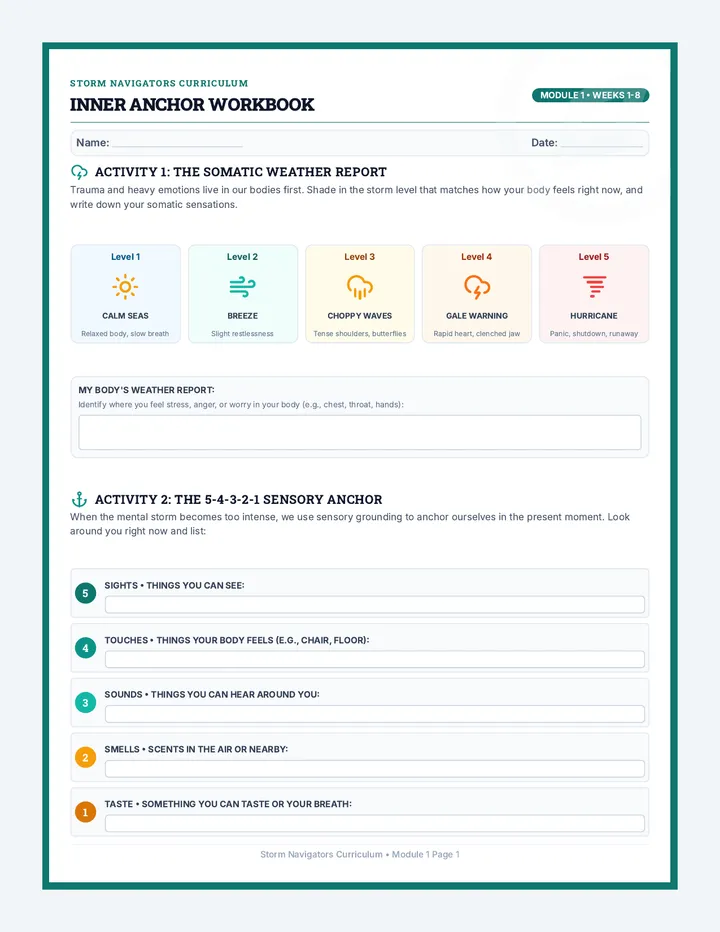
Physiological Regulation (5-4-3-2-1)
5
Visual
4
Tactile
3
Auditory
2
Olfactory
1
Gustatory
Diaphragmatic Breathing: 4s inhale // 4s hold // 6s exhale
Glitch Scenario Answer Key Scenario Answer Key
Glitch Restructuring Guide • Clinician Reference
Master Key
CLINICAL EVALUATION DIRECTIVE
Use this reference key to evaluate student identification of cognitive distortions ("Glitches") and their restructured "Adaptive Repairs." Ensure student reframes are grounded in empirical data rather than toxic positivity or unfounded reassurance.
01. MIDTERM MARGINS Dichotomous Thinking
"If I'm not perfect, I'm a failure..."
Clinical Focus: Remind the student that a grade of B+ (87-89%) is objectively above average. A single non-perfect score does not mathematically or clinically define failure.
02. STAGE FRIGHT Fortune Telling
"I'm going to freeze up and make a fool..."
Clinical Focus: Identify that predicting a complete breakdown is an unproven future claim. Point out that physical anxiety (sweating) is normal sympathetic arousal, not a guarantee of failure.
03. HALLWAY STATIC Mind Reading
"They are laughing at my outfit..."
Clinical Focus: Focus on the total lack of empirical evidence linking classmate laughter to Liam. Classmates looking at a phone are statistically looking at digital content, not him.
04. INCOMING ALERT Catastrophizing
"I'm in major trouble. My life is over..."
Clinical Focus: Highlight that "We need to talk" is completely neutral. The brain jump to catastrophic ruin ("life is over") is an autonomic defense reflex rather than logical fact.
05. THE SINGLE NOTE Mental Filtering
"I completely ruined the entire solo..."
Clinical Focus: Contrast 1 negative comment against 10 positive ones. The student is filtering out 90.9% of positive empirical feedback to focus exclusively on 9.1% critique.
06. SILENT CHANNELS Personalization
"Taylor is mad. I did something wrong..."
Clinical Focus: Discuss how Taylor's bad mood may be entirely independent of Chloe (e.g., family issues, bad grade, fatigue). Avoid assuming agency over others' internal states.
07. BENCHED ERROR Dichotomous / Catastrophizing
"I'm the worst player. I'll never shoot..."
Clinical Focus: Sport involves variance. Missing a final shot is standard athletic performance statistics, not a global condemnation of athletic value or future coaching decisions.
08. ALGORITHM BLUES Mind Reading / Filter
"They skipped it because my art is bad..."
A busy teacher not commenting is not empirical proof of critical disapproval. Point out the fifty positive peer reactions as valid indicators of aesthetic quality.
Static Breaker Guide Facilitation Protocol
System Reset Intervention: Clinical Guide
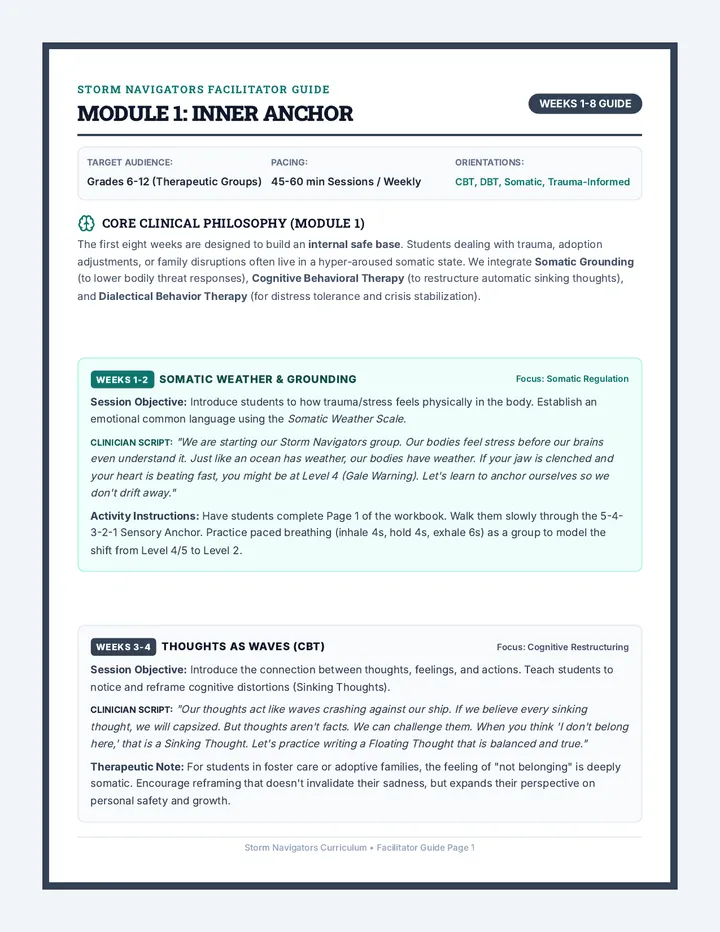
Clinical Objectives
Define the Cognitive-Physiological Cycle of anxiety (Trigger → Appraisal → Activation).
Identify specific Cognitive Distortions (Automatic Negative Thoughts) in real-time.
Implement Evidence-Based Appraisal to perform cognitive restructuring.
Apply Sympathetic Nervous System Regulation techniques for acute arousal.
Aesthetic Rationale
The high-contrast Y2K theme serves to externalize anxiety as "System Noise," allowing for more objective analysis and reducing personal shame during clinical processing.
Implementation Directives
01
Clinical Precision
Utilize formal clinical terminology (Dichotomous Thinking, Antecedent, Negative Reinforcement). Directness builds credibility and provides a clear framework for the student to follow.
02
Analysis vs. Reassurance
Avoid providing reassurance. Focus on Evidence-Based Analysis . Ask: "What empirical data supports this appraisal?" rather than "I'm sure it will be fine."
03
Regulatory Hierarchy
Prioritize physiological regulation if the student is experiencing high sympathetic arousal. Cognitive restructuring is ineffective during acute autonomic activation.
Clinical Troubleshooting
Empirical Validity
If an appraisal has high empirical validity (the threat is real), pivot to Problem-Solving Intervention . Restructuring is only for cognitive distortions.
Cognitive Resistance
Persistent resistance may indicate underlying core beliefs. Note these for future intensive processing but maintain focus on the current protocol's tools.
Processing Prompts
"Identify the primary cognitive distortion currently active in your appraisal."
"Describe the physiological sensations associated with this specific trigger."
"Explain how the negative reinforcement of avoidance impacts long-term regulation."
"Construct an adaptive appraisal based strictly on the empirical data provided."