Signal Crossings Slides
SIGNAL CROSSINGS
Middle School Mindsets
Beginning of the Year Special
Mind Reading or
Real Reality?
Why our brains jump to conclusions in the hallway, lunchroom, and classroom—and how to decode the real signals.
How would you respond?
Slide 1 of 12
SIGNAL CROSSINGS
The Setup
The "Mind-Reading" Trap 🧠
At the start of a new school year, everything feels high stakes. Our brains want to protect us, so they make split-second assumptions.
The Problem: We assume we know what others are thinking, but our "mind-reading" is usually dead wrong.
How a Signal Crosses:
1
The Event
Something neutral happens (e.g., someone frowns near you).
2
The Guess
Your brain jumps: "They must hate me!"
3
The Reality
They just got a bad grade or have a headache.
Let's look at 3 common situations where signals get crossed.
Slide 2 of 12
SCENARIO 1: PART A
The Lunchroom Seat Mixup
First Week of School
Accidentally sitting at a "saved" table
Maya is holding her heavy tray, looking for a spot. She spots an empty chair next to Jordan and sits down. Immediately, Jordan shifts uncomfortably, sighs, and says loudly:
"Uh, someone is actually sitting there."
Class Discussion
What do you think Maya assumed in this moment? What might be the actual reality?
Share your thoughts before we click to see inside their heads!
Slide 3 of 12
SCENARIO 1: PART B
Inside Their Heads
Maya's Mind-Reading
"They hate me."
"They are totally excluding me. I don't belong here, and they want everyone to know I'm not welcome."
Result: Hurt feelings, urge to walk away angry.
Jordan's Reality
"Where is my friend?"
"My best friend has been in line for 15 minutes. If I lose this spot, they won't have anywhere to sit at all!"
Result: Pure logistical stress, not trying to be mean.
Was Maya's brain tricking her? How can we resolve this peacefully?
Slide 4 of 12
RESOLUTION 1
Navigating the Seat Mixup
De-Escalating the Lunchroom Seat Mixup 🕊️
1
Pause Panic
Don't assume they hate you. Remind yourself: saved seats are almost always about holding a spot for a friend, not blocking you.
2
Ask Calmly
Ask a low-pressure question: "Ah, no worries! Is it cool if I sit here until they get back, or do you know of other open spots?"
3
Light Exit
If the space is fully saved, keep your power by saying: "No sweat, have a good lunch!" and move to a new spot without anger.
How would keeping your cool change how other people view you in this scenario?
Slide 5 of 12
SCENARIO 2: PART A
The Hallway Bump
Between Classes
An accidental physical collision
The hallway is packed. Marcus is rushing to avoid getting another tardy sweep. As he turns the corner, he shoulders past Leo, bumping him hard. Leo's binders wobble. Marcus keeps jogging. Leo spins around, clenches his fists, and yells:
"Hey! Watch where you're going!"
Class Discussion
Why did Leo instantly assume the bump was on purpose? What was Marcus's actual situation?
How often do packed spaces create false alarms? Share your thoughts!
Slide 6 of 12
SCENARIO 2: PART B
Inside Their Heads
Leo's Mind-Reading
"He's trying to push me around."
"He did that on purpose to mess with me or see if I'd back down. Everyone is watching, I can't look weak."
Result: Angry response, ready to start a fight.
Marcus's Reality
"I cannot get tardy again!"
"I have 30 seconds to get to the third floor or Mr. Davis will lock his door. I'm literally panicking right now."
Result: Completely oblivious to the bump, just scared.
How does knowing Marcus's fear change Leo's perspective?
Slide 7 of 12
RESOLUTION 2
Handling a Hallway Collision
De-Escalating the Hallway Bump 🛑
1
Check Context
Look around. Is the hallway packed? Is everyone rushing? Give the person the benefit of the doubt—they probably have their own issues to worry about.
2
Quick Check
If you did the bumping, call back instantly: "Ah, my bad! Sorry about that!" even as you keep walking. A simple apology kills hallway conflicts.
3
Cool Down
If you got bumped and they didn't stop, let it roll off: "They're clearly in a massive rush, whatever." and keep moving to your destination.
Why does saying "my bad" hold so much power in a busy school day?
Slide 8 of 12
SCENARIO 3: PART A
Partner Project Panic
In the Classroom
Misinterpreting silent signals & faces
The teacher says, "Find a science partner." Chloe turns to look at Sam, who sits near her. Sam instantly looks down, shifts in his chair, and pulls a heavy frown. Chloe feels her face flush and immediately looks away.
Class Discussion
Why did Chloe feel rejected? What could be the actual, hidden reason behind Sam's frown?
Why is silent body language so hard to read? Guess before we look inside!
Slide 9 of 12
SCENARIO 3: PART B
Inside Their Heads
Chloe's Mind-Reading
"He thinks I'm annoying."
"Sam thinks I'm annoying and bad at science. He'd literally rather work with anyone else than me."
Result: Embarrassment, decides she'd rather work alone.
Sam's Reality
"I'm terrified of being rejected."
"Oh no, public selection time. My heart is beating so fast. What if Chloe doesn't want to work with me? I'm going to look like a loser."
Result: Frozen by anxiety, pulling a face without realizing it.
Both people were actually feeling the exact same fear! How can we resolve this?
Slide 10 of 12
RESOLUTION 3
Navigating Partner Panic
De-Escalating Partner Panic 🤝
1
Ignore Frowns
Frowns, downcast eyes, and sighs usually indicate general anxiety, not irritation or anger directed at you. Don't take it personally!
2
Invite Softly
Offer a low-pressure invite: "Hey Sam, want to partner up? No pressure if you want to work with someone else!"
3
Focus on Work
Once they agree, dive straight into the easy parts of the assignment. Getting down to business is the fastest way to ease awkward vibes.
How does making a "no-pressure" offer help someone with social anxiety?
Slide 11 of 12
SUMMARY TOOL
Your Communication Superpower
The Ultimate Tool: "Pause & Clarify"
When you feel a flash of rejection, hurt, or anger, pause your brain and use this simple formula to find the truth:
"I NOTICED ________. I WAS WONDERING ________."
Example: "Hey, I noticed you frowned when I sat here. Just wondering if we are good or if this spot is saved?"
Saves friendships Stops unnecessary drama Keeps you in control
Be a social detective, not a fictional mind reader.
Slide 12 of 12
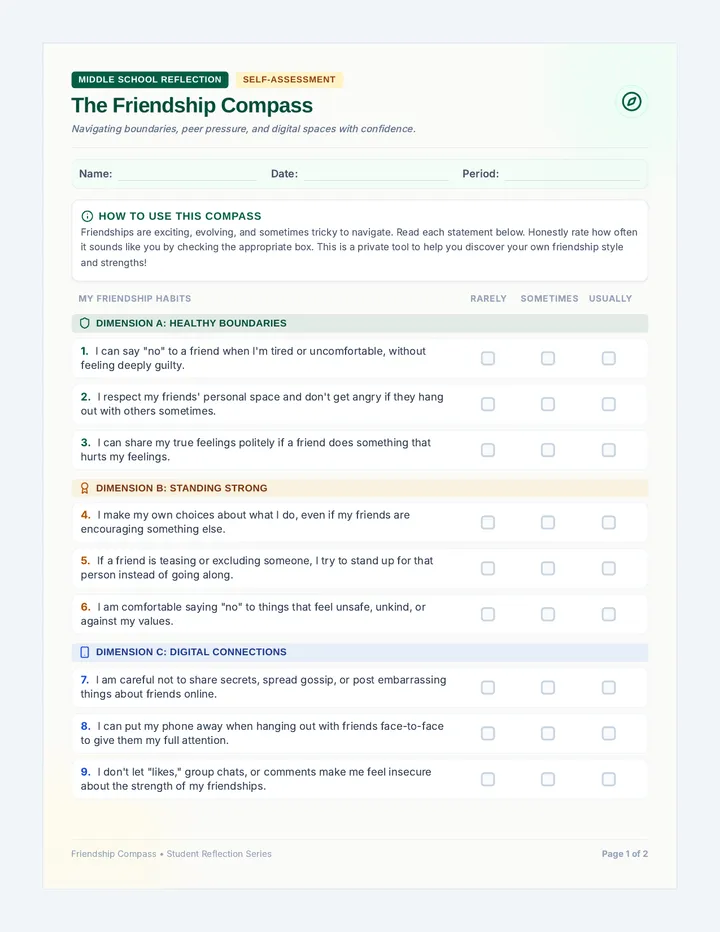
Signal Crossings Worksheet
SIGNAL CROSSINGS
Part 1: The Detective Brainstorm
Name:
Date: Class:
The Social Detective Challenge: Your brain naturally jumps to "mind-reading" conclusions during misunderstandings. For each scenario, brainstorm the assumption and the possible hidden reality before the class reveal!
Scenario 1
The Lunchroom Seat Mixup
"Maya sits next to Jordan. Jordan sighs and says: 'Uh, someone is actually sitting there' and points away."
Maya's Assumption (Mind-Reading Guess)
What did Maya think Jordan meant?
Possible Reality (The Truth)
What could Jordan's real reason be?
Scenario 2
The Hallway Bump
"Marcus is running late to science class, shoulder-bumps Leo hard, and keeps jogging. Leo spins around, clenches his fists, and yells."
Leo's Assumption (Mind-Reading Guess)
What did Leo think Marcus meant?
Possible Reality (The Truth)
What could Marcus's real situation be?
Scenario 3
Partner Project Panic
"The teacher says 'Find a science partner.' Chloe looks at Sam, who instantly looks down, shifts in his chair, and frowns deeply."
Chloe's Assumption (Mind-Reading Guess)
What did Chloe think Sam's frown meant?
Possible Reality (The Truth)
What could Sam's actual feeling be?
Signal Crossings Worksheet Page 1 of 2
SIGNAL CROSSINGS
Part 2: Peaceful Resolutions
Active Resolution Practice
1. Maya's De-Escalation (The Lunchroom Mixup)
Write what Maya can say to Jordan to clarify the seat situation without feeling rejected or starting an argument:
"Hey Jordan, no worries! Is it cool if..."
2. The Hallway Cool-Down (The Hallway Bump)
If Marcus calls back a quick phrase, or Leo tells himself a realistic reason, how does that completely stop the conflict? Write Leo's or Marcus's calm response:
Your response statement here...
3. Chloe's Low-Stress Invitation (Partner Project Panic)
How can Chloe invite Sam to be partners in a way that respects Sam's worry and relieves his public pressure?
"Hey Sam, do you want to..."
The "Pause & Clarify" Formula
Apply the formula to a real-life scenario of your own choice (e.g., a dry text message, a friend sitting elsewhere, or someone whispering near you). Fill in the blanks below:
1. I NOTICED...
Describe the event objectively (e.g., "I noticed you sat at another computer today.")