Social Mapmaker Facilitator Guide Counselor Workshop Guide
Social Mapmaker
Grade Level 6th - 8th Grade
Duration
50 Minutes (1 Session)
Format
Small Group / Classroom
Focus Core
Boundaries & Transitions
Workshop Overview
Entering middle school or starting a new school year triggers major shifts in social landscapes. Old friendships drift, new cliques emerge, and social boundaries become fluid. This counselor-led workshop equips adolescents with "social cartography" tools to visualize their social circle shifts, establish functional personal boundaries, and resolve interpersonal friction without unnecessary drama.
Objectives
Map shifts in social networks and accept friendship evolution as natural.Define and model firm, flexible, and porous personal boundaries.Formulate constructive "I-statements" to navigate peer friction and boundary crossing.
Materials Needed
Social Mapmaker Slides (Presentation)Social Mapmaker Workbook (1 per student)Social Mapmaker Scenario Cards (1 set per 4 students)Colored pencils or highlighters (Green, Yellow, Blue)
Workshop Timeline
Time Phase Key Facilitator Actions 00 - 10 Min 1. Departure Intro Social Mapping; lead the "Social Temperature Check" icebreaker. 10 - 20 Min 2. Shifting Terrain Present Slides 2 & 3. Normalize natural friendship evolution & growth. 20 - 35 Min 3. Setting the Border Introduce physical & emotional boundaries. Guide Page 1 Workbook mapping. 35 - 45 Min 4. Navigation Practice Divide into small groups. Distribute Scenario Cards to practice resolution. 45 - 50 Min 5. Safe Arrival Collect Exit Slips, review final takeaways, and offer supportive wrap-up.
THE SOCIAL MAPMAKER • LESSON PLAN PAGE 1 OF 2
Phase-by-Phase Facilitation Script & Notes
Phase 1 & 2 Arrival & Shifting Terrain (20 Mins)
Say: "Welcome, Mapmakers! Our social lives in middle school are not static; they look more like a fluid transit map. Some friends stay on your line for years, others change trains at different stations. This change isn't a failure—it's just a new route."
Key Metaphor to Reinforce: Friends aren't 'good' or 'bad' based on how close they are now. We have core allies (inner circle), casual travelers (outer circle), and strangers. The goal is to route people to the correct circle without crashing.
Phase 3 Boundary Lines & The Workbook (15 Mins)
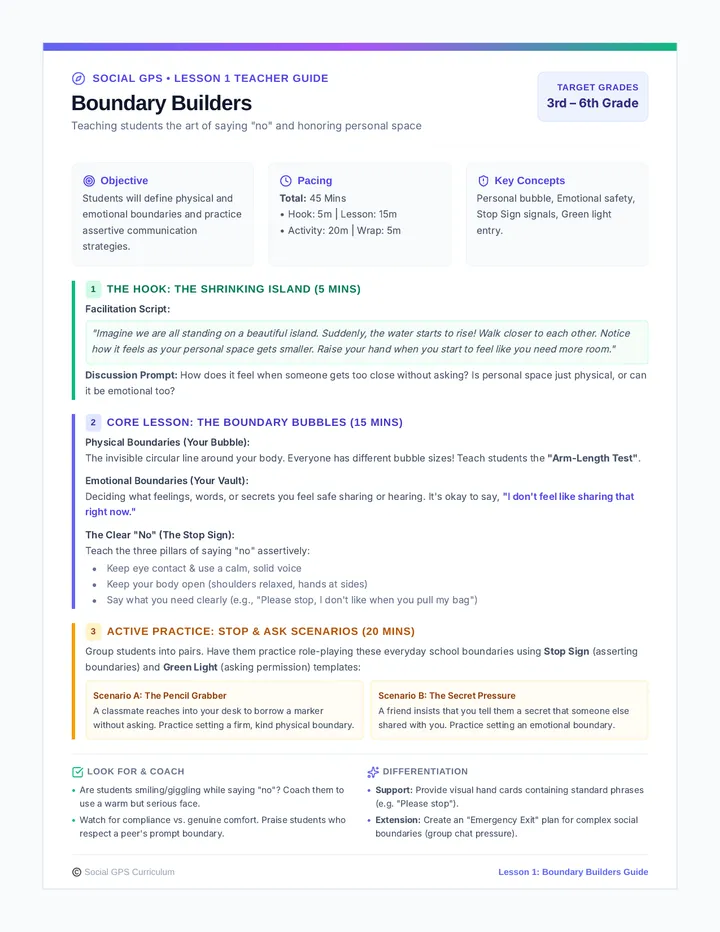
Instruct students to pull out their Social Mapmaker Workbook . Guide them through mapping their current landscape. Introduce the 3 boundary styles:
Wall (Porous)
Letting too much through. Saying 'yes' when you mean 'no' to keep peace.
Fortress (Rigid)
Keeping everyone out. Overly defensive due to past hurt.
Guard Post (Healthy)
Selective entry. Protecting energy while allowing trusted peers inside.
Phase 4 Scenario Navigation Cards (15 Mins)
Divide students into groups of 3-4. Distribute the Scenario Navigation Cards .
Students pull a card and read the dilemma (e.g., rumor, boundary crossing, drift).
They must apply the U-Turn Strategy (Identify emotion, pause, set clear boundary, state consequence).
Students fill out the "Navigation Log" in their Workbook based on their group discussion.
Counselor Troubleshooting Tips
Handling Emotional Resistance Students might struggle to admit feeling lonely. Avoid forcing students to share their specific concentric circles map with peers. Keep that section private.
The "Popularity" Bias Make sure to emphasize that a "Full Inner Circle" isn't better than a small one. Research shows 1-2 core reciprocal friendships are healthier than dozens of superficial ones.
THE SOCIAL MAPMAKER • LESSON PLAN PAGE 2 OF 2
Social Mapmaker Slides Social Mapmaker
STARTING CO-ORDINATES // PHASE 1
Navigating Middle School
Friendships & Boundaries
Your social circles are shifting. Let's learn how to map the changes, build strong boundaries, and resolve friction like experts.
WELCOME & CHECK-IN 1 / 6
Social Mapmaker
THE SHIFTING TERRAIN // PHASE 2
Friendships Change.
And That is Normal.
In middle school, social connections change fast. Old interests fade, new classes bring new faces, and routes diverge.
Changing paths is NOT a personal failure—it is simply a natural part of human growth.
Why Do Maps Change?
✔ Diverging Routes: Different core interests or classes.
✔ New Stations: Joining sports, clubs, or musical groups.
✔ Refining Circles: Learning what kind of friends you truly value.
NORMALIZING SOCIAL SHIFTS 2 / 6
Social Mapmaker
BORDER SECURITY // PHASE 3
What Kind of Boundary Do You Have?
Boundaries act as invisible checkpoints that protect your mental and emotional well-being.
The Wall (Porous)
Too easy to breach. You say yes to avoid conflict, let people cross your lines, or share private thoughts too quickly.
RISK: EMOTIONAL DRAINS
The Fortress (Rigid)
Completely locked off. You don't let anyone get close, refuse to share, and push others away to protect yourself.
RISK: ISOLATION & COLDNESS
The Guard Post (Healthy)
Clear check system. You welcome trustworthy friends and block behavior that exhausts or harms your peace.
GOAL: SECURE & CONNECTED
BOUNDARY ARCHETYPES 3 / 6
Social Mapmaker
THE RE-ROUTE SCRIPT // PHASE 4
The "Re-Route"
Script Formula
Setting limits isn't about being mean—it is about keeping your map accurate and functional. To communicate a healthy boundary, use the 3-step formula.
Be simple, firm, and transparent. Do not make excuses.
1
I FEEL... "I felt uncomfortable..." // "I get overwhelmed..."
2
WHEN... "...when rumors are discussed" // "...when you borrow stuff without asking"
3
SO I NEED... "...so I need to pause" // "...so please ask first next time"
ASSERTIVE COMMUNICATION 4 / 6
Social Mapmaker
Social Mapmaker Workbook Student Navigation Log
Social Mapmaker
Name:
Date:
Section 1: My Social Landscape
Place generic designations (e.g., "Best Friend," "Locker Partner," "Science Partner," "Acquaintance") in the circles. This map stays private.
OUTER CIRCLE
MIDDLE
CORE
List some roles or positions on your map:
Inner Core:
Middle:
Outer:
Section 2: Personal Boundary Checkpoints
Read the student profiles. Label each behavior as either a Wall , Fortress , or Guard Post :
"Sam always says 'yes' to lending homework answers even when feeling exploited, just to avoid conflict."
Archetype:
"Alex sits alone and ignores any class partner's outreach because Alex was burned by a best friend last school year."
Archetype:
"Jordan shares notes gladly with reliable partners, but politely refuses peers who only seek homework shortcuts."
Archetype:
Section 3: My Navigation Script
Use the "Re-Route Script" structure to write a boundary statement for a real or practice scenario. Formula: I feel [Emotion] + When [Behavior] + So I need [Request].
Write your assertive Re-Route script here...
Section 4: Final Coordinates Reflection
What is one concrete action or phrase you can use this week to build a healthier "guard post" on your social map?
My Response Plan:
THE SOCIAL MAPMAKER • STUDENT WORKBOOK PAGE 1 OF 1
Social Mapmaker Scenario Cards Small Group Interactive Resource
Scenario Navigation Cards
PRINT & CUT CARDS
Counselor Guide: Cut along the dashed borders. Distribute one deck per group. Have students pick a card, analyze whether the pressure requires a Wall , Fortress , or Guard Post response, and write down a script using the formula.
ROUTE 01
The Lunch Table Pivot
Your usual friend group moves to a new lunch table with older students. When you sit down, nobody makes eye contact or moves over to give you space.
DILEMMA: EXCLUSION SCRIPT IT →
ROUTE 02
The Group Chat Storm
A friend starts spam-tagging you in a massive group chat, roasting another classmate. They keep texting: "Why aren't you replying? Are you taking their side?"
DILEMMA: CHAT ROASTING SCRIPT IT →
ROUTE 03
The Borrowing Bandit
Your science partner constantly grabs your expensive art markers without asking. They always return them frayed, messy, or with lost caps.
DILEMMA: PROPERTY BOUNDARY SCRIPT IT →
ROUTE 04
The Double-Standard
A friend wants you to listen to all their worries for hours, but whenever you try to share a problem you are facing, they check their phone or say, "Anyway..."
DILEMMA: ONE-WAY FRIEND SCRIPT IT →
ROUTE 05
The Style Switch
Your longtime neighborhood friend starts dressing and speaking differently to match a popular crowd. In private, they are nice, but in the halls, they ignore you.
DILEMMA: HALLWAY DRIFT SCRIPT IT →
ROUTE 06
The Trust Test
A classmate tells you a rumor about your gym partner and says, "Don't tell anyone, but if you're really my friend, you'll find out if it's true."
DILEMMA: TRUST LEAKS SCRIPT IT →
ROUTE 07
The Password Trap
A close friend demands your game console password or social media login to "prove" you trust them, saying "I let you borrow my coat last week!"
DILEMMA: TECH BOUNDARY SCRIPT IT →
ROUTE 08
The Passive Punch
An acquaintance makes a snide, passive-aggressive comment about your shoes, but quickly laughs and says, "Just kidding, don't be so sensitive!"
DILEMMA: HIDDEN ROASTS SCRIPT IT →
THE SOCIAL MAPMAKER • ACTIVITY SHEET PAGE 1 OF 1