Calm Zone Slides Sensory Expedition
Finding Our
Calm Campsites
An explorer's guide to noticing our feelings and finding our favorite places to recharge.
Grade 3 Explorer Crew
Ready to Explore?
Calm Campsite
01 / 05
What is a Calm Campsite?
Just like real campers need a safe spot to rest during a long trek, student explorers sometimes need a cozy harbor in our classroom.
A Safe harbor, not a timeout
It is a tool you choose to use when your body needs a quiet break.
A Place to recharge your power
You use your senses to bring your energy back to a comfortable level.
🏕️ ✨ 🧸
Campsite Tools
Inside our Calm Campsites, you will find cushions to sit on, books to read, squeezing toys, and sand timers to track your rest.
Goal: Return to the crew feeling strong!
*Safe Space Explorer Sequence • Lesson 1*
The Weather Inside
02 / 05
Check Your
Inner Weather
Our feelings are like the weather outside. They change all the time! Successful explorers always check the forecast.
The secret explorer superpower is noticing when a storm is coming before it actually starts pouring rain!
☀️
Calm & Sunny
Your breathing is slow, your mind is open, and you are ready to learn with friends.
Ready to Trek!
💨
Breezy & Restless
Heart beating faster. Hands shaking or tapping. Finding it hard to stay still.
Time to Navigate!
⛈️
Storm Warning
Angry thoughts, tears, clenched fists, or feeling like you need to hide or run away.
Campsite Urgently Needed!
*Safe Space Explorer Sequence • Lesson 1*
Sensory Mapping
03 / 05
Mapping with
Your 5 Senses
Every campsite feels different. Explorers use their senses to understand how spaces affect their bodies.
"A calm space is not just quiet. It's about what we see, hear, touch, and breathe."
What We See
Soft lighting, natural plants, cozy shades, or fewer colors.
What We Hear
Silence, soft whispering, nature sounds, or noise-muffling earmuffs.
What We Touch
Weighted blankets, smooth river stones, soft pillows, or squishy clay.
What We Breathe
Cool air, gentle breeze, lavender scent, or deep, deep belly breaths.
*Safe Space Explorer Sequence • Lesson 1*
Rules of the Trail
04 / 05
How to Use Your Calm Campsite
Follow these 4 explorer guidelines to make the most of your break!
Step 1
Show Your Pass
Silently pick up your Explorer Pass and hold it up so your teacher knows you are walking to safety.
Grab your card
Step 2
Flip the Timer
Find the sand timer at the campsite. Flip it over to start your cozy break (usually 5 minutes).
5 Minute Rest
Step 3
Choose a Tool
Squeeze a calm ball, listen to the earmuffs, trace a breathing square, or close your eyes.
Regulate Senses
Step 4
Rejoin the Crew
When the sand runs out, do a quick weather check. If it feels sunny, take a deep breath and return!
Return Strong
*Safe Space Explorer Sequence • Lesson 1*
Your Explorer Mission
05 / 05
Active Expedition
Create Your
Sensory Map!
You are about to explore our physical classroom to find and rate different calm campsites.
Identify cozy, quiet, or visually soft locations.
Draw or write down your observations on your map sheet.
Choose your personal "Top Safe Spot."
Explorer Code of Conduct
While mapping, work in calm whispers. Respect other explorers' space, and treat the campsite tools with careful hands.
🎒
Remember: A great explorer stays quiet and notices what others miss!
*Safe Space Explorer Sequence • Lesson 1*
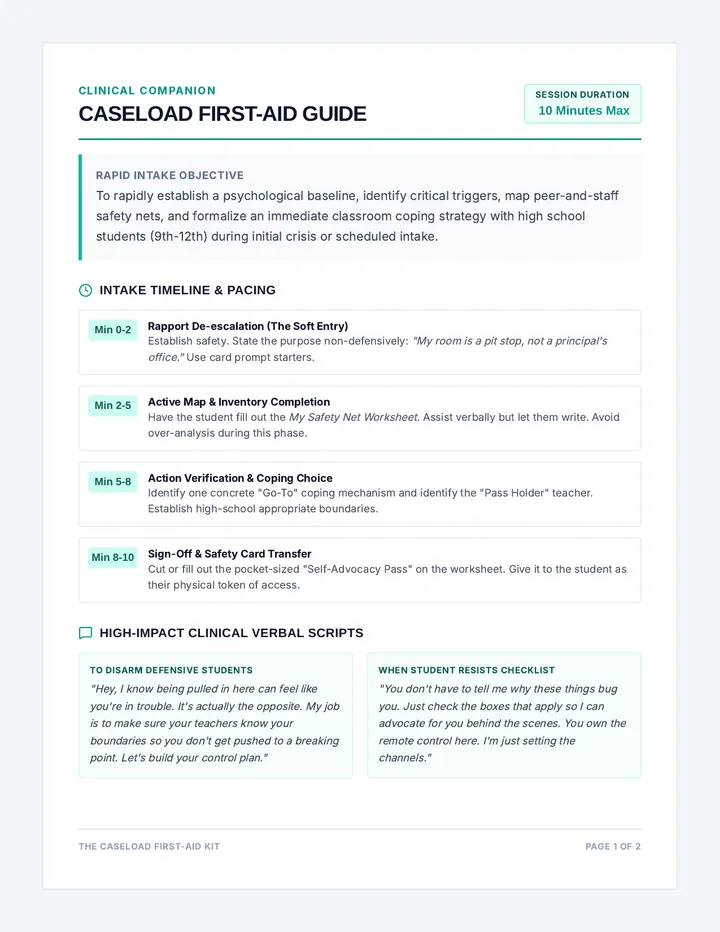
Calm Cartographers Teacher Guide Teacher Facilitation Guide
Calm Cartographers
Lesson Focus
Sensory Self-Regulation
Metadata
Grade Level: 3rd Grade
Time: 45-50 Minutes
Group Size: Whole / Small
Target: Anxiety, Trauma
Key Vocabulary
Sensory Cue: A sight, sound, or feeling that affects how our body feels.Cozy Campsite: A specific classroom cool-down zone used for brief self-regulation.Inner Weather: Our current mental state (Sunny, Windy, Stormy).
Required Materials
Calm Zone Slides
Classroom Sensory Map Sheet
Calm Corner Pass Cards
Sensory items (cushions, sand timers, tactile items)
Trauma-Informed Tip
Always frame the Calm Campsite as a place of safety and choice. Never threaten to send a student there as a punishment or consequence.
Learning Objectives
Students will identify visual, auditory, and tactile factors in physical classroom spaces, map those sensory coordinates, and self-initiate proactive decompression sequences using an 'Explorer Pass' before hitting a crisis point.
Instructional Sequence
1. Internal Weather Check-In (10 Mins) Slides 1-3
Introduce the "Inner Weather" metaphor. Ask students to self-reflect: Is their body Sunny (calm), Windy (restless), or Stormy (overwhelmed)? Emphasize that all weather is okay, but stormy weather requires planning. Teach that early intervention is an explorer superpower.
2. Sensory Elements Explanation (10 Mins) Slide 4
Break down the 5 senses. How do lighting (sight), whispering (sound), and squeeze objects (touch) soothe our internal weather system? Discuss how too many bright colors or loud noises can feed a personal storm.
3. Setting the Exploration Mission (5 Mins) Slide 5-6
Define the physical safe spaces in the classroom (Calm Campsites). Distribute the Classroom Sensory Map Sheet . Explain how to walk quietly like a master cartographer, measuring how calm or hyper each zone makes them feel.
Safe Space Explorer Lesson Plan • Grade 3 Page 1 of 2
Teacher Facilitation Guide
Calm Cartographers
Lesson Focus
Sensory Self-Regulation
4. Active Mapping & Guided Practice (15 Mins)
Instruct students to move in rotating groups to 3-4 different pre-staged zones of the room (e.g., Cozy Library Corner, Silent Study Desks, Window Station, or the official Calm Campsite). Students use their worksheets to map sensory variables and rate each zone.
Classroom Sensory Map Worksheet Classroom Sensory Map
Explorer Logbook & Safety Planner
🏕️
Explorer Name:
Expedition Date:
Your Mission: Walk quietly like a mapmaker. Visit 3 spots in our room. Sit down, close your eyes for 3 deep breaths, and write what your senses notice. Then circle how many tents of calm you feel!
📍 CAMPING ZONE 1
Calm Level: 🏕️ 🏕️ 🏕️ 🏕️ 🏕️
Spot Name / Location
What I Hear Here
What I Touch/Feel Here
📍 CAMPING ZONE 2
Calm Level: 🏕️ 🏕️ 🏕️ 🏕️ 🏕️
Spot Name / Location
What I Hear Here
What I Touch/Feel Here
📍 CAMPING ZONE 3
Calm Level: 🏕️ 🏕️ 🏕️ 🏕️ 🏕️
Spot Name / Location
What I Hear Here
What I Touch/Feel Here
My Explorer Calm Agreement
When my internal weather becomes Windy 💨 or Stormy ⛈️ , I will safely use my coping toolkit.
My favorite Calm Campsite is:
The sensory tool I like most in that spot is:
My Signature:
Teacher Signature:
Safe Space Explorer Worksheets • Grade 3 Classroom Map 1.1
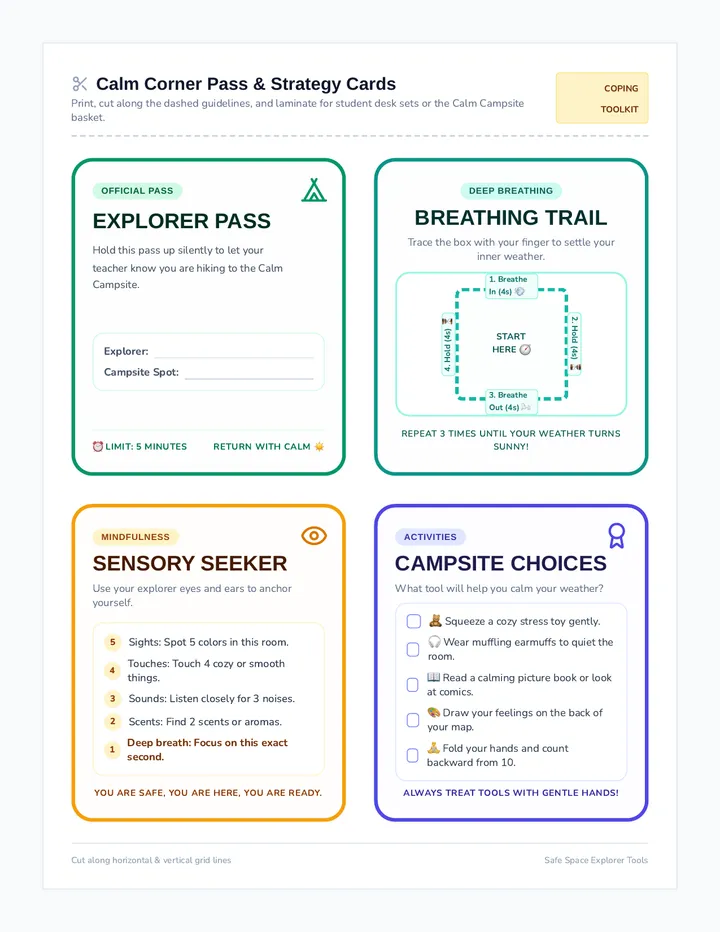
Calm Corner Pass Cards Calm Corner Pass & Strategy Cards
Print, cut along the dashed guidelines, and laminate for student desk sets or the Calm Campsite basket.
Coping Toolkit
Official Pass
EXPLORER PASS
Hold this pass up silently to let your teacher know you are hiking to the Calm Campsite.
Explorer:
Campsite Spot:
⏰ Limit: 5 Minutes Return with Calm ☀️
Deep Breathing
BREATHING TRAIL
Trace the box with your finger to settle your inner weather.
Start
Repeat 3 times until your weather turns sunny!
Mindfulness
SENSORY SEEKER
Use your explorer eyes and ears to anchor yourself.
5 Sights: Spot 5 colors in this room.
4 Touches: Touch 4 cozy or smooth things.
3 Sounds: Listen closely for 3 noises.
2 Scents: Find 2 scents or aromas.
1 Deep breath: Focus on this exact second.
You are safe, you are here, you are ready.
Activities
CAMPSITE CHOICES
What tool will help you calm your weather?
🧸 Squeeze a cozy stress toy gently.
🎧 Wear muffling earmuffs to quiet the room.
📖 Read a calming picture book or look at comics.
🎨 Draw your feelings on the back of your map.
🧘 Fold your hands and count backward from 10.
Always treat tools with gentle hands!
Cut along horizontal & vertical grid lines Safe Space Explorer Tools