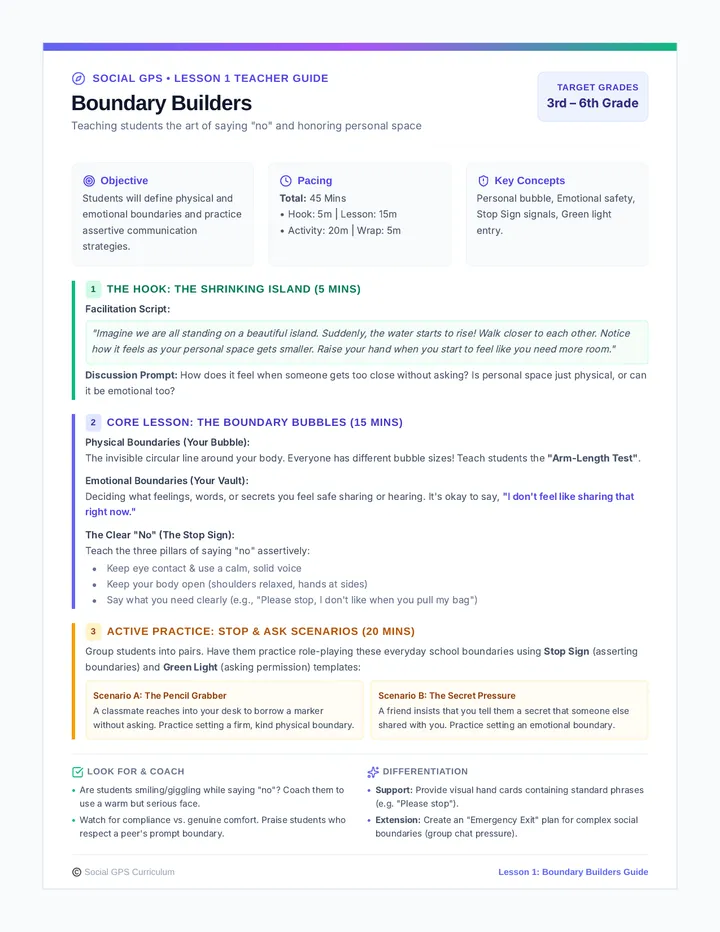
Power Up Facilitation Guide ERMHS Session 1 • Clinician Resource
Power Up Session Guide
30 MINS
Building rapport and establishing a baseline for behavioral self-awareness through a low-pressure, gaming-themed dashboard format.
Target Student
Grade: 6th Grade (Middle School Transition)Diagnosis: OHI (ADHD)Profile: Creative, kinesthetic, gaming interest; prone to defiance or withdrawal under stress.
Setup & Tools
• "Power Dashboard Worksheet" (Student)
• "Connection Cards" (Cut out prior or during)
• Pair of kid-friendly scissors & glue/tape
• Colored markers or gel pens
• Tactile timers or stress ball (optional)
Clinical Strategy
1. Kinetic Flexibility
Allow standing, pacing, or using a fidget. Kinesthetic engagement is a gateway to verbal communication.
2. Low-Pressure Pacing
Do not force direct eye contact. Use the dashboard worksheet as a shared focal point to reduce threat-response.
3. Non-Judgmental Metaphor
Frame behaviors as "Glitches" and positive coping skills as "Patches" or "Power-Ups" to lower defensiveness.
Timeline & Protocol
1. Boot Up (0 - 5 mins)
Intro
Explain your role neutrally: "I'm your coach/consultant. We meet once a month to design custom strategies so school feels easier." Introduce the game-design metaphor.
Prompt: "Ever play a game where you got to customize your own character stats? Today, we're building your personal controller dashboard."
2. Base System Settings (5 - 15 mins)
Dashboard
Guide the student to fill in their name, choose an "Avatar Name," and select their top interest areas on the Power Dashboard . Engage in light drawing of their logo or profile.
Focus: High interest-led focus. Note what makes them light up (Minecraft, YouTube, drawing, sports). Avoid behavioral probing here.
3. Card Sorting & Calibration (15 - 25 mins)
Kinesthetic
Cut out the Connection Cards . Have the student sort them into their "Power-Ups" (strengths) or "System Glitches" (triggers/behaviors like defiance, withdrawal) and paste/place them on the dashboard.
Prompt: "Every awesome software has glitches. When a server goes offline or a button freezes, how does that affect other players? Let's check our settings."
4. Save & Exit (25 - 30 mins)
Wrap-up
Introduce the ERMHS IEP goal naturally: "By next year, we're looking to spot 3 glitches before they crash our team's game, and use 1 power-up strategies." Secure buy-in for next month's "patch upload."
Prompt: "If we can master our system's control panel, school is going to feel like we're playing on cooperative multiplayer mode instead of survival."
Future Goal Integration Checklist
Behavioral Triggers Identified: Did the student select cards that correspond to the IEP goals? (e.g., defiance, tuning out/withdrawing, disruptive noise-making, arguments).
Coping Patches Discussed: Did they recognize positive coping skills (e.g., asking for a pause, gaming breaths, changing task, drawing out stress)?
Power Dashboard Worksheet POWER-UP DASHBOARD
SYSTEM VERSION 6.0 // DESIGN YOUR CONTROLLER PROFILE
Player Name
Today's Date
MY AVATAR PROFILE
Level 1
Draw your main character logo, standard gaming badge, or a symbol representing your style.
[ Sketch Your Badge / Symbol Here ]
Gamer Tag (Alias):
SYSTEM CORE INTERESTS
What triggers your system's high energy? (Select all that fit your character):
Video Games & Gaming
Art, Drawing & Design
Sports & High Movement
Comedy & Telling Jokes
Building (Lego, Mechanics)
Science & Tech Gadgets
ACTIVE POWER-UPS
Strengths
Paste Connection Cards here that highlight things you are great at, or tools that keep you calm & focused.
[ Power-Up Card Area ]
SYSTEM GLITCHES
Triggers
Paste Connection Cards here that represent behaviors or scenarios where your system gets stuck or lags.
[ Glitch Card Area ]
CO-OP MULTIPLAYER MODE ACTIVE
Every good gamer has a co-pilot. We will use these settings to build customized patches (coping strategies) together!
SYS: ONLINE • PING: 12MS
Connection Cards Worksheet Tactile Sort • Cut & Play
System Connection Cards
Cut along the dotted lines!
Work with your coach to cut out these 10 hardware modules. Discuss each card, decide if it acts as a Power-Up or a System Glitch for you, and paste it onto your Dashboard.
High FPS (Super Speed)
My brain processes ideas, solutions, or patterns incredibly fast. I love moving through things quickly.
MODULE #01 STRENGTH OR CRASH?
Creative Mode
Designing, drawing, building things, or thinking of completely out-of-the-box ideas that others miss.
MODULE #02 STRENGTH OR CRASH?
Overheating (Stubborn)
When I feel pushed, bored, or defensive, I refuse commands, shut down, or argue with the game rules.
MODULE #03 STRENGTH OR CRASH?
Lag Spike (Withdrawal)
When instructions get too long or confusing, I zone out, tune out my surroundings, or withdraw completely.
MODULE #04 STRENGTH OR CRASH?
Spamming Chat (Noise)
I tap objects, make sounds, talk over others, or run off-topic jokes to keep my internal engine spinning.
MODULE #05 STRENGTH OR CRASH?
Button Jam (Impulsivity)
I react or yell out answers before my system's planner has time to load. Action happens before the plan.
MODULE #06 STRENGTH OR CRASH?
Mute Sound (Sensory Break)
Taking a 2-minute quiet break, putting on headphones, or looking away from screens to reload my system.
MODULE #07 STRENGTH OR CRASH?
The Pause Hack (Breathing)
Taking 3 deep, controlled "gaming breaths" before responding to a difficult message or command from others.
MODULE #08 STRENGTH OR CRASH?
Co-Op Support
Asking a teacher, friend, or counselor for help instead of trying to play a tough boss battle all by myself.
MODULE #09 STRENGTH OR CRASH?
Server Relocate (Movement)
Moving to a different seat, standing up to stretch, or pacing the hallway to reset my focus levels.
MODULE #10 STRENGTH OR CRASH?
SYS_CARD_PRINT_v6.0 READY FOR ASSEMBLY © ERMHS COLLABORATIVE RESOURCE