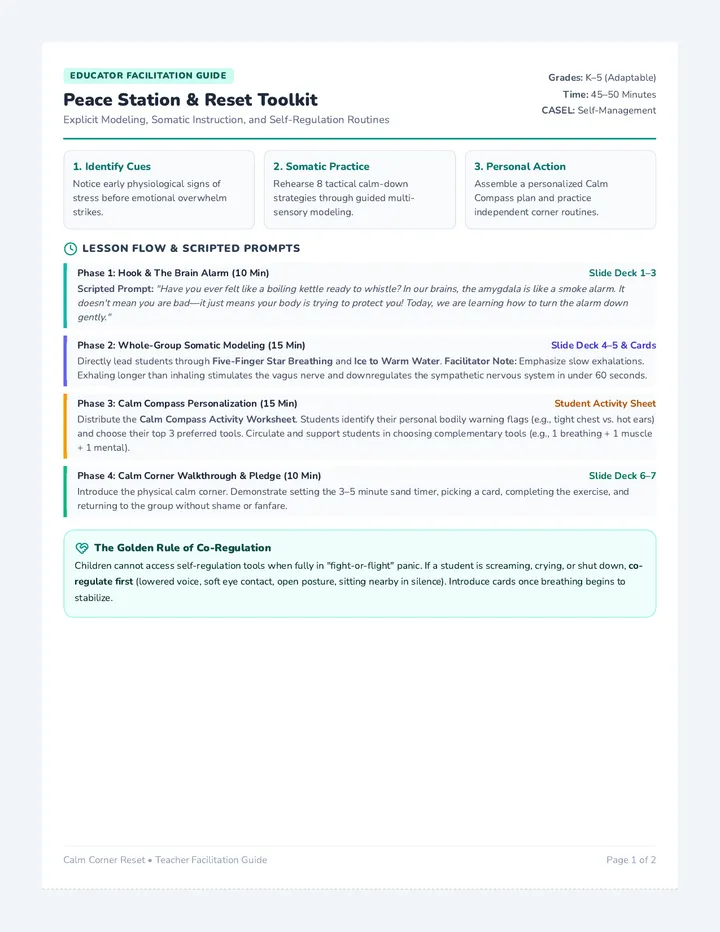
System Restore Teacher Guide SYSTEM RESTORE PROTOCOL
THE RESET BUTTON
DOCUMENT ID: SRP-702
REVISION: 2026.08
Target Level Grades 3 - 7
Run-Time 45 Min (Intro)
Intervention Type Self-Regulation
Status DEPLOYED
MISSION BRIEFING
When students experience strong emotions, their nervous systems enter System Overload (fight, flight, or freeze). This curriculum shifts self-regulation from a passive "sit and think" model to an interactive, tactile, sensory-based "System Reset". Students learn to decode their body's biosignals (overheating, high CPU usage) and use physical, somatic station overrides to recalibrate.
DE-ESCALATION STATION CONFIGURATIONS
Set up these five interactive physical zones in a quiet, designated corner of your classroom:
STATION 1: The Pressure Valve
Heavy work & deep pressure. Includes resistance bands, hand weights, and weighted floor pads to burn hyperactive adrenaline.
STATION 2: The Texture Panel
Tactile grounding textures. Sensory velcro strips, sequin boards, cold smooth stones, or rough sandpaper to shift neural attention.
STATION 3: Visual Diagnostic
Optical calming. Slow-drip liquid timers, color-changing sensory tubes, and geometric tracing pathways to anchor scattered eye movements.
STATION 4: Airflow Calibration
Deep breathing metrics. Using pinwheels, slow-rise squishies, and paced trace boards to lower baseline heart rates.
INSTRUCTIONAL PHASE 1: DIAGNOSTIC (15 Min)
STEP 1
Defining 'System Overload'
Explain that like computers, human bodies run programs. When we feel extremely angry, embarrassed, or hyper, our "CPU" overheats. Define this state not as "bad behavior" but as a system overload that requires immediate cooling protocols.
STEP 2
Identifying Biosignals (Physical Cues)
Lead a brief matching drill with students. Prompt: "What happens to your hardware?" List indicators: clenched palms (Fist Overload), fast breathing (Engine Overheat), heavy stomping or tense shoulders (Structure Strain).
CONSOLE ENGINE PROTOCOL DE-ESC-01
PAGE 1 OF 2
SYSTEM RESTORE PROTOCOL
THE RESET BUTTON
DOCUMENT ID: SRP-702
REVISION: 2026.08
INSTRUCTIONAL PHASE 2: MANUAL OVERRIDE (20 Min)
STATION ROTATION DRILL
Have students visit the established tactile stations in small groups. At each station, they must perform the designated exercise for exactly 2 minutes . Train students to score how the sensation makes their "internal engine" feel on the Station Scorecard.
THE 4-STEP PROTOCOL
Teach students the simple 4-step sequence they will use independently when triggered in the future:
01
Detect Cues
Notice biosignals
02
Select Override
Go to station
03
Execute Reset
Apply sensory work
04
Re-Enter Class
Return with quiet steps
FACILITATION SCRIPTS & PROMPTS
SAY: "It looks like your CPU is running very hot right now. Let's hit the manual override. Take your Station Card and go over to Station 1 or 2 for a three-minute system calibration."
SAY: "We aren't trying to change your mind, we are just resetting your wires. Let's do a fast system test: squeeze this weight for 5 seconds... release. How is your engine power levels now?"
SYSTEM SAFETY STANDARDS (CRISIS PROTOCOL)
DOS FOR TEACHERS
Praise students for noticing their symptoms before they explode.
Keep station limits strictly timed (3-5 mins) with digital visual timers.
Encourage quiet breathing over high vocal explanation.
DON'TS FOR TEACHERS
Don't treat station use as a disciplinary punishment.
Don't force students to explain why they are upset during high arousal.
Don't allow multiple dysregulated students at once.
CONSOLE ENGINE PROTOCOL DE-ESC-01
PAGE 2 OF 2
System Restore Slides SYSTEM RESTORE INITIATIVE
SESSION 01: INTRODUCTION
THE RESET BUTTON
How to run a physical System Reboot when your brain's engine overheats.
SECURE INTERACTIVE PROTOCOL ACTIVATED
SLIDE 1/5
DIAGNOSTICS PANEL
STATUS: SCANNING
WARNING SIGNALS
Is Your System
Overheating?
Just like a phone or tablet, our bodies start running too many programs at once. This leads to a System Overload.
Fast Engine
Heart beating super fast
Thermal Lock
Fists clenching or jaw tight
High CPU Action
Wanting to scream, stomp, or shut down completely
DETECTION PROTOCOLS ACTIVE SLIDE 2/5
HARDWARE DIAGNOSTIC
STATIONS OVERVIEW
THE HARDWARE RESTORE STATIONS
Four tactile tools designed to instantly cooling down your inner engine.
The Valve
Push weight / squeeze tools to discharge tension.
The Panel
Trace textures to trick your racing thoughts.
The Diagnostic
Follow slow geometric movements visually.
The Calibrator
Control air outflow with targeted breaths.
TACTILE SYSTEM GRAPHICS SLIDE 3/5
REBOOT PROTOCOL
SEQUENCE TIMELINE
THE REBOOT
SEQUENCE
When your system alerts you, run this automated cycle step-by-step. Let the sensory hardware do the rest.
01
DETECT CUES
Notice clenching, high heat, or racing pulse.
02
SELECT OVERRIDE
Grab your reset card and choose a system station.
03
APPLY WORK
Squeeze, touch, breathe, or watch for 3 minutes.
EXECUTION ENGINE VER. 1.2 SLIDE 4/5
VERIFICATION STEP
SYSTEM READY
Ready for Re-Entry?
Once your physical gauges have dropped back to green, you are cleared for normal classroom operations.
All systems online. Return to base!
MANUAL DISMISSAL SECURE SLIDE 5/5
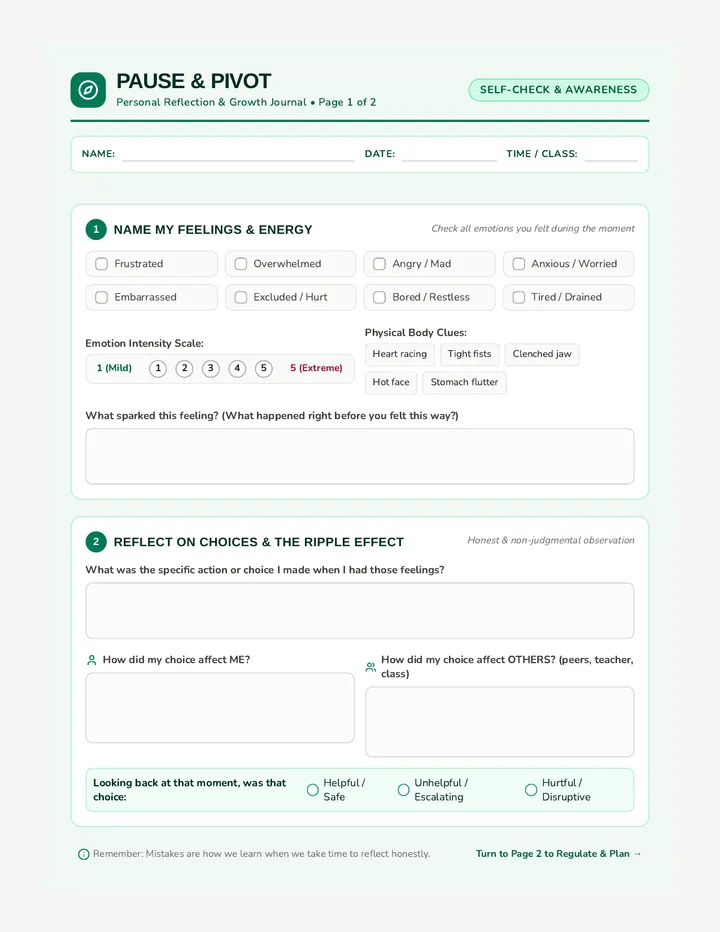
System Restore Scorecard STATION DIAGNOSTIC ACTIVITY
SYSTEM RESTORE SCORECARD
Test each de-escalation station and build your personal sensory reboot profile.
PILOT NAME:
SYSTEM DATE:
1. INTERNAL HEAT DIAGNOSTIC
Check the physical symptoms (biosignals) your body shows when your engine is starting to overheat:
Clenched Hands Fast Breathing Tight Shoulders Red/Hot Ears Fast Heartbeat Loud Voice Heavy Stomping Silent/Shut-down
2. THE SENSORY CALIBRATION TESTS
Visit each station for 2 minutes. Rate how much each sensory tool cools down your engine:
S1
THE VALVE (Heavy Resistance Bands / Squeezes)
Pushes hyperactive energy out of my physical muscles
COOLING POWER
1
2
3
4
5
S2
THE PANEL (Tracing Rough & Soft Textures)
Shifts attention to slow skin sensory inputs
COOLING POWER
1
2
3
4
5
S3
THE DIAGNOSTIC (Calming Optical Paths & Timers)
Slows eye movements down to steady a dizzy brain
COOLING POWER
1
2
3
4
5
S4
THE CALIBRATOR (Paced Breathing Shapes)
Directly commands heart rates to return to secure baseline
COOLING POWER
1
2
3
4
5
3. MY EXCLUSIVE OVERRIDE PLAN
Fill in your personalized action plan for when your system senses high internal temperature:
When my system starts to overheat, my #1 warning biosignal is:
The station that cooled me down the best is:
Because it makes my internal hardware feel:
SYSTEM RESTORE CONSOLE UTILITY SECURE-CHECK
PILOT RECORD CARD SRP-702-01
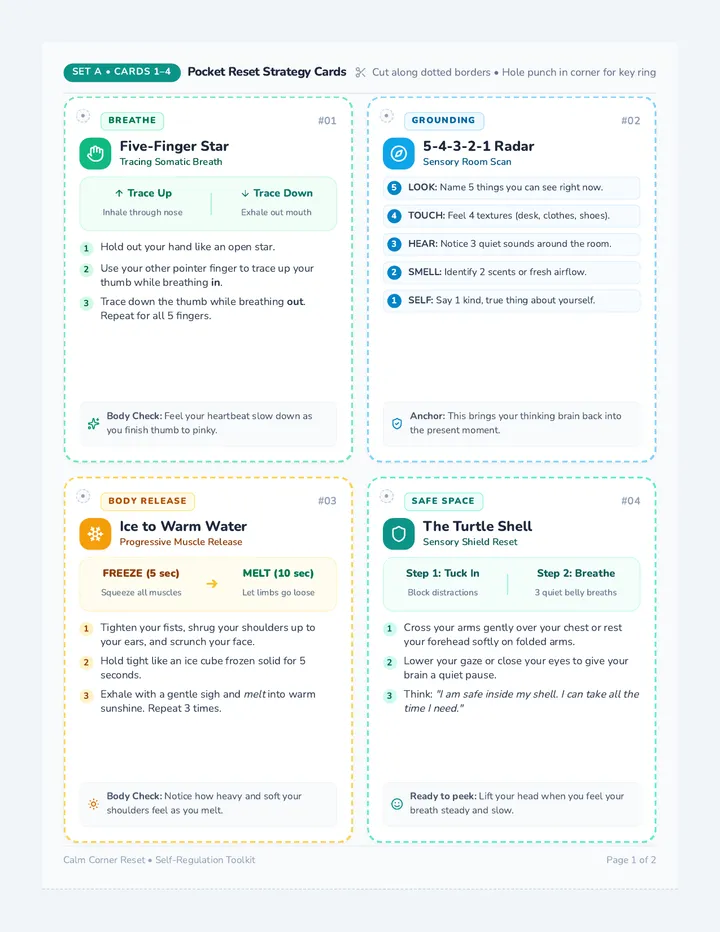
Personal Reset Keys Tactile Grounding Toolkit
PERSONAL RESET KEYS
DESK CODES // GRADES 3-7
SCISSOR CUT OUT SHEET
Cut along the dashed lines. Laminate these cards for students to keep on their desks, in their binders, or on a key ring to perform quiet, physical 'manual overrides' anywhere.
KEY 01
SYSTEM STATUS CHECK
Tap the monitor level that matches your current emotional hardware:
LEVEL 3: OVERHEAT
Heart racing, clenching, angry.
LEVEL 2: WARNING
Fidgety, heavy sighing, anxious.
LEVEL 1: COOL
Calm, clear focus, ready to learn.
Detect warning biosignals early.
KEY 02
BREATHING CALIBRATOR
Slowly trace your finger along the path below. Follow the engine cycle instructions:
START HERE & TRACE BOX
BREATHE IN (4S) HOLD BREATH (4S) BREATHE OUT (4S) HOLD BREATH (4S)
Repeat trace cycle 3 times to lock baseline.
KEY 03
SENSORY RESTORE CODES
If your thoughts are spinning, quiet your brain by finding these items in the room:
5 Things you can see (colors, lines, items)
4 Things you physically feel (desk, shoes, shirt)
3 Sounds you hear (clock ticking, breathing, wind)
2 Smells you can identify in the air
1 Physical taste inside your mouth
Brings scattered signals back online.
KEY 04
MANUAL OVERRIDE CODE
Complete your personalized manual override card to remind yourself how to cool down:
MY PRIVATE LOGOUT CODE:
Example: "Breathe in, blow it out" or "I am safe"
MY CHOSEN REST RESET STATION:
The station that cools you down best.
Your custom-coded reset equation.
PRINT ENGINE UTILITY MODULE PORTABLE-DESK-v1
PAGE 1 OF 1