Repair Shop Slides KINDNESS CAMPAIGN • SEL SKILLS
Module 03 : Restorative Practice
Conflict Resolution & Restitution
The Repair Shop
Mistakes happen. Conflict is normal. What matters is knowing how to rebuild trust, own our impact, and make things genuinely right.
1
Intent vs. Impact
2
4-Step Repair Formula
3
Restorative Solutions
The Core Principle: Intent vs. Impact
Foundation
What was in your head
Intent
What you meant to do. Maybe you made a joke, ran to catch a ball, or didn't realize someone was talking.
"I didn't mean to spill your water bottle!"
What actually happened
Impact
How your action affected the other person's belongings, feelings, safety, or sense of trust.
"Even though you didn't mean to, my homework is soaked and ruined."
Key Takeaway: We judge ourselves by our intentions, but others experience us through our impact. Repair focuses on fixing the impact.
Spot the Counterfeit: Fake vs. Real
Spotting the Traps
The "IF" Apology
"I'm sorry IF you got offended."
Shifts the blame onto the other person's sensitivity instead of your behavior.
Fix: "I am sorry that my comment was hurtful."
The "BUT" Excuse
"I'm sorry, BUT you started it first."
Erases the apology by justifying the harm and picking an argument.
Fix: "I shouldn't have reacted that way, no matter what."
The "Forced Exit"
"Fine! I said sorry, okay?!"
Treats saying "sorry" as a magic exit pass just to avoid trouble, without caring about the person.
Fix: "I genuinely care about how this made you feel."
A genuine apology makes the receiver feel seen, not defensive.
The 4-Part Repair Blueprint
Step-by-Step
1
Name the Specific Harm
Clearly describe what you did without vague words or downplaying.
"I interrupted you while you were presenting and laughed."
2
Validate the Impact
Show empathy by naming how it made them feel or what it cost them.
"That embarrassed you and made you lose your train of thought."
3
Make Restitution (Action)
Offer a concrete action to restore balance or fix the damage.
"Can I tell the group to listen, or how can I help support you?"
4
Commit to Future Change
Promise what you will do differently next time so it won't repeat.
"Next time, I will keep my mic muted and listen respectfully."
Words build the bridge, but actions cross it.
Case Study: The Borrowed Supplies
Practice Lab
The Scenario
Jordan borrowed Devon's art markers without asking and left caps off, drying out two colors.
Devon: "You ruined my markers! Don't touch my stuff!"
Defensive Response (Trap):
"Chill out! It's just two markers."
Restorative Response:
1. Harm: "I took your markers without asking and left caps off."
2. Impact: "I know you need them for your poster project today."
3. Restitution: "I will replace the dried markers with new ones tomorrow."
4. Change: "Going forward, I will always ask before using your supplies."
Accountability means focusing on solving the problem, not protecting your ego.
The Golden Truth About Forgiveness
Realistic Expectations
An Apology is a Gift, Not a Deal
You cannot demand that someone immediately says, "It's fine!" or instantly trusts you again. Forgiving takes emotional time.
If they say "I'm still mad", say:
"I understand you're still hurt. I respect your space, and I'm ready to talk whenever you want."
How Trust Is Truly Rebuilt
Consistency: Doing what you promised over several days and weeks.Patience: Respecting their personal boundaries without resentment.Integrity: Treating them with kindness even when no adult is watching.
Ready to practice in your toolkit? Open your Conflict Repair Toolkit handout
Conflict Repair Toolkit Kindness Campaign • SEL Toolkit
Conflict Repair Toolkit
Mending relationships through genuine apologies and restitution
Name:
Date:
Period:
The 4-Part Repair Blueprint
1. Name Harm
State exactly what you did without sugarcoating.
2. Own Impact
Acknowledge how it made them feel or what it cost.
3. Restitution
Offer an action to help repair the damage done.
4. Commit Change
State how you will prevent it from happening again.
1 Spot the Counterfeit Apology
Read each statement below. Check whether it is Genuine or Counterfeit , and explain what makes it flawed or sincere.
"I'm sorry if your feelings got hurt when I made that joke, but you were being way too sensitive."
Genuine Counterfeit
Flaw/Strength:
"I knocked over your lunch tray because I was running. I know you missed eating, so here is my unopened snack and I will help clean up the floor."
Genuine Counterfeit
Flaw/Strength:
2 Guided Practice: The Lost Science Notes
Scenario: Casey borrowed Morgan’s binder containing study notes for tomorrow's quiz. Casey forgot the binder on the bus, and now Morgan has nothing to study from for the big test.
Step 1: Name the Specific Action (No defensive excuses):
Step 2: Acknowledge the Impact (How does this affect Morgan?):
Step 3: Restitution / Actionable Fix (What can Casey offer immediately?):
Step 4: Future Commitment (How will Casey handle borrowed items going forward?):
Kindness Campaign • Restorative Practices Page 1 of 2
Independent Application
My Personal Repair Blueprint
Planning your own restorative conversation
Action Planning
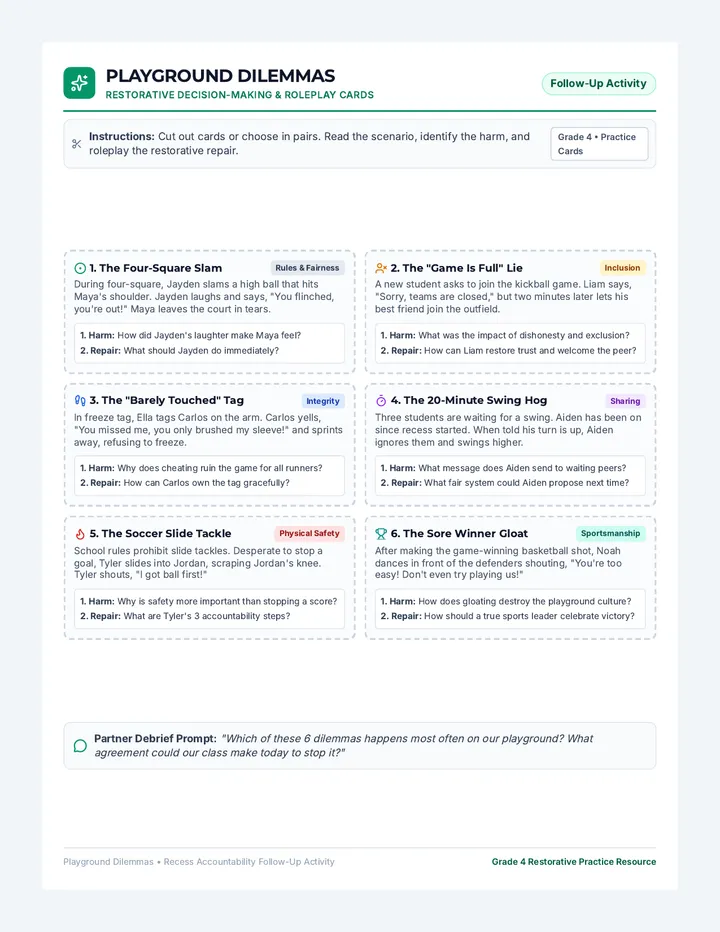
Choose ONE scenario to resolve (or use a real conflict you need to fix):
Option A: The Shared Secret
A friend told you something private, and you repeated it to another student during lunch.
Option B: Recess Game Meltdown
You lost a basketball game, yelled at your teammate, and told them they ruined the game.
My Selected Scenario: Option A / Option B / My Own Experience (circle one)
1. Describe the Conflict & Your Action: What happened? Who was affected?
2. Perspective Taking (Impact): How did the other person feel? What trust was broken?
3. Meaningful Restitution: What tangible action will you take to make things right?
Heart Mending Reflection Kindness Campaign • Reflection & Exit Ticket
Heart Mending Reflection
Checking in with ourselves: Pride, accountability, and the courage to repair
Name:
Date:
Part 1: The Honesty Mirror (Self-Check)
When someone calls me out or tells me I hurt their feelings, my immediate gut reaction is often to:
Defend myself / argue back
Make an excuse ("I didn't mean to!")
Shut down / walk away / go silent
Quickly say "sorry" just to end it
Why do you think apologizing genuinely feels so difficult or scary?
Part 2: Why Restitution Matters More Than Words
Imagine a classmate repeatedly knocks over your supplies or makes teasing remarks, and every single time they shout: "Okay, I said I'm sorry!" but never changes their behavior. How does that affect your trust in them? What is missing?
Part 3: My Restorative Pledge
Complete the personal commitment statement below:
The next time I cause unintentional harm or get into a disagreement, I will pause and:
Instead of getting defensive, I will show courage by:
Exit Ticket: 3 - 2 - 1 Repair Check Tear or submit at the bell
3 Essential Elements of a Genuine Apology:
2 "Trap Words" that can ruin an apology (e.g., words that shift blame or excuse):
1 Action you will take this week to be a better friend and classmate:
Kindness Campaign • SEL Restorative Practices Assessment & Reflection
Repair Shop Facilitator Guide Kindness Campaign • Educator Resource
Repair Shop Facilitator Guide
Instructional strategies, pacing, scripts, and restorative debrief protocol
Target Grades: 4–8
Duration: 45–50 Mins
CASEL: Relationship Skills
Essential Questions
Why does good intention not automatically undo hurtful impact?
What transforms an apology from a forced chore into authentic healing?
How does taking responsibility demonstrate strength rather than weakness?
Learning Objectives
Differentiate between counterfeit (blaming/excusing) and genuine apologies.
Deconstruct conflict using the 4-Part Repair Blueprint.
Draft an actionable restitution plan to restore broken peer trust.
Pacing Architecture (45–50 Minute Framework)
8 Mins
Launch & The Spilled Cup Hook: Present the scenario: "If I trip and spill punch on your sneakers, does saying 'I didn't do it on purpose' clean your shoes?" Establish that impact requires physical and relational cleanup, not just excuses.
15 Mins
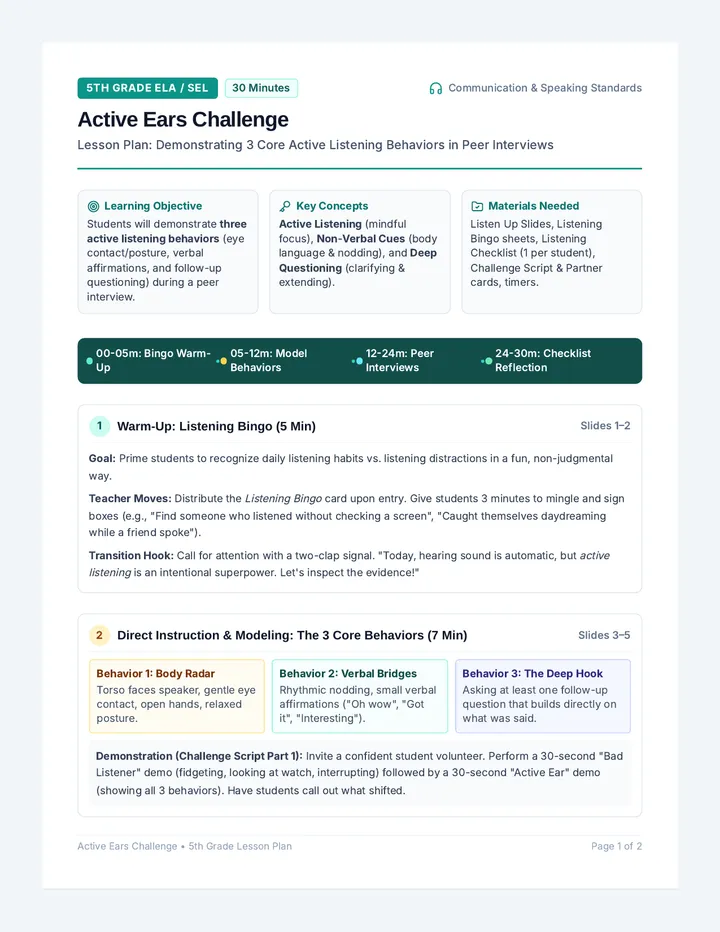
Slide Presentation & Counterfeit Analysis: Project Repair Shop Slides . Contrast counterfeit trap words ("if", "but", "whatever") with the 4-Part Repair Blueprint (Name harm, own impact, restitution, change).
15 Mins
Paired Workshop (Conflict Repair Toolkit): Students complete Page 1 counterfeit checks in pairs, then write out Page 2's Blueprint using either a sample scenario or a real classroom situation.
10 Mins
Personal Reflection & Exit Ticket: Independent completion of the Heart Mending Reflection . Collect the 3-2-1 exit slips as formative data.
Teacher Talk: Reframing Vulnerability as Strength
"Class, anyone can get defensive or run away when they make a mistake. Defensiveness is easy, but it leaves relationships broken. Having the backbone to say: 'I messed up, I see how that hurt you, and I am here to make it right' is what true leaders do. In this room, mistakes are expected, but repair is required."
Kindness Campaign • Educator Guide Page 1 of 2
Facilitation Coaching
Managing Pushback & Scaffolding
Addressing student resistance, differentiation, and restorative circle extensions
Teacher Tools
Navigating Student Resistance & Defensiveness
"They started it first!"
Coach response: "Two wrongs do not make a repair. You are only responsible for your own 50% of the sidewalk. Own your part first."